ONE DAY MORE to revolution (I mean, Oscar nominations). Now it’s time to lock in my Best Picture predictions. It was an extremely tough year to forecast. So without further ado, here are the films I think will be called out by Seth MacFarlane and Emma Stone early tomorrow morning.
See my predictions for Best Original Screenplay and Best Adapted Screenplay.
See my predictions for Best Supporting Actor and Best Supporting Actress.
See my predictions for Best Actor and Best Actress.
See my predictions for Best Director.
Best Picture
- Lincoln
- Les Misérables
- Argo
- Zero Dark Thirty
- Silver Linings Playbook
- Life of Pi
- Django Unchained
- Beasts of the Southern Wild
- The Master
- Moonrise Kingdom
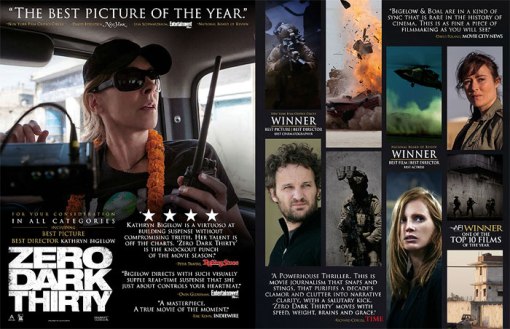
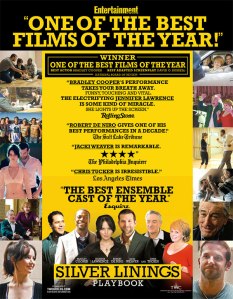 The top five of “Lincoln,” “Les Misérables,” “Argo,” “Zero Dark Thirty,” and “Silver Linings Playbook” are locked in. There has been pretty consistent and unilateral support for these all season long (although some critics have savaged a certain musical I love).
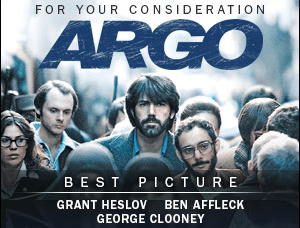
I’d say given the critical beat-down of “Les Misérables” and the Senatorial inquisition into “Zero Dark Thirty,” Steven Spielberg’s “Lincoln” has risen back to the top of the pack. “Argo” has also benefitted from being the least controversial, most agreeable movie in the bunch. Find me someone that hated “Argo,” and I’ll find you a flying pig.
But who knows how the passion will play out? Two years ago, I would have laughed in your face if you told me “The Social Network” was going to lose. There is still time for a “Les Misérables” and “Silver Linings Playbook” surge. If one takes a lot of Golden Globes and then the SAG Ensemble prize, it could pose a serious threat.
Then again, there’s also time for “Lincoln” or “Argo” to build a consensus with wins from either the BFCA, HFPA, or SAG. Wins from PGA and DGA in 2012 may be the biggest shaper of the odds; “Zero Dark Thirty” needs at least one of these guild trophies to prove it’s more than just a critical darling. Hopefully it all gets split up for a fun year!
But beyond the guaranteed five, we are looking at a highly unpredictable field that could include any number of nominees. I mean, literally, there could be no more nominees – or there could be five more thanks to the Academy’s new sliding scale. Some are more likely to score nods than others, but there are a few longshots looking to make a few people gasp on nomination morning. The system also rewards passion because a film needs 5% of the first-place votes to be nominated. Hence, it pays off to be loved, not liked.
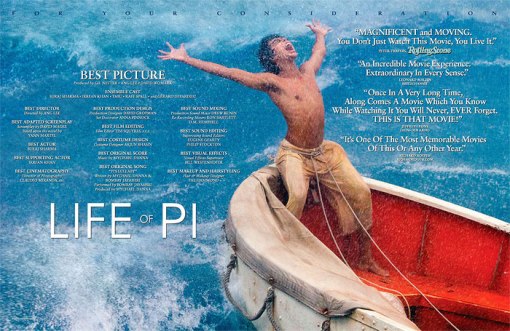
Despite what I keep sensing as a lack of passion for “Life of Pi,” I think it will ultimately wind up with a Best Picture nomination. I thought the flame had been extinguished for “War Horse” and “Moneyball” last year, but apparently 5% of the Academy voters thought they were the best movies of 2011. So if they can do it, so can Ang Lee’s “Life of Pi.” All three movies were feted by BFCA and HFPA, so I’d say it’s a good bet – especially with Lee’s DGA nod. (It’s also effects and craft heavy, so those smaller but no less important portions of the Academy may buoy it to a nomination.)
Ditto “Django Unchained,” which I had initially written off for a Best Picture nomination. Nothing felt right at first. When it only received Critics Choice nods for Best Picture and Best Screenplay, something felt fishy. Then when it was totally snubbed at the SAG Awards, I thought it was dead. (Most shrug this off as due to the fact that it wasn’t widely screened for their nominating committee.)
Yet even when the Golden Globes rescued it with 5 nominations including Best Picture and Best Director, I still didn’t buy into “Django Unchained” striking it big with the Academy. Every year, the Globes give an absurd amount of nominations to a movie that shows up in only a minor way at the Oscars. In 2011, it was “The Ides of March.” (In the past, examples have been “Revolutionary Road” and “American Gangster.”)
But now, with “Django Unchained” being quite the box office hit and the discussion topic of choice at the hypothetical critical water-cooler, I think it’s probably going to be a nominee. Surely more than 5% of the Academy voted for “Inglourious Basterds” for Best Picture in 2009. I expect that same contingent to come out and vote #1 for “Django Unchained” since most (but not I) consider it to be superior.
So … where do we go beyond these seven nominees?
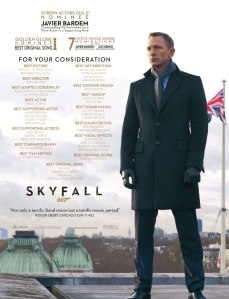
Do they go for more bang and blockbuster with “Skyfall?” Crowd-pleasing comedy with “The Best Exotic Marigold Hotel?” Indie comedy with “Moonrise Kingdom?” Indie drama with “Beasts of the Southern Wild?” Foreign drama with “Amour?” Polarizing drama with “The Master?” I’d say these six films are the most likely to grab any of the three remaining spots in the Best Picture category.
“Skyfall” provides perhaps the most interesting case. Had you told me a few months ago I’d be writing about it as a Best Picture contender, I wouldn’t have believed it. Yet here we are, and the film has grossed over $1 billion globally, racking up series-best praise in the process. The Academy recently announced, too, that they were planning a James Bond tribute at the ceremony. Might that be indicative of Oscar love to come?
At first, I warmed up to it being nominated for some technical nods. Then, I started to wonder if Dench and Bardem weren’t real threats for Oscar nominations thanks to notes from BFCA and SAG.
Now with “Skyfall” making the PGA top 10 list, I’m left to wonder whether it wouldn’t be a smart prediction to land a Best Picture nomination. The PGA did get the ball rolling for “District 9” in 2009, but they gave us false hope on “Star Trek.” Whichever mold “Skyfall” is cut from is anyone’s guess. If it makes the cut for Best Picture, it could easily have a whopping ten nominations! Although if it doesn’t get the big one, it could become one of the most nominated movies ever to not be nominated for Best Picture.
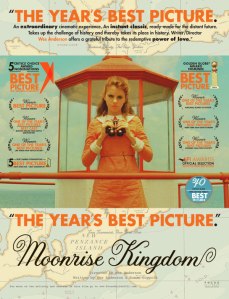 The PGA also showed some love for “Moonrise Kingdom” and “Beasts of the Southern Wild,” two summer successes that many thought might have some hidden pockets of support. But will they choose both, one, or neither?
“Moonrise Kingdom” has been the more visible of the two throughout the season, kicking off the precursor season with a Best Picture win at the Gotham Awards. It then dominated the Indie Spirits nominations, where it could triumph over “Silver Linings Playbook” the night before the Oscars. Topped off with a Golden Globe nod for Best Picture (musical/comedy), the case looks good. But I wonder if there are enough people who think it is the best movie of 2012, not one of the best.
Sundance Grand Jury Prize winner “Beasts of the Southern Wild,” on the other hand, seems to drive more passionate support. But will it be enough for a Best Picture nomination? The critics groups did not speak up loudly enough for it (only 2 wins and they were for long-shot Best Supporting Actor candidate Dwight Henry). It was blanked at the Golden Globes where young Quvenzhané Wallis should have at least gotten a novelty nomination.
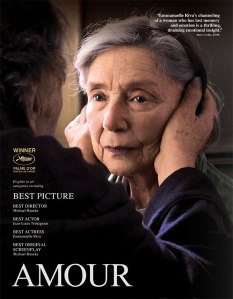
Part of the trouble with predicting “Beasts of the Southern Wild” is its ineligibility with the SAG. We have no idea whether the actors love this movie, and they are one of the most crucial voting blocs. It’s hard to tell where the support for the movie exists, if it even does. I’m hoping that the PGA nod is telling of invisible passion for the movie. “Moonrise Kingdom” is assured a Best Original Screenplay nomination, and I think that may be its limit.
Some have floated “Amour” as a possible nominee based on how well its done with the critics groups. Indeed, I like the idea of a foreign film making the cut because that’s the kind of movie the expanded field is supposed to allow. But I don’t think this will be that first movie (of the new Best Picture era, that is) – it’s too austere and cold.
Perhaps it pops up in various other major categories like “Tinker Tailor Soldier Spy” did last year, but that too faltered because people admire it more than they love it. And if Haneke can’t win Best Foreign Language Film for the critically praised “The White Ribbon,” I don’t think he’s going to cut it in competition with some real heavyweights.
I’m surprised people think there’s more of a chance for “Amour” to be a Best Picture nominee than “The Best Exotic Marigold Hotel.” What part of the equation doesn’t SCREAM Oscars? The old cast of prior Oscar nominees and winners plays right into Academy demographics. It played extremely well with audiences over the summer and managed to stick around in people’s minds. It got two Golden Globe nominations including Best Picture (musical/comedy) as well as two SAG nods including the coveted Best Ensemble. If any movie is poised to pull a shocker like “The Blind Side,” this could be it.
But I’m putting my chips on there being nine films in contention, and that final nominee is “The Master.” I know it is by no means a smart pick. Other than the Critics Choice nod for Best Picture, it’s been pretty silent for the season. It has little guild support. The critics remain fairly divided. But I think that this film could galvanize the Academy, and the people that like it will love it and vote #1. The voters who appreciate it probably know it’s in peril.
So mark it down, I’m going out on a limb for Paul Thomas Anderson’s “The Master,” hoping I’ve just predicted this season’s “The Tree of Life.” If not, it just goes in the pile of other failed Best Picture predictions including “The Girl with the Dragon Tattoo,” “The Town,” “Crazy Heart,” and “Invictus.” But no guts, no glory, right?

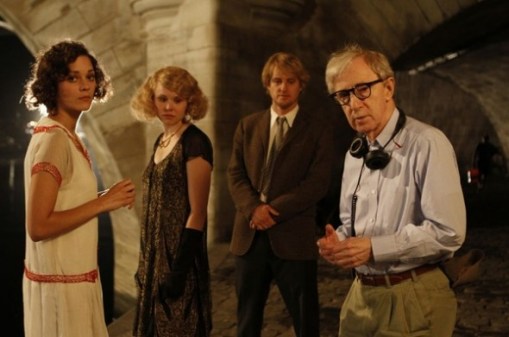
 For those of you not familiar with the movie industry, several high-profile film festivals (Toronto, Telluride, Venice) have occurred over the past week, inciting much talk about the upcoming onslaught of movies that will be highly considered for Academy Awards. For those who read the factoids, it is hardly a secret that this season also brings a rush of euphoria for me. I will keep you posted with trailers and buzz, and I will also soon be posting early predictions for nominees. But as kind of a warm-up for what is to come, I wanted to give my answer to the question an age-old question: how do you define “Best Picture”? What you will read below is an English paper that I wrote last year for a compare and contrast essay, mainly what critics think and what audiences think about the best movie of the year.
 One Sunday in February or March every year, all the focus of popular culture turns to the Kodak Theater in Los Angeles, California, for the Academy Awards. The glitz and glamour dominates the red carpet, yet the two most important people glide down the red carpet almost inconspicuously. Cameras do not flash in their face; people do not ogle at their outfits or speculate about whether or not they will end up in the tabloids; Ryan Seacrest from E! might interview them just for kicks. Although just accountants, these two people hold a briefcase filled with twenty-four envelopes that will change the lives of many people. Millions of moviegoers across the world watch the ceremony to find out the names inside the envelopes, but they stay tuned in to hear the presenter call out a movie, not a name. They want to see what over 5,810 people working in the movie industry voted as the Best Picture. However, for many moviegoers across America, their opinions do not match the Academy’s. Many of them have never heard of some of the nominated movies; some of the movies might not have played in their town. With each passing year, a divide between what the general public perceives as Best Picture and what the Academy chooses as its Best Picture has grown wider and wider.
 The Oscar voters also like to play it safe, rarely awarding controversial or provocative films. In 1993, they awarded Best Picture to “Schindler’s List,” a film about the Holocaust. Although many acclaimed movies were produced about the subject in the 50 years since the horrific genocide, “Schindler’s List” marked the first nomination for Best Picture for a film about the Holocaust. The Academy generally receives movies set in the past more favorably than movies set in the present or future. In 2008, “Slumdog Millionaire” was the only movie set in the present day.
 So why can’t the mainstream moviegoer and the Academy voter find harmony in a pick for Best Picture? Perhaps the Academy has forgotten what Best Picture really means. David Carr of The New York Times said, “It should be the kind of movie that is so good that it brings both civilians and the critical vanguard together.” Ideally, a mixture of box office success and critical praise would result in a Best Picture win (or at the very least a nomination). But if the Academy believed in such a formula, “The Dark Knight,” the film with the highest critical praise and box office gross, would have won Best Picture in 2008. And while that year’s Best Picture winner, “Slumdog Millionaire,” was a box office sensation, the film relied on the awards season to fuel its box office. According to Boxofficemojo.com, over 65% of its gross was accumulated after it received the nomination for Best Picture.

 Marshall and the Movies
Recent Comments