F.I.L.M. of the Week (September 12, 2014)

12 09 2014

True Adolescents

Though the world of a great movie may feel hermetically sealed while you watch it, all sorts of factors outside of it have decided the manner in which you get to experience it.  I’ve made the argument before that the 2008 financial collapse has infiltrated the content of films, yet it probably exerted an even greater influence by limiting our access to a whole world of independently created cinema.

Back in 2009, a small dramedy by Craig Johnson called “True Adolescents” played the SXSW Film Festival.  It was well-received and went on to play some smaller local festivals, but it sat around for three years waiting for theatrical distribution.  Before the economic malaise (or even now in our platform-agnostic present day), this is the kind of film that would be a no-brainer for a company like Fox Searchlight to pick up.  Due to the unfortunate timing of its release, however, it wound up getting a minuscule release thanks to Cinedigm.

Perhaps with “The Skeleton Twins,” Johnson’s second feature which is getting a much wider rollout courtesy of Roadside Attractions, people will begin to discover the joy of which they were robbed years ago.  While the production is small-scale, the film pays off big with its richly observed script and properly defined characters.

The man-child is getting a little tired thanks to brute repetition by Seth Rogen and friends, but it feels good as new in “True Adolescents” thanks to a very authentic incarnation by Mark Duplass.  His Sam has clearly blown past the twentysomething mark and is well into his thirties, hapless and essentially hopeless.

Hoping for some easy sympathy, he goes to crash with his aunt (played by a pre-Oscar win Melissa Leo) and winds up being forced to work for her charity.  Sam gets the distinct pleasure of taking his teenage cousin Oliver and his friend Jake on a camping trip.  I’m not too far removed from that adolescent mindset to know that it takes a special kind of person to handle boys of that age; suffice to say, Sam lacks the requisite saintliness.

As with any narrative centering around a journey in the great outdoors, an inner journey takes place in the characters.  But that’s pretty much where “True Adolescents” stops falling in line with what you expect it to do.  Writer/director Craig Johnson provides a surprising amount of depth within the familiar framework, opting to explore deeper into the complex characters at every turn where melodrama or clichés would be easier.  It’s a real treat to watch him embrace the true in the title of his film rather than the latter word.


F.I.L.M. of the Week (August 22, 2014)

22 08 2014

As I said in my review of “Only Lovers Left Alive,” I have not seen enough of Jim Jarmusch’s work to make a definitive statement as to whether or not he is a great director. But I have seen Jarmusch’s 2005 Cannes prize winner “Broken Flowers,” which is enough to inform me that he has at least one great film to his name.

This dryly humorous pick for the “F.I.L.M. of the Week” is second wave Bill Murray at his best (yes, even better than “Lost in Translation“).  He seems to have reached a status where he seems to reject the need for validation through actively courting our laughs, instead just allowing the comedy arise naturally from the events.  Murrray can then just sit back, maintain a stolidly unruffled facade, and just let the bizarre run-ins of “Broken Flowers” guide his reactions.

In the film, Jarmusch casts him as an aging Don Juan – appropriately named Don Johnston – served with a letter that suggests he fathered a child 19 years prior.  Don would be content to never investigate any further, but his inquisitive neighbor Winston (Jeffrey Wright) insists that he go visit the potential mothers.  So, in a sort of inverted “Mamma Mia,” Don takes off on a series of painfully awkward encounters with former lovers.

The parade of women, including Sharon Stone, Frances Conroy, Jessica Lange, and Tilda Swinton, always entertains.  But Jarmusch isn’t just wheeling out stereotypes or stock characters.  “Broken Flowers” takes each of these women and sets them on an unpredictable but well-imagined path after their split with Don.  It can’t help but raise the question of what exactly his effect on these women was.

To say too much more of what each woman brings to the film is to spoil the fun.  But just dive head first into “Broken Flowers” for off-beat fun throughout and a startling conclusion that packs an unexpected punch.


F.I.L.M. of the Week (August 15, 2014)

15 08 2014

The BelieverIt seems hard to believe now, but there was a time when Ryan Gosling was not a movie star.  Plenty of people acknowledge his Mickey Mouse Club days with Britney Spears and Justin Timberlake, just as others recognize how hilarious he is in “Remember the Titans.”   But most seem to think that he just came out of nowhere, like a gift from God, to steal their hearts in 2004’s “The Notebook.”
In actuality, though, Gosling first got his moment in the spotlight as leading man from 2001’s “The Believer.”  The performance may well be the polar opposite of his stoic characters in “Drive” and “Only God Forgives.”  As Danny Balint, a self-loathing Jew who turns from his upbringing to join a radical neo-Nazi cell in New York, Gosling absolutely electrifies the screen as he futilely struggles to suppress memories of his background in order to commit heinous deeds.

But “The Believer” is not my choice for the “F.I.L.M. of the Week” simply because it is a great performance piece for Gosling.  Though he does steal the show, Gosling is hardly all the film has to offer.  “The Believer” may not quite rival “American History X,” another similar film about neo-Nazis, but it’s still a powerful examination of radicalism on both the personal and the political levels.

Writer/director Henry Bean satisfyingly delves into the psychology of Danny, looking at what might explain his volatile and unpredictable behavior.  There’s never one definitive answer, though, and the only person that seems to frustrate is Danny himself.  He’s a complete wild card, vacillating constantly between his desires to embrace the Jewish community that brought him up and his impulse to eradicate that same group altogether.  Maybe Gosling, now Mr. Strong and Silent, ought to watch “The Believer” now to bring some of the turmoil and conflict back to his work.


F.I.L.M. of the Week (August 8, 2014)

8 08 2014

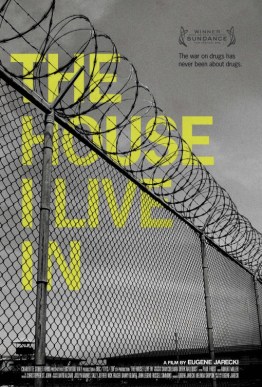
The House I Live InIt’s often easy to put a good deal of distance between ourselves and the Holocaust.  In no way am I promoting this as a good development, but the continuous passage of time only amplifies our sense of removal from the era of mass extermination.  Moreover, Americans in particular can see themselves as the liberators in such a genocidal scenario, not as perpetrators.

Ask Eugene Jarecki about the Holocaust, however, and he will tell you that America has and continues to perpetrate their own against its own citizens.  Sound a little dramatic?  By the time he analogizes the War on Drugs with the Holocaust in his documentary “The House I Live In,” it might not feel all too hyperbolic.

Jarecki’s haunting, informative opus marks my pick for the “F.I.L.M. of the Week” because it nimbly balances both the personal and the political as it explains how the War on Drugs began and the ways it tears at the fabric of our society.  He brings in top academics and scholars (as well as David Simon, the creator of “The Wire”) to discuss the roots of our current situation of mass incarceration.  Perhaps unsurprisingly, a whole lot of it comes back to racism and capitalism.

But “The House I Live In” is far from a lecture.  Jarecki really drives the film’s thesis home by interviewing the victims of the War on Drugs, namely, low-income families and racial minorities.  Crucially, Jarecki allows an emotional entry into the film through the story of his African-American help from his childhood, Nannie, and her family.  He shows the damage the broken system has wrought on her family to devastating effect.

If you saw John Oliver’s segment on prison and crave more information on the problem, go straight to “The House I Live In.”  You’ll be shocked, enlightened, and hopefully outraged enough to demand some changes.


F.I.L.M. of the Week (August 1, 2014)

1 08 2014

The Snowtown MurdersIt usually takes a director two to three features to work out the kinks in their style and settle into a comfortable groove of filmmaking.  That is not the case, however, for Australian director Justin Kurzel.  His debut film, “The Snowtown Murders,” has the confidence and assurance of a director with far more experience under his belt.
Yet even without grading on a curve, it still merits the title of “F.I.L.M. of the Week” for Kurzel’s virtuosic control over mood and atmosphere.  Though a title like “The Snowtown Murders” had me in a mindset expecting something like “Bonnie & Clyde,” following a serial killer from their perspective, the film delivers something else entirely.

Kurzel provides all the chilly commentary on the allure of sociopathic killers that you might expect from a Fincher film like “Zodiac” but adds an incredibly satisfying humanist element.  “The Snowtown Murders” is less about the titular acts themselves and more about the man who perpetrated them, as well as the entourage of bystanders who did nothing to stop them.

The film is told not from the perspective of the actual murderer, John Bunting, but of a 16-year-old boy Jamie drawn into his web of violence.  Bunting spies an opening to tap into some simmering hatred and lust for revenge in a small Australian community, funneling their anger into consent for violent retribution.  Kurzel doesn’t sensationalize the goriness of Bunting’s savagery, though he hardly shies away from it, either.

These bloody events help release some of the tension in “The Snowtown Murders,” yet it hardly dissipates between killings.  Kurzel allows the very darkness of the story drive the film, something it can only do effectively because of his masterful control over tone.  Though he does struggle some with extended sequences of dialogue, his montages are simply mesmerizing.  Kurzel strings together some haunting images and makes them pulsate with a broodingly dark energy (also a function of Jed Kurzel’s score).  And to think, this is Justin Kurzel’s baseline…


F.I.L.M. of the Week (July 11, 2014)

11 07 2014

Gimme the Loot

I saw plenty of crap on the Croisette back in 2012, mainly because I was so obsessed with seeing hyped Cannes official competition titles like “On the Road” and “Cosmopolis.”  Not only did those turn out to be duds, but the time I spent trying to see them precluded me from finding smaller gems at the festival.  Had I been smart, I would have sought out a film like “Gimme the Loot,” Adam Leon’s feature debut that percolates with an exciting energy.

This pick for “F.I.L.M. of the Week” (for those who might have forgotten, that’s First-Class, Independent Little-Known Movie) announces the arrival of a fresh new voice in cinema.  Leon, in just 75 minutes, crafts an engaging film that tells a more complete narrative than some films twice its length.  (Cough, “Django Unchained.”)

Leon also looks at New York, quickly becoming the hipster capital of indie cinema, from an invigoratingly different perspective – that of two teenaged graffiti artists.  “Exit Through the Gift Shop” this is not, though.  Out to prove they can accomplish the mythical feat of “bombing,” or tagging with graffiti, the big apple at Shea Stadium, Malcolm (Ty Hickson) and Sophia (Tashiana Washington) scour across the city to procure the necessary funds to gain the access they need.

Their quest takes them head to head with rivals, awkwardly phoning in old debts, and trying to swindle clueless upper-class whites.  Malcolm and Sophia split up for a good chunk of the film, but the joys of “Gimme the Loot” come from watching their interactions.  Hickson and Washington set up such a fun, interesting dynamic between their characters that feels nothing less than authentic.  The friendship is so believable that they might as well be siblings, bluntly bickering from a place of deep love.

Leon allows the film to play to the strength of his performers, yet it still reflects his prowess as a filmmaker.  It highlights a class and race divide in New York City without ever being preachy … or without really even calling attention to itself.  When it comes to cinematic treats, this is one sweet loot.


F.I.L.M. of the Week (June 27, 2014)

27 06 2014

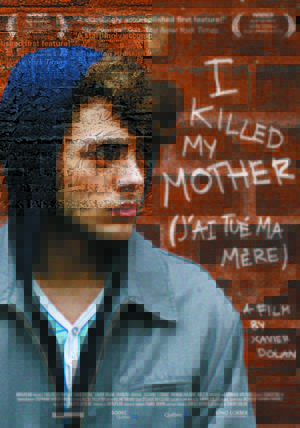
I Killed My MotherXavier Dolan has had quite a run over the past few years.  This May, the 25-year-old wunderkind not only cracked the official competition slate at Cannes, but also won the Jury Prize.  Just five years ago, his debut feature “I Killed My Mother” announced his arrival on the international scene at the Cannes sidebar Director’s Fortnight.
Thought it took that film a whopping four years to wash up on American shores, it’s an incredibly accomplished first feature with the confidence that it takes many filmmakers years to develop.  “I Killed My Mother” is visually daring, emotionally satisfying, and narratively compelling.  As such, it is my pick for the “F.I.L.M. of the Week.”

Despite what the title might have you think, there is no murder in the film.  That’s not to say, however, that Dolan’s angsty 16-year-old character Hubert doesn’t contemplate offing his mother a great deal.  She pushes his buttons just as he pushes hers, resulting in plenty of bickering and nasty quarrels.

It’s not just a rant against mothers, though.  Dolan’s film contemplates the very root of mother-son tensions, the subject of stories for millennia.  “I Killed My Mother” feels like a courtroom drama at times as we weigh who is culpable for all the drama occurring before our eyes.  The answer isn’t ever entirely clear as we’re presented with a dilemma resembling the chicken-and-egg question.  Which came first?

Anne Dorval, playing the eponymous matriach Chantale, provides the pitch-perfect performance for the inquisitive Dolan.  She channels the essence of the matron nicely in the way she tries to provide tough love for her defiant son.  But as hard as she tries to provide consistent care, she lapses as all humans do.  Dorval’s deeply humane portrait of a woman torn by these two forces makes “I Killed My Mother” all the more fascinating to watch unfold.

While Dorval steals the movie on screen, it’s Dolan who commands it off screen.  His remarkable aesthetic flair mixes various styles of filmmaking deftly, giving “I Killed My Mother” an appropriately fractured feel.  The form matches the content remarkably well, for what better way to tell a story about conflicting feelings than with conflicting methods of presentation?  This has all the makings of a masterful film for any director; it’s merely compounded by the fact that it’s a debut for Dolan, who couldn’t even legally buy alcohol in the United States when he made it.  (He’s Canadian, anyways, so that fact doesn’t really matter.)


F.I.L.M. of the Week (June 20, 2014)

20 06 2014

Rian Johnson was announced this week as the next major architect in the “Star Wars” franchise, which was met with cheers from the fanboys.  And understandbly so, as Johnson is a brilliant creative mind who has recently given us the ingenious “Looper” as well as some of the best episodes of “Breaking Bad.”

But as for me, on the other hand, I found myself rather peeved.  The house that Lucas built will require non-stop attention for several years, leaving the cinemas without Johnson’s voice in peculiar but always memorable films.  He’s a master of mining subgenres for unexplored territory, be they high school movies or time travel sci-fi pics.  Johnson’s “The Brothers Bloom,” not your average heist flick, is a unique and underappreciated film that earns my pick for the “F.I.L.M. of the Week.”

Not unlike this year’s Best Picture nominated “American Hustle,” the film uses the art of the con as a means to explore individual identity as well as the nature of storytelling.  Filmmakers and hustlers often pull from the same theoretical toolbox, using the art of illusion to manipulate us into feeling exactly what they want us to feel.  As Mark Ruffalo’s Stephen puts it at one point in “The Brothers Bloom,” the perfect con is the one where  everyone involved gets just what they wanted.

While I’ll stop short of calling this a perfect movie, it’s certainly a very, very good one.  It’s thoughtful and entertaining, a mix that seems to be increasingly less common.  The performances are great, too – Ruffalo and Adrien Brody star as the titular fraternal con artists who pull bizarre stunts with the help of Rinko Kikuchi’s silent pyrotechnics companion Bang Bang.  The three make a hilarious pair, lighting up the screen with their off-kilter chemistry.

But the real dynamo of “The Brothers Bloom” is their target, Rachel Weisz’s cooped-up heiress Penelope Stamp.  Brody’s Stephen manages to win her affection, luring the quirky loner right into their trap.  They let her in on their chosen profession, and Penelope eagerly jumps right into scheme.  Who’s conning who and who’s being honest often gets a little hazy, but every moment is thrilling as we see simultaneously more and less of who the characters really are.  Johnson’s writing gives them so much to work with, and it saddens me to think we won’t be seeing another one of his movies like this for a long time.


F.I.L.M. of the Week (June 13, 2014)

13 06 2014

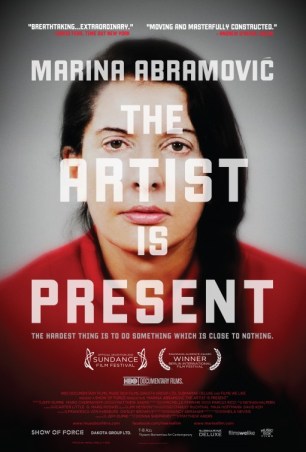
Marina AbromavicI’ve always been fascinated by people on the cutting edge of their art, and even more enthralled by those who are forming just what that art will be.  (Perhaps this explains my recent fascination with early film history.)   One such iconoclast is Marina Abramavic, a performance artist who is pushing boundaries that don’t even exist for her medium yet.
The intriguing documentary “Marina Abramovic: The Artist is Present” follows the titular artist as she prepares for a 2010 MoMA retrospective of her work while also embarking on a new piece, perhaps her most daring yet.  Directors Matthew Akers and Jeff Dupre ably balance both an introductory course in performance art as well as an intimate portrait of the artist herself, creating a satisfying piece that I have chosen as the “F.I.L.M. of the Week.”

Abromavic’s work is bold and confrontational, breaking down the conventionally accepted barriers between the artist and the consuming audience.  She often involves her body in the works she creates, usually in ways that draw attention to the ways we enact violence and sexuality.  The performances are important for her, but they also start an important conversation with the viewer that they will hopefully continue in their minds.

So what better way to have the ultimate conversation with her fans than making herself completely open to them?  In the centerpiece of her retrospective, she performs a new work entitled “The Artist is Present.”  Wearing a blank slate of a facial expression, Abramovic sat completely still for several hours per day at a table in an expansive space at MoMA.  Visitors could sit at a chair across from her and literally enter into conversation with the present artist.

As the film progresses, we get to see her astonishing effect on the exhibit’s guests.  (There’s also an oh-so-predictable cameo from James Franco at the exhibition because of course he would be there.)  Yet the documentary also grants us an intriguing look at how they in turn affect her.  The piece may seem simple; however, it slowly takes its toll on Abramovic.  In the end, though, it pays off in spades for her personally and professionally.  And hey, “Marina Abramovic: The Artist is Present” has converted a neophyte observer like me into a huge fan.


F.I.L.M. of the Week (January 24, 2014)

24 01 2014

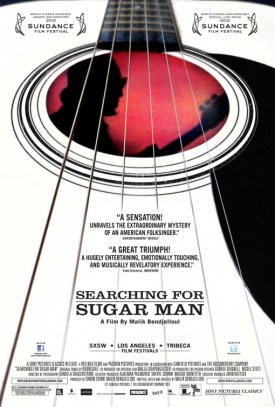
Searching for Sugar ManThankfully, there never seems to be any shortage of documentaries tackling the quandaries and complexities of our livable reality, but at times the sheer volume of non-fiction film can be overwhelming. Even from just a search of what’s available on Netflix, it’s hard to sort out the real deal from the TV special or the DVD extra quality material.  Thankfully, the Academy Awards are pretty helpful at shining a spotlight on a selection of high quality documentaries each year.

While I might quibble with their flagrant (some might argue inexcusable) exclusion of “Stories We Tell” in their 2013 crop, they brought a film called “Searching for Sugar Man” to my attention last year when it won the Oscar for Best Documentary Feature.  Malik Bendjelloul’s film might seem a little slight on the surface, but it’s my pick for the “F.I.L.M. of the Week” because it shows the surprising cultural impact of its subject along with his inspiring story.

The film follows the mysterious figure of Rodriguez, a folk singer who could easily have been a figure of Bob Dylan’s stature.  (Just listen to his jam “I Wonder” and feel yourself get taken away by the music.)  Despite his incredible talent, his music just never hit a nerve in America.  Rodriguez then faded into obscurity and then disappeared from the public eye entirely.

Meanwhile, in South Africa, his music sparked a cultural revolution.  To them, Rodriguez was like Elvis Presley or the Beatles as his music pushed boundaries on sexual expression in public culture.  And this was just his lyrics alone; there was no man associated with them.  The music just spoke for itself.

But after several decades South Africans began to wonder who the singer really was and began a quest to track down the elusive man.  Bendjelloul documents their investigation like a gripping mystery until they eventually find their answer.  The man they discover is hardly the recluse we’d expect, though.  He’s just an average man shocked to find out the impact his songs had on a faraway country.

In our hyper-connected world today where we can know our favorite musicians every thought on social media, it’s unlikely that we’ll ever see another story like that of “Searching for Sugar Man” again.  It’s like the ultimate edition of Entertainment Weekly‘s “Where Are They Now?” issue but told with more heart than a journalistic article.  Bendjelloul’s film is a touching ode to the way music can change the world – as well as one man, many years later.


F.I.L.M. of the Week (January 17, 2014)

17 01 2014

You’ve seen biopics of complex figures, but director Todd Haynes isn’t interested in presenting his portrait of musician and cultural icon Bob Dylan like anything else ever made.  His “I’m Not There” is a bold experiment, manifesting the fragmentation of Dylan’s persona by literally splitting him into six characters.  This iconoclasm pays off in a rewarding and challenging experience, leading me to name the movie my pick for the “F.I.L.M. of the Week.”

It’s not necessary to know Bob Dylan or his music really well to admire “I’m Not There.”  Rather, all it takes is a willingness to see the connection between the six pseudo-Dylans … or perhaps their incongruity.  The Dylans take many different shapes, including a young African-American (Marcus Carl Franklin), an older man (Richard Gere), a born-again folk singer (Christian Bale), and an actor attempting to get inside of him (Heath Ledger).  We float through each of their lives and struggles in bits and spurts.  Just when we think we get a grip on Dylan, he slips away.

Oddly enough, the one who looks the most like the Bob Dylan we know … is played by a woman.  Cate Blanchett is Jude, a raspy-voiced chain smoking folk musician.  Not unlike her work in “Blue Jasmine,” Blanchett disappears inside her character and makes us forget that aura of regality she so often conveys.

She captures all the frustration of misunderstood artistry along with all the pains of drug addiction.  Blanchett brilliantly fulfills the most frequently recognized Dylan iconography yet also breathes something deeply human into her character, something no amount of cameras or reporters could ever really capture.   She’s at once vulnerable and inaccessible.

Much like Jude, “I’m Not There” floats between all these contradictory lives of Dylan, back and forth with well-orchestrated indirection.  It never settles, never aims for some sort of absolute truth.  It’s like a fictionalization of the concepts brought up in a documentary like Sarah Polley’s “Stories We Tell.”  We are many different things to many different people, and there is no fixed point from which to observe reality or memory.  Perhaps we just exist as the sum total of the masks we wear.


F.I.L.M. of the Week (January 10, 2014)

10 01 2014

Alfonso Cuarón is an almost certain nominee for Best Director (although you never know with the Academy’s directors branch, I said Ben Affleck and Kathryn Bigelow were undebatable nominees at this point last year).  If his work on “Gravity” isn’t enough, just look at the incredible stylistic and storytelling diversity of his post-2000 work.  He’s tackled a Harry Potter film (and made the best one, in my opinion), made a dystopian Nativity allegory, and “Y Tu Mamá También,” my pick for the “F.I.L.M. of the Week.”

This 2002 Mexican road trip drama is character driven like “Gravity” but has a lot more to offer in terms of a firm story to follow.  (The original screenplay netted Cuarón and his brother Carlos their first Oscar nominations.)  Even in subtitles, their snappy dialogue has an undeniable pop to it.

The movie follows the exploits of two sexually active teenage boys, Julio (Gael Garcia Bernal) and Tenoch (Diego Luna), who find themselves suffering from upper-middle-class ennui after their girlfriends go for an extended trip to Italy.  Looking for something to do, they take a spontaneous trip to the beach with the older Luisa (Maribel Verdu) whom they just met at a wedding.

As they drive through the poorer parts of their country to find the beach, the three have frank conversations about love and sexuality.  Eventually, their conversations give way to … well, do I really have to say?!  Don’t watch this movie with anyone with whom you’d feel awkward seeing lots of naked bodies.

But in case that last sentence had you thinking “Y Tu Mamá También” is some kind of smutty pornographic film, you’d be mistaken.  It’s a fascinating character study, a gripping journey, and a bold exploration of what men are really expressing when they enter into love triangles.  I’ve only seen this movie once, but I’d love to give it a second look soon to more closely examine how the surprising ending is foreshadowed and how the film addresses the sociopolitical context of late ’90s Mexico.


F.I.L.M. of the Week (January 3, 2014)

3 01 2014

Tom Hanks, even at the relatively young age of 57, is such a legend of the screen that every role he takes is reason for excitement.  (Unless it’s “Larry Crowne.”)  2013 graced us with not just one but TWO Hanks performances in “Captain Phillips” and “Saving Mr. Banks,” at least one of which is likely to result in an Oscar nomination.  The two-time winner hardly needs any recognition for his acting prowess, nor does he need to be lauded for his producing skills (the man has 5 Emmys sitting on his mantle).

What does deserve some attention, though, is Hanks’ directorial debut “That Thing You Do.” (We’ll just pretend “Larry Crowne” didn’t happen, just like American audiences did.)  My pick for “F.I.L.M. of the Week” shows a fun-loving, crowd-pleasing side to Hanks that will make you wish he was sitting in the director’s chair as often as the producer’s seat.

The film follows a would-be Beatles boy band, the Wonders (formerly the One-Ders), as they rise from garage obscurity to Billboard chart-topping fame.  None of it would have happened, though, without the inspired improvisation of replacement drummer Guy (Tom Everett Scott) that turns the song “That Thing You Do” from a ballad into an up-tempo rock ‘n’ roll number.  From there, they acquire a swanky manager played by Hanks himself, go on tour, perform on television … and deal with all the motion sickness caused by such a meteoric ascent to stardom.

Thanks to HBO, I’ve seen “That Thing You Do” dozens of times over the past 15 years or so, and I’ve never tired of it.  (For that same reason, I’ve only seen it start to finish a handful of times.)  Similarly, I still listen to the movie’s soundtrack frequently; it’s got a number of ditties that you can have stuck in your head for days.  The whole movie, really, is such a delight.  It’s a toe-tapper of a musical with plenty of dramatic tension and rich characters that’s wonderfully orchestrated by Maestro Hanks.


F.I.L.M. of the Week (December 27, 2013)

27 12 2013

The year 2014 is fast approaching, which portends a myriad of things for people.  For many, it is a fresh start, a chance to renew lapsed goals and resolve to become a better person.  Yet for all of us, it is an inescapable marker of time slipping through our fingers.  For what is a year but just two signposts of elapsed time, a set of brackets to contain our ups and downs?

Mike Leigh’s “Another Year,” my pick for the final “F.I.L.M. of the Week” in 2013, looks at this widely-recognized span of time from a refreshingly realistic angle.  It’s not a tale that escalates dramatically like a conventional fictional plot.  Rather, Leigh presents four chapters – one for each season – in the lives of ordinary people going about their business.  There is not necessarily any grand significance to their trials and triumphs, but in simply recognizing these normally unrecognized moments, Leigh grants them a beautiful dignity.

To detail the occurrences of “Another Year” in any great detail would be to spoil the flow of the picture.  Like many films by Mike Leigh, it involves a large ensemble cast who are more than just actors in the movie – they are true collaborators.  Their characters drop in and out of the story with the exception of the two anchors of the film, the old married couple Tom and Gerri Hepple (Jim Broadbent and Ruth Sheen, respectively).  They are a solid bedrock for their many friends, steady and resolute from their many years of experience weathering whatever is thrown at them.

There’s no indication that the year chronicled in “Another Year” is one of any particular challenge for Tom and Gerri.  Both continue to work their jobs, tend their house, care for their grown son, and love each other.  They even manage to stay relatively unfazed by their erratic friend Mary, played by Lesley Manville in what should have been an Oscar-nominated performance. (Sadly, confusion over whether she was a leading or a supporting actress may have cost her a shot at a trophy she deserved to win.)

As she endures a particularly biting mid-life crisis with an accompanying lack of direction and self-worth, Mary provides the tension that makes “Another Year” more than just pure naturalism.  Manville is nothing short of stunning in the role, providing just about every emotion one can feel over the course of a year within the film.  Leigh closes with a long-held shot of her face, and it is truly devastating.  Not unlike the final shot of “Zero Dark Thirty,” all the action and events of the film are ultimately reflected in the face.  And in “Another Year,” the events are life itself, in all its small victories and tough disappointments.


F.I.L.M. of the Week (August 30, 2013)

30 08 2013

“Football doesn’t build character,” says Coach Bill Courtney, “it reveals it.”  It’s one of many wise maxims uttered by the sage volunteer football coach in the documentary “Undefeated,” my pick for “F.I.L.M. of the Week.”  It’s a great watch during football season, an inspiring and rousing time for everyone.

Directors Daniel Lindsay and T.J. Martin did not win the Oscar for Best Documentary Feature because they made a superb sports movie.  “Undefeated” is a football film with surprising insights that extend deceptively far beyond the field.  It’s got everything you love about “The Blind Side” without everything that I hated about “The Blind Side.”

The film brilliantly uses football to shine a light on problems plaguing inner-city communities such as this one in Memphis: poor education, lack of sufficient funding and facilities, absent fathers, and a lack of positive role models, just to name a few.  Over the course of the season, many of these issues come to a head, threatening to derail all the hard work of Manassas High’s fledgling and upstart football team.

With a quiet and understated lens, Lindsay and Martin catch Coach Courtney dealing with these the best way he knows how: with patience, understanding, and character above all.  Courtney himself grew up without the strong presence of his father, and he has chosen to pay it forward out a kind and generous heart.  It’s remarkable to see the way he and his team are able to overcome so many obstacles on the field and in their community.  Sure enough, we see all the heart and character laid bare before our eyes as promised by Courtney.