F.I.L.M. of the Week (November 23, 2012)

23 11 2012

It really is a shame that Mel Gibson had to go off the deep end right before the release of “The Beaver.”  The movie is a deeply powerful examination of family and interpersonal dynamics in the wake of an increasingly isolating digital world.  However, if you’ve watched E! any time over the last few years, you’ve no doubt become aware that Gibson isn’t exactly in his right mind all the time.  Thus, they were successfully able to sell Jodie Foster’s excellent film to the public as “that crazy Mel Gibson movie where he talks with a beaver puppet” as if it were autobiographical.

“The Beaver” isn’t the story of Mel Gibson; it’s the story of all of us who ever disappear into our screens at the expense of human connection.  For that reason, it’s my pick for the “F.I.L.M. of the Week.”  It cracked my top 10 last year, and the more I think on the film, the more pleased I am that I went out on a limb for it.  I think in a few years, when all the tabloids quit running their sensational stories on Gibson, there will be a massive critical reevaluation of “The Beaver.”  And I will be proud to have been a supporter since I first saw the film at an early morning showtime in May 2011.

The titular beaver puppet is actually not a product of the insanity of Walter Black, Gibson’s character.  Well, at least not in the sense that TMZ tries to paint him as insane.  Walter’s been asleep at the wheel for years, failing as a parent and husband.  After a severe bout with depression, he discovers the beaver puppet and begins living vicariously through it.  The beaver becomes a psychological distancing mechanism, allowing Walter to separate himself from the guilt of past deeds that weighs down on him like a rock.

What director Jodie Foster and writer Kyle Killen explore in “The Beaver” with such dexterity is how each of the other characters have their own beavers, so to speak.  Each erect false facades designed to convey a persona that does not match the person underneath.  Walter’s son, Anton Yelchin’s Porter, is trying to project that he is the polar opposite of his dad.  Yet in his evasion, he becomes even further disengaged from his family and increasingly abrasive – the very traits that precipitated his beaver crisis.

There’s also Jennifer Lawrence’s Norah, Porter’s high school classmate who is by all means considered to be the paradigmatic girl of their class.  Yet she’s struggling with dark issues of grief behind closed doors, and she is even willing to pay Porter to write a big speech for her to hide it from others.  While their unconventional romance is a subplot to the larger arc of the 90 minutes of “The Beaver,” it makes a big impact because Yelchin and Lawrence act from such a dark recess of their souls.  They manage what many actors twice their age cannot, a connection on both an intellectual and an emotional level.

So get over Mel Gibson, sit down with an open mind, and watch “The Beaver.”  If you are willing to really think, you’ll find some very interesting questions being raised.  What are the beavers in our life that keep us from loving others?  Jodie Foster shows you those of Walter, Porter, and Norah to devastating effect; it’s up to you to figure out your own.
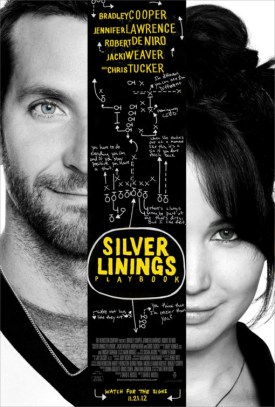


REVIEW: Silver Linings Playbook

21 11 2012

Over six months later, it appears that I can finally reveal to you the mystery movie that Harvey Weinstein unveiled for me at a screening for international buyers and distributors in Cannes: a rough cut of “Silver Linings Playbook.”  Although had you told me it was a final cut, I would have believed it.  The film felt totally complete and in no need of further tweaking.  In fact, I almost ran my review of that version when the film premiered at the Toronto Film Festival, hoping people assumed I was there and saw the theatrical cut.

Now that I’ve seen the movie for a second time, I’m definitely glad I did not run a review on the rough cut.  The film improved by leaps and bounds over the four months in which David O. Russell and company worked out the kinks in the film, and most of the things I would have griped about in my review of the rough cut disappeared.

On the surface, everything is relatively the same: the story still plays out in the same way, the rhythm of the film kept in tact, among other things.  But I noticed a much more complex visual scheme, one that made “Silver Linings Playbook” feel like a David O. Russell film, not your run-of-the-mill romantic comedy.  Rather than the standard back-and-forth, he’s-talking-now-she’s-talking editing, Russell opts to go deeper and use the camera to probe his characters psychologically.  Rather than merely capturing the plot like the rough cut, Russell ultimately found ways to suggest levels of depth extending far below a single shot.

Russell is able to make the performances shine by keying off the wacky family dynamics that made “The Fighter” such a hoot (and also harkening back to the zaniness “Flirting with Disaster” –  for fans of Russell’s early work).  You wonder how these relationships can possibly function in any way other than what Jim Morrison called “mutual wierdness,” or love.  He draws us in with characters who wear their flaws on their sleeves yet keeps us engaged by continuing to show how they motivate the character at their core.

Read the rest of this entry »


REVIEW: The Hunger Games

23 03 2012

From the very beginning of “The Hunger Games,” it is very clear that this literary adaptation has in common with “Harry Potter” only the hype surrounding their release.  While Rowling and an army of talented directors transported us to a universe accessible only in our wildest imaginations, writer/director Gary Ross shows no such inclinations in bringing Suzanne Collins’ best-seller to the big screen.  As her novel is meant to hold a mirror up to our own reality-TV saturated culture, he plants the film in an America just a little bit of social upheaval removed from our current one.

He has no interest in sweeping formalist cinematography that basks in the beauty of castles and countryside.  Ross’ style adheres more closely to the films of Danny Boyle with a kinetic desire propelling every shot; watching the struggles in the wilderness harkens more to Aron Ralston’s fight against nature in “127 Hours” than it does to anything in the Forbidden Forest.  The editing is more deliberate, too, lingering on the actors to communicate internal monologues with their eyes rather than conveying that the editor forgot to take their Ritalin.

Of course, not everything in the film looks as gritty as District 12 and as unyielding as the Arena.  The Capitol, where the rich and the elites bask, is embellished to the maximum for an especially emphasized contrast.  The men and women look like they walked out of Hunter S. Thompson’s acid trip, and their lavish makeup and attire are nothing short of ridiculous.  (So don’t be surprised if “The Hunger Games” takes home a technical Oscar or two next February.)

All of this makes Panem, a strange society born from the ashes of an America that tore itself apart, a fascinating place to build a story of triumph over the odds.  16-year-old Katniss Everdeen, played by Jennifer Lawrence, volunteers to participate in the Hunger Games in place of her younger sister.  The Games require the competitive edge of an Olympic athlete in addition to the cut-throat inclinations of a Real Housewife of Beverly Hills, and it gets worse for Katniss as class bias is institutionalized in the rigid caste society of Panem.

Read the rest of this entry »


REVIEW: Like Crazy

6 03 2012

An indie movie for people that hate indie movies, “Like Crazy” aims for the lowest common denominator at all times by stretching the star-crossed lover formula to the edges of watchability.  Writer/director Drake Doremus really tests his audience’s patience by asking them to sympathize with two characters who spend 90 minutes complaining about a dilemma caused by their own willful negligence of the law.  You would think that only in a fantasy universe do actions not have consequences, but the reality of the film expects to defy the logic of reality.

The entire film hinges on the notion that we are supposed to somehow blame the government for the rift in the relationship of young lovers Jacob (Anton Yelchin) and Anna (Felicity Jones) when it is clearly their fault.  Only two morons would really believe that she could just overstay her visa in the United States and not face any ramifications.  Just because they are “in love,” as they see but we don’t, does not mean that immigration officials will simply deny the fact that she broke the law.  I guess such is the independent spirit of upper-class educated hipsters, believing everyone to be below them and thus only there to serve their peculiarities and desires.

Maybe it would be easier to forgive the two idiotic protagonists if they actually had some chemistry; Yelchin and Jones have as much heat as an industrial-strength freezer.  Their relationship begins almost on a whim, continues due mostly to carnal passion, and subsequently fades because an ocean separates them as they are forcibly split by the government.  Tell me where I’m supposed to root for anyone in this story, not to mention the actors make their characters surly, grumpy, and generally unpleasant.  They’re kind of like the grouches you really hope aren’t making your coffee at Starbucks in the morning.

Really, if Doremus wanted the audience to care at all about such stupid characters, he had to give them something to work with.  Instead, he gives us nothing, and it’s all too easy to resist the story and whatever it might have to say about love.  “Like Crazy” had the opportunity to really say something about connectivity and modernity, yet it settles to just be two attractive twenty-somethings moping about having to take responsibility for their actions.  Welcome to adulthood, kids.  C+


REVIEW: X-Men: First Class

9 06 2011

I’m not quite sure how “X-Men: First Class” fits in to the universe created by the other 4 films (like “Superman Returns“), or if it’s supposed to create a whole new universe in itself (like “Batman Begins” or “Star Trek”).  This confusion makes it hard to write about the summer superhero tentpole movie.  However, rather than worry myself with such fanboy concerns, I’ll review it like I chose to watch it: as a fun, entertaining reintroduction to the mutants that provides some interesting background on their origins (as well as shining some light on the REAL events of the Cuban Missile Crisis).

Matthew Vaughn makes it easy to forget your worries about the movie’s place in the series by keeping a smooth pace through a script that balances big explosions with character development.  It’s like a two hour pilot that introduces you to a fantastic ensemble while also fleshing out the conflict between its two biggest stars.  He’s no Christopher Nolan behind the camera, but he’s certainly much better than Michael Bay or whoever made the horrific “X-Men Origins: Wolverine” (which I still think was just an excuse for Hugh Jackman to prance around naked on camera).

Vaughn also makes some very savvy casting decisions; rather than filling out the large cast with marquee names or falling stars, he casts up-and-coming stars who make up for what they lack in marketability with their impressive acting chops.  James McAvoy (“The Last Station“) and Michael Fassbender (“Inglorious Basterds“), Xavier and Magneto respectively, are two incredibly reputable actors who bring drama and dynamism to the roles that Patrick Stewart and Ian McKellen made campy and stale. Oscar nominee Jennifer Lawrence (“Winter’s Bone“) brings soul and heart to Mystique, two things Rebecca Romjin did not endow her character since she was too busy being sexy.  Nicholas Hoult (“A Single Man“) is a warm-hearted and lovable big-footed scientist.  January Jones provides some nice eye candy for those who might miss Halle Berry, although she will always be Betty Draper of “Mad Men” for me, while fans of Rose Byrne (“Bridesmaids,” “Get Him to the Greek“) will also rejoice to see her featured as mutant protector Moira MacTaggert.

It’s like he’s trying to have the 25 year reunion of this cast be on the cover of “People” with the title LOOK HOW FAR THEY’VE COME in big bold letters (while Lindsay Lohan is arrested for the 30th time in the sidebar).  Vaughn uses these superheroes to create superstars, many of which will be touting above-title billing after this movie.  His choice not to overload with actors who we already associate with other roles makes us more drawn in to the characters and less distracted by the people portraying them.

Read the rest of this entry »


REVIEW: Winter’s Bone

26 12 2010

For a long time, “Winter’s Bone” was a blank box that needed to be checked on my essential 2010 movie viewing.  Now that I’ve seen beside Debra Granik’s gritty drama, the movie remains little more than a box that I’ve checked.  It’s bleak and unsparing, not meant to be anything grandiose or over-the-top, yet in accomplishing this goal, the movie manages to make itself rather forgettable.

At the center of the movie is a fascinating heroine, Ree Dolly (Jennifer Lawrence), forced to be a mother to her younger siblings as her father has disappeared and her mother is incapable to care for them.  She’s forced to become the best bounty hunter of 2010 (take THAT, Gerard Butler) when she’s informed by the police that since her father put the family home for bond, she will lose it if her father doesn’t show in court.

Commence a search for her father amidst the backdrop of the Ozark drug dealing underworld, where she encounters plenty of unsavory figures with some disgusting meth faces who don’t want her nosing around in their business.  They recognize that she will stop at nothing to save her family, and with Ree’s determination, she could lead the wrong people into their operations and put a pinch on their profits.  She finds one ally in her uncle, Snowflake (John Hawkes), who does his best to protect her.

Lawrence gets the opportunity to play a very strong and courageous female character in Ree, and as the movie’s landscape bores, she keeps us drawn into the action.  The sheer trauma of facing reality and the consequences of her father’s actions is overwhelming, yet Lawrence manages to play it with such subtlety that it fades into the mountains with the rest of “Winter’s Bone.”  I wouldn’t jump straight to awards for Jennifer Lawrence, but my discordant voice is practically inaudible among a chorus singing her praises. B-


Oscar Moment: “Winter’s Bone”

15 06 2010

All is looking good for Deborah Granik and Jennifer Lawrence, two people who you likely hadn’t heard of before this post and almost assuredly hadn’t heard of before this year.

Granik started off 2010 premiering her film, “Winter’s Bone,” at the Sundance Film Festival to massive acclaim.  It won the Grand Jury Prize for dramatic films, a very prestigious award, and was bought by Roadside Attractions for $500,000.  It was released last Friday, June 11, to outstanding critical reception – a 90% fresh rating on Rotten Tomatoes and an outstanding 87 on Metacritic.

Looking at the last two winners of the dramatic Grand Jury Prize might show us some potential fates for “Winter’s Bone.”  2009’s recipient was “Precious” (then known by the name of its source material, “Push”), and the 2008 winner was “Frozen River.”

“Precious” had more than just the Grand Jury Prize going for it coming out of Sundance.  It won the Audience Award as well, showing how popular it was with everyone who attended the festival (Mo’Nique also won the first of many prizes for her role in the movie).  It also got the sizzle and added press from its support by Tyler Perry and Oprah Winfrey.  “Winter’s Bone,” on the other hand, has a release with as little grandeur as its setting in the Ozark Mountains.  “Precious” went on to make nearly $50 million and score a stunning 91% on Rotten Tomatoes and a very good 79 on Metacritic.  As we all know, it received Best Picture nominations from the Golden Globes and Oscars, winning 2 Academy Awards on Hollywood’s biggest night.

I see more parallels with “Frozen River,” the decidedly unglamorous and gritty tale of a desperate mother (Melissa Leo) who illegally smuggles people across the U.S border with Canada.  After winning the Grand Jury Prize, it was picked up by Sony Pictures Classics (an expert in marketing independent movies) for $500,000.  They opened the movie in late August to tepid audience reaction, opening with a fairly weak $10,000 per theater average, a statistic that shows that theaters weren’t exactly packed.  Critical reception was much more positive, showed by its 88% on Rotten Tomatoes and 82 on Metacritic.  But at the end of the year, people remembered “Frozen River.”  It picked up momentum as the season dragged on, beginning with a surprising SAG nomination for Leo that eventually led to an Oscar nomination over the favored Sally Hawkins.  Leo’s strength undoubtedly helped Courtney Hunt’s screenplay get into the Best Original Screenplay fold as well.

I’m inclined to say “Winter’s Bone” will take the “Frozen River” path mainly because they have very similar, dark tones, a strong female performance, and a well-written script (“Winter’s Bone” picked up a screenwriting award at Sundance).  But the per theater average was nearly double that of “Frozen River,” so perhaps it will have a little bit more audience support to carry it through.  I’m just really not expecting it to receive a massive outpouring like “Precious” because it is “one of the unshowiest and most true-blooded epics of Americana you’re ever likely to see,” according to Entertainment Weekly‘s Lisa Schwarzbaum (who gave it an A).

The movie’s leading lady, Jennifer Lawrence, just screams “this year’s Carey Mulligan.”  Even younger than last year’s Best Actress nominee at 19, Lawrence has been a huge talking point of the movie.  Her breakout role has garnered her large attention from the media, leading to a spotlight from Esquire with a fairly steamy photo shoot.

Granik gave Vera Farmiga her big break with her debut feature, “Down to the Bone,” for which she was nominated for an Independent Spirit Award and won Best Actress from the Los Angeles Film Critics Association.  Don’t quote me on this, but I’m fairly certain that Jason Reitman has stated that seeing her in “Down to the Bone” led to her casting in “Up in the Air,” the movie that got her Golden Globe, SAG, and Oscar nominations.  So while it remains suspect how much love Lawrence will receive for this particular role, all signs point to a promising future for the young performer.

BEST BETS FOR NOMINATIONS: Best Actress (Lawrence), Best Adapted Screenplay

OTHER POTENTIAL NOMINATIONS: Best Picture, Best Director (Granik)