Telluride Film Festival
In 2002, President George W. Bush declared, “Here in America, if you own a home, you’re realizing the American Dream.” Six years later, that unbridled spirit of homeownership at all costs led to a bubble of subprime mortgages bursting and contributing to the tanking of the nation’s economy. This time of panic and crisis brought about pain for many hard-working Americans, and it also provides the foundation for writer/director Ramin Bahrani’s gripping look into the dark heart of capitalism, “99 Homes.”
Over five years years ago, George Clooney’s Ryan Bingham arrived on screens to inform blue-collar workers they were out of a job in Jason Reitman’s “Up in the Air.” A similar task falls to Andrew Garfield’s Dennis Nash, the protagonist of “99 Homes,” who enforces evictions in working-class Florida neighborhoods. Bingham, however, could stay detached from the plight of the newly unemployed; Dennis can receive no such comfort. Before becoming the man doing the evicting, he and his family were the evicted.
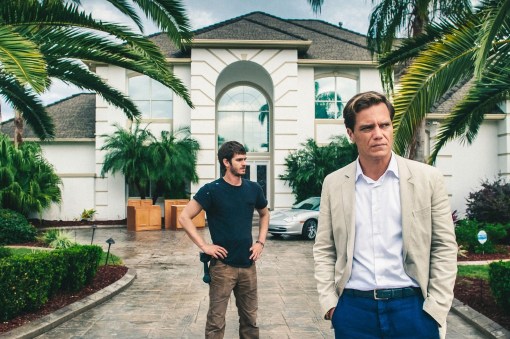
In order to provide for his son Connor and mother Lynn (Laura Dern), Dennis turns to the very person responsible for putting them in dire economic straits: the vile, e-cigarette smoking realtor Rick Carver (Michael Shannon). While everyone suffers, his business booms, and Dennis is willing to sell his soul to his persecutor if it means putting food on the table. Sure, he shares in some of the profits. But, at the end of the day, Dennis heads back to the same kind of cheap motel to which he banishes countless other families.
Through Dennis, Bahrani brilliantly illustrates the sociological concept of false consciousness. He buys into Carver’s policies and slowly deludes himself into believing he is of a higher class standing. Carver, an unabashed believer that America only bails out winners like himself, takes the spoils and leaves workers like Dennis with the scraps. Advancing out of their precarious position is merely an illusion.

If this sounds pessimistic, Bahrani earns the right with his intellectual depth. “99 Homes” also wisely focuses on characters whose very livelihoods are in jeopardy because of the financial crisis. Most films that have tried to grapple with the effects of the recession – “The Company Men,” “Margin Call,” “Arbitrage,” “Blue Jasmine” – only dare to assume the perspective of the upper-class descending to the middle-class. Dennis and his family are not worrying about losing the Porsche or selling off the jewelry. If they descend any lower, it is outright poverty and destitution.
Stemming from this standpoint, the stakes feel appropriately extreme enough both to feel deeply and contemplate thoroughly. Bahrani often scores the film with tense, thriller-like music, and it works exceptionally well. If the lives hanging in the balance and the severity of the moral compromises being made do not merit an increasing heart rate, nothing does.

If the film feels exaggerated and over the top, the financial crisis was an absolute nightmare for many families that felt borderline apocalyptic, so grandiosity is justifiable. If it feels like a preachy morality play, at least Bahrani has his heart and mind in the right place. He understands that the home is a symbol of heritage, inheritance, legacy, and personal pride.
Yet “99 Homes” communicates something more important. The home itself is not the American Dream. It is the well-being of the people inside of the home. A- / 
 Earlier this year, I had the distinct pleasure to attend the Student Symposium at the
  There are many people who romanticize the European model of making films, and Tyldum is not one of them. He admitted to favoring the honesty of Hollywood filmmaking over the pretentiousness of the Scandinavian system. Tyldum also lamented the way it was suspicious to make a commercially successful film in his home country, so no wonder he wanted to get out – “Headhunters” is the
  And critics of “The Imitation Game” have been quick to take the filmmakers to task for whitewashing or downplaying Turing’s sexuality. Seemingly in response to these criticisms, Tyldum highlighted the richness of the story and just how many distinct angles and interpretations that different filmmakers could extrapolate from it. While some might see it as an opportunity for a LGBTQ message or a lesson on science and math, Tyldum stated that he saw the movie as “about how important it is to listen to people who are different.”
 Telluride Film Festival
 Telluride Film Festival
 Telluride Film Festival
 Telluride Film Festival


 Telluride Film Festival





















 Telluride Film Festival


 Marshall and the Movies
Recent Comments