F.I.L.M. of the Week (December 29, 2016)

29 12 2016

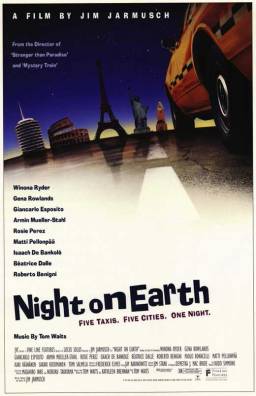
night-on-earthMy apologies to whichever friend or professor enlightened me with the following observation; I have to give credit because it is not my own. There’s a reason why so many heated, important conversations take place in cars. The automotive space is an inescapable one for its passengers, but the tableau where all seats face forward also allows confrontations to occur with an excuse to avoid eye contact.

Before HBO’s notorious “Taxicab Confessions” explored the taxi as a conversational space, there was Jim Jarmusch’s “Night on Earth.” This astutely observed and wryly humane dark comedy is an international omnibus exploring the unexpected connections that can be made across the divide between passenger and operator. The circumstances and the outcomes change with each successive city and set of characters, but the joy of observation remains unchanged throughout my pick for the “F.I.L.M. of the Week.”

The segments of “Night on Earth” could easily have just amounted to a filmed version of a screenwriting challenge. (I recall one film school application I looked at requiring multiple scenes taking place in an elevator.) A shared setting may unite the vignettes, though little else does. Jarmusch begins in Los Angeles where Gena Rowlands’ wealthy passenger Victoria Snelling can never quite understand the aspirations of her driver, Winona Ryder’s Corky, to become a mechanic. He ends in Helsinki, where three ruffians allow themselves to be moved deeply by the plight of their driver. And just before that, a segment in Rome pits Roberto Benigni’s sexually frustrated cabbie against a horrified Catholic priest in a comedy reminiscent of early Woody Allen.

There’s no grand statement or thesis here. If there was, it would certainly be secondary to just taking in “Night on Earth” beat by beat with these characters. Both the journeys and the destinations are fascinating and surprising in equal measure.


REVIEW: Paterson

28 12 2016

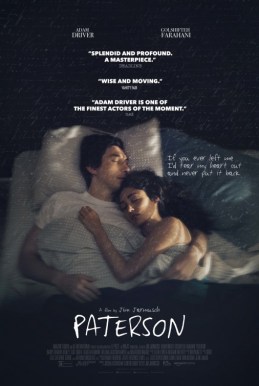
patersonHouston Cinema Arts Festival

I suspect like many in the blogosphere, I write not for a living but because it gives me some purpose to my passion. There’s a tendency among those us who keep up such a habit to compartmentalize life into the daily, the mundane, that which pays the bills … and the time for doing what brings true, deep, intrinsic satisfaction. These dual spheres are seemingly always battling for influence, the ideal scenario being one where the time allotted to one’s avocation can supersede that given to their vocation.

With his latest narrative film “Paterson,” however, writer/director Jim Jarmusch envisions a different way. His subject, Adam Driver’s Paterson, is a bus driver by trade in the carcass of the old industrial town of Paterson, New Jersey. Not for a second do we pity what appears on the surface to be a humdrum existence. It’s the presence of a steady routine – his morning mosey to work, his regular route, his late night dog walks, his quiet evening grabbing drinks at the bar – that allows him the headspace to write great poetry. In the absence of disruption or chaos in his life, Paterson can easily nestle his calling within his career.

This does not mean that Paterson skips merrily to get behind the wheel each day. His face lights up at any occasion to discuss poetry or writing, and such animation is hardly ever visible when he dons a stoic expression to face down another day of his regular routine. Paterson does not so much resign himself to this fate as he makes peace with it, and 2016’s struggling artists in films from “La La Land” to “Don’t Think Twice” as well as “Maggie’s Plan” would be wise to take a page from his playbook. In his own way, he has found contentment and seems quite happy with it.

Foil that with Paterson’s girlfriend, Golshifteh Farahani’s warmly supportive Laura, who appears allergic to anything resembling order or stability in her schedule. “Paterson” follows a little over a week with these characters, and no day is ever the same for her. She’s always following a new whim or passion, never fully gratified by her last pursuit. She can create cute tchotchkes, perhaps, but she moves too fast to notice the vibrant life surrounding her. Thanks to Jarmusch’s understated but steady vantage point into their world, we get to notice the unexpected virtue of stability and the joy that comes from having the perception to notice the variations and deviations that break up the monotony. A-3halfstars


REVIEW: 13th

27 12 2016

13th“We have to understand before we can move on,” states an interview subject early in Ava DuVernay’s documentary “13th.” The movie does just that by establishing a baseline of knowledge among people who watch the film. There’s no title cards before the closing credits trying to funnel viewership into political action. In fact, we are more likely to feel complicit in our silence than empowered with our activism.

I’ve seen “13th” twice now, once before the election and once after. Among the many films that I have rewatched in the wake of Trump’s victory, this is the one that feels to have changed the least. That’s a huge credit to DuVernay’s laser-sharp focus on her thesis that the past 150 years of America’s prison system is a reincarnation of slavery thanks to a loophole in the titular Constitutional amendment. She did not try to predict the future; in fact, both of 2016’s major party candidates make appearances in archival material that their campaigns would rather have buried. Instead, DuVernay casts her glance backward at the structural and institutional conditions that allowed “crime” to become a proxy war against black Americans.

“13th” shows less of the inside baseball of politics than the standard political documentary, although some invisible actors like the FBI and ALEC do get properly chided. DuVernay opts to look at cultural flash points such as D.W. Griffith’s “The Birth of a Nation,” which fueled the popular image of black men as indolent indigents, and George H.W. Bush’s infamous dog-whistling Willie Horton campaign ad. These are important to examine both in their creation and their adoption. Were Americans willing to wholeheartedly dismiss these negative images as propaganda, perhaps we would not be in our current situation. But we didn’t, as recent events have shown, and our country may be forced to refight some of the battles that appear settled or reversed by the Obama administration.

But to talk about “13th” purely in terms of content does a disservice to the great artistry that DuVernay brings to the project. The documentary is far more than just a sleek presentation of introductory poli-sci college seminar material. She’s reliant on talking heads to convey the history of American penal injustice as well as to editorialize, yet she usually does not display the subject’s name or affiliation until they have spoken several times. The effect allows us to build up trust and judge their words before we can write them off based on their qualifications. (She also shoots some wonderfully dynamic interview framing, conveying mood and motion along with information.)

DuVernay repeatedly confronts us with the word “CRIMINAL” in big block letters every time the word is uttered. It’s a call to consider the term not as a person but as a construct, one that has been weaponized specifically against one group of our fellow citizens. True, it is technically race-blind. But we must understand that its conceptualization does not align with its practice in order to correct a systemic imbalance in our country. A-3halfstars


REVIEW: La La Land

24 12 2016

Houston Cinema Arts Festival

Richard Dyer, perhaps the most important modern academic writer on the cinematic musical, divided the genre into three camps. The first two, backstage and the more “escapist” variety, fashion their musical numbers as set apart from the main narrative. These song and dance sequences are very obviously a performative or fantasy space – a separate reality.

But the third, which he dubbed the “utopian” musical, featured a more porous exchange between sequences of the mundane and the melodic. These musical numbers are a heightened version of the reality we see in scenes with regular dialogue and blocking. The choreography and the chants add emphasis to mood and tone rather than simply carry water for plot and character development.

If the extended explanation did not already make it clear, Damien Chazelle’s “La La Land” falls into this utopian musical category. When Ryan Gosling’s Sebastian and Emma Stone’s Mia move together, it’s pure bliss. The camerawork of Linus Sandgren captures them in long, fluid takes demonstrating the beauty of their synchronicity in the same way the staccato editing of Chazelle’s “Whiplash” conveyed the violence of drumming. While both actors can spar like Old Hollywood stars and emote like their contemporaries, their feelings are always better expressed in footwork and tentative croons.

Many classic musicals had to use dancing as a metaphor for sex given the strict censorship codes of the time. No such limitation exists to keep Gosling and Stone apart, but Chazelle’s insistence on adhering to the representational language of these films opens up “La La Land” to speak in a highly formalistic manner. It’s a bold choice to wed the film’s crowd pleasing elements to a borderline avant-garde aesthetic, but the elements harmonize quite nicely.

Read the rest of this entry »


REVIEW: Toni Erdmann

23 12 2016

toni-erdmannFantastic Fest

I caught up with Maren Ade’s “Toni Erdmann” at an odd stop along the festival circuit: Alamo Drafthouse’s Fantastic Fest, a far different crowd from the high-minded cinephiles lining the Croisette at Cannes, filling the gondolas at Telluride or packing New York’s Lincoln Center. Sandwiched between genre fare at the festival was this German comedy of manners that has become the year’s critical darling. And yet, the connection between the film and one about cannibals felt apparent to me.

I consider that a testament to just how remarkable Ade’s work is, at once so assured and so open to a multiplicity of reads. Part of that may be a natural result of a 162 minute runtime – for what its worth, the film never feels it. But “Toni Erdmann” is not simply impressive because Ade keeps a great number of plates spinning; in fact, the simplicity of the father-daughter story has stuck with me as much as anything. Through such tight focus on their dynamic, Ade can then shed light onto some relevant themes and issues adjacent to the narrative.

As the film begins, aging prankster Winfried (Peter Simonischek) seeks a new outlet for his antics following the passing of his beloved dog. Around this time, his distant offspring Ines (Sandra Hüller) washes up in Germany again. Winfried jokes about hiring a “replacement daughter,” an idea at which she scoffs. But her brisk dismissal sparks in him a much grander idea that will first drive a tremendous wedge between them – with the goal of perhaps ultimately draw them closer together.

Ines works as a mid-management level consultant in Bucharest, gluing herself to a cell phone screen and PowerPoint presentation to forcefully make the case for outsourcing jobs to the far reaches of the EU. Just as she needs to be closing the deal with the client, who appears at every inopportune moment but Winfried? Only here, he has donned the guise of Toni Erdmann, an unkempt straight-talker who immediately foils with Ines’ buttoned-up sterility.

The immediate aim is embarrassment, which often takes a raucous and ribald form. Yet the long-term objective is mortification: breaking down Ines so she can rebuild herself in a more compassionate way. Watching Ines squirm is an honest (albeit guilty) delight, especially because Hüller pulls from a vast repertoire to express the character’s discomfort in her face and body language.

Read the rest of this entry »


REVIEW: Sing

21 12 2016

When it comes to making movies for children, simplicity is your friend. In the case of Illumination Entertainment’s “Sing,” however, animators must have just decided to meet the times and deliver a scattered mess of characters in need of Adderall and concision. There’s genuine heart and sweetness in Garth Jenning’s film, but it gets choked out of the equation in favor of more songs, more gags, more scenes, more … everything.

There’s really no need to stuff in another animal, another backstory, another musical number. We already know what’s going on from the get-go because “Sing” is not a particularly complicated film. Koala bear Buster Moon (voice of Matthew McConaughey) is a man after many of our own hearts – inspired by art at a young age, he doggedly and even naively sets course to be a booster and patron in the community. When his theater falls on hard times, he holds auditions for a singing contest to spotlight the unsung stars of the town.

While he struggles to pay the rent and keep the lights on, his contestants engage in battles of their own. Yet among the handful of singers, each given about equal screen time, there are really only two issues – nerves and family expectations. Be it the dedicated domestic engineer Rosita (Reese Witherspoon’s plucky pig Rosita), the shy elephant Meena (Tori Kelly), or the bank robber-cum-closet crooner Johnny (Taron Egerton’s gorilla Johnny), the conflicts all bleed into each other. By their final numbers, there’s no surprise or jubilation because we know these animals as nothing more than familiar character dilemmas. With our attention spread so thin between them, there’s no connection built up, either.

If anything, “Sing” feels like an animated television series retrofitted into a feature-length film. Well, actually … maybe that’s the motivation after all. Even so, that doesn’t change the fact that this is an uninspiring pilot episode. C+2stars


REVIEW: Passengers

20 12 2016

Franchise action flicks catch a lot of flak – rightfully – for existing as little more than an excuse for merchandising. But maybe the problem doesn’t stop there. Is it possible that our star vehicles have similarly been co-opted to serve as personal branding for actors?

There is a very plausible scenario in which a year from today, I will remember little of what happened between Jennifer Lawrence and Chris Pratt’s characters in “Passengers.” I’ll probably never forget how angry I felt watching them play into the flaws of the script – more on that in a bit. What I am most likely to remember, however, is their late-night talk show appearances and lab-created viral video moments. The film itself feels like an afterthought amidst the millions upon millions of media impressions the duo generated on a month-long press tour.

The ancillary content for “Passengers” further cements the personas of both actors: Lawrence the raucous and relatable girl next door, Pratt the goofy but lovable working man. But the film itself cuts against the grain for each of them, making everything feel entirely disingenuous. This does not constitute much of a problem for Chris Pratt, who gets to play the tortured center of a deep space morality play. The prematurely awakened space passenger Jim Preston represents Pratt’s first chance to really display his dramatic chops, and director Morten Tyldum spotlights them by … focusing heavily on his puppy dog eyes whenever he’s grappling with a deep emotion or question. Whomp!

Lawrence, on the other hand, plays totally against type for both her on- and off-screen feminism. As Aurora Lane, the object of Jim’s gaze and manipulation, she gives herself over to being little more than a sex object ready to please on cue as well as a backstage figure to male heroism in the face of danger. This is Katniss Everdeen and Joy Mangano! This is the actress who dared to call out Hollywood’s sexist payment practices! What’s going on with this retrograde role choice?

Read the rest of this entry »


REVIEW: The Magnificent Seven

19 12 2016

“Progressive” is hardly a common adjective used in conjunction with the western genre, at least ones that are made in the classical (as opposed to revisionist) style. And yet that’s essentially what “The Magnificent Seven” is at its core. All things considered, Antoine Fuqua’s film is an emblematic Obama-era movie – if not in content, than at least in themes and representation.

Gone is the lone gunman or the reluctant savior of the John Wayne era. In comes the diverse band of outsiders who must collaborate and cooperate to save a small frontier town from hostile takeover. These gunslingers might not always see eye to eye, but they can unite over a common goal of helping out the endangered townspeople. Moreover, they do not just glide in as mercenary heroes; they also train the citizens to fight alongside them for control of their land. While they might lack funding, they more than compensate for that deficit with a surplus of ingenuity.

The setup of the sometimes bitter racial, cultural and partisan divides from Nic Pizzolato and Richard Wenk’s script can get a bit tedious. But by the time the final battle for the heart and soul of Rose Creek arrives, all elements of “The Magnificent Seven” cohere. I found myself invested not only in the fate of the characters but also in the very ideals at stake. Both on and off the screen, that fight is far from settled. B2halfstars


REVIEW: I, Daniel Blake

18 12 2016

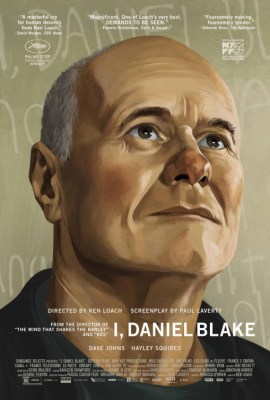
i-daniel-blake“This doesn’t have to be your problem.”

The above is essentially a throwaway line in Ken Loach’s “I, Daniel Blake,” but it’s the one piece of dialogue that stuck with me throughout. The global rise of far-right politicians and policy remedies has threatened longstanding social welfare structure, and this is likely a much scarier development in Europe, where these programs are much more deeply ingrained. In this time, what constitutes a problem, and for who?

Loach has long been an empathetic chronicler of people relegated to the periphery of central institutions in their lives – family, city, nation. By involving us in their marginalized or overlooked stories, his cinema makes the case that a problem caused by our societal arrangements is not just a problem for one person. They are a problem for all of us, and by taking society at face value, we sign off in support of these issues.

“I, Daniel Blake” takes an unsparing, unadorned look at austerity in England through the eyes of a man most likely to slip through a hole in the safety net. Dave Johns’ eponymous Daniel Blake is among the most vulnerable left behind by technological changes in the economy: a senior citizen losing his capacity to contribute physically and remains well behind the pace digitally. When a heart problem sidelines him from a construction job, Daniel must navigate the bureaucratic mess to collect disability leave … or is it unemployment? The system can never quite figure out what to do with him or what kind of checks he should collect.

Loach’s feelings about the red tape ought to be crystalline from the opening credits, which roll over a black screen during a dialogue exchange between Daniel and a welfare officer. She’s obviously reading from some kind of script meant to level the playing field by creating easily replicable standard talking points for each person she sees. To Daniel, however, this talk is demoralizing and as depersonalized as hearing words spoken by people we cannot see in the frame.

Read the rest of this entry »


REVIEW: Fire at Sea

17 12 2016

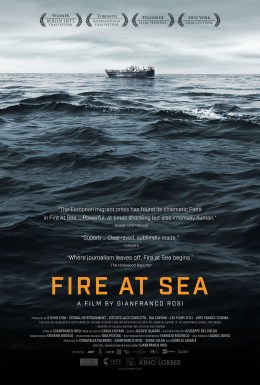
fire-at-sea“Cinema is a matter of what’s in the frame and what’s out,” Martin Scorsese famously said. I’ve had this quote saved in a document of quotes about cinema that I compiled when starting this site back in 2009. To the best of my knowledge, I have yet to deploy it in a review (though perhaps it popped up in a freelance writing assignment or academic paper). And, frankly, this is good news given that I grossly misconstrued its deceptively complex meaning for many years.

The truth of Scorsese’s statement seems self-evident. Of course these things make up the cinema. But the most important portion of this maxim reminds us that a director’s deliberate choices are not limited to inclusion. They also include exclusion, and we often forget to consider these decisions given the vast amount of things they chose not to do. Gianfranco Rosi’s documentary chronicle of the current refugee crisis, “Fire at Sea,” makes for an exemplary film to demonstrate this concept.

This verité chronicle of life on Lampedusa, an island off the coast of Italy that proves a hub for refugees making their way across the Mediterranean, shifts frequently between several centers of gravity. There’s the town doctor who treats locals and migrants alike. There are the migrants themselves, some of which we see but many of whom we simply hear over the radio systems of the boats sent to rescue them. And then perhaps most prominently, there’s the 12-year-old native child of Lampedusa, Samuele Pucillo. We see him the most, receiving an excess of information about his glasses, his schooling and his breathing problems.

Samuele’s life is important, and his struggles are not to be dismissed out of hand. But while watching “Fire at Sea,” it’s easy to wonder why he’s at the forefront so often. As we learn more about his life, we gradually begin to lose touch with the narrative of the refugees. That’s not an accident, oversight or some kind of unconscious bias guiding suspect editorial judgment. Rosi executes a brilliant Brechtian maneuver, making us aware of what we are seeing – and, by extension, what we are not. What’s left outside the frame, the refugees washing up by the boatload, is what we expect to be the real story.

I suspect many people, like myself, will watch “Fire at Sea” with the best of intentions and varying degrees of bleeding hearts. Rosi does not reward intention alone and refuses to let us emerge with a clean conscience. How many of us were able to compartmentalize the sufferings of Aleppo and let some small agitation in our own lives take center stage? Rosi isn’t interested in putting the refugee crisis into some kind of grand perspective. He just wants to make sure we are all aware of the current perspective in which we have chosen to situate it, whether it appears as some distant challenge or a problem in our own backyard.

Far too often in “Fire at Sea,” as in our media and greater public consciousness, the refugee crisis is out of the frame. It doesn’t have to be that way, and the first step toward changing that is to do more than just watch Rosi’s documentary. We must let it guide our thoughts so that it can then motivate action. B+3stars


REVIEW: Rogue One: A Star Wars Story

16 12 2016

Filmed entertainment in the “Star Wars” universe is valuable, expensive real estate – and I am somewhat skeptical that “Rogue One: A Star Wars Story” is a good use of it.  Admittedly, it is nice to see a film contributing something to a multiverse that isn’t a mere brand extension. But given that the events are a direct vamp up to the pre-determined beginning of the original 1977 film, what’s the point in spending two hours with characters working towards an outcome we already know? Why invest in them?

“Rogue One” has plenty to cheer on, not the least of which includes the thrill of watching the coalition of women and minorities successfully band together to defeat the fascistic empire-seeking men. (Do these things only happen in fiction now?) In a deftly constructed battle sequence to steal the plans to Darth Vader’s Death Star, they come together in an act of valiant sacrifice to save the galaxy. It’s a sight to see, though it does feel like a component or two has gone missing.

The rebel team of rivals, which includes the daughter of the Death Star’s architect (Felicity Jones’ Jyn Erso), a rebel intelligence officer (Diego Luna’s Cassian Andor), an Imperial pilot defector (Riz Ahmed’s Bodhi Rook), a blind Force-wielder (Donnie Yen’s Chirrut Îmwe) and his mercenary pal (Jiang Wen’s Baze Malbus), comes together over the course of “Rogue One.” Given the somewhat languorous speed at which their union occurs, one would think that this is a setup for multiple sequels, “Avengers“-style. By the end of the film, however, it’s quite clear that such is not the case.

So why does Chris Weitz and Tony Gilroy’s script take such a cursory approach to defining each of these characters? The threads they tie together by the final battle are quite thin. Jyn Erso leads her band of rebels into a daring maneuver with the call to action, “Rebellions are built on hope!” The line falls short of rousing because we know so little about her. We know even less about her companions. For all the vicarious inspiration “Rogue One” provides, it offers almost nothing in the way of personal connection and emotional investment. B-2stars


F.I.L.M. of the Week (December 15, 2016)

15 12 2016

Gideon's ArmyAva DuVernay’s superb documentary about America’s failing criminal justice system, “13th,” does an excellent job providing a high-level overview of race relations from Reconstruction to Trump. She masterfully ties together many threads and connects many dots, although DuVernay does admit that a limitation of her perspective is that she cannot do the deep dive that many subjects deserve.

In an interview with Film Comment, DuVernay listed a few documentaries that gave a feature-length treatment to a topic she had to brush over by necessity. One such recommendation was Dawn Porter’s “Gideon’s Army,” which she cited as a detailed look at how the system of plea bargains turns our prison system into a modern-day slavery. The film does shine a harsh light on how predatory penal practices puff up our incarcerated population, but it also does so much more.

“Gideon’s Army” is a testament to the selfless, tireless and often thankless work of America’s public defenders. These underpaid, overworked men and women are foot-soldiers of democracy as they fight on behalf of the accused that the state would rather strong-arm into a guilty plea. The laws make attempts to push back extremely difficult with mandatory minimum sentences that discourage defendants taking charges to trial. But these brave public defenders dare to climb uphill.

Porter might be the first filmmaker who makes an overloaded narrative enhance a film, which makes “Gideon’s Army” an obvious choice for the “F.I.L.M. of the Week.” We get to see how many plates the public defenders must keep spinning at a time – often 180 cases at once – in the fractured editing that never lets us spend too much time with a lawyer or client. Their defendants are both black and white, mostly young, and often times unsure of how the system works. The lawyers we observe sometimes have the herculean tasks of rebuilding trust in their office after a bad public defender bungled a case for their defendant.

We see their struggles along with the successes and failures that punctuate their continuous toiling. But after watching “Gideon’s Army,” it’s hard not to be incredibly thankful that there are public defenders who want to serve as more than a rubber stamp on the path from arrest to incarceration. It may come as cold comfort to the defenders themselves, yet this film turns viewers into supporters.


REVIEW: The Edge of Seventeen

14 12 2016

“I’m going to kill myself,” proudly proclaims the protagonist of “The Edge of Seventeen,” Hailee Steinfeld’s Nadine Franklin … as her first line. At such an early stage in the story, it’s hard to tell whether we should take her literally or seriously. By the end of the film, however, we get our answer: neither.

Pardon the brief soapbox moment, but teenage depression and even suicide are not matters purely relegated to the realm of fiction. I’ve known people who struggled after a tragic loss like Nadine’s (her beloved father at age 13), taken pain medications and seen therapists. Unfortunately, I’ve also seen a fair share who took their own life.

These are real issues that rarely get honest depictions on-screen, and writer/director Kelly Fremon Craig might have been wise to lean into them. Instead, Nadine is a character who gets all the narrative benefits of an outwardly depressed character while “The Edge of Seventeen” on the whole skirts responsibility for dealing with the seriousness of the problem. Craig bends over backwards to make sure we know that she’s not like regular teenagers, she’s a justifiably angsty teenager! Yet once it becomes clear that she really needs professional help, the film makes it all too easy for one kind act to lead to a personal revelation that turns back time.

It’s really too bad that “The Edge of Seventeen” lacks the teeth in its bite because Craig is unapologetic in making Nadine one of the meanest main characters in recent memory. She is incapable of leaving a conversation that she has not “won,” and if she cannot achieve victory on the strength of her own arguments, Nadine will kamikaze by lobbing a vicious insult. Around the point when she defeatedly declares, “I have to spend the rest of my life with myself,” I realized that she is essentially Anna Kendrick’s Twitter feed personified – just with double the self-loathing and half the self-aware charm.

Read the rest of this entry »


REVIEW: Neruda

13 12 2016

nerudaHouston Cinematic Arts Festival

2016 has been a great year for films that toy with the notion of genre; “Neruda” is the second from Pablo Larraín in this calendar year alone. Like “Jackie,” this is a work at war with the preconceived notion of the biopic. Although in this film, Larraín and screenwriter Guillermo Calderón seek less to redefine the genre so much as they desire to smash it.

This portrait of Chilean poet and political activist Pablo Neruda (Luis Gnecco) casts scant attention on his artistic achievements or his radicalization. If you wish to come away from “Neruda” knowing these things, you’ll have to head to Wikipedia while the credits roll. Instead, the film more closely resembles a police mystery with Gael García Bernal’s inspector Óscar Peluchonneau hunting down the fugitive Neruda. It’s a cat and mouse thriller, and the mouse is particularly elusive because he can shape-shift.

Neruda, ever the writer, confounds the search by essentially turning his life into a novel before our own eyes. Separating the truth from his narrative spin becomes trickier with each passing scene, especially because Neruda is quite a playful author. From the film itself, Peluchonneau comes across like a long-lost brother of Joaquin Phoenix’s Doc Sportello from “Inherent Vice.” Is that his actual persona? We’re not meant to know – or care.

I always understood the intended effect of “Neruda,” but Larraín’s insistence on keeping us at arm’s length proved frustrating. With such distance, the film feels like a cold intellectual exercise – something to understand but not involve yourself in. In the absence of any kind of connection or investment, the labyrinthine plot comes to tire by the end of the film. B-2stars


REVIEW: Manchester by the Sea

12 12 2016

manchester-by-the-seaEarlier this year, Richard Linklater’s “Everybody Wants Some!!” concluded an earnest moment of connection (slight spoilers – as much as that movie can be spoiled) with the protagonist, Blake Jenner’s Jake Bradford, describing his college essay’s reinterpretation of the Greek myth of Sisyphus. In his mind, the Sisyphean task of rolling a boulder up a hill only to have it roll back down, was not merely cosmic punishment. His eternal recurrence was instead an unintended cosmic gift that gives him a chance to find meaning and purpose.

No such solace or comfort can be found in the more straightforward Sisyphean tale told by Kenneth Lonergan in “Manchester by the Sea.” We meet his central character, Casey Affleck’s Lee Chandler, going through a series of repetitive toils in his work as an apartment complex’s janitor. Going from unit to unit, he fixes problems that residents could either fix themselves or avoid entirely. When not waiting hand and foot on tenants, Lee shovels the snow off the walkway to his basement dwelling, and the snow never seems to stay clear.

Lee Chandler is a modern Sisyphus of Massachusetts, a fate made even more distressing because he appears to have resigned himself to it. His percolating wit and acerbic banter with the people he must serve indicates an intellect far superior than the average sanitation engineer. If there is any upside to this situation, Lee willingly blinds himself to it.

As time passes and tragedy strikes the Chandler family tree with the young death of Lee’s brother Joe (Kyle Chandler), we come to possess a deeper understanding of Lee’s self-imposed exile. He is the ultimate embodiment of Catholic guilt, responding to a perceived lack of divine justice against a life-changing mistake by taking the role of punisher away from a seemingly absent authority. He enters into an existence of almost complete asceticism, not because he hopes to earn redemption but because he wishes never to escape the burden of his misdeeds.

Read the rest of this entry »