REVIEW: The Adderall Diaries

23 04 2016

The Adderall DiariesIf there were some prize to honor the busiest movies of the year, Pamela Romanowsky’s “The Adderall Diaries” would definitely be an early contender. In just over 80 minutes, the film juggles storylines like a poorly trained rodeo clown juggles clubs. That is to say, it does well for a while and then just kind of collapses to slightly humorous effect.

“The Adderall Diaries” is adapted from the memoir by Stephen Elliott, which served as a partial exorcism for the demons of his past, including a toxic relationship with his estranged father (Ed Harris) and just general malicious teenage tomfoolery. As such actions are wan to do, they carry repercussions for Elliott into the present that make him unreliable to meet publication deadlines, reckless in personal relationships and inexplicably drawn to a murder trial in which a husband (Christian Slater) supposedly killed his wife.

The action ebbs and flows from one story thread to the other, all reflecting back on the mess that is Elliott’s life. At its best, “The Adderall Diaries” recalls the impressionistic editing of Jean-Marc Vallée in “Wild.” More often, however, it recalls the kind of work produced by someone who forgets to take the titular medicine if prescribed. Not only is the sum less than the total of its parts, but those parts just never get the space to develop. C+2stars


F.I.L.M. of the Week (April 21, 2016)

21 04 2016

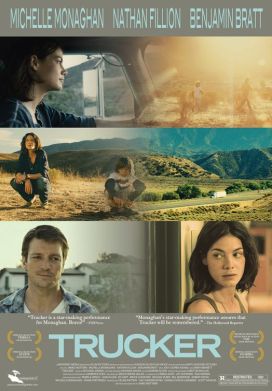
TruckerDo you ever stop and think about what could have happened in an actor’s career if they had caught the right breaks? If people had paid more attention to them when they were younger? (It’s a fascinating thought experiment, if you ever have the opportunity to daydream.)
In such an alternate universe, I wish Michelle Monaghan were a far greater star than she is today. And if not a star, at least she would be recognized for her vast array of acting talents. 2009’s “Trucker” might be for Monaghan what 2013’s “Short Term 12” was for Brie Larson – a showcase of tremendous ability that in turn serves as a valuable stepping stone towards wider renown.

The film, written and directed by James Mottern, does not necessarily bring much new to the table. Its story of an adult reluctantly assuming the duties of parenthood is something we have seen before. But the kind of selfishness and feet-dragging displayed by Monaghan’s character, the titular truck driver Diane Ford, is the kind usually portrayed by deadbeat dads.

Mothers usually must stay strong and unfailing in their love or face vilification. Mottern refuses to do that, letting Diane crave what any person being wants – a space to relax, a moment to breathe, an iota of satisfaction – without passing judgment. That quiet dignity and soft-spoken feminist angle on a traditional domestic drama gives “Trucker” just enough edge to put it in “F.I.L.M. of the Week” territory.

Monaghan matches Mottern’s tenor beat for beat, constantly spitting in the face of conventional moments for either demonization or lionization. Diane is not there as an object for our scorn or admiration. She is just fully human like us – probably a little more selfish than selfless, more stubborn than sociable. Diane does not move towards reconciliation with her son, forgiveness from her ex-husband (Benjamin Bratt) or love with her platonic pal (Nathan Fillion). She just moves from day to day, taking life like it is.

Sometimes, that’s nice. Sometimes, that’s the best way to really understand the experience of someone else.


REVIEW: Eye in the Sky

20 04 2016

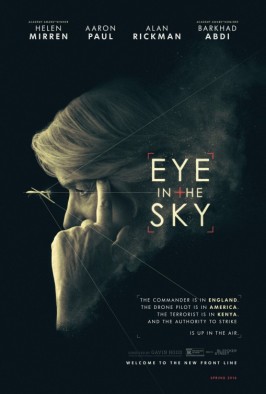
Eye in the SkyMore than a mere morality play, Gavin Hood’s “Eye in the Sky” displays an impeccable representation of how we fight now, particularly in the later years of the Obama administration. The film goes farther than the largely character-based drama of Andrew Niccol’s 2015 drone-related flick “Good Kill,” demonstrating both the individual and the collective effects of conducting warfare on a screen in a remote room.

“Eye in the Sky” mostly depicts a single mission conducted as a collaboration between the United States, United Kingdom and Kenya. Together, their militaries scope out Al-Shabaab terrorists from an unmanned aircraft flying high above the ground. From this vantage point, they scope out a large quantity of explosives getting ready to leave a safe house – attached to the chest of a suicide bomber.

The decision to strike seems like a no-brainer to British Colonel Katherine Powell (Helen Mirren). Even though they started tracking a citizen-turned-extremists for the purpose of capture, the clearly observed threat raises the stakes. Her position far from the battlefield would seem to make her, as well as her superiors, more likely to make the informed and rational decision. Yet with all the details they can observe, they also see their potential collateral damage up close and personal: a young girl, unrelated to the terrorists, sent out to sell bread in the streets.

Rather than take swift action, everyone now tries to kick the can up the road to their supervisor or boss. No one wants to be the last voice or the final finger on the trigger with a child likely to die as a result. In scenes of rapid succession that resemble a one-act play more than a film, Guy Hibbert’s script depicts a kind of bureaucratic nightmare unfolding in real time. Eventually, “Eye in the Sky” takes on the tenor of “Dr. Strangelove“-esque farce.

Read the rest of this entry »


REVIEW: Hardcore Henry

19 04 2016

The vicarious thrill-ride and emphasis on spectacle over story are just two aspects of video games that seem to have infected the contemporary action movie. Yet very few, if any, can commit to maintaining the first-person aesthetic so prevalent in the format. At least, that is, not until Ilya Naishuller’s Hardcore Henry.”

The film takes its viewers on a wild ride through a strange Russian criminal underworld through the eyes of Henry, a man saved from death thanks to the installation of a few cybernetic limbs. Though he lacks the mental capacity to fully understand what this means, it makes him into a ruthless killer – essentially a human weapon.

“Hardcore Henry” is best understood – no, best felt – as a visceral experience. Though what it replicates is less the effect of playing a video game and more a kind of “Cloverfield”-style nausea. With perpetual off-balance motion, the film recalls the sensation of being a fumbling, stumbling drunk more than it gives the feeling of being an assassin. Its GoPro-shot immediacy also does the video quality few favors, summoning memories of YouTube videos more than any kind of cinematic adventure.

Furthermore, the authenticity of the mad rush of blood to the head gets consistently undercut by Naishuller’s visible artifice. When assuming the identity of an avatar with their joystick, gamers get a level of continuity. Essentially, their play only gets interrupted by the end of a round (or by pausing the action). In “Hardcore Henry,” however, the action gets spliced up like a “Bourne” film, and each cut only serves to showcase the limitations of the technology Naishuller and producer Timur Bekmambetov tout as being so awesome.

But those gamers need not worry, as “Hardcore Henry” panders to them even more obviously than “Deadpool.” Women are little more than sex objects; at one point, their subtitled dialogue overlaps as if to suggest that one female is indistinguishable from another. Bloodshed and murder take place at gratuitous levels, enough to raise the possibility that its creators have little to no regard for human life. At least in the films of someone like Tarantino, gore goes in purpose of themes or characters. “Hardcore Henry” just revels in raking up a body count because it can. Naishuller’s innovations here are worth exploring – mainly so they can be improved. B-2stars


REVIEW: Elvis & Nixon

18 04 2016

Elvis and NixonDirector Liza Johnson has a tendency not to go for the easy laughs, perhaps even to the detriment of the films. In 2014’s “Hateship Loveship,” she almost never allowed Kristen Wiig’s pathetic protagonist to become the butt of the joke, even as she gets mercilessly pranked by a child half her age. Similarly, in “Elvis & Nixon,” the first name mentioned in this meeting of the minds seems ripe for humor at the expense of his larger-than-life persona.

Yet the comedy never really comes out of what feels like an easy farce. Johnson opts for a tone more dramatically oriented where the laughs feel incidental, not the very foundation of the film itself. She deserves a certain amount of respect for taking a more difficult path, but the question of “why?” does loom rather large. “Elvis & Nixon” is a glorified made-for-TV movie (perhaps not coincidentally, Amazon Studios is handling the film and giving it a relatively half-hearted theatrical release) which goes for entertainment value over thematic articulation each chance it gets. Her will for the film seems to clash with its essence.

Johnson seems to genuinely care for the characters, particularly Elvis Presley, played by Michael Shannon in the same way Michael Fassbender portrayed Steve Jobs: conceptual over essential. Sideburns and sunglasses might be his get-up, though Elvis is a walking meditation on celebrity more than anything else. For reasons that seem partially out of genuine concern and partially out of a “Make America Great Again”-style quest for greater societal repute, Elvis decides he wants to become a Federal Deputy At-Large to crack down on the drugs messing with kids’ minds. To do so, he feels the need to engage President Richard Nixon, performed by Kevin Spacey as a variation of Frank Underwood that spent significantly less time on the row machine.

The film is essentially just the lead-up to their meeting and then the meeting itself, nothing more or less. It’s simple and to the point, which proves both a strength and a weakness. Strong when considering how streamlined the whole operation is (“Elvis & Nixon” runs a slender 86 minutes) yet weak when contemplating all the threads of minor storylines that never get the development they deserve.

This is mainly disappointing for Alex Pettyfer, an actor in the midst of mounting a comeback after on-set drama with “Magic Mike” got him blackballed in the industry. As Jerry Schilling, Elvis’ right hand man, he must learn the consequences of his loyalty as they place a great strain on personal relationships. Too bad the film grants him such second fiddle status that his struggles feel inconsequential in the grand scheme of the narrative. B-2stars


REVIEW: The Jungle Book

17 04 2016

I do not have a strong attachment to the 1967 original Disney animated film “The Jungle Book.” I do not have strong feelings one way or the other about Jon Favreau’s 2016 live action Mowgli/CGI animal version of “The Jungle Book.” I remain, for the most part, fairly ambivalent, unable to summon strong words to praise or condemn any aspect of the film. And that makes for the hardest kind of review to write.

Might as well start with the good: Bill Murray as Baloo. The actor has become a cult figure over the past few years for his erratic and endearing off-screen behavior (as well as for his partnership with hipster darling Wes Anderson). When not acting inside one of Anderson’s dollhouses, Murray’s iconography can often overcome the project in which he participates. That film becomes “The Bill Murray Show,” for better or for worse. Favreau finds a happy balance of letting Murray entertain while also ensuring that he never distracts too much.

The CGI is quite good, I suppose, yet should we not be asking for photorealism from all movies these days? Call me a child of the digital age, but I only tend to notice computer animation when it goes horribly wrong. The graphics impress, though not to the extent that they truly wow.

“The Jungle Book” glides along on lots of charm and slickness, which gets it decently far. Mowgli (Neel Sethi) makes for a rather bland protagonist, one we mostly follow for the talking animals he encounters along his reluctant and perilous journey to rejoin his human companions. The episodic nature of the plot makes it hard for momentum to build, which is something that does not bother me in particular though seems an odd choice for a film pitched at youngsters. The message of cross-species cooperation to raise and protect someone who might be a predator is – timely, I guess? (“Zootopia” did it better.)

There is a lot going on, although there is simultaneously not enough going on. I could try to resolve or reconcile my feelings, but I would rather just leave them be. Other films just seem more worthy of that time. B2halfstars


REVIEW: Midnight Special

9 04 2016

SXSW Film Festival

NOTE: This piece is adapted from a piece I wrote for Movie Mezzanine at SXSW comparing “Midnight Special” to Richard Linklater’s “Everybody Wants Some!!”

Midnight Special” owes a great debt to widely recognized commercial filmmaking styles of the 1980s – chiefly, Steven Spielberg and John Carpenter. Nichols makes no secret of his artistic touchstones for the film, even ribbing before the SXSW premiere screening that the poster “shamelessly rips off Spielberg.”

The film has many thrilling and breathtaking moments that deserve recognition as creations of Nichols’ and his creative team in their own right. Several crew members stuck with him through many projects for the past decade, which saw the director make the leap from $250,000 indies to $20 million studio fare. In his fairly unsubtle homages to films like “Close Encounters of the Third Kind” (which was released in 1978, to be fair), “E.T.” and “Starman,” Nichols grants them a kind of aesthetic supremacy in his yearning for the paradise lost of this post-New Hollywood era.

This very specific window of studio filmmaking, after the “Movie Brats” took power but before the dawn of nonstop CGI interference, found a satisfying balance between artistic integrity and audience satisfaction. Nichols employs his post-“Mud” goodwill to attempt a return to such a happy median, injecting the American indie sensibility into Spielbergian conventions of storytelling and presentation. He favors suspense over scares and restraint over excess, in everything from Adam Stone’s measured cinematography to David Wingo’s affecting score.

These interventions revise – and perhaps even formalistically improve upon – the foundations of ‘80s commercial cinema. But the vague plot and characterization, along with the more complex tonalities, are to “Midnight Special” what the non-animatronic monster was to J.J. Abrams’ “Super 8.” That is to say, these aspects appropriated from modern filmmaking belie the original films being referenced and just throw into stark relief how the new creations are not like their forbearers.

Read the rest of this entry »


REVIEW: Demolition

8 04 2016

DemolitionDirector Jean-Marc Vallée might not receive an editing credit on his latest film, “Demolition,” but his fingerprints are as visible in the rhythm as they were in “Dallas Buyers Club” and “Wild.” (Vallée was credited under the pseudonym John Mac McMurphy for the two films, which he also directed.) In many ways, the effort feels like the closing of a loose thematic and visual trilogy for him. Each film replicates the emotional landscape of a character who gets shaken up by the realization of their own mortality and thus makes a drastic course correction in their own life.

For Jake Gyllenhaal’s Davis Mitchell, that abrupt discovery comes about when his wife dies tragically in a car accident – while he, in the passenger seat, escapes virtually untouched from the wreck. The cliché that normally follows such a traumatic event is the overwrought, grief-stricken husband schtick. “Demolition” goes in the opposite direction. Davis feels absolutely nothing. That’s not to say he feels hatred of his late wife or excitement over her passing (a la “About Schmidt” or, heaven forbid, “Dirty Grandpa“). He’s just numb.

Vallée does not shy away from the challenge of portraying such entropy and attempts to replicate that sensation of feeling desensitized and unresponsive to all the cues that one’s surroundings can throw. In “Demolition,” that looks a lot like destroying the “scene” as it is commonly known. Shots bleed into each other, but they also break off mid-thought and even jump wildly to a tangent. Each successive time Vallée has employed this impressionistic style, it becomes less a service to the story and more of a replacement for it. In other words, reactions likely vary based on feelings towards the character or story.

Read the rest of this entry »


F.I.L.M. of the Week (April 7, 2016)

7 04 2016

IdiocracyA new subgenre of criticism seems to have spouted up in the past few months eager to find things in culture and society to blame for the rise of Donald Trump. To be fair, I too have given him consideration on my site, but it has taken on the tenor of looking at things that might explain his popularity rather than directly cause it. A look back at the cinema of the ’00s shows various prescient takes on the underlying issues in America that have recently bubbled to the surface: xenophobia, nationalism, authoritarianism, and anti-intellectualism.

Few distill these into a frightening, humorous essence as well as Mike Judge’s “Idiocracy,” however. This comedy played as ridiculous when it was released in 2006; its studio, 20th Century Fox, regarded it as such and unceremoniously dumped it in theaters with no fanfare. But in the decade since, it becomes less and less like an imagined portrait of America and more like a plausible future. Such eerie insight, roughly as it might be presented, makes it a fitting selection for the “F.I.L.M. of the Week.”

To say too much about how “Idiocracy” hits the nail on the head would only ruin its considerable pleasures for those yet to experience the film. Judge remarkably shied away from the easy targets of the time, choosing to satirize some less obvious culprits in the dumbing down of the country. He digs into demographic trends in population and education level to find the fault lines in society. He examines the cumulative effect of the “infotainment” dominating the news media. He takes corporate influence over the government to its logical extreme.

For Luke Wilson’s Corporal “Average Joe” Bauers, a man chosen for cryogenic freezing then unceremoniously forgotten for 500 years, this strange world of 2505 seems completely foreign. Yet even from a vantage point just 10 years ahead of when Joe gets frozen, this dysfunctional America hardly seems implausible. There are almost too many ideas packed into the running time of “Idiocracy,” so many that each issue gets a slightly cursory examination. If only Judge had the budget or the time of, say, a miniseries to really unpack his social critique. Sequel, anyone?


REVIEW: The Boss

6 04 2016

Picture this: a highly successful businessperson, who augments the public’s perception of their wealth by doubling as a skilled entertainer, needs to bounce back after suffering some public humiliation.

This person enters a field knowing little about the profession but finds a way to prosper by exploiting complacency, deriding rivals with unwarranted personal attacks and even inciting violence.

The captain of industry boasts about cruel implementation of shrewd business tactics and remains unfazed when compared to totalitarian rulers.

(Oh, and this individual’s distinctively styled hair never gets dented.)

Did I just describe Donald Trump or Michelle Darnell, the lead character of the new film “The Boss” played by Melissa McCarthy?

The two larger-than-life figures share quite a few similarities, though McCarthy (along with co-writers Ben Falcone and Steve Mallory) could not possibly have known that her burlesqued portrayal of a corporate mogul would hit the marketplace at the same time as an equal ludicrous figure marched towards the nomination of a major political party. Literally, production ended on “The Boss” two weeks before Trump made the infamous escalator announcement. The ill-fated timing of its release makes it play like an inverse of “Zootopia,” this year’s most fortuitous arrival.

The odd parallel here and there between the fictional and the absurd business tycoon is not necessarily bothersome. And, in the interest of fairness, Donald Trump did not spend five months in jail for insider trading like Michelle Darnell. But a line feels crossed when she declares, “We’re participating in the American Dream!”

Out of context, this might seem harmless. However, Darnell utters it right before an all-out brawl takes place between her group of entrepreneurial thugs and the Girl Scout-like troop from which they disaffiliated. How can one find humor in the perversion of the American Dream on screen when a demagogue is ushering in a national nightmare in reality? Charlie Chaplin’s “The Great Dicator” showed that comedy had a definite place in a time of bullying leaders, though it ought to contain some confrontational element if it is to be anything more than a diversion. “The Boss” comes across as oblivious in regards to the implications of its dull satire.

Read the rest of this entry »


REVIEW: 21 Years: Richard Linklater

5 04 2016

21 Years Richard LinklaterWhen the folks assembling the Criterion Collection edition of “Boyhood” go scouting for bonus features (and apparently this is happening), I hope they include Michael Dunaway and Tara Wood’s documentary “21 Years: Richard Linklater.” Such is really the best location for an anecdotal and borderline hagiographic tribute to the perennially underappreciated director.
The directors do not necessarily cast his work in a new light or uncover latent themes running through his filmography. “21 Years” is simply a magnificent feting of Linklater as told by the people who love him the most, both collaborators and contemporaries. Linklater is noticeably absent from the proceedings, talked about but never speaking for himself.

But even without a particularly revelatory angle, Dunaway and Wood still find ways to delight, amuse and enlighten with “21 Years.” Want to know how Linklater gets such natural sounding dialogue while also maintaining a high degree of precision? Let his actors tell you an amusing story about how they got cooly chided for veering off script. Curious about Linklater’s casting instincts? Listen to Anthony Rapp or Zac Efron recount how the director believed in them when they did not necessarily believe in themselves.

The portrait sketched is one of a gentle, unassuming yet visionary artist. So maybe with a little more vision, “21 Years: Richard Linklater” would be the celebratory toast he deserves. But even absent that, it’s a worthy explainer and salute that would be all too perfect directly before or after one of the director’s masterpieces. B2halfstars


REVIEW: Miles Ahead

4 04 2016

Miles AheadNew York Film Festival, 2015

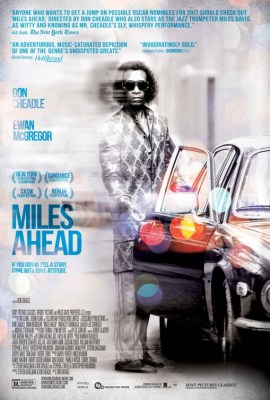
Biopics, particularly those chronicling musicians, tend to follow predictable patterns surrounding a rise from obscurity filled with pitfalls and setbacks. With judgments of quality momentarily tabled, Don Cheadle’s “Miles Ahead” deserves some credit for avoiding the traditional structure. The film, which captures the spirit of jazz great Miles Davis, does not resemble the jagged line of the normal genre piece. Instead, it feels like a series of jagged glass shards, presenting themselves for reassembly.

The form matches the subject quite nicely; Davis, in the film’s later timeline, appears wonked out from drugs and chronic pain. The shifting back and forth with little straightforward logic reflects his mental state. But the freeform flow of the film also mirrors Davis’ craft. “Miles Ahead” recalls the riffing and improvisation of jazz – or, as Davis himself was prone to call it, “social music.”

Content-wise, however, Cheadle’s film is not nearly as impressive. Davis says, “Change it up!” Ironically, “Miles Ahead” rarely heeds that advice and shows history repeating itself again and again. Per usual, the cross-cut stories do ultimately manifest their similarities. Yet along the way, the film somehow dabbles in a heist film-cum-buddy comedy as Davis and Rolling Stone reporter Dave Braden (Ewan McGregor) track down a stolen session tape together. The arrangement may not be familiar, but the notes played in the film certainly are. B2halfstars


REVIEW: City of Gold

3 04 2016

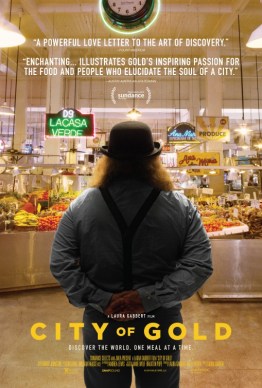
City of GoldThe temptation for foodie-oriented flicks, be they fictional like “Chef‘ and “Burnt” or documentary like “Deli Man” or “Jiro Dreams of Sushi,” is to indulge in food porn. The director as professional Instagrammer sensibility gets especially enflamed around a delicious dish of well-plated grub.

So color me pleasantly surprised that documentarian Laura Gabberts seems more interested in sumptuous displays of the prose of her subject, Los Angeles Times food critic Jonathan Gold, than the delicious tacos on which he chows. Her film, “City of Gold,” provides a deeper glimpse into the titular figure than his columns can provide. Of course, to read a writer’s words is to know the writer. (At least I’d like to think so.) But by training her camera on Gold as he drives to his next taco truck, she gets him to open up on the thematic threads that run latently through his work.

Gold typically eschews the stuffy five-star restaurants so that he can explore the cuisine of the streets. He flocks to hole in the walls, strip centers and mobile eateries. For him, food is not mere sustenance, nor is it empty consumption. Food serves as a manifestation of our culture, and if journalists and critics wrote only about the spots easily offered up by well-funded PR machines, they would not be doing their jobs. Instead of serving as advocates or crusaders for the best there is to offer, such a form of criticism just serves to reify a pay-to-play world.

As Gold constantly seeks to find the pulse of Los Angeles, he travels out to suburbs and ethnic communities in order to get a sense for how their cuisine reflects both the city and the nation in microcosm. For all those who write criticism, food-related or not, “City of Gold” serves as a reminder call for best practices along with a master class on par with a portion of A.O. Scott’s book “Better Living Through Criticism” or the Roger Ebert documentary “Life Itself.” Everyone else will likely take away a deeper appreciate not only for what critics do but also the ways in which criticism as a medium of expression works on them. B+3stars


REVIEW: Remember

2 04 2016

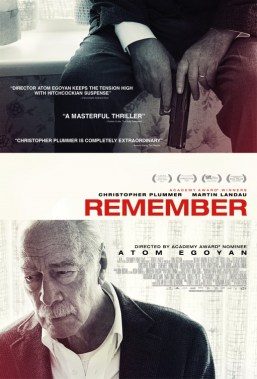
Remember“As I speak to you now, the icy water of the ponds and ruins fill the hallows of the mass graves, a frigid and muddy water, as murky as our memory.” These words come from the powerful closing monologue of Alain Resnais’ seminal 1955 documentary short “Night and Fog,” one of cinema’s first attempts to grapple with the Holocaust. It may seem hard to believe from our 21st century vantage point, but there was a time when our culture seemed in danger of turning its back on the horrors of the Nazi’s brutality and ultimately forgetting the sights of the concentration camps altogether.
In the past two decades, films as varied as “Schindler’s List,” “The Pianist” and “Son of Saul” all made cases for how culture and film can help us understand these events by reliving them. Spielberg, especially, pleads for collective remembrance, even going so far as to bleed the fictional representation into a then-present day verité scene.

Atom Egoyan’s “Remember,” as the title implies, is a film about memory. Specifically, it follows Christopher Plummer’s dementia-riddled Auschwitz survivor Zev Guttman as he embarks upon a quest to identify Nazis who assumed the identities of exterminated Jews to sneak into America. The film’s tension comes just as much from the lapses in Zev’s memory as it does from each stop on his cross-country journey to visit the many men assuming the alias Rudy Kurlander.

But in the world created by screenwriter Benjamin August, the act of remembrance is not a central thematic concern. It is the pretext for a revenge thriller. He misses an opportunity to use fading memory as more than a plot device. Remembering what happened in the Holocaust is perhaps more important than ever in a time where a new generation will never personally encounter survivors and a leading presidential candidate wavers on disavowing an unrepentant racist who wants to rehabilitate the image of Adolf Hitler. Many blame genocides in Syria and Darfur on our cultural amnesia. Might it strike again, if we are not vigilant?

August and Egoyan are free to make whatever movie they want. But why bother dredging up such loaded historical material only to produce a standard-issue genre flick? Art can be equal to the challenges of our times. We should not let those works content to stay disengaged off the hook so easily. C+2stars


REVIEW: I Saw the Light

1 04 2016

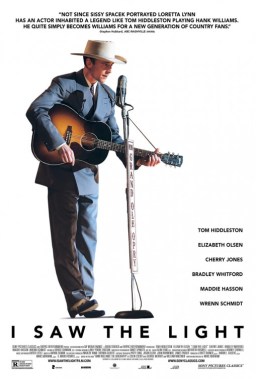
I Saw the LightIf the biopic of Hank Williams is to be believed, he saw the light when his first-born child entered the world. (We know this, of course, because he sang it.) Around this time in the film, I found myself wishing I saw a different kind of light – the one at the end of the tunnel, if that tunnel were the interminable film “I Saw the Light.”

Marc Abraham begins the film with a long take that circles around Tom Hiddleston as he introduces us to his take on Williams through music: an a capella rendition of “Cold, Cold Heart.” (Conspicuously, his voice lacks that deep Southern drawl that so defines the Williams sound.) He rest firmly in the spotlight, though the camera angle obscures his face until the very end of the song. Ironically, the introduction provides a perfect encapsulation of the film’s flaws.

“I Saw the Light” places its subject front and center, but Abraham never really finds a satisfying angle through which to analyze him. As a performer, his chief adversity is … convincing people to get over the fact that he holds onto notes for too long. As a person, he is guilty of … philandering, like far too many musicians depicted on screen. At one point, seemingly out of nowhere, it is revealed that Williams struggles with alcoholism to a point of self-endangerment. One aspect, isolated and explored with gusto, might have helped the film gain some footing. Without such focus, it flounders.

Often times, biopics lacking a strong directorial hand or a definitive angle can find salvation in a strong lead performance. Yet Hiddleston, charming as he can be, just never quite gets comfortable as Hank Williams. The film clearly values veracity as it awkwardly intersperses documentary-style interviews with Williams’ manager (Bradley Whitford), but the central performance never quite registers as an adequate facsimile for the real thing. C2stars