F.I.L.M. of the Week (November 7, 2014)

7 11 2014

Headhunters

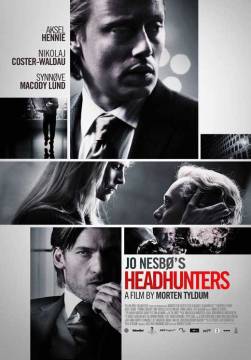
Professional rivalries often run cold, but rarely (save perhaps “Passion“/”Love Crime“) do they ever turn as dangerous as they do in “Headhunters.”  This compelling Norwegian action flick from Morten Tyldum, who has since turned in Oscar-worthy work on “The Imitation Game,” packs some true thrills into its 100 minute runtime.  The manner in which Tyldum provides this entertainment, however, is hardly derivative.

“Headhunters” is my pick for the “F.I.L.M. of the Week” (as a reminder, that’s First-Class, Independent Little-Known Movie) because it’s the rare genre film where action sequences bolster the plot rather than replacing it altogether.  Tyldum directs the violence to advance the film’s core conflicts; it’s not just there to inspire agape reactions at an impressive effects reel.

Even though things escalate quickly, “Headhunters” never loses its grip on reality (a la every recent Liam Neeson movie).  The film begins with its figurative corporate headhunter, Aksel Hennie’s Roger Brown, compensating for his small frame with an expensive house, a dime of a girlfriend … and a side habit of stealing art to sustain it all.  One job swindling his client Clas Greve (Nikolaj Coster-Waldau) gets Roger in a little too deep.  All of a sudden, he finds himself entangled in a disastrous web with people who take on his job title in a much more literal sense.

What ensues is an action movie as it should be done.  “Headhunters” has actual stakes that feel real to all the participants, especially during its violent segments.  Tyldum requires attention in these interludes, too, because they are more than just a momentary obstacle to the inevitable triumph of the hero.  They are human clashes that could go any number of ways.  Now that is excitement.


REVIEW: The Monuments Men

6 11 2014

The Monuments Men

On paper, “The Monuments Men” sounds like a movie that could be not only exciting entertainment but also great intellectual resonance.  The premise of the film, following a ragtag band of brothers assigned to save Europe’s greatest artworks from Hitler’s grasp, promises all the action of a World War II flick and a potent reminder of the vast importance of art.

Yet somewhere between the concept and the screen, George Clooney’s film takes its eye off the prize.  What he pulls together is rather disappointing given all the impressive elements at his disposal.  “The Monuments Men” is not necessarily a bad movie; it’s just a shockingly unsubstantial one.

Nothing really seems to propel the film forwards, leaving it suspended in a state of sustained mediocrity.  Though Clooney assembles quite the prestige cast, including Matt Damon, John Goodman, Jean Dujardin, and Bill Murray, he rarely lets them play off each other as an ensemble.  From the outset, they split up in pairs on separate missions, inhibiting attachment and fracturing the narrative.

Obviously, a film steeped in history should try to model its narrative based on the actual events (although that rarely stops movies these days).  But there had to be some way for Clooney and co-writer Grant Heslov to spice up the script without deviating too far from the facts.

Honing the focus, like picking a central character to follow with dedication, might have been helpful.  “The Monuments Men” has no shortage of amusing supporting characters yet no driving leading force.  At times, the film just feels like a series of short films and amusing moments tied together into one bland, bloated two-hour feature.  C+2stars


REVIEW: I Love You Phillip Morris

5 11 2014

i_love_you_phillip_morrisIn his opening monologue at the Golden Globes in 2011, Ricky Gervais quipped, “Not nominated, ‘I Love You Phillip Morris,’ with Ewan McGregor and Jim Carrey, two heterosexual actors pretending to be gay.  The complete opposite of some famous Scientologists, then.”  I have nothing to say about said couch-jumper, largely because I’m not trying to get sued or anything.

But I do have plenty to say about the two straight actors playing gay.  Jim Carrey and Ewan McGregor were, quite frankly, borderline offensive in “I Love You Phillip Morris.”  They play the broadest, most stereotypical feminine and weak homosexuals I could possibly imagine.  It’s these types of characters and performances that are undermining any sort of progress towards a more equal and accepting world.

Carrey’s idea of playing gay is to be the most over-the-top, female, scenery-chewing performer in the history of cinema.  He has succeeded in doing exactly what he set out to do, at devastating effect (for all the wrong reasons).  It’s as if he’s merely one of his other characters from his outrageously physical career, but on acid.  To Carrey, homosexuality appears to be a sort of affectation, trivializing it in the process.  McGregor is slightly better, but not by much as the bizarre energy of Carrey ultimately rubs off on everyone else.

The whole movie is just strange.  It’s a major misfire for Glenn Ficarra and John Requa, the directorial team who gave us the hilarious and inspired “Crazy Stupid Love” after this disaster.  They take a tale that should be played as a tragedy and spin it into a comedy, largely at the expense of criminals and homosexuals, who take the brunt of the jokes.

What’s so funny about Carrey’s character, Steven Jay Russell, a closeted homosexual who lives a lie with his wife?  What’s funny about him leaving her devastated with his revelation, running off to Florida living an absurdly extravagant lifestyle with a male lover?  What’s funny about that lover, played by Rodrigo Santoro (Paulo Poops-A-Lot from “Lost”), later dying?  What’s funny about him falling into a life of crime?

What’s funny about him finally meeting the love of his life, Ewan McGregor’s Phillip Morris, only to be separated from him?  What’s funny about several people being stricken with AIDS, a disease that has ravaged the homosexual community like a plague?  This has all the makings of serious, touching drama.  But Ficarra and Requa see it as a comedy, why?  Because it has gay people?  Why give them feelings, why give them heartfelt moments?

In “I Love You Phillip Morris,” humanity for homosexuals takes a backseat to letting them traipse around effeminately in an attempt to prey on horrible preconceived notions for humor.  I am wowed by the insensitivity of this movie from the directors to the stars.  C-1halfstars


REVIEW: Fury

4 11 2014

FuryThe “war is hell” thesis argued by David Ayer’s “Fury” is certainly nothing new under the sun.  But as the amount of viewers with personal connection to warfare dwindles daily, cinema must continue to provide this myth-making service to provide those images for our culture.  Ayer’s film serves as a reminder of the sacrifices that soldiers make as well as the brutality to which they are exposed on a consistent basis.
“Fury” begins at the end of the journey in 1945 Germany for a tank division under the leadership of Brad Pitt’s Don “Wardaddy” Collier, an equally red-blooded but less caricatured version of Aldo Raine from “Inglourious Basterds.” He commands a group of men who have all been visibly demoralized by fighting the inhumanity of the Nazis, particularly Shia LaBeouf’s world-weary Boyd “Bible” Swan.  His sobering nihilism marks the first clean break the actor has made from his goofy Louis Stevens persona, which has been an unwelcome legacy looming over all his work.

After one of their drivers is gunned down, the unit receives an unwelcome replacement in Logan Lerman’s green, babyfaced Norman Ellison.  Prior to stepping in the tank, his only experience of World War II had been from behind a typewriter doing clerical work.  Norman becomes the entry point into “Fury” as well as its emotional core, two roles that Lerman performs astutely.

Read the rest of this entry »


REVIEW: Art and Craft

3 11 2014

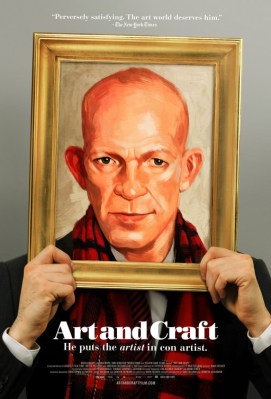
Art and Craft“Who’s the master, the painter – or the forger?”  Such was the question posed by Christian Bale’s Irving Rosenfeld in last year’s “American Hustle.”  A similar spirit of giving credit to those who can imitate as well as an artist can create forms the backbone of “Art and Craft,” a kooky documentary about one eccentric oddball.

The film follows Mark Landis, a truly gifted art forger whose counterfeit works fooled a number of galleries across the country.  He has no real malicious intent, nor does he intend to profit from selling the paintings.  In fact, Landis technically does not even engage in criminal behavior since he donates the works to museum as a gift.

The mysterious Landis, who speaks in a soft and nonthreatening murmur, provides quite an unusual yet fascinating subject for a documentary.  He’s a curious fellow, one that “Art and Craft” takes a good chunk of time to explore.  The film quickly moves beyond his schizophrenia and really tries to understand why he acts the way he does.  The directors make the key discovery that he views himself as an actor in a role, which might allow him to dismiss the moral consequences of his actions.

Surprisingly, though, Landis does not view himself as an artist.  All the curators who accepted his bogus pieces ought to be embarrassed to see that the man who bamboozled them is no scholar of the form.  In fact, Landis freely admits to having no knowledge of the tools or techniques used to create the originals that he rips off!

“Art and Craft” feels like the kind of human interest piece that would grab attention on a news magazine program and leave viewers craving a little bit more than just the few minutes of the segment.  The feature-length documentary provides plenty of additional information, which is fascinating to an extent.  The law of diminishing returns does kick in after a while, though, as additional insight adds marginal value to the piece.  Still, it’s a fun and worthwhile documentary, albeit one that might have been best realized as a short subject.  B2halfstars


REVIEW: Nightcrawler

2 11 2014

NightcrawlerThese days, it seems like a lot to ask for a movie to seriously tackle one topic with the requisite depth to provide satisfaction.  On that criterion, “Nightcrawler” more than succeeds with its blistering critique of the media.  Writer/director Dan Gilroy takes our present “if it bleeds, it leads” local news culture and absolutely skewers it, exposing the obvious immorality caused by its hunger for profits and ratings.

Jake Gyllenhaal’s Lou Bloom quickly moves from amateur to aesthete in his documentation of Los Angeles’ grisly, gory violence.  With each new recording, he learns how to best appeal to Nina Romina, Rene Russo’s particularly desperate station manager at KWLA.  She seeks footage akin to “a screaming woman running down the street with her throat cut” in order to jolt the station’s jittery suburbanite watchers, and Lou is eager to provide that material irrespective of any sense of ethics or decency.

This savage criticism alone would satisfy, yet shockingly, Gilroy is not satisfied with setting his aim on just that target.  Somehow, he manages to use “Nightcrawler” as a vessel for exploring a second major topic: extreme careerism.  The media is also a business where it takes more than whetting a certain appetite to advance oneself.  More than talent, it requires the marketing of oneself to a point where the line between self-promotion and shameless whoring disappears.

Though this Juvenalian satire happens to be moored to an excoriation of broadcast media, “Nightcrawler” could really be about anybody searching for lucrative employment in the business world today.  Gilroy writes Lou Bloom as the desperate post-recessional job seeker followed logically (and sociopathically) into absurdity.  Essentially, he gives us a Joel Osteen for the religion of capitalism, preaching the gospel according to LinkedIn.

Read the rest of this entry »


REVIEW: The Judge

1 11 2014

The Judge” tries to be a lot of things, among them a courtroom drama, a family drama, an illness drama, and a relationship drama.  It’s a shame that amidst all that action, seldom does the film manage to be any good.

It’s certainly admirable that Robert Downey, Jr. wants to convert his mainstream credibility into something of greater cinematic value.  But the effort is in vain as “The Judge,” which he and his wife Susan produced, bites off more than it can chew in nearly every aspect.  Their one genius move was bringing Janusz Kaminski, the cinematographer for Steven Spielberg’s last two decades of work, on board to give the film the sheen of prestige.  (Not as great a hire? Director David Dobkin, whose recent credits include “Fred Claus” and “The Change-Up.”)

Kaminski’s beautiful rays of ambient light flood every frame, but the beauty largely stops there.  “The Judge” meanders for the whole of its runtime – a bloated 140 minutes – without ultimately settling on any kind of identity.  Every time one of its subplots begins to pick up steam, the film inexplicably shifts gears to follow another one.  As such, momentum never builds, and “The Judge” just begins to feel like a life sentence.  One with lots of cloying montages set to Bon Iver.

Read the rest of this entry »


F.I.L.M. of the Week (October 31, 2014)

31 10 2014

My Country My Country

Despite what the N.R.A. might tell you about the upcoming midterm elections (“your safety depends on it”) or even Democratic Super PACs (“if you want to prevent another Ferguson”), there is relatively little danger or risk in a single vote here in America.  A voter, or even a bloc of voters, sitting out will a fairly small impact on the direction of the country.

But democracy isn’t always so clean and simple, as shown by Laura Poitras’ documentary “My Country, My Country.”  Her camera follows various stories unfolding around the first democratic elections in Iraq, which took place in January 2005.  In an interesting see-saw, Poitras features not just the U.N. peacekeepers working to ensure valid and sefe elections but also Dr. Riyadh al-Adhadh, an Iraqi candidate from the Sunni minority.

Poitras’ film is my pick for the “F.I.L.M. of the Week” precisely because of the latter angle on the story.  She shows a genuine care and concern for life on the ground in Iraq, one that is certainly unmatched by any documentary on the Second Gulf War that I have seen.  Riyadh, his family, and the people he hopes to represent are important to Poitras in their own right as human beings – not simply as a means to critique the United States’ involvement in the region.

From her essentially journalistic vantage point, Poitras captures the growing pangs of a new Iraq with clarity and circumspection.  Riyadh is fervent in his desire to have a democracy that represents all of Iraq, which thus necessitates Sunni participation.  But all around him, he finds a reluctance from likeminded members of his community to engage in the election.  These conflicts have no easy resolution, and Poitras leads us on a thought-provoking journey towards the cut-off point of “My Country, My Country.”  She had to stop recording at some point.  But, as we know, the story of democracy in Iraq is still ongoing…


REVIEW: Keep On Keepin’ On

31 10 2014

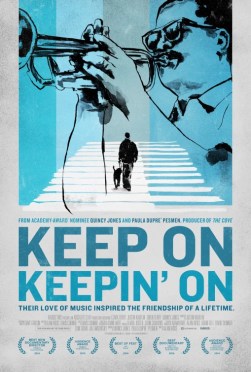
Keep On Keepin OnI have sat through more than enough leadership and mentorship training meetings and sessions in my day.  All the principles run together and become rather boring quite quickly.  So, in order to impart these values, I recommend all future seminars of this ilk just show the documentary “Keep On Keepin’ On.”
Al Hicks’ documentary shows the spirit of teaching and bequeathing one’s talents in joyous, uplifting fashion by focusing on an exemplary case study.  Over the course of several years, he shows a teacher-student bond that blossoms into the most heartwarming of friendships. His main subject, Clark Terry, is a now-nonagenarian jazz trumpeter who learned from Duke Ellington and made Quincy Jones the musician he is today.

In spite of his fading health and increasing fragility, Terry still prioritizes bringing up the next generation of jazz musicians.  As an instructor, he meets the young blind pianist Justin Kauflin, and the two form an unmatchable rapport as Terry himself has begun to lose his own vision due to diabetes.  Their sessions together, as recorded by Hicks, will often last into the wee hours of the morning no matter if Terry is at home or in the hospital.

By watching Terry’s purposeful guidance and inspiration, we have the privilege to see what the right kind of encouragement and care for others can yield.  He does it not for any sort of vicarious thrill or ego boost but rather out of genuine love of his art and its future.  And while it might not yield any particularly insightful revelations or break exciting new ground, “Keep On Keepin’ On” is a sweet and touching film to watch nonetheless simply because of the purity of Terry and Kauflin’s dynamic.  B2halfstars


REVIEW: Listen Up Philip

30 10 2014

Listen Up PhilipIf you were to put a gun to my head (but I hope you wouldn’t) and asked me to a name a novelistic film, I would most likely offer up “The Place Beyond the Pines.”  The rich detail provided in the hundreds of pages of text is usually translated into cinematic terms through depth and immensity of scope.  This is far from representative of all the capabilities of the novel, however.

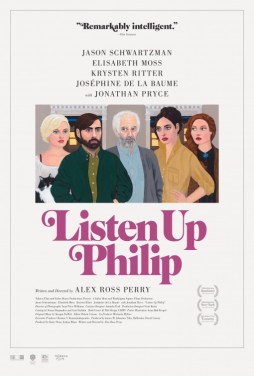
Alex Ross Perry’s “Listen Up Philip” might lack a sprawling canvas of time, yet it feels perhaps more novelistic than any film in recent memory.  It not only captures the content of the writing style, but it also manages to somehow resemble the form itself.  Perry’s consistent employment of voiceover to verbally elucidate the internal worlds of his characters as they trod a frustrating journey of self-actualization makes the experience of viewing akin to curling up with a book on the couch.

To be fair, “Listen Up Philip” is not quite a page-turner in the same way as a novel like “Gone Girl.”  If I was reading the story at my own pace, as opposed to having it told to me for an hour and 45 minutes, I don’t think I would be in any huge rush to see it through to the bitter end.  (Emphasis on bitter for this snarky scowler of a story.)  But the replication and simulation of the prosaic absorption process within a condensed period is certainly a worthwhile use of time.

And while the story is not even particularly innovative or enjoyable, Perry definitely aligns the nature of his plot with the tenor of his form.  It seems only logical that an ingeniously written and self-aware film would follow the misadventures of an ingenious and very self-aware writer.  Perry’s protagonist Philip (Jason Schwartzman) is Woody Allen meets Whit Stillman distilled into an entitled millennial novelist.  A semi-successful writer releasing his second book, Philip is forced to deal with the fallout from the clashes of his elephantine ego in both personal and professional settings.

Schwartzman, given the unjustly rare chance to take center stage, provides a potent mix of pretentious pedantry and embraceable anxiety.  Thankfully, though, the film also provides nuance and detail to the ensemble surrounding Philip.  This allows Elisabeth Moss and Jonathan Pryce to deliver rich performances as Philip’s exasperated girlfriend and his overeager older mentor, respectively.

“Listen Up Philip” takes all the grandiosity normally imbued in the passage of time in novelistic cinema and transfers it to the characters.  Letting personalities propel the proceedings is certainly nothing groundbreaking in independent film, but achieving it in this manner is definitely a less common treat.  B+3stars


F.I.L.M. of the Week (October 3, 2014)

3 10 2014

We Steal SecretsOscar-winner Alex Gibney isn’t called the hardest working man in documentaries without reason.  It’s not uncommon for him to churn out more than one feature-length film in a given year, and unlike Woody Allen, they all manage to be exceptionally good.  His first of two 2013 docs, “We Steal Secrets: The Story of WikiLeaks,” more than hits the sweet spot.
Gibney tackles the politically charged and highly controversial subject of Julian Assange and his WikiLeaks, a site committed to publishing information that powerful figures would rather be kept under wraps.  But unlike Gibney’s films tackling a pretty clear-cut right and wrong, such as his chronicle of Elliot Spitzer in “Client 9,” the ethics and morality of “We Steal Secrets” are incredibly murky.  This masterful steering through foggy gray area makes the film a perfect pick for my “F.I.L.M. of the Week.”

The documentary also provides a great blend of two very different narrative styles, the individual portrait and the issues-based landscape of their broader intellectual context.  Gibney gives us plenty of biographical information on Assange, shedding light on his background and thus allowing us to better make sense of him.  Yet even with all this knowledge, he still remains a question mark.  That is not to insult Gibney’s filmmaking but rather to complement it – he casts Assange as neither hero nor villain, simply a man who has made choices that we can interpret in a variety of ways.

As Assange fundamentally changes the nature of geopolitics, it is certainly a fact that he pushes the world in the direction of being more transparent.  Gibney fills “We Steal Secrets” with commentators on both sides of the privacy debate, with a passionate and well-informed case being made for each.  Ultimately, the choice of whether secrets are good, necessary, or justifiable is left up to the viewer.  And after Gibney’s powerful documentary, not forming some kind of philosophy is simply not an option.  One can only hope he has something similar in mind about Edward Snowden…


REVIEW: Her

2 10 2014

Writer/director Spike Jonze’s “Her” is an uncommonly thoughtful film, one that is lightyears ahead of what we can really even fathom.  Most works tackling the topics of technology and humanity are set in distant futures, yet they never seem to escape the mire of our present times.

“Her,” on the other hand, dares to imagine a world only tenuously related to our own.  Jonze’s vision is hardly disconnected from contemporary concerns, though.  It just requires us to adjust our frame of reference to imagine issues we may not have even contemplated.  As a result, Jonze is able to urge us to see the world differently – a very worthwhile way to wield the power of cinema.

In his unspecified future Los Angeles, Joaquin Phoenix’s socially isolated Theodore Twombly finds romantic companionship not in another human being, but rather in his OS, Samantha (voiced by Scarlett Johansson).  The soothing sultriness of her voice allays our concerns about intelligent computers, so we’re never worried about her turning into HAL from “2001.”  Instead, we can focus on the very unique insights their relationship yields about intimacy and emotional mediation.

All that we think we know is up for reconsideration in “Her,” even the very nature of love.  In the hands of many directors, this kind of existential revelation might leave us feeling depressed or hopeless.  But Jonze, with a respect for artificial intelligence and an optimism for the future that feels quite groundbreaking, deposits us at a higher ground of understanding that almost overrides any emotional response.

Read the rest of this entry »


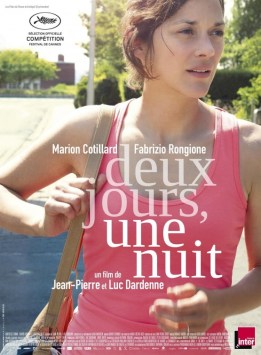
REVIEW: Two Days, One Night

1 10 2014

Two Days One NightTelluride Film Festival

In 1999, Jean-Pierre and Luc Dardenne arrived on the world stage of cinema in a big way with “Rosetta,” a film that won them the Palme d’Or at Cannes as well as global renown.  That story, which they both wrote and directed, followed its eponymous 17-year-old protagonist as she battles for self-survival in an unfeeling Belgian capitalist system.  In spite of all the setbacks she faces, however, Rosetta always summons the strength from within to get back on her feet and scrounge around again for a job.

Two Days, One Night” arrives from the brothers 15 years later, who once again take an out-of-work female as their subject.  Marion Cotillard stars in the film as Sandra, a struggling factory worker who learns she has one weekend to convince 16 coworkers to relinquish a bonus in order for her to stay on the company’s payroll.  Such a daunting task would seemingly shock anyone out of lethargy and into tenacious survival mode.

Yet when the Dardennes first introduce Sandra, she lies motionless on her side and is content to simply let an important phone call ring until it gets forwarded to voicemail.  Throughout the film, Sandra appears to believe that going to fight for her job is a futile waste of her time and energy.  Most of the push to continue the journey, in fact, comes from her rather saintly husband, Manu (Fabrizio Rongione).

Much of Sandra’s lack of confidence is explainable by her personal struggles with depression (that might be a generalized description of the specific condition afflicting her, which seemed to resemble bipolar disorder).  To focus solely on the personal, however, diminishes a whole world of social commentary in “Two Days, One Night.”  This is the second time that the Dardennes have placed the imminent possibility of joblessness in front of their central character, and the response that follows has shifted from powerful pugnacity to alarming apathy.

Read the rest of this entry »


REVIEW: The Skeleton Twins

30 09 2014

The Skeleton TwinsCasting Kristen Wiig and Bill Hader, two recent products churned out by the “Saturday Night Live” star-making factory, definitely leads to a certain set of expectations about what antics should follow.  So when “The Skeleton Twins” begins with two very serious suicide attempts by its leads, who play long-estranged siblings, all assumptions fly right out the window.

Yet that’s only where the reversals begin since co-writer and director Craig Johnson refuses to let his film devolve into angst-ridden or melodramatic clichés.  He charts a tricky tonal course but manages to navigate it seamlessly.  “The Skeleton Twins” is thus hard to categorize since it so effortlessly defies the normally clean-cut division between comedy and drama.

To label it a dramedy seems to miss the mark, too.  The serious and the sardonic do not merely coexist in “The Skeleton Twins;” they are interwoven to the point of being nearly indistinguishable.  The film’s closest blood relative might be 2007’s “The Savages,” which also concerned two acerbic siblings trading barbs over grave family issues.  Johnson finds humor not merely a relief to the film’s drama but rather a means for exploring its repercussions more thoroughly.

But really, to compare “The Skeleton Twins” to anything at all does it a disservice.  Johnson fashions something wholeheartedly organic with his film.  It is not beholden to any pattern or formula but rather to capturing the truths of existence.  With his detailed and nuanced portraiture of the two leading characters, Milo and Maggie, Johnson allows their specific aches and struggles to illuminate those that hit closer to home.

Read the rest of this entry »


REVIEW: The Conjuring

28 09 2014

Mass-produced horror series like “Saw,” “Paranormal Activity,” and “Final Destination” (with “Insidious” rapidly approaching supersaturation) tend to give the genre a bad name.  It’s hard to believe that, once upon a time, a horror film like “The Exorcist” could get a Best Picture nomination.

I certainly do not mean to draw a parallel that implies “The Conjuring” is equal in stature to William Friedkin’s aforementioned terrifying masterwork, nor am I saying that James Wan’s film was robbed of Oscar glory at last year’s ceremony.  I merely aim to point out that when done well, horror films can really be exemplary pieces of filmmaking.

Wan expertly utilizes filmic tools like sound design and cinematography to cast quite the spell with “The Conjuring.”  He’s interested in more than the quick “gotcha” of a jump-out scene.  The scares those generate, after all, generally tend to dissipate within seconds.  Wan’s filmmaking lingers with its eeriness, leading you to wonder when all the tension floating around will materialize into a nightmare.

His mission is also aided by a more than passable script, based on a true incident from the call of duty of demonologists Ed and Lorraine Warren.  Though hauntings, possessions, and exorcisms are old hat to most by now, “The Conjuring” never seems plagued by triteness.  If anything, the well-plotted and developed screenplay hampers Wan’s filmmaking through its sheer length and scope.

In the time between the film’s big scares, some of the tautness of the terror has a chance to loosen.  Taking ten to fifteen minutes out of the final edit might have made this one of the all-time greats.  Still, “The Conjuring” delivers where it needs to – and delivers big when the frights arrive.  B2halfstars