REVIEW: A Million Ways to Die in the West

2 06 2014

According to Seth MacFarlane, there are a million ways to die in the west.  Too bad not a one of them could have come to put me out of my misery while watching his dreadful new film.  It doesn’t just miss the mark of Western comedic great “Blazing Saddles;” MacFarlane pretty much misfires on laughs altogether.

A Million Ways to Die in the West” amounts to little more a bloated reel of MacFarlane kvetching about everything in his life.  At first, it just seems like a long-winded way of setting up the perilousness of the primitive civilization he intends to mock.  Yet after about 10 minutes, it becomes clear that MacFarlane is never going to shut up.  The experience becomes akin to being locked in a room with your annoying friend that can only speak in the form of complaints – for nearly two hours.

MacFarlane’s relentless pessimism is so pervasive that it overpowers the rest of the cast.  Only Neil Patrick Harris, cleverly employed here as a cocky cuckold with a finely-kept mustache, manages to entertain in the slightest with any wit.  Charlize Theron, as MacFarlane’s pseudo-love interest, coasts through the film on autopilot and never really sparks.  Amanda Seyfried and Liam Neeson are mentally checked out as well, but they’re playing such familiar roles that it really doesn’t seem quite as egregious.

Read the rest of this entry »


REVIEW: Maleficent

1 06 2014

What’s old must become new again in order to keep movie studios’ back catalogues fresh so they can earn money; thus, we end up with “Maleficent,” a reimagining of their “Sleeping Beauty” tale.  It’s a film that uses the same formula as “Oz the Great and Powerful” and then splashes it with flourishes from Tim Burton’s 2010 revisionist “Alice in Wonderland.”  It trots out the familiar mythology – only now in sleek CGI! – and then puts a few twists on it to justify the remake.

Analyzed in tandem with the Mouse House’s 2013 megahit “Frozen,” the film yields interesting insights into the psyche of Disney.  This marks their second straight tentpole that does not give the audience the expected male-female romantic ending, leaving them to ponder the many different forms love can take.  One can only wonder where these progressive messages will ultimately end.

But that’s about all the intellectual discussion I can pull out of “Maleficent.”  It’s a sloppily written film filled with feckless characters whose discernible motivations are few and far between.  The movie needlessly complicates the simple 1959 classic story, making it a slow plod.  And, from a perspective likely only depressing to me, it reduces great actors like Imelda Staunton and Lesley Manville to playing cartoonish fairies in a failed comic relief subplot.

What should be the star in absence of these elements, the visual effects, are even quite confused.  Scenes designed to showcase the work of artists who work in the medium of pixels are cluttered with details that don’t cohere for a unified look.  At times, the film resembles the Pandora of James Cameron’s “Avatar;” at others, Burton’s “Alice.”  The opening scenes resemble an illustrated children’s storybook … and then, there are 3 mo-cap fairies.  The whole collective vibe recalls a 2002 video game like “Kingdom Hearts.”

Read the rest of this entry »


REVIEW: Fed Up

20 05 2014

Fed UpFed Up” certainly trumpets its connection to the Al Gore lecture doc “An Inconvenient Truth,” which got plenty of people alarmed about the subject of climate change and (perhaps more importantly for marketing) won an Oscar. Stephanie Soechtig’s documentary, narrated by Katie Couric, does indeed offer many frightening reasons to get concerned about the obesity epidemic that has been plaguing America for the past 30 years.

Yet the impact is dulled by the film’s voracious desire to bite off more than it can chew.  It covers far too many subjects in its 98 minute runtime than it can handle, each feeling slightly less persuasive than the one before it.  The journey to her call to action is so exhausting that, ironically, it made me want to reach for some horribly fattening sweet treat from the freezer..

Soechtig wisely begins by breaking down the science of nutrition and obesity, shedding some helpful light on what is actually making our country fat.  A calorie is not just a calorie, and exercising to burn them off can only put a dent in the problem.  Many issues stem from the overconsumption of sugar, which is often hidden in processed foods by using confusing polysyllabic names as fronts.

The film then wades into the murkier grounds of politics and business, and the wheels begin to fall off.  At times, “Fed Up” resembles Charles Ferguson’s stellar documentary “Inside Job” with its fervent attacks on the dangerous intertwining of the two institutions.  Yet it lacks the zeal to really chide politics and business as usual.
Read the rest of this entry »


REVIEW: Lone Survivor

29 01 2014

There’s no sugar-coating or sanitization of the conflict in Afghanistan to be found in Peter Berg’s “Lone Survivor.”  His adaptation of Marcus Luttrell’s memoir of pulls no punches in its visceral portrayal of the unlikely triumph of one man over relentless enemies and harsh earth.

Despite the film’s ultimate resolution being implied in the title, the action is always gripping and engrossing.  Berg’s riveting handheld camerawork ensures that we’re buckled in to feel every moment leading up to the climax.  Every fall down a cliff, every bullet entry wound piercing flesh, and every last dying breath lands deeply in the gut with tremendous force.  When coupled with masterfully precise sound mixing and editing, “Lone Survivor” has the impact of a film like “127 Hours.”

It’s not all about the action, however.  Perhaps the biggest testament the effectiveness of Berg’s multifaceted approach to “Lone Survivor” is that the film’s most nail-biting scene comes not in combat but in a moral debate.  As Luttrell (Mark Wahlberg) and his SEAL recon team (Taylor Kitsch, Emile Hirsch, Ben Foster) weight the respective merits of killing three of their prisoners to save their own hide or letting them go and risking their own lives, a quintessential problem for America in contemporary geopolitics becomes an immediately necessary quandary to mull over.

Read the rest of this entry »


REVIEW: The Invisible Woman

28 01 2014

The Invisible WomanLondon Film Festival

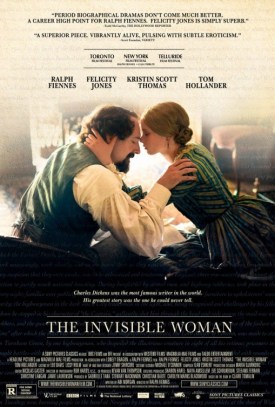
I generally try to avoid Victorian-era costume dramas as I usually find them quite stuffy and more attentive to the threads of the clothes than the threads of the story.  I didn’t need a reminder of their mediocrity, but Ralph Fiennes’ “The Invisible Woman” provided one for me anyways.  For nearly two hours, I endured the screen as a runway for the fashions of two-centuries past while a story played out in the background.

Abi Morgan, writer of films as brilliant as “Shame” and as dull as “The Iron Lady,” veers closer to the latter with her script for “The Invisible Woman.”  The movie tells the story of Charles Dickens’ mistress, Nelly Ternan (Felicity Jones).  She’s supposedly the true love of his life and an inspiration to his work, but it’s hard to feel any affection for Ternan from Jones’ performance.

Jones is as inaccessible here as she was in the brutal ultra-indie “Like Crazy.”  Ternan shows little emotion throughout the film save a scene where she walks alone on an expansive beach.  Though her silence does reflect the Victorian social norms, it makes for a tough watch with such a distant protagonist.

Fiennes’ Dickens becomes infatuated with Ternan while she is little more than an attractive wallflower in the background of a theatrical production.  They carry out an extended affair in the shadows, as both must protect their reputations, him as a public figure and her as a lady.  I felt as if  “The Invisible Woman” was pulling me to pull for Ternan, but I ultimately sympathized most with Dickens’ matronly wife Catherine.

I guess maybe you ought to call me a Victorian with that set of morals pulling for the married couple over what might be classified as love.  If I admit it, can I stop watching movies set in that era though?  C+2stars


REVIEW: Labor Day

27 01 2014

London Film Festival

I’ve made no effort to hide my love of writer/director Jason Reitman. With each of his first four films, I’ve been impressed with his ability to push himself in terms of tone, characterization, and style. Reitman is the first director that I have followed critically since the beginning of his career, and I have truly enjoyed watching him evolve before my eyes.

His fifth feature, an adaptation of Joyce Maynard’s novel “Labor Day,” shows perhaps the biggest stride in his visual storytelling to date. The film boasts impressive atmospheric editing with some eerie impressionistic flashbacks. His sets and staging seem much more delicately composed here, as does the cinematography.

Yet with this step forward, the bedrock of his past films – the characters and the script – take two big steps back. The narrative is essentially stillborn, providing us with three high-strung characters but little accompanying plot tension.

Labor Day” is an odd fit for Reitman’s talents as shown by his previous films, although it’s hard to fault a director willing to go this far out of their comfort zone. The story follows the odd events in 1987 that unfold when the withdrawn Adele (Kate Winslet) takes her son Henry (Gattlin Griffith) to the grocery store … and they come back home with the escaped convict Frank Chambers (Josh Brolin). At first, they appear to be his hostages, but Frank and Adele fall into an odd romance that soothes the sores of their troubled pasts.

Read the rest of this entry »


REVIEW: Gimme Shelter

26 01 2014

Gimme ShelterFor a brief interlude in “Gimme Shelter,” James Earl Jones appears as a hospital chaplain.  You read that right: the James Earl Jones, no confusion such as there might be with the directors named Paul Anderson (Paul Thomas made “The Master” while Paul W.S. made the “Resident Evil” franchise).  We’re talking the James Earl Jones with the Emmy, Grammy, Oscar, and Tony Award.

Jones’ inclusion in the film’s cast is one of many touches director Ronald Krauss adds to “Gimme Shelter” to increase its credibility and reach.  A name like Jones lends prestige to a project, and a star like Vanessa Hudgens has the potential to open up an audience of younger viewers that a film about teenage homelessness and pregnancy might not have otherwise.

But all these flourishes meant to endow legitimacy to “Gimme Shelter” only serve to emphasize the disparity between its ambitions and what it is actually capable of achieving.  Though it aims for the nitty-gritty reality of contemporary homelessness, Krauss is really only working with a Lifetime movie-quality script.

Moreover, the drama falls consistently flat.  It’s really a shame as I don’t think Krauss and his cast were truly attempting to turn real-life struggle into pure kitsch.  Hudgens certainly cares for her character Apple, transforming herself physically and accessing some very dark emotional places to convey some searing pain.  But neither she or Ann Dowd (on a career upswing after her fantastic turn in “Compliance“), who plays the saintly Kathy DiFiore with grace, can escape the mire of the cliché-riddled script.

The campy drama detracts from the real problems that “Gimme Shelter” raises.  But issues dramas should do more than just portray a tough subject; they ought to call us to action.  And rather than compel me to immediately help the homeless, the film just drove me to laugh at Vanessa Hudgens trying to outact James Earl Jones from her hospital bed.  She’s the best thing about the movie, to be sure, but that does not mean she can take down Darth Vader and Mufasa.  C2stars


REVIEW: Nebraska

25 01 2014

Cannes Film Festival – Official Competition

It’s tempting to analyze frequent writer/directors like Alexander Payne, Jason Reitman, and Noah Baumbach as if both their contributions to a film are co-dependent upon each other. Especially for someone like me, who values the power of the written word, it’s easy to think that a good script might just direct itself.

Nebraska,” a film directed but not written by Alexander Payne, offered a unique chance to observe his helming prowess independent of his writing. As it turns out, maybe I’m a bigger fan of Payne’s writing than I am of his directing. Payne’s critical stance towards his native Midwest almost seems to be working against the gentle tenderness of Bob Nelson’s script.

Payne’s previous scripts have all had a certain kind of bite to them. Perhaps that comes with the territory, though, as they mostly explore people going through crises – midlife, old age, the death of a spouse. “Nebraska” is remarkably simple, a tale of a grown son indulging his demented father in a road trip to claim a million dollar Publisher’s Clearinghouse prize.

For such a quaint tale, it’s refreshing to see a cast so free of pre-existing iconography assembled for “Nebraska.”  Perennial character actor Bruce Dern stars as Woody Grant, a patriarch of no particular distinction other than his unrecognized charity.  He’s calculatedly remote, both out of learned habit and elderly retreat.  Woody is often absent, but Dern is always present, making his character most alive in those dead moments.  It’s fascinating to watch the way he slowly reveals what Woody has mostly kept silent for years to a son with whom he’s not particularly close.

Read the rest of this entry »


F.I.L.M. of the Week (January 24, 2014)

24 01 2014

Searching for Sugar ManThankfully, there never seems to be any shortage of documentaries tackling the quandaries and complexities of our livable reality, but at times the sheer volume of non-fiction film can be overwhelming. Even from just a search of what’s available on Netflix, it’s hard to sort out the real deal from the TV special or the DVD extra quality material.  Thankfully, the Academy Awards are pretty helpful at shining a spotlight on a selection of high quality documentaries each year.

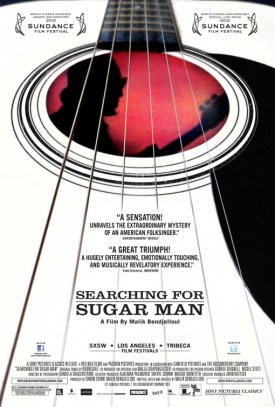
While I might quibble with their flagrant (some might argue inexcusable) exclusion of “Stories We Tell” in their 2013 crop, they brought a film called “Searching for Sugar Man” to my attention last year when it won the Oscar for Best Documentary Feature.  Malik Bendjelloul’s film might seem a little slight on the surface, but it’s my pick for the “F.I.L.M. of the Week” because it shows the surprising cultural impact of its subject along with his inspiring story.

The film follows the mysterious figure of Rodriguez, a folk singer who could easily have been a figure of Bob Dylan’s stature.  (Just listen to his jam “I Wonder” and feel yourself get taken away by the music.)  Despite his incredible talent, his music just never hit a nerve in America.  Rodriguez then faded into obscurity and then disappeared from the public eye entirely.

Meanwhile, in South Africa, his music sparked a cultural revolution.  To them, Rodriguez was like Elvis Presley or the Beatles as his music pushed boundaries on sexual expression in public culture.  And this was just his lyrics alone; there was no man associated with them.  The music just spoke for itself.

But after several decades South Africans began to wonder who the singer really was and began a quest to track down the elusive man.  Bendjelloul documents their investigation like a gripping mystery until they eventually find their answer.  The man they discover is hardly the recluse we’d expect, though.  He’s just an average man shocked to find out the impact his songs had on a faraway country.

In our hyper-connected world today where we can know our favorite musicians every thought on social media, it’s unlikely that we’ll ever see another story like that of “Searching for Sugar Man” again.  It’s like the ultimate edition of Entertainment Weekly‘s “Where Are They Now?” issue but told with more heart than a journalistic article.  Bendjelloul’s film is a touching ode to the way music can change the world – as well as one man, many years later.


REVIEW: August: Osage County

22 01 2014

August OsageI’m a firm believer that there are some source texts that are absolutely impossible to botch, provided they keep the main narrative intact.  Tracy Letts’ play “August: Osage County” belongs in such a category.

Many in the theatrical community already assert that it will be in the American dramatic canon along with works by Arthur Miller, Tennessee Williams, and Tony Kushner.  Letts provides some of the most gripping familial tensions I’ve ever read, and it’s chock full of meaty characters in an ensemble for the ages.

John Wells’ film adaptation of “August: Osage County” brings that story to a larger audience than likely could ever be reached on one stage.  Moreover, the cast he assembles is like the kind of “one night only” extravaganza that fans can only dream about.  I’ve never seen the show live, so I can’t really speak to its theatrical power.

Letts’ words did, however, jump off the page and paint such a vivid picture in my mind that I feel as if I did.  While the film does a decent job translating the action to the realm of cinema, there still feels like a bit of raw intensity evaporated in the transfer.

That’s not to say, though, that Wells doesn’t effectively harness the power of the screen to bring a different dimension to Letts’ opus of intergenerational discord.  On a stage, you can’t key off the subtleties in an actor’s facial movements, which is one of his most clever editing tricks in “August: Osage County.”  Some theorists have labeled film a fascist form because it has the power to direct your attention towards only what it considers relevant, but the way Wells chooses to organize these massive scenes is actually quite freeing.  It ensures we do not miss crucial reactions that serve to define the arcs of the characters.

Read the rest of this entry »


REVIEW: Captain Phillips

21 01 2014

From the outset of Paul Greengrass’ “Captain Phillips,” there is a conscious attempt to mirror the film’s two leading men, the titular cargo ship commander played by Tom Hanks and the Somali pirate Muse humanized by Barkhad Abdi.  Where most films would try to draw attention to the gulf between them, Greengrass and screenwriter Billy Ray bring to light the comparisons few would ever make.

Phillips and Muse rally their troops in the same way, command authority similarly, and follow the scripted narratives their societies have written for them.  They’re explicitly paralleled in the structure of the script as well as in Greengrass’ visual language of “Captain Phillips.”  It leads to a provocative line of mental questioning, but the sort of political allegory for which they aim winds up slightly unfulfilled.

It feels like an appropriate cherry on what I view as an unofficial, non-consecutive trilogy for Greengrass.  This series of interrelated movies is composed of 2006’s “United 93,” 2009’s “Green Zone,” and 2013’s “Captain Phillips,” all of which are critiques of contemporary American power and its narrow-minded exercise.  It’s yet another outsider’s critique of the currently reigning global superpower, which you can choose to listen to or dismiss.

The least of the three, “Green Zone” is a rather obvious criticism of the U.S. invasion of Iraq under some rather dubious pretexts.  “United 93” might seem like a straightforward cinematic presentation of an important historical event, but it uses the ill-fated flight on 9/11 for the self-destructive ends of America’s myopic worldview.  In his treatment of that film, Greengrass described the hijacking as a “hermetically sealed world disrupted by a savage and violent act.”  The premise of his “Captain Phillips” sounds like a riff on the same thought, which makes the films interesting companions.

Read the rest of this entry »


REVIEW: Jack Ryan: Shadow Recruit

20 01 2014

Economics majors may be get some major wish fulfillment through “Jack Ryan: Shadow Recruit,” the latest reboot and recasting of Tom Clancy’s paperback protagonist. As the CIA’s best “analyst” on Wall Street, he’s a compliance officer with a badge! Ryan gets to audit some assets in Russia and uncovers a terrorist plot that’s being developed in tandem with an orchestrated economic meltdown.

While this may sound exciting, it’s far more appealing as a synopsis than as the actual movie that plays out. Kenneth Branagh’s take on Jack Ryan feels like a feature-length first act of a great film. Nothing ever seems to escalate to levels where we feel the need to engage and maybe worry. The action is drawn out rather than reigned in, and as a result, it feels like seeing an incomplete movie. The problem is reminiscent to those that plagued Branagh’s last outing, the first film of the “Thor” series.

Even scarier than Branagh’s directing of “Jack Ryan: Shadow Recruit” is his acting in it. Playing the villainous Russian banker Cheverin with a heinously slapdash accent, he’s hardly menacing or intimidating. I found myself pining for a Philip Seymour Hoffman, a revelation in “Mission: Impossible III,” to put Branagh out of his misery.

Perhaps more troubling, though, than not having an antagonist to root against is the lack of a protagonist to root for. Chris Pine’s Jack Ryan feels copied and posted from his work as Captain Kirk in the “Star Trek” franchise. That’s not to say that one star cannot be at the helm of two series. But to be pulled off successfully, the two characters need to be distinct. For example, no one would mistake Robert Downey Jr’s smug Tony Stark from “Iron Man” for his cunning detective in “Sherlock Holmes.”

Pine’s bland acting brings nothing new to the Jack Ryan universe. His acting feels like it could be just any old script; he’s not creating a character that will really endure. As such, the only successful case that “Jack Ryan: Shadow Recruit” makes is that its titular character should just be left behind in the ‘90s.  C+2stars


REVIEW: Gravity

19 01 2014

The story of Alfonso Cuarón’s “Gravity” is quite simple. Astronaut Ryan Stone’s spaceship is obliterated by Russian satellite debris, and she must find her way back down to Earth or float away until her oxygen runs out. Only Murphy’s Law propels the narrative – that is to say, everything that can go wrong with technology will go wrong.

In a sense, this bare-bones script suits the film’s visual bravura perfectly. There are no flashbacks, no cutaways, and only minimal reference to Stone’s past. With nothing to distract, we are trapped with Stone. We’re left to share in her panic, breathe her remaining air, and drift through the starry void.

Total immersion is the only way that “Gravity” should ever be consumed; it’s such a shame some viewers will have to watch it on a television, a laptop, or even a cell phone that perhaps the film should never be released for home viewing. I found myself legitimately worried that pieces of flying shuttle shrapnel were going to fly off the screen and harm me when I saw the film in 3D. For how extensively the film utilizes the technology, it only once resorts to gimmickry of tricks with space.

Read the rest of this entry »


REVIEW: The Great Beauty

18 01 2014

If you’re expecting “The Great Beauty” to be a picturesque travelogue like “Roman Holiday” or Woody Allen’s recent “To Rome With Love,” you’ll be in for a bit of a shock.  Yes, Paolo Sorrentino’s tale unfurls in the Eternal City, and the setting does indeed inform the proceedings.  However, it is more than just a series of events in the foreground with Rome in the background.

Sorrentino’s film aims to strip back the facade of the city and examine what lies beneath.  There’s something more to the city’s beautiful art and architecture as well as the creative class of intelligentsia basking in its legacy.  But when Sorrentino drills for the core, he finds a lot of air.  That’s not to say the film is meaningless, but perhaps the lifestyles of the people parading across the screen are.

“The Great Beauty” exposes the vacuous hedonism of Rome’s elite.  Here, they bask in the legacy of history while leaving little of their own behind.  The film’s protagonist, writer Jep Gambardello (Toni Servillo), slowly discovers the vapidity of his social circle upon turning 65.  They’re obsessed with performance, and they’re either watching performance art or putting on a show of inheriting a city’s history.  Jep’s no exception; he wrote one novella while young yet never wrote another piece of fiction despite its incredible success.  Jep is numbed by the empty pursuit of luxury, leaving him in creative paralysis.

While Jep might be suffering from a lack of inspiration or ability to find what he calls “the great beauty” of life, Sorrentino has no such trouble.  His camera seems to glide perpetually through the picture, recalling Jeff Cronenweth’s photography for David Fincher’s “The Social Network” and “The Girl with the Dragon Tattoo.”  I do think the film is occasionally guilty of trafficking in the opulence it also critiques (seemingly a common thread this year – cough, “The Bling Ring” and “The Wolf of Wall Street“).

While the images never cease to stun, Sorrentino’s unique story structure often threatened to stun me to sleep.  Jep’s dealings with various Romans, from his editor to a 42-year-old stripper to a future saint, never really seem to build any dramatic momentum.  The film feels rather stagnant, making its point clear in about an hour and then lingering for an additional 80 minutes like an unwanted house-guest.  Still, at least “The Great Beauty” has a little something for you to chew on other than the classic iconography of the city.  B- / 2stars


F.I.L.M. of the Week (January 17, 2014)

17 01 2014

You’ve seen biopics of complex figures, but director Todd Haynes isn’t interested in presenting his portrait of musician and cultural icon Bob Dylan like anything else ever made.  His “I’m Not There” is a bold experiment, manifesting the fragmentation of Dylan’s persona by literally splitting him into six characters.  This iconoclasm pays off in a rewarding and challenging experience, leading me to name the movie my pick for the “F.I.L.M. of the Week.”

It’s not necessary to know Bob Dylan or his music really well to admire “I’m Not There.”  Rather, all it takes is a willingness to see the connection between the six pseudo-Dylans … or perhaps their incongruity.  The Dylans take many different shapes, including a young African-American (Marcus Carl Franklin), an older man (Richard Gere), a born-again folk singer (Christian Bale), and an actor attempting to get inside of him (Heath Ledger).  We float through each of their lives and struggles in bits and spurts.  Just when we think we get a grip on Dylan, he slips away.

Oddly enough, the one who looks the most like the Bob Dylan we know … is played by a woman.  Cate Blanchett is Jude, a raspy-voiced chain smoking folk musician.  Not unlike her work in “Blue Jasmine,” Blanchett disappears inside her character and makes us forget that aura of regality she so often conveys.

She captures all the frustration of misunderstood artistry along with all the pains of drug addiction.  Blanchett brilliantly fulfills the most frequently recognized Dylan iconography yet also breathes something deeply human into her character, something no amount of cameras or reporters could ever really capture.   She’s at once vulnerable and inaccessible.

Much like Jude, “I’m Not There” floats between all these contradictory lives of Dylan, back and forth with well-orchestrated indirection.  It never settles, never aims for some sort of absolute truth.  It’s like a fictionalization of the concepts brought up in a documentary like Sarah Polley’s “Stories We Tell.”  We are many different things to many different people, and there is no fixed point from which to observe reality or memory.  Perhaps we just exist as the sum total of the masks we wear.