REVIEW: Stories We Tell

18 08 2013

Last semester, I took a course that had me write a paper using my family as the evidence to explore sociological themes.  A requirement of this essay was to conduct ethnographic research myself – that is, interview four members of my family.  From just those brief sessions, I learned plenty about my own family history.

But perhaps the biggest lesson I took away from that project was that every person had their own way of describing the same person, thing, or event.  Moreover, what was included and excluded from someone’s narrative was a story in and of itself.  While it was not related to the focus of my paper at all, the research got me fascinated about the way that we filter history through the lens of our own experiences.

A few months later, I was sitting in a dark room watching Sarah Polley’s “Stories We Tell,” and a silent prayer was answered.  This documentary is an ethnography project, handbook, and critique all tied up in one immensely satisfying bundle.  It addressed all the lingering questions from my project – and then went a step further by brining to light many more intelligent issues that continue to bounce around in my head.

Have no worry, you don’t need to have completed an academic exercise in ethnography (the study of people) to get something out of “Stories We Tell.”  It’s a film for anyone who has ever told their own story or been told their history by someone else.  Polley’s documentary may be about her own family, but its sharp insights penetrate so deeply into the human condition that her findings apply to just about anyone.
Read the rest of this entry »


REVIEW: The Butler

17 08 2013

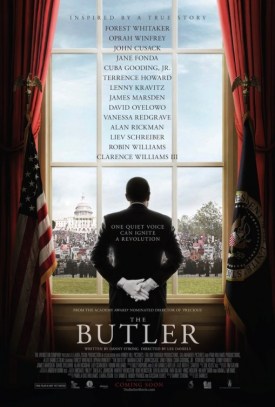
ButlerBased on the trailer for Lee Daniels’ “The Butler,” I had prepared myself for “Forrest Gump: Civil Rights Edition.”  It looked to be in a filmmaking tradition of heavy-handed, cloying, and over the top shenanigans designed to easily trigger emotion.  As it turns out, I didn’t even have to resist because the film was not any of these things.

It was just a plain, bad movie.  “The Butler” is poorly written, unevenly directed, and meagerly acted.  It vastly oversimplifies history, both that of our nation’s struggle for civil rights and also the remarkable life of one man who served many Presidents with honor and dignity.  And in spite of its golden hues and stirring score stressing the importance of every moment, the film just fell flat the entire time.

Screenwriter Danny Strong writes the story of Cecil Gaines, Forest Whitaker’s titular character, into a parade of presidential caricatures – leaving out Gerald Ford and Jimmy Carter since they apparently never grappled with civil rights.  (I’m ok with a narrowed portrait of history, just not a narrowed portrait of the people who made that history.)  Each man is a waxwork figure, a set of immediately recognizable traits tied up in a bow by a crucial civil rights decision, that happens to be served tea by the same man.

And every president is somehow swayed by the mere presence of Cecil, who will make a passing remark to each.  He’s apparently the perpetual Greek chorus of the White House or even the nation’s most influential civil rights adviser.  It’s a little ridiculous to infer causality here, even with a generous suspension of disbelief.  This trick worked in Robert Zemeckis’ “Forrest Gump” because it was done with a wink and a sense of humor.  It fails in “The Butler” because no one can seriously believe Cecil was an actual policy influencer.

Read the rest of this entry »


F.I.L.M. of the Week (August 16, 2013)

16 08 2013

As the summer begins to wrap up, it might be a good time to squeeze in a viewing of Francois Ozon’s steamy “Swimming Pool,” my selection for the “F.I.L.M. of the Week.”  While this scintillating thriller makes the most sense for a seasonal watch, I’m fully convinced it could stand up in any of the other nine months of the year.  It’s a completely engaging film with a plot that will envelop you entirely as it prepares for a killer final act.

The action begins when Charlotte Rampling’s Sarah Morton, a British mystery author beginning to hit a creative wall, settles into her boss’ French country house to get her creative juices flowing.  Just as she begins to find enough quietude in the locale to write a new book, Sarah gets an unexpected house guest: her publisher’s daughter, the young and capricious Julie (Ludivine Sagnier).  The two mix like oil and water as the crotchety Sarah refuses to entertain any of Julie’s whims.

However, as we dive deeper into “Swimming Pool,” we begin to see that Sarah is deriving a sort of perverse inspiration from Julie’s various romantic exploits.  As she begins to observe, the real-life drama begins to spill onto the page … or perhaps it’s the other way around?  Ozon throws the boundary between reality and fiction into complete question towards the film’s finale, one that leaves us reeling for days.

That conclusion would not work, though, were it not for Ozon’s tight and precise direction throughout “Swimming Pool.”  He makes every moment build tension until it bursts by the end.  It also helps that Rampling and Sagnier are quite a devious duo, playing with and off each other in brilliant ways.  Combining all their power makes for one refreshingly original and captivating thriller.


REVIEW: The Spectacular Now

16 08 2013

I really did like the first act of “The Spectacular Now” because it felt honest and real. Miles Teller’s Sutter Keeley felt like someone I would have known in high school, a burgeoning alcoholic with a big unchecked ego. And Shailene Woodley’s Aimee Finicke reminded me quite a bit of myself, someone bookish but a bit insecure and completely unable to picture anyone having romantic feelings about them.

I was so looking forward to the direction that the film was heading … and then Sutter and Aimee share the moment we saw coming a mile away, their first kiss. From there on out, “The Spectacular Now” heads south as the authenticity of the story and the believability of the characters flies out the window. The script, penned by “(500) Days of Summer” scribes Scott Neustadter and Michael H. Weber, descends into a mire of archetypes and cliches.

It’s a little more understandable for Sutter to become a flat character as his personality is so based on living up to a cultural ideal of care-free ignorance. But it’s disappointing to watch Aimee just a flip a switch and become a totally different person. Before the kiss, she was so refreshingly independent and derived her sense of self-worth from within, not from others. Afterwards, Aimee becomes little more than an accessory to Sutter, fawning over him at all times and constantly caressing him.

Read the rest of this entry »


REVIEW: Jobs

15 08 2013

Joshua Michael Stern’s “Jobs” finds itself caught between “Lincoln” and “The Social Network.”  The film teeters uncertainly on the precipice of canonization in the Spielberg/Kushner model and humanization in the Fincher/Sorkin mold.  It ultimately settles on an unhappy median, providing a portrait of Apple founder Steve Jobs that feels like laughable corporate folklore.

Just because the film’s characterization is fickle does not mean that its message is muddled.  Stern is clearly pushing an agenda to persuade his audience that Steve Jobs is the American Einstein, a visionary misunderstood in his early years.  And just like Einstein, we will not fully comprehend his genius until years after his death.  But eventually, we will come to use his name as a synonym for innovation.

Ashton Kutcher does do a half-decent job of resurrecting the essence of Steve Jobs.  The 35-year-old actor takes the icon from his college years, a barefoot braniac that seems to have escaped from a Terrence Malick film, to his introduction of the iPod as a slower sage.  At times, though, it does feel like quite a studied portrayal.  His Jobs is often much robotic imitation, opting for parroting over true personality.

Even with such faults, he’s the only thing that “Jobs” really has going for it.  Stern’s script is an overlong mess where Steve Jobs, even from his days at Reed, speaks not in sentences but in maxims that seem to be adapted from Confucian teachings.  When it delves into emotions and not just events, the drama of “Jobs” becomes quite laughable.  All in all, though, the film just feels superfluous.  Why do I need to sit through a two hour “for your consideration” ad for Steve Jobs to inducted into the pantheon of great minds when practically every computer, cell phone, and music player in my house is an Apple product?  C2stars


REVIEW: Young & Beautiful

14 08 2013

Jeune & JolieCannes Film Festival – Official Competition
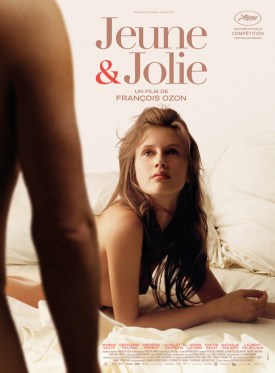
After both years I’ve gone to Cannes, I have suffered painful withdrawals from the world’s best curated art cinema.  I find myself wanting to revisit these fascinating movies I’ve just seen but am forced to wait months on end before they see Stateside release.  (I’m still waiting to get a second helping of “The Hunt,” my favorite film of the 2012 festival.)

Strangely enough, the movie from Cannes 2013 I’ve been most anxious to see again was not my favorite film of the festival, James Gray’s immaculate “The Immigrant.”  I find myself thinking quite often about Francois Ozon’s odd “Young & Beautiful,” flaws and all.  It’s a film I can’t wait to see again because it’s so unconventional and refreshingly different.

From the moment I left the orchestra of the Lumiere Theater on that rainy Thursday afternoon, I have been trying to figure out how Francois Ozon made the peculiar concoction that is “Young & Beautiful” work at all.  I am even more perplexed as to how it managed to entrance and beguile me so fully.  Because, quite frankly, it walks a rather fine line between being provocative and being offensive.

Read the rest of this entry »


REVIEW: We’re The Millers

13 08 2013

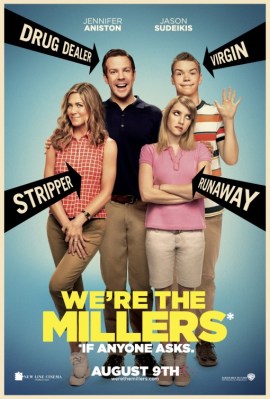
We're the MillersIn “We’re The Millers,” television’s “Breaking Bad” meets film’s “National Lampoon’s Vacation” as mid-level drug dealer David Clark (Jason Sudeikis) enlists a crazy cast to help him smuggle marijuana across the U.S.-Mexico border.  (So in that way, perhaps it’s more like “Maria Full of Grace” meets 2013’s “Identity Thief.”)  This motley crew from near his building includes well-meaning exotic dancer Rose (Jennifer Aniston), tough teenage street rat (Emma Roberts), and an aloof adolescent boy Kenny (Will Poulter) with a passing resemblance to Tintin.

The movie manages to provide a few decent laughs along the journey, though they are largely front-loaded.  “We’re The Millers” starts off with some very clever and witty banter, largely uttered by Sudeikis, who is quickly proving himself to be quite the sultan of snark.  It’s certainly a much better role for him than his bland characters in “Horrible Bosses” and “Hall Pass,” and he could soon be rivaling Paul Rudd for roles.

But the film starts to veer off course in the second half, resorting to more and more ludicrous gags to provide humor.  These ridiculous scenarios often provide their fair share of cringe-worthy moments, enough to make the film feel like it has overstayed its welcome by a solid 30 minutes.  Though I don’t want to say too much, at least “We’re The Millers” doesn’t end by caving to all the road trip, family, or rom-com tropes.

By the time the gag reel rolls, the film essentially arrives at a comedic standstill.  It’s got enough sardonic and standoffish Aniston and sulky Roberts to make anyone roll their eyes.  But it’s also got some good Sudeikis everyman sarcasm and a pretty winning performance from Poulter, playing naive innocence with gusto.  So, in other words, “We’re the Millers” is decidedly average.  C+2stars


REVIEW: Blue Jasmine

12 08 2013

Woody Allen’s latest feature shows our most prolific filmmaker access a side of his writing seldom seen: dark and unsparingly grim tragedy.  I’ve seen all of his 48 films, and perhaps not since 1992’s “Husbands and Wives” has he taken such a bleak and hard-hitting look at the demons we battle and the struggles we face.  His “Blue Jasmine” is a modern “A Streetcar Named Desire” mixed in a cocktail with the Bernie Madoff scandal and washed down with a toxic mixture of alcohol and antidepressants.

It’s no stone-faced drama like “Match Point,” though.  There are still plenty of laughs to be had here, although they definitely don’t resemble the kind of humor you’d find in Allen’s early farces like “Bananas.”  Nor do they even take the shape of the clever wit of “Annie Hall” or even “Midnight in Paris.”  In “Blue Jasmine,” we chuckle as we cringe.  Almost all of our laughs are muffled as they come while we grit our teeth.

That’s because his protagonist, Cate Blanchett’s Jasmine (formerly Jeanette, but that name wasn’t exciting enough), is slowly charting her own way to another complete mental breakdown.  She suffered her first one after her husband’s vast fraudulent financial empire collapses, leaving her penniless to fend for herself in the world.  Lost and not placated by her Xanax, she journeys cross-country to San Francisco to stay with her sister Ginger (Sally Hawkins) in the hopes of getting back on her feet.

But Jasmine quickly finds that she’s woefully underprepared to enter the workforce since she has no degree, dropping out of Boston University with a year left to marry Hal (Alec Baldwin).  Despite offers from Ginger’s circle of friends to help her find secretarial or wage labor, Jasmine remains defiant, unable to accept the reality that she is no longer among the privileged Park Avenue lot.  Her half-hearted effort to come to terms with her new social standing leads to clashes with her eventual employer, Michael Stuhlbarg’s genial dentist Dr. Flicker, and Ginger’s boyfriend, Bobby Cannavale’s unabashedly honest Chili.

Read the rest of this entry »


REVIEW: Smashed

11 08 2013

Finding comedy in alcoholism and recovery, two notoriously heavy subjects that hit close to home for many audiences, is no easy task.  “Smashed” is hardly a gut-buster or a laugh riot, although a little humor does help some of its rougher and rawer moments.  It’s no “Rachel Getting Married” (nor the lesser-known “Sherrybaby“), that’s for sure, but that’s not to say the film doesn’t have its smaller triumphs.

Director James Ponsoldt, newly heralded as an emerging director (and being entrusted to helm an upcoming Hillary Clinton biopic and an adaptation of the musical “Pippin”), steers the film rather uneasily.  As a result, the film has some abrupt and rather jarring tonal swings.  I’m not quite sure if he intended “Smashed” to leave a comedic or a dramatic impression, but it really winds up leaving very little impression at all.  Similarly, Mary Elizabeth Winstead’s performance is good, yet it never goes the full mile like Anne Hathaway or Maggie Gyllenhaal in the aforementioned dramas.

If it sounds like I’m being vague on details, that’s because I remember very few of them.  “Smashed” is a film I didn’t dislike, but it failed to win me over or secure a spot in my memory.  Regardless, it’s an interesting and, at 81 minutes, brief bauble of a film that isn’t entirely a waste of your time.  At the very least, you’ll enjoy seeing a union of some of TV’s best talents: Aaron Paul of “Breaking Bad,” Nick Offerman of “Parks & Recreation,” and Megan Mullally of “Will and Grace.”

Oh, and there’s Octavia Spencer (Oscar-winner for “The Help“) as an AA sponsor.  She never disappoints.  2halfstars


REVIEW: Paul

10 08 2013

2011 saw one movie, J.J. Abrams’ “Super 8.” corner public interest on the influence of Steven Spielberg’s filmmaking on modern moviegoing.  I’m a little upset that “Paul” couldn’t bask in a little of that light.  It’s a fun, spirited send-up of science-fiction tropes featuring a hilarious self-aware alien, Paul (the voice of Seth Rogen).

“Paul” also puts science-fiction, comic-book culture under the microscope to be sent up.  And for that task, there’s probably no one better than Simon Pegg and Nick Frost, two men whose humor seems to play particularly well to that crowd.  Pegg and Frost both wrote the film, and they also star in it as Graeme and Clive, two Brits who come across the pond for comic-book Mecca … Comic-Con.

Traveling the United States in an RV, they encounter crude, crass extraterrestrial Paul.  He’s the masterstroke of the movie, perhaps the best manifestation of Pegg and Frost’s comedic brilliance to date.  He’s got ties to all sorts of conspiracy theories and is incredibly connected to the entertainment industry.  The problem is, the rest of the movie just falls short of the character’s shrewd construction.  Though it is a satire of the human-meets-alien movies of the past two decades, “Paul” often allows itself to lazily slip into the trappings of the subgenre.

And, lest I forget to mention it, “Paul” has Kristen Wiig as one-eyed fundamentalist trailer trash taught to sin by Paul.  Sure, her character’s a little juvenile, just like the rest of the movie when it isn’t cleverly harkening back to ’80s sci-fi classics.  But Wiig, and “Paul” as a whole, somehow make the stupidity seem more fun than they probably are.  B-2stars


F.I.L.M. of the Week (August 9, 2013)

9 08 2013

With Amazon.com’s Jeff Bezos buying up the Washington Post this week, I felt it would be an appropriate time to revisit Andrew Rossi’s documentary “Page One: Inside the New York Times.”  The film, which takes a magnifying glass to the paper’s 2010 calendar year, is still fresh even though the news is old.  It’s packed with enough relevant and insightful discussion of the news industry in the age of Twitter that it stands as my pick of the “F.I.L.M. of the Week.”

Rossi follows the reporters and editors of The New York Times as they deal with various journalistic challenges, including Julian Assange’s WikiLeaks revelations and the bankruptcy of the Tribune media companies.  Each provide fascinating fodder for thought on the role of the press in maintaing an open society and an informed citizenry.  Rossi’s camera catches all sorts of intriguing behind-the-scenes action to give the film the pop of an “All the President’s Men” (or even 2009’s Oscar-nominated doc “The Most Dangerous Man in the World“).

But as the slogan of the film hints, “Page One” is most concerned with the state of the paper – because as we are aware, we can get the news from a whole host of sources now.  No one is more painfully aware of this than the staff of The New York Times themselves, feeling tangible effects from the digital revolution in tandem with the collapse of their old advertising model.  They show how often we take the news for granted, often times as if it were some kind of public good.

The documentary finds a fun protagonist in David Carr, the paper’s media reporter whose blunt but always intelligent observations on the state of the industry provide a firm center for the film.  He’s an unconventional reporter who took a wild journey to end up at The New York Times, but he’s also a compelling cheerleader for the necessity of conventional journalism and the integrity that comes with it.

Carr and “Page One” make me proud to spend $8 a month to gain access to the newspaper, a decision announced during the timeframe covered in the film.  While I’m sure the monetization of my support has been helpful, the battle clearly isn’t over as I get endless mailers asking me to add home delivery to my subscription package…


REVIEW: Antiviral

8 08 2013

The world’s obsession with the lifestyles of the rich and famous is no secret.  In 2013, it’s already been the subject of Sofia Coppola’s “The Bling Ring,” a darkly comedic look at how the desire to be like celebrities is so great that it can even compel people to literally steal from their E! news idols.  You could even argue that, on a more subconscious level, it’s what made a new film adaptation of “The Great Gatsby” both necessary and commercially viable.

If you’re willing to follow this craze illogically into absurdity, you might find Brandon Cronenberg’s “Antiviral” at the end of your line of thought.  This Juvenalian satire blended with a gross-out horror imagines a dystopian future where people literally infect themselves with viruses from their favorite celebrities to feel more connected to them.  It’s an interesting and quite frightening concept, to be sure, but Cronenberg pushes the boundaries of plausibility and believability a little too far.

That’s not to say I couldn’t stomach the film, though Brandon has inherited his father David’s penchant to make his audience squirm.  Anyone afraid of needles will find “Antiviral” particularly nightmarish as no skin penetration is simulated; Cronenberg delights in the sight of piercing needles and refuses to cut away from them.

Yet as painful as all those were, they had nothing on the excruciating plot.  Brandon also seems to have inherited his father’s storytelling woes evident in fellow Cannes 2012 entry “Cosmopolis.”  Visual talent is evident here, I will concede.  But Brandon Cronenberg still has a long way to go as a writer.  C2stars


REVIEW: Monsters University

7 08 2013

Monsters UMonsters University” may not scale the emotional heights of Pixar’s most recent towering achievements “Up” and “Toy Story 3,” but that doesn’t mean the film isn’t moving, charming, or sweet in other ways.  It’s a movie that will be special and touching to anyone who has ever felt like an impostor or an underdog in their own life.  And for those big kids who have been to college themselves, it’s especially meaningful to anyone who has struggled to find their place on campus.

The film opens with a sight to make your heart melt – a tiny Mike Wazowski, the most adorable little nugget with big dreams to become a scarer at Monsters, Inc.  He’s got plenty of book smarts but lacks the intimidating frame to take the Scare Floor by storm.  Mike (Billy Crystal) meets quite the foil in a cocky young James P. “Sully” Sullivan (John Goodman), a dumb party animal who slacks off because he’s blessed with natural skill.  It’s a pretty standard nerd vs. jock dichotomy, in case you hadn’t already figured it out.

But the Pixar plot machine doesn’t have them battle in conventional ways.  Rather, after a big mistake lands them in hot water with Dean Hardscrabble (the ever-intimidating Helen Mirren), Mike and Sully are forced to team up to earn their stripes in the scare program.  They have to win the prestigious Greek Scare Cup to gain reentry into the class, leading them join up with a lovable band of misfits, Oozma Kappa.

The oddballs of Oozma Kappa, a fraternity house that’s also someone’s mom’s house, bring a lot of the vitality and humor to “Monsters University” that we don’t get in spades from seeing our old friends Mike and Sully (and Randall, who’s thrown in for good measure).  The novelty of these myriad new characters, however, does tend to overpower our reliable staples.  It’s still an enjoyable romp with astutely observed characters that offer very applicable life lessons for everyone.

And I think the fact that I’m currently in college led me to feel especially endeared to the film, which so accurately captured a key aspect of my own experience.  It’s easy to come into college expecting that we’re going to be one person, yet we so often find ourselves inexorably and immutably changed by unexpected people and events.  And thanks to Pixar’s great storytelling genius, they find a way to expand this valuable nugget of wisdom beyond the campus of Monsters University and into a larger reservoir of human experience.  B+3stars


REVIEW: Passion

6 08 2013

PassionI don’t even know where to begin with Brian DePalma’s “Passion,” an instant contender for the worst movie of 2013.  It’s one of the tackiest and most tasteless films I’ve ever seen, an exploitative B-movie that tries to masquerade as something classier.  It isn’t.

Though it cries to be taken seriously as an art film, I place “Passion” next to “The Hangover Part III” in terms of a disturbing trend from summer movies in 2013.  Both films take an undercurrent of same-sex attraction from their prior incarnations (for “Passion,” this is a well-made French thriller from 2010 called “Love Crime“) and turn into ridiculous and overt subject matter.  While the relationship between manipulative boss Christine and her brilliant protege Isabelle had some tension in the original film, it’s to the point of full-on make-outs and lesbian love declarations.

Not that there’s anything wrong with that.  However, we don’t live in a time where homosexuality needs to be transmuted into some exotic abnormality, so the campiness of “Passion” plays as somewhat offensive and insensitive.  Noomi Rapace at least plays Isabelle with some grounding in reality. Rachel McAdams’ Christine, on the other hand, is played with all the gusto of her iconic Regina George from “Mean Girls” but with all the energy channeled into making her an insatiable sexual animal.

Although to put the blame for “Passion” on the shoulders of its two leading ladies is unfair.  The movie is a mess because of director Brian DePalma, whose attempts at Adrian Lyne-esque steaminess or Wachowskian cerebral thrills just fall flat on their face.  His adaptation of “Love Crime” drains every ounce of subtlety from the story, turning a tale of professional rivalries turned criminal into crazy lesbian bloodlust (to be short and blunt about what this film is).

“Passion” aims for somewhere between Stanley Kubrick’s “Eyes Wide Shut” and Darren Aronofsky’s “Black Swan” but falls firmly into the territory of unintentional farce destined for the $2 DVD bin at CVS Pharmacy.  D+1halfstars


REVIEW: Touchy Feely

5 08 2013

Touchy FeelyHow ironic that director Lynn Shelton should begin to lose her touch in the film “Touchy Feely,” a film about people who literally touch for a living.

All the seemingly effortless perceptiveness into our very humanity in Shelton’s prior two films “Humpday” and “Your Sister’s Sister” have eluded her grasp in her latest feature.  “Touchy Feely” is a mess, unfocused and unorganized from the get-go.  Shelton writes plenty of interestingly odd characters, but they ultimately offer us nothing to take home and apply to our own lives because we can’t identify with them.

The film jumps from emotional non-sequitur to emotional non-sequitur as everyone seems to act in only the most bizarre and irrational ways possible.  Whether it’s taking ecstasy, forcing their significant other to strip in a bathroom at their place of business (only to then walk out), or going to an experimental massage therapist to improve their dentistry, Shelton’s got the sheer unpredictability of human nature cornered.  The problem is, however, that none of these quirks add up to anything – nor do they highlight anything about what it means to be alive, or in love, or a productive member of society.

The actors could have turned “Touchy Feely” into their showcase by picking up the slack from Shelton’s script, but they wind up falling into the same humdrum, forgettable pattern of the film.  Rosemarie DeWitt’s erratic Abby shows nowhere near the vitality and inner life of her titular bride in “Rachel Getting Married,” and Ellen Page just plays Juno on downers.  Not even Allison Janney could breathe any fresh air into the film.

On a final sad note, I was really hoping this would be a breakout role for Josh Pais, a stalwart character actor who first caught my eye as a cantankerous Harlem teacher in “Music of the Heart” when I was seven years old.  He’s been popping up in movies and TV shows for years, and I’ve always enjoyed seeing him.  But his role in “Touchy Feely,” a deadbeat dentist, was a droning monotone. Hopefully he gets another shot at a big part like this again; I just hope this wasn’t the first time a casting agent saw him on screen.  C-1halfstars