REVIEW: Blue Is the Warmest Color

15 06 2013

Blue is the Warmest ColorCannes Film Festival – Official Competition

Producers of the upcoming film adaptation of “Fifty Shades of Grey,” I have found your director.  Thank me later.

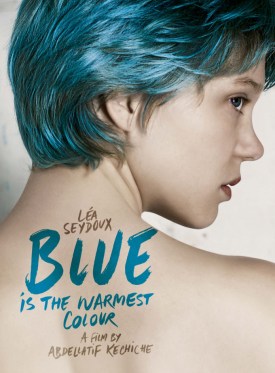
In the past three weeks since I’ve seen Abdellatif Kechiche’s “Blue Is the Warmest Color,” I have gone back and forth on whether I deem it to be pornography.  What I can say without a doubt, however, is that it features the most graphic depictions of sexuality between any two people that I have ever seen on film.  It takes that honor away from Steve McQueen’s 2011 masterpiece “Shame,” which used pornographic aesthetics to ironically point out just how little pleasure was present in the carnality occurring before our eyes.

Kechiche’s camera, whether voyeuristic or artistic, captures human sexuality between the timid young Adele (newcomer Adele Exarchopolous) and the nubile Emma (Lea Seydoux) at an extremely intimate level.  On the one hand, it seems almost animalistic as we feel their every body movement, see the saliva drip, and hear their every moan.  Yet at the same time, it’s also highly erotic.  Kechiche seems more focused on capturing the act from every angle and less on the experience that Adele and Emma are having.

The story just stops as we are left to gaze at Adele and Emma entangling in a frenzied sexual embrace.  Acting halts as well since the camera just cares about Exarchopolous and Seydoux’s extremities, not their faces.  In addition, Kechiche’s segues into sensuality are so abrupt and unexpected that once the first scene occurs, it’s impossible not to be constantly wondering if the next edit will lead into intertwining limbs or passionate moans.

Read the rest of this entry »


F.I.L.M. of the Week (June 14, 2013)

14 06 2013

Looking for the ultimate counter-programming this summer?  Heaven knows Hollywood is giving us plenty of comic book films this summer, be it a new Iron Man or a rebooted Superman.  But while those films may feature a man of steel, they certainly don’t feature a man who’s real in the same way that comic book film “American Splendor” does.

Imagine a comic book adaptation where a Woody Allen type (only with even more self-loathing) was the superhero.  Well, Paul Giamatti’s Harvey Pekar is hardly super … or a hero.  He’s just a protagonist, the main character of his life trying to live to fight another day.  Writer/directors Shari Springer Berman and Robert Pulcini find the herculean struggle in these everyday battles and draw them out in appropriately stylized ways.

Why “American Splendor” is my pick for “F.I.L.M. of the Week,” however, is not necessarily because it’s an alternative/indie comic book movie.  Make no mistake about it, this is no “Kick-Ass.”  Berman and Pulcini are incredibly dexterous filmmakers who find clever ways to blur conventional lines in cinema.  Their film is both documentary and narrative, both animated and live-action.

That’s right, the film toggles between different modes of storytelling.  If it sounds weird, it looks and feels just right.  In fact, I think it’s the only way “American Splendor” could have been adapted.  Conventional technique could never pin down such an unconventional person and character like Harvey Pekar.  The multi-pronged approach works on so many levels, all of which I won’t attempt to pin down in a brief review.

But while it experiments with the form in exciting ways, it never forgets what Harvey Pekar said so brilliantly through his “American Splendor” comics for years.  At the end of the day, it’s all about the story of life.  We all have to live it, and everyone has issues that make them want to scream.  “American Splendor,” with emotional potency to spare, makes Harvey’s journey a vivid and infinitely relatable one.  He’s the comic book protagonist we need (but probably don’t deserve).


REVIEW: This Is The End

13 06 2013

Now that I know the kind of deep analyses I can write on films, I’ve grown cautious of over-intellectualizing.  It’s like learning to reign in a superpower; just because you can use it doesn’t mean that you always should.  And, often times, I feel like many film reviewers and critics pull meanings out of films that might not even be there.

This Is The End” poses quite a conundrum for me.  I’m weary to read into it too much, but I think the apocalyptic comedy could be subversively smart.  Or it’s just another culturally-savvy product of the Apatow gang (although Judd himself had no part of this film).  Whichever it is, however, Seth Rogen and Evan Goldberg’s feature-length directorial debut is an outlandishly good time that packs some killer laughs.

I go back and forth on whether Rogen and pals are brilliant minds … or just stoned out of those same minds.  The fact that stars like Rogen, James Franco, and Jonah Hill are playing themselves certainly seems to indicate a certain level of self-reflexivity.  After all, no one would mistake “This Is The End” for a documentary as everyone seems to be playing an exaggerated version of themselves: Rogen the jovial teddy bear, Franco the off-kilter artiste, and Hill the slightly fruity sass-pot.

But then again, Rogen and Goldberg could easily have just been thinking of a way to make the ultimate end of the world comedy (lest we forget, there has already been the morose “Seeking a Friend for the End of the World“).  When it came time for their silver bullet, perhaps the idea popped into their head that rather than characters, the film should feature real celebrities.  Indeed, there are times that the real comedians feel a little gimmicky.  I’m not going to complain, however, so long as I get to hear Rogen and Franco weigh the relative merits of “Pineapple Express” and “Your Highness.”

Read the rest of this entry »


REVIEW: The Purge

12 06 2013

The PurgeThe amateur sociologist in me finds plenty to love about “The Purge.”  Though not without its holes, the film is aiming at some deep social commentary about the causes of our seemingly never-ending modern woes.  It posits a quasi-utopian 2022 where unemployment and crime have virtually disappeared thanks to a single night called The Purge where nothing is illegal for 12 hours.  Robbery, assault, and even murder are all acceptable because it provides an opportunity for society to unleash all its pent-up anger.

Sound a little elementary to you?  All society needs to do to achieve harmony is get out some rage?  That’s because it is.  Writer/director James DeMonaco has a brilliant concept, but it probably needed a little bit more time to be developed.  For example, for all the psychological good The Purge supposedly does, could you really go to work the next day if your boss tried to kill you as if nothing happened?

Yet while the oversimplification allows for plot holes aplenty, it also allows the film’s message to (hopefully) reach the average horror film viewer, normally not accustomed to anything deep from the genre.  Not to bash an entire class of movies, but horror generally waters down to small universes where only the moral stave off their doom.  “The Purge” is not particularly subversive, but it’s closer to Michael Haneke’s “Funny Games” than it is to “Evil Dead.”

Read the rest of this entry »


REVIEW: Violet & Daisy

11 06 2013

Geoffrey Fletcher’s jump from writing the Oscar-winning “Precious” to penning and directing “Violet & Daisy” is hardly a logical one.  How someone goes from something so raw and emotionally moving to a film so austere and oblique is a career move I doubt I would be bold enough to make.  Though I’d prefer that Fletcher stick to his much-lauded strengths, I am all for artists diversifying and taking risks.

His “Violet & Daisy” is certainly a very interesting film from a stylistic standpoint, blending together everything from French New Wave technique to an almost Tarantino-esque sense of stilted reality.  The story, meanwhile, is fairly simple, mostly involving the two titular assassins (played by Saoirse Ronan and Alexis Bledel) trying to decide whether or not to whack Tony Soprano himself (James Gandolfini’s Michael).  Consider it the film art version of any great action movie conversational stand-off.

But while the style drew me in, it also took me out of the movie.  Fletcher’s characters speak very ear-catching dialogue and head into compelling situations.  Yet the sort of detachment that comes with the aesthetic led me to feel a cold distance from the action.  That was likely the intent, but I felt that it also downplayed the importance of Fletcher’s script.  The drama doesn’t hit home, and “Violet & Daisy” really can’t connect when it matters most.

It’s still a more or less entertaining and interesting watch, though.  I just don’t think I would ever want to watch it again.  And I’d only recommend it to someone else if they were a particular kind of viewer in a particular kind of mood.  But I also don’t tend to embrace movies in the mold of “Violet & Daisy,” so perhaps it’s best that I was nonplussed by it.  B-2stars


REVIEW: Now You See Me

10 06 2013

Now You See MeNo one would ever mistake Louis Letterier’s “Now You See Me” for Christopher Nolan’s “The Prestige,” that’s for certain.  But if not living up to the Nolan standard was a crime punishable by death in Hollywood, we’d have corpses lining Sunset Boulevard.

We pretty much know the drill in these magic movies by now and have come to expect the unexpected.  However, even if you know that the rug is going to get pulled out from underneath you, that’s better than watching a mind-numbing formulaic genre pic.  “Now You See Me” at least engages the audience and tries to get them guessing.  Granted, the film is only about as deep as the bag of popcorn.  But at least it’s something!

Leterrier does a half-decent job of playing to the film’s strengths: the off-color comedic stylings of Jesse Eisenberg and Woody Harrelson, the allure of Isla Fisher and Dave Franco, and that singular authority commanded by Morgan Freeman when he comes into the frame.  Less effective is the FBI/Interpol duo of Mark Ruffalo and Melanie Laurent that try to get to the bottom of the magic.  They’re an awkward pairing made worse by their segueing into a dumb and forced romance. (Sorry to semi-spoil, but you’ll see it coming the second they make eye contact.)

The film packs enough twists and turns to stay captivating and interesting even through the duller Ruffalo/Laurent segments.  Leterrier is smart enough not to dwell on the novelty and gimmickry of magic as audiences have been numbed to its power thanks to decades of CGI; his emphasis on the thrill and the audacity is what makes “Now You See Me” such fun.  Though it takes one surprise twist too many, it’s still a highly enjoyable movie that makes for great summer entertainment.  The fact that such a feat is accomplished with little more than a well-imagined story is quite magical indeed.  B2halfstars


REVIEW: Rampart

2 05 2013

The slogan for “Rampart,” though not on the poster I’ve embedded in this review, is “the most corrupt cop you’ve ever seen on screen.”  To that, I merely laugh.

So I guess they assume we haven’t seen “Training Day.”  Or “Crash.”  Or “The Departed.”  Heck, I’d even say “Pineapple Express” and “Date Night” had more crooked cops than “Rampart.”

Sure, Woody Harrelson’s Dave Brown is working outside the law.  He’s a foul racist who uses excessive force on the regular.  By no means am I saying that I didn’t deplore his actions and conduct.  But for whatever reason, I just didn’t feel hatred welling up inside me for him.

Harrelson brought nothing new to the character that he hasn’t shown us in everything from “The People vs. Larry Flynt” to “The Messenger” to Haymitch in “The Hunger Games.”  He’s great at playing total jerks, and Brown is in a league of his own.  But there’s nothing special about this character, nothing that stands out in his repertoire.

Add that to direction from Oren Moverman that lacks any compelling action or camerawork and you’ve got one heck of a bore.  As much as I wanted to feel repulsion or loathing, all I could feel was apathy.  C2stars


REVIEW: Good Hair

1 05 2013

You could be forgiven for thinking that Chris Rock directed the documentary “Good Hair.”  He produced it, narrates it, and essentially acts in it.  Heck, the movie is even attributed to him on the poster as if he directed it!

Technically, Jeff Stilson directed it.  But Rock’s fingerprints are clearly all over “Good Hair,” and his loud personality makes its way into the deepest recesses of the film.  And I’d say that’s not for the better.

The movie traverses the world in an attempt to find an answer to a rather sweet and seemingly innocuous question posed to Rock by his young daughter: “Daddy, why don’t I have good hair?”  The documentary waxes sociological as it looks at the root causes for why African-American women spend thousands of dollars on their weaves or hours putting the extremely dangerous chemical compound known as “relaxer” in their hair.

“Good Hair” actually does make some pretty fascinating discoveries.  Why is this multi-million dollar industry of hair-care products for black women run nearly exclusively by whites?  Where is all this hair from weaves coming from?  Are weaves putting strains on the African-American community?

While I wanted the film to delve deeper on some of these fascinating questions, it always stops its analysis far too soon.  Rock keeps it cursory, explaining a few shocking details and then making a remark or comment that cheapens the entire section.  With his presence always known, this “infotainment” piece goes heavy on the entertainment value.

It even frames the discussion within the bounds of an absurd hair competition in Atlanta, almost as if it were an ESPN hour-long special.  This might have made for an interesting side show or tangent, but it distracts from the main purpose and discussion of the film. When “Good Hair” concluded, I was left thinking more about the ridiculous hair styles on display than the serious issues raised.

Then again, I’m a twenty-year-old white male.  This information was interesting to me, but what can I really do with it?  If Chris Rock and the filmmakers felt like the way they made the documentary was appealing and engaging to African-Americans, that’s what matters.  They are the ones who need the knowledge disseminated in “Good Hair.”  I just worry the film lacks a significant call to action or arms.  C2stars


REVIEW: Margaret

30 04 2013

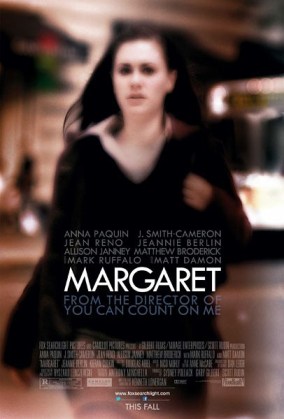
MargaretIt’s hard to talk about authorial intent in “Margaret” when the studio interference on the project was so insane.  Long story short for those who don’t know: the movie was supposed to be released in 2007, but Kenneth Lonergan failed to lock in a cut to Fox Searchlight’s satisfaction.  Ultimately, they quietly dumped a version of “Margaret” into the theaters that was much shorter that Lonergan would have liked.

And indeed, what I saw in the theatrical cut (sorry, folks, did not drop the money to watch the director’s cut) was a little messy.  But for whatever reason, that didn’t bother me.  I was along for the ride with “Margaret” the whole way through, drawn in to the story by its imperfections.

There’s something very fascinating about knowing that a movie’s flaws are not something invented in your head.  And in such a realization, you can start to find the diamond in the rough by peeling away the layers of sloppiness you observe.  “Margaret” in its very journey to the screen is not about the drudgery of life but rather the painful process of art.  There’s a little bit of magic in getting to find your “Margaret” inside of what Fox Searchlight and Lonergan slapped together for us to avoid litigation.

My “Margaret” is a compelling drama of post-9/11 guilt and anger unfolding in New York City, told from the perspective of an ordinary girl, Anna Paquin’s Margaret.  On just any old day walking, she observes the death of innocence at the hands of a vast piece of machinery.  No, I’m not talking about the planes flying into the World Trade Center; I’m talking about a sweet old lady being struck and killed by a bus.

I don’t want to overload the allegory, though, but it’s impossible not to feel the legacy of the tragic day looming over all the proceedings.  On a human scale, it’s an affecting tale of a mother (J. Smith-Cameron’s powerfully acted Joan) and daughter, a teacher (Matt Damon’s earnest Mr. Aaron) and a student, as well as victims, perpetrators, and observers.  And that’s the beauty of watching the imperfect “Margaret” – doing your own internal rack focusing is not just encouraged.  It’s practically required to make sense of the events.  B+3stars


REVIEW: Let Me In

29 04 2013

It’s rare to see a horror movie made with as much artistry as Matt Reeves’ “Let Me In,” and I think it’s all the more haunting because of that.  The film focuses on developing a hostile environment over cheap screams, a move that pays off in spades over the course of the film.

Believe it or not, the blood-sucking adolescent vampire Abby (the omnipresent Chloe Moretz) is hardly the most menacing villain of the film.  That dubious honor would belong to the bullies, who make life a living hell for the shrimpy but sweet 12-year-old Owen (Kodi Smit-McPhee of “The Road“) for no other reason than the fact that he’s an easy target.  And they aren’t just name-callers or lunch money-stealers; they want to inflict potentially life-threatening pain.  Maybe they are a little excessive, but after all, movies are a heightened reality!

The ravenous Abby inspires the unassuming Owen to fight back against his tormentors, and indeed he does.  But she also teaches him a thing or two about friendship and love, which seems to innocuously bloom between the two outcasts.  It’s this rose amongst a bed of thorns that gives “Let Me In” such a peculiar warmth and comfort amongst the bluntly portrayed horrors of Abby’s bloodlust.

All the while, there’s a peculiar undercurrent of Ronald Reagan and all that he has come to represent running throughout the film, an interesting setting change by Reeves.  It’s easy to tell he has a real vision for the movie and tender compassion for its characters.  That makes a difference in a horror movie, where everyone seems written only for the purpose of dying.  B+3stars


REVIEW: Anonymous

28 04 2013

I know I’m always calling for directors to expand their horizons and try different kinds of movies to see if any surprising realizations result.  So I really hope this doesn’t come off as hypocritical, but Roland Emmerich should really just stick to apocalyptic disaster movies like “Independence Day” and “2012.”

I applaud the director for trying a conspiracy theory flick that actually plays like – gasp – drama, something that would appear to be totally out of his wheelhouse.  It’s far bolder a choice than, say, Michael Bay, whose “Pain and Gain” literally just appears to be a micro version of “Transformers” without those pesky anthropomorphic robots.  But now that we’ve found out that Emmerich is not capable of meeting the demands of something this serious, he should just go back to blowing up culturally iconic landmarks with his regular gusto.

Anonymous,” an exploration of the not-so-hotly debated question of Shakespeare’s authorship of his famous plays is pretty much a failure from the get-go.  I couldn’t keep up with any of the characters, which is a problem in a movie with many of them.  The relationships were fuzzy, and on top of that, alliances and allegiances were never clear.  For a movie on a human scale, these are basic necessities that need to be established.

Sometimes I zone out when watching movies but can pick up enough context to still follow the basic plot and direction of the film.  Such was not the case with “Anonymous,” surprising in a cast that included Rhys Ifans, Joely Richardson, David Thewlis, and Oscar-winner Vanessa Redgrave.

I just thought it was a big, fat messy ink blot of a movie.  However, I bear no animosity for Roland Emmerich attempting to do something out of the ordinary.  There are many things “Anonymous” is not, although perhaps the only positive thing on that list is that the movie bears little to no resemblance to “2012.”  C-1halfstars


REVIEW: The Company You Keep

27 04 2013

There are all sorts of cinematic experiences you can have these days when going to the movies.  Sometimes, as was the case with Robert Redford’s “The Company You Keep,” I felt like I was mostly just following the events unfold as opposed to actively watching the film.  Sure, I was taking it in, but it reminds me of the experience of reading SparkNotes or a Wikipedia summary – not exactly engaging or satisfying, in other words.

Redford appears to be angling to win the SAG ensemble award on paper with this cast of Oscar winners, nominees, and Shia LaBeouf.  Though with this A(ARP)vengers of ’70s and ’80s greats assembled, you’d think the drama would not be so turgid and lifeless.  It’s stiff and uninteresting as both a journalistic crusade as well as a fugitive thriller.

The more I thought about it, the more I realized this had all the potential to be “All The President’s Men” meets “The Fugitive.”  Both those movies had tension, though, and Redford can’t even manufacture it synthetically with a Cliff Martinez (“Drive,” “Contagion“) score.  The characters also lacked depth, both in terms of emotional development as well as decent dialogue for them to say.  Everyone speaks in self-righteous platitudes in “The Company You Keep,” making for some rather excruciating confrontations.

With all that’s going on these days, an old home-grown terrorist and a young maverick journalist in the era of print media’s growing obsolescence should be a no-brainer for fascinating conflict and thought-provoking meditations on the world we live in.  But it just goes to show the even with the company Redford keeps – Julie Christie, Sam Elliott, Brendan Gleeson, Terrence Howard, Richard Jenkins, Anna Kendrick, Brit Marling, Stanley Tucci, Nick Nolte, Chris Cooper, and Susan Sarandon – you can’t just throw acclaimed actors and actresses in a pot and expect it to boil.  C+2stars


F.I.L.M. of the Week (April 26, 2013)

26 04 2013

I’ve now (finally) caught up with David Lynch’s “Blue Velvet” and “Mulholland Dr.”  Those films have given me an idea of what the term Lynchian really means.  Yet while both of those movies have their merits, the director made an entirely different movie called “The Straight Story” that’s virtually unrecognizable in his ouvre.

I saw this simple, straightforward film at the age of 7 upon its release in 1999.  Even then, its beauty was not lost on me.  I recently watched it again only to find that my critical instincts from a very young age were completely vindicated, so I figured it would make an excellent pick for the “F.I.L.M. of the Week.”

Though it’s easy enough for a child to understand, this is a film that works for everyone ages 7 to 77.  “The Straight Story” is about family, love, and dedication at its purest.  The late Richard Farnsworth, nearing the end of his life as the movie was shot, pours his heart and soul into the role of Alvin Straight.  He’s a simple country man in deteriorating health unable to drive a car to visit his ailing and estranged brother, Lyle (Harry Dean Stanton).

But that doesn’t stop the iron-willed Alvin.  He decides to buy a tractor and drive it from his home in Iowa all the way up to Lyle in Wisconsin.  At a speed of never more than 6 miles per hour, Alvin and his trailer chug through America’s heartland.  Along the way, he meets fascinating people that give the journey a powerful emotional component.

Lynch has called “The Straight Story” his most experimental film, a strange distinction given some of the bizarre things that have happened in some of his other movies.  However, the film isn’t merely worth remembering due to the fact that the raw, unadulterated compassion is emanating from David Lynch.  It’s one of  the sweetest, most heartfelt films I’ve ever seen from any filmmaker, period.  This is the ultimate family movie, so gather everyone around the television and watch it with the whole crew.


REVIEW: See Girl Run

24 04 2013

See Girl RunI am literally one of the biggest and most devoted “Parks and Recreation” fans out there. So when I say that I could not even remotely enjoy a movie starring the show’s unsung hero, Adam Scott, you know that the movie is a dud.

I really did want to like “See Girl Run,” a rom-com by sophomore director Nate Meyer.  I had the privilege of hearing him do a Q&A after the screening of the film at the RiverRun International Film Festival last year, and it did make me appreciate what the film was trying to do a little bit more.  But ultimately, I don’t grade a film based on concept; I evaluate it based on execution.

And in the end, “See Girl Run” fails to do anything interesting.  It’s not formulaic, per se, but I felt like I had seen the concept or story played out before.  I don’t even think the movie is worth the effort for me to go look up the plot summary, so needless to say, it’s a forgettable flick…

I do remember there being no chemistry between leads Robin Tunney and Adam Scott, largely because they share only one scene together!  That’s right, the film’s romantic leads, and they don’t talk to each other until the climax.  I suppose it’s bold, but Meyer builds up so much to this scene, and it can’t help but disappoint.

Scott is a bright presence, I suppose, but watch “Parks and Recreation” if you really want to see him in action.  Tunney, on the other hand, plays a brutal character who can’t decide which man or life she wants.  It works when Reese Witherspoon does this because she brings a charm and levity to the bind.  Tunney is just a lot of angst and whining.  If there was supposed to be a “realist” aspect to this, I found it shallow at best, unconvincing and uninteresting at worst.  C-1halfstars


REVIEW: The Kings of Summer

23 04 2013

The Kings of SummerRiverRun International Film Festival

More and more, I’ve come to appreciate movies that can use montage to great effect.  Scenes have their own power, sure.  We remember those scenes from our own life; they constitute reality.  But that’s not always how we remember our lives.  We see them in glimpses and flashes, which add up to make truth.

Even though it might not connect at every moment, sometimes a well-edited montage can capture the ephemera of life with such raw power that they tap into and connect with something deep within ourselves.  The most obvious example in recent memory is Terrence Malick’s “The Tree of Life,” whose camera floats through life itself and reaches you with evocative imagery (even if its story leaves you unmoved or just plain confounded).  More subtly, films like “Up in the Air” and “The Artist” have caught these moments of fleeting joy in well-cut dance scenes.

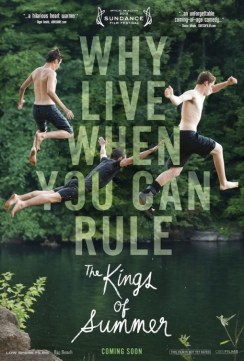
The Kings of Summer,” though it features a compelling narrative that plays like “Superbad” meets “Moonrise Kingdom,” is at its best when it captures these brief snapshots of unfettered adolescence.  Though I’m still in the process of moving into full independence, I can look back on the days of yearning for escape from my parents’ house with the slightest bit of nostalgia.  And while the majority of the film is silliness and shenanigans, every once in a while an image would flash on the screen that really got at something subconscious within me.

Read the rest of this entry »