REVIEW: My Week with Marilyn

14 01 2012

While I’m always urging filmmakers to push the envelope, sometimes it can be nice to see a movie that takes no risks and is proud of it.  Provided that the movie is pleasant, easygoing, light and breezy like a Sunday stroll in the park, these movies can be a real treat to sit back, relax, and enjoy.  Very few movies get my “Sunday stroll” certification, and “My Week with Marilyn” earns it with ease.

It’s a little more serious than the usual stroll, but it’s a great deal of fun to watch largely because of how easily Michelle Williams totally loses herself in the persona of Marilyn Monroe.  She effortlessly brings to life the charm, the sultriness, and the seduction of the actress, making us wonder if we’re falling in love with Monroe all over again – or Williams for the first time.  While she has shocked in “Blue Valentine” and riveted in “Brokeback Mountain,” Williams has shied away from endearing and glamorous characters.  Yet with Marilyn Monroe, it provides the perfect marriage of her stunning, red-carpet looks and grace with her remarkable ability to plumb the depths of tortured and confused women.

The script by Adrian Hodges gives Williams an ample base to build her interpretation of Monroe without constraining her artistic decisions.  She may spout some lines we would expect the famed actress to say, but he thankfully realizes that the majority of the performance would come from her physicality and the bubbling psychological torment she builds up so deftly.  It’s a perfect blend of understated and flashy that will make you want to spend a week with Marilyn.

Read the rest of this entry »


F.I.L.M. of the Week (January 13, 2012)

13 01 2012

If you’ve been wowed by “The Artist,” no doubt you wondered where the dream team of writer-director Michel Hazanavicius, actor Jean Dujardin, and actress Bérénice Bejo came from … and maybe you even wondered where you could get more.  Well, thankfully for the Americans who are discovering their abundant charm, the three of them have teamed up before in “OSS 117: Cairo, Nest of Spies,” my pick for the “F.I.L.M. of the Week.”  As a parody of James Bond and other entries into the super-spy genre, it’s a spot-on tongue-in-cheek take to remember.

Dujardin, often said to be the French equivalent of George Clooney, stars as Hubert Bonissieur de la Bath – code name OSS 117.  In 1955, he’s sent to investigate the death of fellow agent and close (perhaps too close) friend Jack in Cairo, where he stumbles into a web of international espionage involving Egyptians, British, Russians, and Nazis with a very personal score to settle.  He also has to deal with women fawning all over him, including his femme fatale escort Larmina El Akmar Betouche, played with charm by Bejo.  Together, and at times separately, they work to get to the bottom of Jack’s murder with intrigue and hilarity following them always.

Hazanavicius is an incredibly astute observer of style, and much like “The Artist” felt like a movie straight out of the 1920s, “OSS 117” feels like pure 1960s campy fun.  The difference is in the approach – while the early Bond movies were cool but unconsciously a little corny, this movie is unabashedly and fully intentional in their ridiculousness.  OSS 117 is an outrageous character, as clumsy and bumbling as he is suave.  He spends more time insulting Larmina’s culture and customs than he does wooing her, yet she’s totally seduced nonetheless.  Hazanavicius toys with our preconceived notions of the genre in such clever and crafty ways, subverting them so effectively and often that I doubt I’ll ever watch a Bond movie in the same way.


REVIEW: The Iron Lady

12 01 2012

I can’t imagine painting a cinematic portrait of British Prime Minister Margaret Thatcher, a controversial and important figure in history, would be easy.  However, I’m almost certain that a fairer and more complete one that the one “The Iron Lady” presents can be forged.  It’s less a portrait than a profile, meant only to show her dark side and highlight her demons rather than her successes.
While I’m definitely open to people finding innovative new ways to approach the tired and typical de rigueur biopic, screenwriter Abi Morgan’s solution doesn’t give us an overview of Thatcher so much as it gives us her opinion of Thatcher.  By anchoring the movie in her declining years as she suffers from Alzheimer’s and the resultant hallucinations of her deceased husband Dennis (Jim Broadbent), “The Iron Lady” starts with the proposition that Margaret Thatcher is crazy.  Director Phyllida Lloyd then complements this by giving these scenes the ambience of paranoid thriller as she slips in and out of reality, all the while wondering if her caretakers will take her away from home.

Then, once her spacey unreliability has been established, they begin the voyage into her storied past from her days as Margaret Roberts, the grocer’s daughter, to her rise in the Conservative Party all the way to the top position as Margaret Thatcher.  The structure barely works as it stands because it shifts so abruptly, giving the movie the same uneven and rough feel that Lloyd bequeathed to her film adaptation of “Mamma Mia.”  But the worst part is that, whether it came from Morgan’s script or Lloyd’s direction, the voices don’t go away and Thatcher is made out to be crazy even when she was totally in her right mind.

Read the rest of this entry »


REVIEW: War Horse

11 01 2012

One of the best compliments I can give “War Horse” is that it feels like Robert Zemeckis’ “Forrest Gump,” just following a smart horse instead of a dumb man.  Both films are among the best cinematic examples of cinematic historical fiction, showing the way things were through unique perspectives that make us rethink how we ourselves see them.  They extoll the power of one good, pure-hearted soul to intertwine us all into a common destiny – and then throw in beautiful landscapes, gorgeous sunsets, and a poignant score by maestro John Williams.

By now, you’ve probably heard all the main talking points on this movie.  Detractors decry it for being all schmaltz and sentimentality, as if they were so far below Spielberg.  Fans love it for its warmth and touching narrative, as if Spielberg had lost his mojo since “Schindler’s List.”  Basically, they just found different ways to react to same thing: this is a movie designed to tug on your heartstrings in thinly-veiled manipulation using old-time technique and sensibility.

You can choose to either judge this movie on principle or on execution; I choose the latter as the movie is unapologetically and unabashedly what it is, and that’s totally fine with me.  Where it becomes an issue, though, is when it falls just short of the lofty expectations it sets for itself.  Granted, it’s a little unfair to judge Steven Spielberg against his own work, which contains many of the modern masterpieces of our time, but it lacks both the visceral and the emotional intensity of his previous films that “War Horse” can’t help but harken back to.

Read the rest of this entry »


REVIEW: Hugo

10 01 2012

It’s slightly disingenuous to make a film all about the magic of the movies and then have little to offer itself in the way of enchantment, but that’s what Martin Scorsese’s “Hugo” is – take it or leave it.  His ode to the pioneering days of cinema, when trailblazers like the Lumière Brothers began making movies and Georges Méliès invented special effects, is definitely heartfelt and powerful enough to awaken plenty of latent nostalgia.  However, his movie serves as a better tribute to their genius than it does as an equally majestic film deserving to stand alongside them in the annals of history.

What I left the theater being nostalgic for was “Goodfellas” and “The Departed” and “Gangs of New York.”  While I certainly admire Scorsese for taking on a radically different project, and good for Paramount to give him $150 million to realize this passion of his, I missed the bullet-riddled, F-bomb filled director that I’ve come to love.  It’s a very finely crafted movie, clearly the work of an expert like Scorsese.  All of the below-the-line elements are as good as ever with his usual suspects – editor Thelma Schoonmaker, costume designer Sandy Powell, production designer Dante Ferretti, and cinematographer Robert Richardson – returning to whisk us away to a train station in 1930s Paris with astounding precision.

Read the rest of this entry »


REVIEW: The Artist

9 01 2012

There’s more than just silence that makes “The Artist” a magical throwback to a bygone era.  Writer and director Michel Hazanavicius uses an old style to capture an old-fashioned mood of narrative simplicity and purity, and he executes it with such grace and elegance that it becomes absolutely irresistible.  However much ice your heart may have accumulated over the year, this movie is bound to – at least in a few moments if not in its entirety – melt some layers and make you feel moved like your grandparents did before the talkies came around.

If the sheer bliss of being transported back to a simpler era like Owen Wilson in “Midnight in Paris” (minus the reality check at the end) doesn’t get you, then the sheer charm of the movie is bound to make you weak at the knees.  Between the wonderfully emotional story, the jaunty score by Ludovic Bource, and the magnetic and charismatic performances of the lead actors, Jean Dujardin and Bérénice Bejo, the undeniable heart of the movie will register with you on some deep, emotional level at least in fleeting moments.  For me, the “Waltz for Peppy” sequence is one of the most beautiful, touching scenes committed to film in recent memory, ranking in the pantheon with the postcards scene from “Benjamin Button” and the wedding sequence from “Up in the Air.”

You can’t refute the passionate love behind crafting “The Artist;” however, you may be able to resist falling passionately in love with it.  The movie’s simplicity and breeziness, while a main component in making sure the film’s silent strategy works, also leaves a bit of longing for something more.  While there are moments where Hazanavicius exhibits a Charlie Kaufman-esque flair for the meta, overall, the movie lacks a great spark of originality in its plot.  At times, it settles for clever homages to movies like “Singing in the Rain” and loving winks to classics like “Vertigo” where it could have forged its own trail.

Read the rest of this entry »


REVIEW: The Adventures of Tintin

7 01 2012

You don’t need to know who Hergé’s Tintin is to enjoy the “The Adventures of Tintin,” all you need is to be primed for an exhilarating and fun adventure with the man who introduced many of us to adventure itself, Steven Spielberg.  Whether it was “Jurassic Park,” an “Indiana Jones” movie, or “E.T.,” the director – whose name has become synonymous with cinematic virtuosity – has once again vividly realized the power of technology to invoke an old-fashioned sense of wonder in movie watching.  With the motion-capture technology looking more real and life-like than ever, it makes for an interesting paradox that “Tintin” removes you so easily from reality while so seamlessly replicating it.

Thanks to Spielberg’s partnership with Peter Jackson and his visual effects team at WETA, the two filmmakers take leaps and bounds from the early Zemeckis films like “The Polar Express” and “Beowulf” to fully capture the complexity of human anatomy and emotionality.  As a result, there’s nothing to distract you from getting fully engrossed in this old-fashioned Spielbergian adventure, no moment where you can think that a character looks fake or like an out-of-place animated replica.  It has been remarkable to watch this technology improve over my lifetime, and “Tintin,” along with “Rise of the Planet of the Apes,” makes 2011 a landmark year for its progression.

Read the rest of this entry »


F.I.L.M. of the Week (January 6, 2012)

6 01 2012

With previous Oscar winners George Clooney and Tilda Swinton coasting towards another nomination for “The Descendants” and “We Need to Talk About Kevin,” respectively, it’s as good a time as ever to feature a movie they starred in together, Tony Gilroy’s “Michael Clayton.”  The 2007 Best Picture nominee (and winner for Swinton’s performance) is a gripping legal thriller that never takes you farther than a deposition room but provides legitimate fodder for thought beyond the annals of the court.  Gilroy presents three characters, played by Clooney, Swinton, and Tom Wilkinson, who each must consider what place morality and truthfulness has in their lives and in their jobs as lawyers.

It all begins with Jerry Maguire-esque moment of awakening for Wilkinson’s Arthur Edens, an incredibly respected New York attorney, who suddenly realizes that he no longer wishes to deny his conscience by representing UNorth in a class action lawsuit that violates his ethics.  After meeting with the victims of the company’s agrochemical products, the class action suit suddenly gets a human face for him … and Arthur feels the need to purge this skin of falseness so urgently that he strips naked in the middle of a deposition room.

While Arthur has a history of mental shakiness, Clooney’s Michael Clayton, the fixer for their firm Kenner, Bach & Ledeen, knows that there’s something more to the meltdown that a few chemical issues.  Michael, facing staggering debt from a failed restaurant and questioning the value of his job, is forced into a rigorous self-examination that Clooney animates with the perfect balance of internalized and externalized emotion.  He proves himself to be one of the best, if not THE best, actor of his generation at exploring tortured souls.  He realizes Michael’s flaws so vividly but finds some hidden nobility so we care about the journey even while vacillating on our opinion of the character.

Meanwhile, the scene stealer is Swinton’s Karen Crowder, the general counsel for UNorth.  She’s an über-Type A perfectionist who labors and frets over the smallest of details and really has no idea how to handle a situation like Arthur’s, which threatens to undo years of litigation and jeopardize millions of the company’s dollars – not to mention their reputation.  As he descends into madness (or a divine clarity depending on where you stand), she descends into a professional hell where her off-the-record, back-alley decisions make the difference for the fate of the lawsuit.  Karen, like the rest of the characters in the movie, are so richly written by Gilroy, who uses them to explore complex issues without ever being preachy or turning “Michael Clayton” into a silly morality play. In an era where “Inside Job” shows the actual moral bankruptcy of corporate America, the four-year-old movie remains incredibly relevant.


REVIEW: A Dangerous Method

5 01 2012

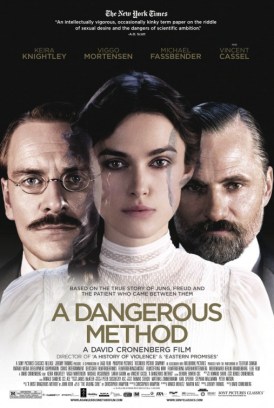
If I were sitting in a test screening or reviewing the script of “A Dangerous Method,” I could sum up all my reactions in a lyric from an Elvis Presley song: a little less conversation, a little more action please.  There’s plenty of interesting psychoanalytic banter between the three main characters, but from the beginning it  is evident that screenwriter Christopher Hampton is much like the long-winded priest of your childhood who is perfectly content to listen to himself talk all day.  While it can be intellectually stimulating at times (although its appeal might be limited to those with prior knowledge in the field of psychology), director David Cronenberg makes little case for why this should be a movie and not a textbook or an educational play at the Museum of Natural History.

That’s not to say that the feud between the psychoanalytic master Freud (Viggo Mortensen) and his thoughtful analytic practitioner Jung (Michael Fassbender) doesn’t have its moments of compelling drama, nor does it mean that the taut sexual tension in the doctor-patient relationship between Jung and the crazy/crazily intelligent Sabina Spielrein (Keira Knightley) isn’t an interesting study of sexual desires and repressions.  But Cronenberg’s movie, largely due to Hampton’s script, is at war with itself, unable to decide what it is and how it wants to address its internal contradictions.  The balancing act is made especially difficult by the fact that the battle of the minds is a rather understated conflict while the battle of the sexes is garishly over the top due to Knightley’s performance.  Is it a movie of ideas or a movie about Jung’s self-examination through those ideas?

Read the rest of this entry »


REVIEW: Mission: Impossible – Ghost Protocol

4 01 2012

Leave it to Brad Bird, a member of the Pixar brain trust responsible for such triumphs as “The Incredibles” and “Ratatouille,” to figure out how to make the year’s purest, most enjoyable action movie with “Mission: Impossible – Ghost Protocol.”  For 135 minutes, the adrenaline pumps steadily as the eye is treated to a potpourri of dazzling stunts followed by stunning cinematography.  It’s skin deep, sure, but Tom Cruise has been unabashedly likewise for years, so who cares?  Movies like this are supposed to be fun, and so often they aren’t.  This one is.

Maybe it’s the sort of child-like wonder and awe that Bird brings with him from Pixar that makes this movie “Mission: Enjoyable.”  But whatever that X factor is, it works well.  There’s slightly less substance and character development than J.J. Abrams’ last installment in the series five years ago, which also featured one of the most maniacal villains in recent memory in Philip Seymour Hoffman’s Owen Davian.  But when you’re seeing Tom Cruise actually scale the world’s tallest building in the world – yes, he actually did that stunt himself – Bird more than compensates for the film’s major shortcoming.

He draws on two valuable resources to make the movie such ruckus fun.  The first is simplicity: it’s much easier to enjoy the ride when you aren’t having to keep track of a million different characters and names caught up in a huge scheme of political espionage.  When it’s Tom Cruise’s Ethan Hunt, being as corny and ridiculously impetuous as ever, being backed up by an eclectic IMF squad going against a crazy Swedish scientist and a small gang of confederates trying to nuke the world, it makes it easier to sit back and enjoy the car chases and the cool gadgets.

Read the rest of this entry »


REVIEW: Sherlock Holmes: A Game of Shadows

4 01 2012

I was largely against popular opinion with my disappointed ambivalence towards Guy Ritchie’s first “Sherlock Holmes” film, writing two years ago that “it fails to captivate and engross like detective stories are supposed to do.”  I then went on to make a statement that is now quite ironic: “I do look forward to seeing the sequel which was clearly set up in the ending, hoping in the meantime that Ritchie and his team can figure out a way to get me more engaged.”

Well, here we are, two years later, and I’ve seen “Sherlock Holmes: A Game of Shadows,” Ritchie’s follow-up.  As I sat in the theater and each interminable minute passing felt like five times as long, I wished I could have been sitting in the first movie.  Everything wrong about the 2009 reimagining of Arthur Conan Doyle’s classic detective series was multiplied and magnified, and most of what was done right was gone entirely.  Robert Downey Jr. is now skating on thin ice with me as I’m now almost totally averse to his pompous smugness.  It was awesome in “Iron Man,” amusing in “Sherlock Holmes,” annoying in “Iron Man 2,” and it’s just acrid in “A Game of Shadows.”

He’s suffering from what I’ve dubbed “Johnny Depp syndrome” – a performance and a persona dubbed iconic will eventually become an imitation and a mere shadow of its former self if repeated multiple times.  And with a movie this poorly plotted, Ritchie needed Downey at his A-game … and wound up getting probably about a C or a C minus-game.  His Holmes, this time around, feels jaded and bored, which makes me wonder if it’s the character or the actor who we are really seeing reflected on the screen.

Read the rest of this entry »


REVIEW: Contagion

3 01 2012

While talking to a friend who was on the fence about seeing “Contagion,” I threw out the following selling point without really even thinking: “It’s a Steven Soderbergh movie.”  Then I recoiled for a second and actually thought about what that meant.  Granted, I haven’t seen his watershed indie “Sex, Lies & Videotape,” but when I look back at his filmography, I wouldn’t label many of them directorial triumphs.  “The Informant!” succeeds mostly because of Matt Damon, “Erin Brockovich” is 100% Julia Roberts, and the slickness of the “Ocean’s” series is what made them popular.  “Traffic” is, I suppose, although I don’t think I would recommend that.

So a Soderbergh movie with a cast of eight Oscar nominees (so many that two didn’t even make the poster) had no shot at being a director’s movie … or so I thought.  Surprisingly, this is a movie where Steven Soderbergh is the biggest and most brightly shining of all the stars.  He’s in total control of this vehicle, setting the mood from the first frame and then keeping it an even-keeled movie even when Scott Z. Burns’ script goes a little haywire.

In a time where hyperlink cinema has become a hackneyed plot device, Soderbergh, one of the pioneers of the style with “Traffic,” reminds us why it’s even around in the first place.  These stories can be linked across countries because technology and globalization has made us linked into a common destiny. Yet in the decade since “Traffic,” several events have linked us as well: 9/11 and various disease threats, such as SARS and the swine flu scare.  A thin thread of paranoia connects us all, and Soderbergh gently reveals to us that this link exists in the opening stages of the film.  And then he proceeds to vibrate that thread at pulse-pounding frequencies with his unflinching realism to then make sure we feel that uncomfortable pit in our stomach every single second of the film.

Read the rest of this entry »


REVIEW: New Year’s Eve

2 01 2012

What were you doing this new year’s eve?  I hope you were celebrating with those you love or just celebrating in general.  But if you happened to be at the movie theater, I pray that you were nowhere near the egregious load of crap disguised as a movie called “New Year’s Eve.”  If you were one of those looking to get in the holiday spirit, I surmise you walked out not blissful for the year to come but rather disgusted that movies like this are allowed to exist.

Only see the movie for the following reasons:

1. You for some reason like to watch bad actors doing bad acting.  Yes, Katherine Heigl, you should not have spit in Judd Apatow’s face because he actually gave you a multi-dimensional character.  Now, enjoy being stuck in movies like this and “Life As We Know It” for the rest of your life.  Zac Efron … it’s official, your glory days were in the “High School Musical” era.  And in case you need a reminder, many musicians can’t act – looking at you, Ludacris and Jon Bon Jovi.  Oh, and Lea Michele too, who somehow to forgot how to act between “Spring Awakening” and “New Year’s Eve,” picking up how to be a gratingly obnoxious diva.  (Wait, she got that from “Glee!”  Thanks a lot, Ryan Murphy…)

2. You for some reason like to watch good actors doing bad acting.  Can you count the Oscar wins and nominations on this poster?  13 Oscar nominations and 5 wins.  While we can’t get the Academy to reclaim the statues (and indeed they shouldn’t), we as a public can take away their credibility and prestige.  I just don’t understand why Robert DeNiro can’t seem to stop the out-of-control downward spiral that is his career.  Strangely enough, the most unbearable members of the cast is a horserace between two-time Oscar champion Hilary Swank and three-time Oscar nominee Michelle Pfeiffer.  Any good will for a career comeback after “Hairspray” just went down the drain.

Read the rest of this entry »


REVIEW: The Girl with the Dragon Tattoo (2011)

1 01 2012

Dragon TattooWhile on the path to triumphant Oscar glory last year, Aaron Sorkin made the wise observation that no matter what movie he chose to do next, it would always be seen as “the movie after ‘The Social Network.’” The same could be said for director David Fincher, snubbed of a much-deserved Oscar for a movie he clearly crafted with an intricate and delicate precision. “The Girl with the Dragon Tattoo” is no different as Fincher’s immaculate visual sensibilities dazzle the eye consistently for over two and a half hours; however, it suffers because of its placement in the director’s canon.
Had it preceded the masterpiece rather than succeeded it, there would probably be a river of praise flowing about his adaptation of Stieg Larsson’s international bestseller. But the specter of Mark Zuckerberg lurks insidiously like an elephant in the theater, making any viewer familiar with Fincher’s work consistently aware of the fact that something is keeping the movie from being truly great. Never is there that sense of jaw-dropping, mind-blowing state of total awe that the director has inspired so many times in his previous features. “The Girl with the Dragon Tattoo” may be his first movie that fails to live up to the promise of its trailer. (To be fair, Fincher’s movies always seem to have the BEST trailers.)

That’s not to say there isn’t plenty to marvel at in the movie. The story is incredibly engaging, and it gets a great visceral charge from Steven Zaillian’s faithful script and Fincher’s knack for palatable sadism. Taking a 700-page book and compressing into a single movie is no simple task, and “The Girl with the Dragon Tattoo” is particularly dense on the page with its labyrinthine family structures, concurrent narrative arcs, and taut mystery. Whether it came from Zaillian in the writing or Fincher with editors Kirk Baxter and Angus Wall in the cutting room, the pacing is a marvel of control, never bloated or convoluted. The 158 minutes go by very quickly as the plot moves along at a nice, even clip.

Read the rest of this entry »


REVIEW: Insidious

13 10 2011

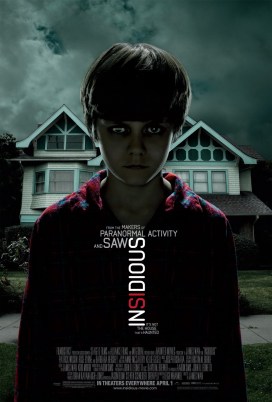
The only kind of horror that has any sort of power over me is ambiental terror, such as “The Exorcist,” “Rosemary’s Baby,” and for a modern example, “Paranormal Activity.”  Any hooligan can orchestrate something to jump out of an obscure spot as an eerie violin slowly vamps to a forte; it takes skill and artistry to craft a lingering sense of foreboding doom.  While “Insidious” would like to join this club, it really falls short of the mark on some basic levels.

It’s clearly aiming for “Exorcist”-level scares with the whole demonic child plot device.  Dalton Lambert winds up in a coma after a freak accident, throwing his grief-stricken parents (Patrick Wilson and Rose Byrne) into distress and panic.  When all sorts of strange and paranormal activities start to occur, they quickly blame the house.  But according to the advice of a spectral expert, the fault is not in their house but in Josh and Renai’s baby.  (Yes, I did just work in references to all three of the movies I mentioned in the opening paragraph.  I had to find some way to make this lackluster movie have some sort of memorable review.)

It won’t take me long to quickly sum up the major flaws of “Insidious” – the exposition is too prolonged and uneventful, the atmosphere is never well established, and the story takes multiple turns towards the ridiculous and absurd towards its finale.  It gets so bizarre that I think Tom Cruise and his Scientologist buddies would even call it far-fetched.  But at least it excels at doing what many sub-par horror movies have to settle for achieving: entertainment.  C+ /