According to the American Film Institute, it’s the eighth funniest movie and third best romantic comedy ever. The Library of Congress has added it to the National Film Registry of movies deemed “culturally, historically, or aesthetically significant.” It was the first movie to win the “Big Five” Academy Awards: Best Picture, Director, Actor, Actress, and Screenplay. By all measures, Frank Capra’s “It Happened One Night” is a movie for the books.
So then why was I so unaffected by it? Is the movie really so seminal that it feels hackneyed and trite in retrospect?
My conclusion is yes, “It Happened One Night” is a movie that contributed so much to the medium of cinema that Frank Capra’s film itself looks so small in comparison. The fact that the “opposites attract” premise is still the dominant plot point of romantic comedy over 75 years later should serve as testament enough to the movie’s influence. While my lack of definitive cinematic knowledge prohibits me from declaring with certainty that this is the first movie to introduce the idea, I think the movie’s widespread industry and critical acclaim cemented that the formula was acceptable.
I wouldn’t DARE compare a Frank Capra movie to a horrible Jennifer Aniston movie, but I will say that “The Bounty Hunter” sure did rip off this classic. The romantic comedy babe, played here by a star of the century, Claudette Colbert as Ellie Andrews, is a spoiled brat running away from her tyrannical father. The hunk is the great Clark Gable as Peter Warne, a rogue reporter looking for a story … and finds one in her. The story is amusing enough, but it’s very cut and dry. I’m happy to call it generational differences because I sure can respect “It Happened One Night,” but that doesn’t mean I have to be head over heels for it.
OK, don’t get me wrong, I can enjoy immature humor. And I can be very amused and moved by James Franco. And I love Danny McBride. If you’ve read this site at all in the past year, then you know that I REALLY love Natalie Portman. But man, oh man, did I hate “Your Highness!”
Every aspect of this movie reeks of an imbecilic juvenility, from the ridiculous high-concept to its poor execution. The whole idea of the movie seems to have stemmed from McBride watching “A Knight’s Tale” when he was just a little too baked. I’m sure with enough marijuana in your system, the idea of combining the raunchy comedy with the medieval epic sounded awesome. Heck, it even sounded kind of funny in a synopsis and in a trailer.
But somewhere between McBride’s brain and my laptop screen, whatever connection “Your Highness” had to comedy was lost. Instead, what I wasted $4 on iTunes for was a comedy in name only, something so void of laughter that I couldn’t even be amused or endeared by its ridiculous vulgarity. The lack of effort put into the movie was apparent from the first scene when McBride broke his accent no less than five times, and the movie just continued to deteriorate from there.
I’m sorry, but Danny McBride just being Danny McBride isn’t funny; he needs a good script to make him that way. I’m sorry, but James Franco playing dumb just doesn’t work when he’s done “Pineapple Express” already (and “127 Hours” too). I’m sorry, but Natalie Portman, between this and “No Strings Attached” in 2011, should really just stay out of comedy altogether. And I’m really sorry, Hollywood comedy gurus, but you can’t just whip out the phallus of a Minotaur for an easy laugh. Believe it or not, you actually have to try. Sorry to be the latest bearer of bad news. D+ /
The sports movie is in a rut, I’ll just go ahead and say it. When movies like “Warrior” receives almost unanimous acclaim and “The Blind Side” can get a Best Picture nomination, the genre is in need of an influx of creativity and ingenuity. And what better movie to do that than Bennett Miller’s “Moneyball,” a movie that is actually about creativity and ingenuity?
Miller, along with screenwriters Aaron Sorkin and Steven Zaillian, pulls off a feat not unlike that accomplished by Billy Beane and the Oakland A’s: working within the framework of a failing system, they employ clever cinematic maneuvering and ingenuous thinking to create a fantastic societal and self-examination. Michael Lewis’ non-fiction tome is about putting the brains back in the business of sports; Miller’s film is about one man trying to find his heart again in sports by using math as a means to achieve his long-sought satisfaction. It may be that “Moneyball” uses sports only as a backdrop for its deeper, probing questions, something that wouldn’t be entirely uncharacteristic of Sorkin, who just last year won an Oscar for using the rise of Facebook in “The Social Network” as a setting for an exploration of modern power, greed, and friendship.
So while sports fans may be disappointed that “Moneyball” is not a sports movie but rather a movie about sports, Hollywood will no doubt continue to spit out run-of-the-mill, color-by-numbers inspirational movies for them. Everyone else, on the other hand, can marvel at a movie about athletic competition that doesn’t teach us the hackneyed values of the triumph of individual will over adversity. While glorifying impressive human achievement makes us feel good, Sorkin doesn’t indulge us in such escapism. In 2011, we must face the fact that we don’t always win, the system may overpower even the most brilliant of ideas, and satisfaction isn’t just a win or a loss away.
“Battle: Los Angeles” may be the worst Michael Bay movie not made by Michael Bay. And regardless of who directs a stereotypical “Michael Bay movie,” you should probably know that my recommendation for that movie can be summed up in one word: RUN!
Jonathan Liebesman directs a symphony of discordant noise and pathetic human drama without even the slightest hint that he knows he’s making a truly painful movie. It’s a nearly two-hour long (still a marathon but no “Transformers“) montage of bullets flying and strange aliens invading shot in a gritty documentary style. It has no substance, no emotional pull, no fantastic special effects, no impressive technical aspect. It’s just a waste of time.
How can I fill this obligatory third paragraph? Hmmm … I could blast Aaron Eckhart for taking two giant steps backwards from all of his independent and mainstream successes. I could ask why Michelle Rodriguez, Bridget Moynahan, and Michael Peña chose this movie, but I don’t necessarily put their acting skills on a pedestal. I could ask why this movie isn’t acted solely by rappers like Ne-Yo (models might have also done this nonexistent script justice), but all the “why?” questioning won’t get me those two hours back. Maybe one of these days, I’ll learn my lesson. D /
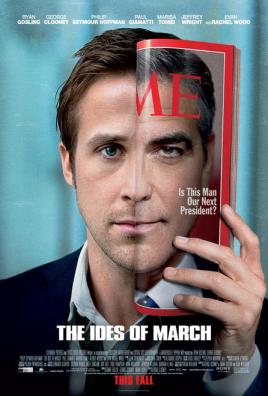
George Clooney’s “The Ides of March” makes plenty of references to the brokenness of the American political system, something you can observe by merely turning on the news nowadays. But perhaps the most problematic indicator of the nation’s shortcomings is how easily the film can be read as a black comedy. Clooney and co-writer Grant Heslov’s script is chock full of cruel ironies, many of which are veiled references to various political scandals. And the very liberal Clooney is all too happy to throw Bill Clinton, and to some extent, Barack Obama, under the bus.
In an era where Congressmen send lewd pictures over Twitter, governors have foreign mistresses, and presidents act improperly with interns, is it possible that we’ve become so desensitized to scandal that we have just accepted that the system will fail us? “The Ides of March,” with its grandiose plot of political intrigue, seems to imply yes by the lengths it has to go to shock us. And in 2011, when public opinion seems to have turned against the establishment, this may be the movie people watch in the future to see American disillusionment and the failure of Obama’s hope and change rhetoric.
I don’t quite know what inspired me to watch “25th Hour” recently, but I’m certainly glad that I did. Spike Lee’s 2002 film about the heavy weight of the past and the future that we carry around in the present got little attention at the time, but over time, it has gained some passionate backers, namely Roger Ebert. That inspired me to check the movie out, and while I don’t think it’s one of my favorites of the decade, it’s good enough to qualify as a “F.I.L.M. of the Week.”
David Benioff’s script captures a day of solemn importance in the life of Montgomery “Monty” Brogan, played with typical excellence by Edward Norton. We follow Monty in the last 24 hours before he must head up to prison to serve a 7 year sentence for dealing drugs. He is remorseful for his past, apprehensive for his future, and filled with anger and hatred in the moment. As he spends a day in a sort of purgatory state, we see the uneasy state of his relationships with his friends (Philip Seymour Hoffman and Barry Pepper) and girlfriend (Rosario Dawson) as they all offer a sort of false optimism.
While this story is quite limited, what makes “25th Hour” such an interesting film (and one that I suspect will be increasingly viewed as a reference for future generations) is how poetically Spike Lee juxtaposes Monty’s biography with the larger tale of society, here post-9/11 New York City. After the film’s prologue, Lee rolls the opening credits over various takes of the two bright beams of light shining to the heavens from Ground Zero. Much like Monty, the site is a reminder of the emptiness of that day, while the lights represent a brighter future that can still be rebuilt once the ashes are removed.
In perhaps the film’s most memorable scene, Lee employs a sort of Allen Ginsberg-meets-NWA rhythmic lyricism to express the pent-up rage that many New Yorkers felt in the wake of the tragedy. It’s an unsettling, no-holds-barred diatribe against the city and everyone in it, and a man like Monty about to lose everything is the perfect person to deliver it. Yet “25th Hour” is not just a movie of anger; indeed, Lee, ever the New York filmmaker, makes his movie an admiring tribute to the city’s strength and perseverance. Even as Monty heads off to the pen, there’s a smiling child on the bus in the next lane willing to smile at him.
Many times, critics try to write the film history books by declaring movies groundbreaking, innovative, daring, or bold. We note trends, developments, and overall moods in the field of cinema at large. We have little power to affect artistic merit, but we have a great deal of power in affecting how much cultural merit a film has.
It’s all too easy to make our ultimate standard of good filmmaking those movies that we can declare relevant. Sometimes, though, it’s nice to get a reminder like “In a Better World” that these aren’t the only criteria for great movies. Susanne Bier’s film is a powerful and moving testament to cinema’s ability to engage us through authentic portrayal of primal human emotions. It’s unlikely to shake the earth with its ingenuity, but it’s almost guaranteed to make your heart shake in your seat.
While the title “In a Better World” conveys a sense of almost utopian optimism, perhaps the original Danish title, which translates to “Revenge,” better conveys the film’s exploration. Across two continents, Bier weaves a parable about the forces that bring about one of our ugliest, deepest, yet most primordial instinct and how the strength and resilience of the human spirit can resist caving into it. The story may have been told before, but it’s one of the greatest cinematic feats when someone like Bier can make the narrative just as captivating as if we were experiencing it for the first time.
For the record, I don’t hate understated movies. I love a movie that can say a lot without actually saying much at all. I can appreciate when the mood or the atmosphere tells the story instead of a 200-page script.
But “Of Gods and Men” is that kind of understated that can really rub me the wrong way. It’s the kind of movie I can only admire because of the overarching thematic content that deals with keeping faith in a higher power amidst the most crushing worldly forces. It is painfully deliberative, so slow that it feels like a ten-hour mini-series with the plot arc of a short film.
It gives zero character development save for their de facto leader, the aptly named Christian, choosing to follow them as a uniform group. Yes, monks and all believers view themselves as one in the body of Christ, I know. But just for the sake of the narrative, couldn’t director Xavier Beauvois have done something to distinguish each of them? It’s a crummy feeling to get to the end of a movie and only feel a connection to one person when you are supposed to feel connected to the whole group.
I do think the journey of these Algerian monks is fascinating, and their tenaciously peaceful resistance to the encroaching Muslim population is truly a divine act. I just wish I didn’t have to see them gardening so much. The movie may be a good watch if for nothing other than one fantastic scene where the monks silently reaffirm their commitment to the community and to each other to the tune of the “Swan Lake” theme. It’s a well-executed and moving moment in a movie that otherwise does very little movement at all. B- /
Anyone even willing to touch on the deep questions of religion that still loom large in life starts off a winner in my book. The mere hint of discussing God on film sends people either hiding under a rock or complaining on the Internet, so it really takes someone with grace, eloquence, and poise to give their take in modern times. Vera Farmiga, both acting on screen and directing behind the camera, lends a respectful voice to the conversation in “Higher Ground,” a movie about a woman truly wrestling with her faith.
As a first feature, it’s impressive, yet there are some typical novice errors like uneven tone and inconsistent pacing that keep the film from being an impressive movie in its own right. But Farmiga’s movie is still an effective in the sense that it asks – no, demands – its audience to ponder some incredibly deep questions. She directs the film in such a way that it falls outside the normal pendulum of “religious” movies. It definitely does not paint the best portrait of a Christian community, but it also doesn’t disparage them, either. It doesn’t openly profess faith, but it doesn’t profess atheism. Farmiga remains honest, neutral, and remarkably even-keeled so her movie can inspire conversation as opposed to complaints.
I don’t know whether “Drive” feels like such a radical movie because of its own merit or because Michael Bay and the “Transformers” culture have made violence and art antonyms in the cultural thesaurus. Regardless, anyone who realizes that the two can coexist will rejoice in seeing someone approach the genre like a painter with a palette, not a 12-year-old with plenty of testosterone to exude. Through his stylization and aestheticization of action, director Nicolas Winding Refn gives us hope that the “impending Dark Age,” as Roger Ebert coined it, is not inevitable at a cinema near you as long as people are still willing to take bold risks like combining the art film with the heist film.
Much like his viscerally charged “Bronson,” a career-launching vehicle for Tom Hardy, “Drive” is a dazzling visual experience that struts across the screen with swagger and confidence. Refn’s film comes with that increasingly rare sense that every moment and every frame have been carefully and purposefully constructed, and as a result, his film will be watched again and again. Maybe in a few years, this movie will be a textbook for how to actually direct – and not just supervise – an action movie. (I can dream, can’t I?) The times call for a new “New Hollywood” movement, and directors like Refn and Steve McQueen are entering mainstream consciousness at the perfect time to lead it.
I had the benefit of seeing “Warrior” in August well before critics had really begun to weigh in on the movie, thus alleviating me of the responsibility of sorting out exacerbated expectations. But after I watched it, rave reviews started rolling in by the dozen. My response was a lot of head scratching. What exactly did they see in the movie?
If we are really so desperate for an underdog story in these hard times that “Warrior” is exalted as a great film, then the recession has run a lot deeper than I thought. Gavin O’Connor’s film is an over two hour snooze, hitting cliché after cliché with no imagination and even less personality. It has no emotion, no character, no fire in its belly – something especially disappointing that O’Connor is the man who helmed the fantastic “Miracle,” one of the last truly great sports movies.
“Warrior” gives you no reason to care for anyone, not Tom Hardy’s washed-up soldier who wants to deny his heroism, not Joel Edgerton’s struggling teacher who boxes on the side for extra cash, nor their recovering alcoholic father who has estranged these two brothers played by Nick Nolte in a shameless “life imitating art” ploy. They slowly – and I’m talking molasses slow – train towards the MMA Sparta tournament, Hardy’s Tommy with his father Paddy and Edgerton’s Brendan with an old buddy. It’s about as moving as watching me type this review.
Some movies have such a powerful, heartbreaking intensity that you only need to see them once. They don’t grab you by the shirt; they grip you body and soul. “Revolutionary Road,” my pick for the “F.I.L.M. of the Week,” is one of these movies if you haven’t already figured that out. In 2008, it was plagued with what I like to call the curse of the Oscar frontrunner – predestination for incredible levels of greatness that it couldn’t possibly live up to its hype. But now with that season firmly behind us, we can now see it for its incredible capacity to captivate and move us.
Sam Mendes has a particular knack at peeling back societal façades of contentment and revealing the dark underbelly of suburban society, first with “American Beauty” and then with this adaptation of Richard Yates’ 1961 novel about the 1950s. Frank and April Wheeler (Leonardo DiCaprio and Kate Winslet) are a typical couple – meeting after the war, they have big dreams and aspirations. Yet Frank winds up taking a miserable desk job at his father’s company and moves them out to Connecticut when April gets pregnant. A few years later, he has almost disappeared into a grey flannel suit and she into an apron.
However, neither can shake the idea that they have bought into an empty illusion, that there has to be more to life than to be just like everyone else. Roger Deakins’ haunting cinematography emphasizes their Stepfordian conformity and echoes the story’s implication that they are trapped not only in this house but in this life. However, April refuses to dismiss what Betty Freidan called “the problem with no name” in her manifesto “The Feminine Mystique,” proposing that the family move to Paris to reclaim their livelihoods. While she brings in the money in a secretarial position, Frank would be able to relax and discover what truly makes him happy.
They start to go through with the plan, and for a moment, this ideal setup revives a failing marriage. Even in spite of protests by friends and neighbors left aghast, particularly realtor Mrs. Givings (Kathy Bates) and their best friends the Campbells (Kathryn Hahn and David Harbour), they keep their heads held high. In fact, the only person who seems to see their logic and rationale is John Givings (Michael Shannon), Mrs. Givings’ brilliant but possibly mentally ill son who has the best perspective on the times of anyone.
Nevertheless, the idea becomes just an idea, no longer a plan of action, leaving an embittered Frank and April to confront their problems with a pugnacious brutality. In their arguments, Mendes and scribe Justin Haythe fully accomplish Yates’ goal of indicting the glorified hollowness of the 1950s. While “Revolutionary Road” is beautifully written and directed, the film’s aims are best achieved through the tour de force performances by DiCaprio, Winslet, and Shannon. As first the paradigm of suburban contentment and then its victims, the Wheelers truly needed to be personified by two actors who can fully realize the tragedy. It just so happened to play out that these two people are world-famous star-crossed lovers thanks to James Cameron’s “Titanic.”
This may very well be the best work in the diamond-crusted careers of both DiCaprio and Winslet, which is saying a lot. The fact that neither of them received Oscar nominations for the movie is absolutely criminal, although lack of awards recognition should hardly be the ultimate judge of their performances. They both perfectly calibrate every scene, every emotion, every last movement so that it resonates with a scarily beautiful ring. Kate Winslet is particularly striking as the active wife defying stereotype and lashing out against the image of the perfect housewife, making her final act devastatingly crushing. And with powerhouse Michael Shannon as the mouthpiece for Yates and the Wheeler’s foil, the acting of “Revolutionary Road” is what drives that fist of furious emotion right into the gut.
For that very reason, I must warn you that this movie is not for the faint of heart. Its mind-boggling emotional power doesn’t end when the credits roll; it may linger in the form of a depressing mood or a bleak outlook on life for anywhere from 1-3 days. But don’t let that keep you from missing one of the best movies of 2008, and for my money, one of the most formidable films on society in recent memory. You need only see it once to achieve the full effect – although if you want to see it twice like me, it’s still phenomenal.
The cinema of cancer is a curious thing. The disease is usually a tack-on to the end of a movie, merely a plot device meant to make the audience appreciate the fragility and fleeting nature of life. When the film is centered around it, the pathos is meant to unlock our most tucked-away, maudlin sentiments.
Cancer is less of a medical condition on screen than it is a transformative experience. The victim is less of a human and more of a fighter or soldier, the underdog forced to do battle for their life. Having known people who have been struck with this horrible disease – some emerging victorious, others not so fortunate – I can attest that they must indeed lace up their boxing gloves and pugnaciously duke it out. But there’s more to the struggle than chemotherapy and radiation; there’s a desire for a Warren Harding-style return to normalcy as people insist on treating the patient as a different person living in a different world.
This is precisely where “50/50,” Jonathan Levine’s sophomore feature, excels. Rather than hitting us with a tsunami of sadness, it takes us through all the emotions of living with and through cancer. From Will Reiser’s moving script comes a story “inspired” (as the lawyers required it be advertised), by real experiences that is rooted in a startlingly authentic humanity. His protagonist, Joseph Gordon-Levitt’s Adam, is never defined by his unpronounceable cancer; he is defined by his responses to a landscape that shifts much faster than he has anticipated.
Much of the U.S. racial history that I learned as a kid in school could be summed up with this sentence: “Then Martin Luther King had a dream, he made the civil rights movement happen, and suddenly everyone could go to school together and racism wasn’t a problem anymore.”
There’s so much wrong with that statement, but I’ll start out by pointing out that racial tensions can never be covered up, erased, or eradicated; they can only be soothed and toned down to the point that they no longer present a basis for discrimination. And the tensions cannot be controlled by the government; they can play a significant role in the process, but racial tensions have to be fixed by society because that’s the place from where they were derived in the first place. The Civil Rights Act and Brown v. Board of Education were important steps on the way to deinstitutionalizing racism, but they did not magically make the problem disappear.
It’s a quick, easy pat on the back to say that since there was once a time when segregation in schools existed, we are a progressive and equal society. The fact is, however, that we are not a society void of discrimination. It still exists. Whether it’s directed towards homosexuals, blacks, whites, Hispanics, Christians, Muslims, Jews – it is still out there, and it’s still a big problem.
Not to digress too much, but that’s why I think “The Help” was such an important discussion piece over the summer. By showing us how backwards the Southern attitudes towards their African-American maids were, dehumanizing them to the point that they needed separate toilets, it reminded us of how horrible discrimination is. If you really wanted to meditate on the late summer breakout hit, you could think about how much discrimination still exists in our society (positive or negative) on the basis of race, class, gender, sexual orientation, or just about any other categorical distinction you can make.
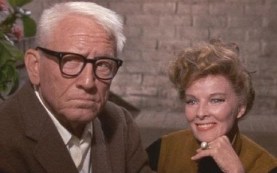
So now to the main point of discussion, the 1967 film “Guess Who’s Coming to Dinner?” Stanley Kramer’s film was nominated for 10 Academy Awards in a legendary year for cinema, winning a third Best Actress trophy for Katharine Hepburn and another trophy for Best Original Screenplay. The film deals with one question: is it actually acceptable for Joey, an upper-class white woman (Katharine Houghton), to marry John Prentice, a black man (Sidney Poitier) even if he is extremely well-off and accomplished?
The question is directed at three groups. The first is Joey’s parents, well-off California liberals Christina (Hepburn) and Matt Drayton (Spencer Tracy in his final film). The issue tests how committed they are to their ideals by muddling their interests in with the final product. The second is the other African-Americans in the film, John’s parents and the Drayton’s maid Tillie. They seem to doubt the sincerity of the gesture, wondering if the move is motivated by power rather than love.
And the third group is us, the audience, be it in 1967 or 2011 or 2100. Some considered it dated even upon release, according to The New York Times‘ Frank Rich. “What couple would not want him as a son-in-law,” he asks upon restating John’s impressive résumé. Some critics have said that he was too white and have thus dulled the movie’s impact. But as Rich said, “[W]hat’s most startling about this archaic film is the sole element in it that proves inadvertently contemporary. Faced with a black man in the mold of the Poitier character — one who appears ‘so calm’ and without ‘tensions’ — white liberals can make utter fools of themselves. When Joe Biden spoke of Obama being ‘clean’ and ‘articulate,’ he might have been recycling Spencer Tracy’s lines of 41 years ago.”
We can pretend that by electing a black President, we’ve purged ourselves of a long history and assuaged our guilt (an explanation that many have proffered now that his approval rating hovers in the low 40% range), but movies like “Guess Who’s Coming to Dinner?” remind us never to stop questioning our values. Taking place after the passage of civil rights legislation, I can assume many people would have liked to put their feet up and pretend equality had been achieved.
Sure, its script may not have much to offer, the music may be brutal, and it lingers for too long. But amidst all of that, there are numerous challenges to think about our notions of equality that society needs to continue to ponder on if we ever intend to keep moving forwards.
As I talked about in my “Weekend Update” column two weeks ago, comedy with lasting cultural value is few and far between at the movies nowadays. The genre has become heavily manufactured, producing standard-order products that entertain at the most basic level to turn a quick profit. Ben Fritz of The Los Angeles Times wrote this about the state of the movies in July: “Increasing concern about the economics of comedies has also led studios to increasingly rely on well-known names with track records. That’s why Apatow, Adam Sandler and ‘Hangover’ director Todd Phillips remain among the busiest people on Hollywood’s comedy circuit.”
But as I am quite notorious for insisting, the instant gratification culture that began in earnest with the proliferation of the Internet is truly far-reaching, changing the way that the industry makes movies. They want movies to make money so they can appear to be in the black for their shareholders. The easiest way to do that is by producing a movie that barely has enough laughs to sustain a 150 second trailer and then building clichéd tropes as filler around it. This makes for instant gratification, sure, but how many of our comedy favorites of this decade will be not only memorable but still funny in 50 years? “The Hangover?” “Superbad?” “Wedding Crashers?”
To keep viewers for many years to come, studios should be patterning their comedies more like “Some Like It Hot,” Billy Wilder’s classic that was ranked the funniest American film ever by the American Film Institute in 2000. I don’t know if I wholeheartedly espouse this choice, but I will say this: on first view at home, it made me laugh more than most modern comedies make me laugh in the theaters. And on second viewing, it held up better than any recent genre effort.
The key is this, in my opinion: it’s all in the nuances. Humor calibrated to please the culture of its time will rise and fade like a setting sun; take for instance 1973’s “Blazing Saddles.” Yes, it’s absolutely a riot, but a scene of flatulence which was shocking then is now commonplace and incredibly tame compared to the nonstop easy scatological humor that Hollywood comedians insist on throwing at us like we’re nine years old. (Looking at you, Happy Madison.)
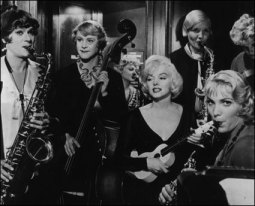
It all starts at the grassroots, namely with the writers and the actors. This is where comedy flourishes, when everyone is game to generate something hilarious once and just as good afterwards. Billy Wilder, perhaps one of the most diversified figures in cinematic history, co-wrote this story that lovingly pastiches multiple movie archetypes – the gangster flick, the screwball sex comedy, the slapstick humor popularized in the silent era by Chaplin and the Marx Brothers, and a non-tailored romance with some interesting twists and turns. His excellent cast, which includes the enchanting Marilyn Monroe and “her bosom companions” played by Tony Curtis and Jack Lemmon, carries the movie to comedic transcendance.
Not too unlike “The Hangover,” Wilder’s film begins with a crazy premise: Curtis and Lemmon’s macho Prohibition-era Chicago musicians, fleeing the scene of a gang massacre, get in drag to join a women’s band on the road. They fit in rather nicely on just appearance, but that’s the least of their problems. There’s the issue of another smoking hot singer in the group (Marilyn Monroe) who’s voice is as stunning as her face. There’s also the problem of them attracting other men to their new personas as the billionaire Osgood Fielding takes a special interest in one of them.
It’s a movie of twists and turns, mistaken identities, hilarious physicality, snappy dialogue, and just plain fun. Now doesn’t THAT sound like the type of comedy you’d pay to see?

 George Clooney’s “
 Many times, critics try to write the film history books by declaring movies groundbreaking, innovative, daring, or bold. We note trends, developments, and overall moods in the field of cinema at large. We have little power to affect artistic merit, but we have a great deal of power in affecting how much cultural merit a film has.
 For the record, I don’t hate understated movies. I love a movie that can say a lot without actually saying much at all. I can appreciate when the mood or the atmosphere tells the story instead of a 200-page script.
 Anyone even willing to touch on the deep questions of religion that still loom large in life starts off a winner in my book. The mere hint of discussing God on film sends people either hiding under a rock or complaining on the Internet, so it really takes someone with grace, eloquence, and poise to give their take in modern times. Vera Farmiga, both acting on screen and directing behind the camera, lends a respectful voice to the conversation in “
 I don’t know whether “
 So now to the main point of discussion, the 1967 film “Guess Who’s Coming to Dinner?” Stanley Kramer’s film was nominated for 10 Academy Awards in a legendary year for cinema, winning a third Best Actress trophy for Katharine Hepburn and another trophy for Best Original Screenplay. The film deals with one question: is it actually acceptable for Joey, an upper-class white woman (Katharine Houghton), to marry John Prentice, a black man (Sidney Poitier) even if he is extremely well-off and accomplished?
 The key is this, in my opinion: it’s all in the nuances. Humor calibrated to please the culture of its time will rise and fade like a setting sun; take for instance 1973’s “Blazing Saddles.” Yes, it’s absolutely a riot, but a scene of flatulence which was shocking then is now commonplace and incredibly tame compared to the nonstop easy scatological humor that Hollywood comedians insist on throwing at us like we’re nine years old. (Looking at you, Happy Madison.)

 Marshall and the Movies
Recent Comments