F.I.L.M. of the Week (August 5, 2011)

5 08 2011

I decided to hold using Charles Ferguson’s “No End in Sight” for my pick as “F.I.L.M. of the Week” (contrived acronym meaning First-Class, Independent Little-Known Movie) as I didn’t think it would be proper to publicize a movie critical of the government when Washington was in the midst of a debt ceiling deadlock.  But now that the debacle has put postponed the doomsday clock until 2013, I figure now it’s no longer kicking a man while he’s down.

Much like he did in his Academy Award-winning documentary “Inside Job,” Ferguson sees a blunder and ruthlessly investigates and holds everyone responsible.  While he has a pointed emphasis on the cabinet of George W. Bush, no one goes unexamined in this tale an operation gone tragically wrong in the face of simple, avoidable mistakes that were the result of clarity-blinding egos.  Ferguson is simply the best documentarian out there at taking complex things like the War in Iraq and breaking them down into simple, understandable components without dumbing down the entire movie.

He shows how the Persian Gulf War fought under the first President Bush led to mistaken assumptions that the Shi’ites would welcome a United States invasion, just as Donald Rumsfeld mistakenly believed that we could invade them with half the troops.  By giving us this tragic set-up, Ferguson makes the botched administration of the occupation magnify in disastrous impact.  While some might argue that Ferguson only presents one side of the story, his interviewees are highly competent and he, along with narrator Campbell Scott, matches their level-headed retrospect.  It’s less a call for heads as it is a call for reason and logic.  If Libya were to go south, I guarantee Ferguson would make “No End in Sight 2” and point the same finger at President Obama.


REVIEW: Burlesque

4 08 2011

For this to be nominated for Best Picture at the Golden Globes, you KNOW there had to be some sort of bribery going on.  For all the glitz and glamour, “Burlesque” is one heck of a dud.  And just because that dud is coated in more glitter than a Ke$ha concert doesn’t make it entertaining or even watchable.  At a bloated nearly two hour runtime, this melodramatic musical makes “Mamma Mia!” look like a classic.

Adding together two musical superstars from different generations like Cher and Christina Aguilera seems like a combination that would produce some fireworks – or at least some cross-generational appeal.  However, it’s just dreadful to watch as their diva attitudes aren’t left behind in the trailer and a contempt beyond something written in the script for their characters.  Cher exudes an unlikable uptightness that’s about as rigid as her plastic face, and Christina Aguilera in her acting debut really can’t act unless she’s emanating a disdainful superiority.  For a novice actress, she really has a lot of guts acting like she’s better than her humble-roots character.

The rest of the movie is better than them, but that’s not saying much.  Cam Gigandet’s ambiguously sexual character is just plain annoying, and Kristen Bell’s entitled prima donna just makes a case for why she should stay in romantic comedies (that’s nt a compliment).  Meanwhile, Julianne Hough’s role is hardly impressive and doesn’t give the country star the big mainstream break she deserves.  Stanley Tucci is alright though, but he’s always good so that doesn’t really count.  Diane Warren’s musical numbers are pretty colorless, and with the exception of the titular final number, there’s nothing worth listening to again.  So skip this strip unless you need to be convinced that the New Wave of American Musical on screen is in its death throes.  C- / 


REVIEW: The Girl Who Kicked The Hornet’s Nest

3 08 2011

Had I not read the whole of Stieg Larsson’s fascinatingly intriguing Millenium trilogy, I probably would have given up on Niels Arden Oplev’s lackluster film adaptations back whenever “The Girl Who Played With Fire” stunk it up like a skunk.  “The Girl Who Kicked The Hornet’s Nest,” the final installment of the Swedish-produced trilogy, turns the series around in a positive direction but not nearly drastically or radically enough to make it all that worthwhile of a moviegoing experience.  The faithful adage “read the book first” still rings true, although I won’t be as harsh to say it has never rang truer.

The series does a pretty intense tonal shift in the third segment, becoming less of an intensely violent thriller and more of an Aaron Sorkin-esque courtroom drama.  (Hey, that’s actually a great idea – let’s start an Internet petition to bring together “The Social Network” dream team for the American version of this movie!)  Because of this, it’s almost unfair to compare it to the previous two movies in the series.  It has to rely on the Larsson’s plot for the suspense, which is actually a really good thing.  As its predecessor showed us, the late author knows best.

Rapace’s performance is sharp again as her Lisbeth Salander, a unique cinematic creation, endures the crucible of a lifetime in her confrontation of the vast injustices that have plagued her life.  She is, once again, the highlight of the movie and perhaps the only reason I can give to watch the movie instead of read the book.  Larsson’s prose is infinitely more exciting on a page than watching Oplev’s attempt at translating its zing.  If you really can’t keep from biting your nails until David Fincher gets his hands on the series, this will help you bide your time – but won’t really do much else.  B- / 


REVIEW: Howl

2 08 2011

If you yearn for an alternative to the tired narrative structure of Hollywood films but want it without all the puzzling avant-garde vibes of a Terence Malick movie, perhaps “Howl” is a good pick for you.  It’s experimental but stays largely within comfortable confines, shifting between various storylines tied together by Allen Ginsberg’s poem in a fairly standard non-linear format.  The movie is overall not as provocative or engaging as it should be, but it does make give some interesting background on the discontent of the Beat Generation while also giving a portrait of a very interesting thinker.

Ginsberg is full of a cryptic intelligence and a paradoxically reserved openness thanks to a brilliant portrayal by the new millenium’s Renaissance man James Franco.  Behind the cigarette smoke and tucked away behind the Ray-Ban lenses is a fully understood man, even if Franco doesn’t want to grant us full access to his mind.  Call it the anti-“127 Hours” because rather than letting it all out in a furious display of emotion, he gets to do a slow reveal characterized by a careful restraint.

That doesn’t keep us from appreciating his portrait of Ginsberg.  Much like he convinced us we were watching Aron Ralston and not James Franco, he gets lost in Allen Ginsberg, fully absorbing his strange vocal cadences while reading “Howl” and picking up his easy-going, laid-back mannerisms that also exhibit the pain he has experienced in the interview portion of the movie.  It’s amazing what Franco can do when he sets his mind on acting because when he isn’t fully engaged in the movie, his boredom pulsates beyond the screen.

“Howl” is more than just the James Franco show, though, and it does more in 80 minutes than many movies do in two hours.  The ambitious film, directed by Rob Epstein and Jeffrey Friedman (two documentarians instrumental to making Gus Van Sant’s “Milk” work), tackles not only Allen Ginsberg but his effect on literature and American culture by also showing the obscenity trial surrounding the controversial poem that is totally separate from Franco’s Ginsberg.  This section asks us to challenge where obscenity overlaps with art, a question that still plagues us today.  What the two produce in their first narrative film is hardly a groundbreaking or game-changing film, but the experiment is hardly a failed one.  If you want an introduction to Ginsberg’s enigmatic poem that will provide you some valuable insight into what exactly he meant – and what his work meant for society as a whole.  B / 


Classics Corner: “Blazing Saddles”

30 07 2011

In need of a Western without any pesky aliens?  Perhaps it’s time to revisit the good old faithful “Blazing Saddles,” Mel Brooks’ 1974 sendup of the genre as well as the racism that they, whether blatantly or inadvertently, often promoted.  Comedy usually shares very little in common with wine – while the beverage gets better with age, the movies normally don’t – but here is one glorious exception.  The humor is very fresh, rooted in a very rich cinematic source rather than in shallow contemporary waters.

Brooks deconstructs the mythologized West by pointing out the stereotypes that we have assumed to be factual, when in reality, they may amount to little more than a representation to the attitudes of the filmmakers or the time.  He brings out hilarious, borderline self-aware, archetypes such as the down-and-out gunslinger (played here by Gene Wilder), the seductress (Madeline Kahn in a hysterical Oscar-nominated performance), and the power-crazy governor (Harvey Korman in all hilarity).  But Brooks turns the tables and makes another hallmark character from western films, the sheriff, an African-American (Cleavon Little), thus exposing the true attitudes of the town which looked so perfect and ideal.

The classic scene showing the revelation of this fact is funny not only because of Brooks’ clever wordplay but also because it rings true of the post-Civil Rights America.  While everything on the surface looked equal in 1974, there was still a ways to go, largely in terms of changing the racist attitudes that had been ingrained in people’s minds.  Through his tenure as sheriff, comedy ensues from all sorts of presumptions of race.

But if you want to just enjoy it as a surface level comedy, there are plenty of chances for you to do that as well.  Brooks’ unwillingness to subscribe to propriety or political correctness results in a ruckus of a movie which still produces belly laughs over 35 years later.  Be it through anachronisms, crafty inversions of genre expectations, toying with the limits of cinema, or good old-fashioned actor-driven humor, it could almost have a seal guaranteeing laughs on its poster.

I’d give anything to see Mel Brooks make another movie; it would be so refreshing amidst a sea of forgettable and immature comedies.  If only the sophomoric “Scary Movie” series hadn’t convinced everyone that genre spoofs have to be stupid, then the angels would herald his return.  But for now, I think every comedy writer would do well to watch “Blazing Saddles” again before they send off their script because, quite frankly, no one is coming close to this standard blazed by Brooks.


F.I.L.M. of the Week (July 29, 2011)

29 07 2011

Was “Midnight in Paris” not enough Woody Allen for you this summer?  Was his latest film so dazzling that you are suddenly curious to delve deeper into his extensive filmography?  If you answered yes to either of these questions, perhaps you ought to check out “Small Time Crooks,” Allen’s 2000 annual that bubbles with humor and excitement in a way that only he can deliver.

It’s a recipe for chaos when the blundering criminal Ray (Allen) asks his short-tempered manicurist wife Frenchy (Tracey Ullman) to be a front for his latest thieving operation.  She runs a cookie shop aboveground while he and his dim-witted partners from prison work underground to tunnel into the vault of the adjacent bank.  The success story, however, gets inverted when Frenchy’s cookies become a runaway sensation and Ray’s robbery totally fizzles.

All of a sudden, fast forward a year and Frenchy and Ray have incorporated their cookie company, coming into more money than they could ever dream of.  How they react, however, is totally different.  Ray wants to remain the same, humble to his low-brow roots, while Frenchy becomes obsessed with joining the elitist art crowd of New York City … which is less than happy to take in white trash with money like her.

Their divergent paths lead to inevitable humor as Ray becomes involved with Frenchy’s spacy cousin May (Elaine May) and Frenchy recruits a high-class aristocrat, David (Hugh Grant), to train her for entry into high society.  It’s not incredibly deep, but it’s a fun examination nonetheless of class in America and how money can affect some parts of our lives but leave other aspects totally unaffected.  And in that uniquely Woody Allen fashion, “Small Time Crooks” can make you laugh in spite of its mopiness and defeatism.


REVIEW: Crazy Stupid Love

29 07 2011

I sit through way too many romantic comedies each year hoping that one of them will wind up being something like “Crazy Stupid Love.”  Coming at the tail end of summer 2011, this genre-pic manna tastes way too sweet.  But it’s not worthy of exaltation just due to the sea of flops surrounding it or praise just because it wasn’t bad, it’s actually just a good movie, one with heart, humor, and insight.

Take away the Christmas setting and it’s actually reminiscent of a small-scale “Love Actually.”  The movie provides perspectives on love from Generations X, Y, and Z, stories that are told with an uncanny sincerity that overpowers their slightly hackneyed development.  Written by Dan Fogelman, who had previously only dabbled in light kiddie fare like “Tangled” and “Cars 2,” delivers a work full of maturity and scope, one that winds up being surprisingly clever.  The movie has a few tricks up its sleeves, and it makes the movie a great deal more engaging than any other movie dealing with this subject matter.

Fogelman’s best maneuver, however, may be reminding us to expect the unexpected when it comes to something as complicated (or crazy and stupid) as love.  While Hollywood may require a certain ending point, the journey to get there doesn’t have to be formulaic or predictable.  The characters of “Crazy Stupid Love” make that voyage fun because they are hardly conventional romantic comedy archetypes, save perhaps Emma Stone’s insecure burgeoning career woman.

Read the rest of this entry »


REVIEW: Cowboys & Aliens

27 07 2011

From the very beginning of Jon Favreau’s “Cowboys & Aliens,” a very uneasy unevenness settles on the screen.  The movie feels torn between whether to be an alien invasion movie that happens to be set in 1870s New Mexico or a Western movie where the villains happen to be aliens.  Rather than make an executive decision and splice the genres, Favreau settles for an unhappy medium, vacillating back and forth between which of the two he’d rather use for the particular scene.  The resultant jumble is just that, a movie that haphazardly joins various elements from both genres to create a bitter hodgepodge that barely satisfies on basic entertainment levels.

The film basically glides by plotlessly for nearly two hours, floating on the very thin premise that feels like an infantile idea to begin.  Combining cowboys and aliens sounds like a game played by a five-year-old when his mom throws the “Star Wars” toys in the Lincoln Logs bin.  It might be fun for a little while as the two clash, but we eventually come to the realization that the novelty can’t sustain, much like that child probably would as well.

The kids-at-heart writing this story, otherwise known as the guys who gave you such wide-ranging projects as “Star Trek,” “Transformers,” the television show “Lost,” “Children of Men,” “Iron Man,” and the unforgettable classic “Kung Pow: Enter The Fist,” have the attention span of that five-year-old child.  They fail to take the movie anywhere worthwhile past the original jolt of imagination that inspired them to combine the two worlds in the first place.  Once they get the whole thing assembled and need to get the plot rolling, they abandon it to play with Legos and leave the movie going on autopilot.

Read the rest of this entry »


REVIEW: Attack the Block

25 07 2011

When I had the chance to see “Attack the Block” back in May 2011, it had neither a release date in the United States nor a domestic trailer.  Its strongest advocates were fanboy-type bloggers on sites like /Film, so I went in with fairly high expectations.  Based on the only trailer I could find, which was for its recent release in the United Kingdom, I had the impression that the film was a comedy with some alien butt-kicking added in the mix.

However, when I walked out of the theater (at the end of the movie – it wasn’t THAT bad), none of my preconceived notions held up.  It was more of an alien invasion horror movie that had some incidental humor, mainly from an easy and tired source – marijuana.  If it was intended to be a comedy, it lost a lot of hilarity on the voyage across the pond.  I’ve never been a big fan of British humor, but I’ve always managed to get a few good chuckles out of movies like “Shaun of the Dead” or “Hot Fuzz.”  This, on the other hand, provided very little in the way of laughter.

But speaking of the films of Edgar Wright, “Attack the Block” feels like a very belated rip-off of the now famous director’s conventions and style, particularly “Shaun.”  Wright isn’t my favorite director, but Joe Cornish’s imitation sure made me appreciate the original even more.  His “Attack the Block,” while entertaining and amusing at times, doesn’t come close to replicating the creativity or fun of a Wright film at any point in its short duration.

American audiences in July, however, will see parallels between another film: “Super 8.”  Both feature teenagers fighting strange extraterrestrials that threaten their homes and livelihoods.  The difference, though, is that “Attack the Block” does not have a visionary director like J.J. Abrams at the helm.  Even though Abrams was paying homage to an earlier innovator, a take on Spielberg is inevitably more entertaining than a take on Edgar Wright.  To top it off, the teens of “Attack the Block” were just plain vulgar and unsympathetic (juvenile delinquents tend to be like that).  Not to sound like a prejudiced American, but their practically unintelligible and profane vernacular just didn’t register with me at all either.

So by all means, in case you haven’t had enough retread this summer, spend your time and money on “Attack the Block.”  It’s a redundant movie not only within its own genres, but within the season as well.  B- / 


REVIEW: Life Above All

24 07 2011

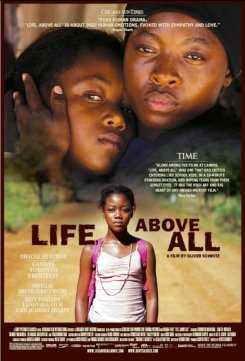
It’s entirely possible to agree with a movie’s message but not like the movie itself.  Case in point, “Life Above All.”  A South African export, the film tells the story of a young girl’s struggle to keep her family together in the face of her young sister’s death and mother’s diagnosis of AIDS, knowing that the prejudices of her village would tear them apart if she fails.  It’s a journey of courage, but director Oliver Schmitz find countless ways to devalue it for us by surrounding her journey with average, boring filmmaking.

Had it moved at a quicker pace, not spent so much time on expository details, introduced the characters in a more coherent manner, or put some emotion into the first two acts, the movie could have been a tour de force.  Although the AIDS pandemic has begun to die down in the United States, it is still ravaging an Africa where myths about the medical condition still abound.  The present day setting of “Life Above All” makes the community’s attitudes, which resemble ’80s televangelists who claimed AIDS was a plague from God, all the more frightening.  However, Schmitz never gives the movie the searing universality it needs, instead concentrating too much on the minutiae of South African society.

But alas, I was given so little reason to care that I don’t think the movie deserves my speculation on its could have beens.  The story is utterly lacking in the pathos it needs to convey the power of the narrative, and by the end, the worthiness of the effort to read the entire movie in subtitles was dubious.  While I can see the value in the protagonist’s crusade for normalcy amidst crisis and the expose of misplaced South African views of AIDS, I sat through the duration of “Life Above All” feeling incredibly nonplussed – and I think impassioned and inspired was what Schmitz was aiming for.  C+ / 


REVIEW: No Strings Attached

23 07 2011

It’s pretty unfair that “No Strings Attached” was the first sex friends movie of 2011.  Simply by the calendar, it automatically made “Friends with Benefits” the other movie, the rip-off that people would avoid on principle.  Too bad, as the Natalie Portman-Ashton Kutcher combination is inferior to Justin and Mila’s tryst in just about every way.

Not even judging it against its doppleganger, it still disappoints, falling at the low end of the already low romantic comedy spectrum.  Kutcher and Portman have such an awkward chemistry that unfailingly feels fake and manufactured.  Their two acting backgrounds – he from “Punk’d” and “Dude, Where’s My Car,” she from working with Luc Besson, Mike Nichols, and Darren Aronofsky (not to mention her Harvard education) – make them a mismatch from the get-go.  Their incompatibility makes the inevitability of their relationship’s end just that much more unbearable.

Portman as doctor Emma and Kutcher as TV writer Adam make for strange bedfellows, quite literally.  Their relationship hardly qualifies as friendly before having sex, and how they wind up starting their casual affair makes even less sense.  Everyone surrounding them is just as brutal, including his father dating an old ex-girlfriend (Kevin Kline), his encouraging friends (Ludacris among others), and her flat and useless colleagues (Greta Gerwig and the very funny Mindy Kaling, undeservedly wasted here).  It’s an unfortunate blemish on Portman’s otherwise very impressive résumé, and perhaps the film’s reception will give her more caution in her selection of comedy films from now on.  As for Ivan Reitman, the family mojo has clearly shifted to Jason as this is clearly not the same filmmaker who made classic comedies like “Stripes” and “Ghostbusters.”

Turns out you can’t have sex without falling love in an American romantic comedy … who knew?!  In case Hollywood hasn’t hammered this into your head enough over the past decade, the studio executives gave you TWO movies this year that literally say it to your face.  So if you don’t want reruns of a rerun, choose “Friends with Benefits” because it will actually make you laugh on the way to its predictable conclusion.  “No Strings Attached,” on the other hand, will bore you with its unconvincing romance and bland melodrama.  C- / 


F.I.L.M. of the Week (July 22, 2011)

22 07 2011

Director Will Gluck has made two hilarious movies in “Easy A” and “Friends with Benefits.” The two share quite a few things in common, but one not-so-flattering similarity I noticed was a slightly unfavorable portrayal of homosexuals. In “Easy A,” Dan Byrd’s gay teen Carter participates in an elaborate subterfuge with Emma Stone’s Olive in order to convince the masses that he is heterosexual. In “Friends with Benefits,” Woody Harrelson’s Vogue editor plays a one-note gay character that is totally defined on screen by his homosexuality. (He does get a slight pass, however, because the character is supposedly based on the president of Screen Gems.)

While I certainly don’t consider Glick a hateful person who would deliberately reinforce negative stereotypes, cinema has seen better, more respectful portrayals. Dwelling on my observations, I couldn’t shake one movie from my mind that handles homosexuality with decency: “In & Out,” Frank Oz’s 1997 comedy. It’s a funny, touching movie that hits on some big issues without every feeling preachy or activist, and as such, it is my pick for the “F.I.LM. of the Week.”

A high concept comedy rooted in reality, namely in imagining the fallout of Tom Hanks’ Oscar acceptance speech for “Philadelphia,” the movie follows small-town professor Howard Brackett (Kevin Kline), unintentionally outed by his Academy Award-winning former pupil (Matt Dillon) … on the week before he is about to marry his longtime girlfriend Emily (Joan Cusack).  He expects it all to blow over quickly since his marriage should be proof enough that he is straight.  Yet his sexuality is relentlessly scrutinized everyone and is only amplified by the presence of press and the prejudices of the town.  Howard is forced to confront the idea that the facade he projects to the world is just that, and Oz finds humor in his self-examination every step of the way.

When watching “In & Out,” you have to remember this came before “The Kids Are All Right,” before “Milk,” and even before “Brokeback Mountain” made gay issues a mainstream conversation topic.  It was considered very bold at the time and still retains some of that power today.  It’s relevance is due largely in part to its very level-headed perspective, most clearly articulated in its conclusion.  Sexuality is not what defines our identities, and this is what I think “Easy A” and “Friends with Benefits” seemed to be missing.  Our identity should be defined by our character, and “In & Out” glorifies this to the highest level.


REVIEW: Friends with Benefits

22 07 2011

It’s time for a movie to come along that changes the romantic comedy genre for better and for always (or at least reverses the way it’s heading at the present moment). A movie willing to avoid the sappiness and the cliched, predictable genre tropes. A movie willing to be a little bit sneaky and subversive in its delivery of what the audience wants from the genre. A movie that gets to the heart of what the genre is supposed to be – truthful, believable romance with some observations on the tricky thing that is love with some humor sprinkled on top.

Friends with Benefits” is not that movie, although it desperately wants to be. It gets some points for trying, though. It takes some good pot shots at the genre through the very clever usage of a fake romantic comedy starring Rashida Jones and Jason Segel inside the movie, and levels some very accurate criticism of them that will no doubt have audiences nodding along with Timberlake and Kunis’ sex pals.

But like so many of the recent onslaught of meta movies, it winds up devolving into the very thing it scorns. It wants all the benefits of self-awareness but none of the responsibilities, which here would include being creative and providing an alternative to the laughable aspects of the genre that it constantly lampoons. To use a sports metaphor, it has the swing but not the followthrough. It boldly goes where few romantic comedies will go and then backs away when honesty and ingenuity is asked of it.

However, it’s nice (for once) to see the movies giving us some indication they realize how RIDICULOUS the romantic comedy has become. Even though “Friends with Benefits” eventually subscribes to the formulaic rules of the genre straight from the textbook, I’ll take a movie with squandered potential over one with no potential any day. Not that it makes it any less disappointing, but the movie sort of gives us a wink and a nudge when it crosses over to the dark side. It’s almost as if director Will Gluck (last year’s excellent “Easy A“) is so apologetic for selling out that he all but superimposes the text “I’M SORRY” over the closing scene.

Read the rest of this entry »


REVIEW: Captain America: The First Avenger

21 07 2011

The bookend of a four comic book/superhero summer, “Captain America: The First Avenger” was given the onerous responsibility to keep audiences from succumbing to genre fatigue.  Luckily, it’s one of the better of these four – but that’s not saying much given this summer.  Joe Johnston’s take on the classic character actually gets some of the basics right, having the narrative storyline that “Thor” lacked and the decent visuals that “Green Lantern” didn’t bother to have.

But just because it’s an improvement doesn’t necessarily means it good, especially taking into account how poor the aforementioned movies were.  “Captain America” is barely bearable, so middling and nondescript that you can’t help but wonder how smashing “The Avengers” could possibly be with all these sub-par buildup movies.  If it’s lucky, it will be equal to the sum of its parts – and Chris Evans and company do about as little to fix the existing Marvel deficit as the President and Congress are doing to fix our national deficit.

Evans has remarkably little charisma despite being devilishly (albeit guiltily) entertaining in the “Fantastic Four” series, neither as a CGI-enhanced shrimp nor as a P90X-enhanced “Men’s Health” cover model prototype.  Playing Steve Rogers, selected to become the superhuman Captain America thanks to his tenacity in the face of bullying, he never really gives us a reason to get invested in the movie – something crucial for a lackluster summer blockbuster in need of some distinguishing feature.  He hits one note the whole movie: dull.  At least in most action movies, the main guy seems to be enjoying kicking butt … and Captain America gets to fight Nazis in World War II!  What more could an action hero ask for?!

Read the rest of this entry »


REVIEW: Buck

20 07 2011

There’s nothing terribly wrong with “Buck,” Cindy Meehl’s documentary about the real “horse whisperer” Buck Brannaman.  It’s a little story of a tortured soul who finds his calling in being gentle and humane, told with tenderness and compassion.  Using the pretty standard biographical documentarian style, it weaves back and forth between Buck’s present day giving unorthodox horse training clinics and his past, both painful and glorious.

But while this is all good and nice, I spent most of the movie wondering why I was watching it on the silver screen as opposed to a 22-inch screen in my kitchen.  The small scale of “Buck” makes it feel like a double-length Animal Planet special that you save on TiVo for a few months before playing.  You can even feel the built-in commercial breaks!  Meehl’s small-scale filmmaking seems targeted towards a niche audience (even more so than the independent film community) because it lacks universality.  When the most profound insight offered in the film is Buck saying “your horse is a mirror to your soul,” you know it’s only going to strike a chord with a select few out there.

I’m not one to demand that a documentary expose vast injustice (like “The Cove“) or hypothesize about massive financial meltdowns (like “Inside Job“); they can be just as powerful by narrowing their lens on a smaller subject.  However, this narrowing should always be to widen our perspective, not limit it.  Buck Brannaman, noble gentleman and very interesting figure that he is, simply doesn’t feel like a microcosm of anything.  He’s fun to watch like a skin-deep Barbara Walters special, but he lacks a certain cinematic quality that makes “Buck” underwhelm.  B- /