REVIEW: Passengers

20 12 2016

Franchise action flicks catch a lot of flak – rightfully – for existing as little more than an excuse for merchandising. But maybe the problem doesn’t stop there. Is it possible that our star vehicles have similarly been co-opted to serve as personal branding for actors?

There is a very plausible scenario in which a year from today, I will remember little of what happened between Jennifer Lawrence and Chris Pratt’s characters in “Passengers.” I’ll probably never forget how angry I felt watching them play into the flaws of the script – more on that in a bit. What I am most likely to remember, however, is their late-night talk show appearances and lab-created viral video moments. The film itself feels like an afterthought amidst the millions upon millions of media impressions the duo generated on a month-long press tour.

The ancillary content for “Passengers” further cements the personas of both actors: Lawrence the raucous and relatable girl next door, Pratt the goofy but lovable working man. But the film itself cuts against the grain for each of them, making everything feel entirely disingenuous. This does not constitute much of a problem for Chris Pratt, who gets to play the tortured center of a deep space morality play. The prematurely awakened space passenger Jim Preston represents Pratt’s first chance to really display his dramatic chops, and director Morten Tyldum spotlights them by … focusing heavily on his puppy dog eyes whenever he’s grappling with a deep emotion or question. Whomp!

Lawrence, on the other hand, plays totally against type for both her on- and off-screen feminism. As Aurora Lane, the object of Jim’s gaze and manipulation, she gives herself over to being little more than a sex object ready to please on cue as well as a backstage figure to male heroism in the face of danger. This is Katniss Everdeen and Joy Mangano! This is the actress who dared to call out Hollywood’s sexist payment practices! What’s going on with this retrograde role choice?

Read the rest of this entry »


REVIEW: The Magnificent Seven

19 12 2016

“Progressive” is hardly a common adjective used in conjunction with the western genre, at least ones that are made in the classical (as opposed to revisionist) style. And yet that’s essentially what “The Magnificent Seven” is at its core. All things considered, Antoine Fuqua’s film is an emblematic Obama-era movie – if not in content, than at least in themes and representation.

Gone is the lone gunman or the reluctant savior of the John Wayne era. In comes the diverse band of outsiders who must collaborate and cooperate to save a small frontier town from hostile takeover. These gunslingers might not always see eye to eye, but they can unite over a common goal of helping out the endangered townspeople. Moreover, they do not just glide in as mercenary heroes; they also train the citizens to fight alongside them for control of their land. While they might lack funding, they more than compensate for that deficit with a surplus of ingenuity.

The setup of the sometimes bitter racial, cultural and partisan divides from Nic Pizzolato and Richard Wenk’s script can get a bit tedious. But by the time the final battle for the heart and soul of Rose Creek arrives, all elements of “The Magnificent Seven” cohere. I found myself invested not only in the fate of the characters but also in the very ideals at stake. Both on and off the screen, that fight is far from settled. B2halfstars


REVIEW: I, Daniel Blake

18 12 2016

i-daniel-blake“This doesn’t have to be your problem.”

The above is essentially a throwaway line in Ken Loach’s “I, Daniel Blake,” but it’s the one piece of dialogue that stuck with me throughout. The global rise of far-right politicians and policy remedies has threatened longstanding social welfare structure, and this is likely a much scarier development in Europe, where these programs are much more deeply ingrained. In this time, what constitutes a problem, and for who?

Loach has long been an empathetic chronicler of people relegated to the periphery of central institutions in their lives – family, city, nation. By involving us in their marginalized or overlooked stories, his cinema makes the case that a problem caused by our societal arrangements is not just a problem for one person. They are a problem for all of us, and by taking society at face value, we sign off in support of these issues.

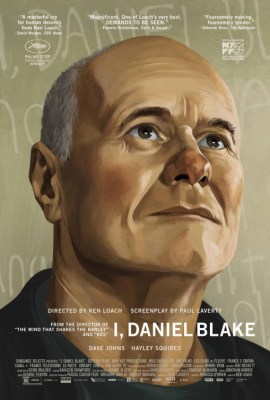
“I, Daniel Blake” takes an unsparing, unadorned look at austerity in England through the eyes of a man most likely to slip through a hole in the safety net. Dave Johns’ eponymous Daniel Blake is among the most vulnerable left behind by technological changes in the economy: a senior citizen losing his capacity to contribute physically and remains well behind the pace digitally. When a heart problem sidelines him from a construction job, Daniel must navigate the bureaucratic mess to collect disability leave … or is it unemployment? The system can never quite figure out what to do with him or what kind of checks he should collect.

Loach’s feelings about the red tape ought to be crystalline from the opening credits, which roll over a black screen during a dialogue exchange between Daniel and a welfare officer. She’s obviously reading from some kind of script meant to level the playing field by creating easily replicable standard talking points for each person she sees. To Daniel, however, this talk is demoralizing and as depersonalized as hearing words spoken by people we cannot see in the frame.

Read the rest of this entry »


REVIEW: Fire at Sea

17 12 2016

fire-at-sea“Cinema is a matter of what’s in the frame and what’s out,” Martin Scorsese famously said. I’ve had this quote saved in a document of quotes about cinema that I compiled when starting this site back in 2009. To the best of my knowledge, I have yet to deploy it in a review (though perhaps it popped up in a freelance writing assignment or academic paper). And, frankly, this is good news given that I grossly misconstrued its deceptively complex meaning for many years.

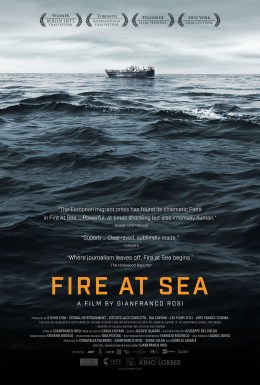
The truth of Scorsese’s statement seems self-evident. Of course these things make up the cinema. But the most important portion of this maxim reminds us that a director’s deliberate choices are not limited to inclusion. They also include exclusion, and we often forget to consider these decisions given the vast amount of things they chose not to do. Gianfranco Rosi’s documentary chronicle of the current refugee crisis, “Fire at Sea,” makes for an exemplary film to demonstrate this concept.

This verité chronicle of life on Lampedusa, an island off the coast of Italy that proves a hub for refugees making their way across the Mediterranean, shifts frequently between several centers of gravity. There’s the town doctor who treats locals and migrants alike. There are the migrants themselves, some of which we see but many of whom we simply hear over the radio systems of the boats sent to rescue them. And then perhaps most prominently, there’s the 12-year-old native child of Lampedusa, Samuele Pucillo. We see him the most, receiving an excess of information about his glasses, his schooling and his breathing problems.

Samuele’s life is important, and his struggles are not to be dismissed out of hand. But while watching “Fire at Sea,” it’s easy to wonder why he’s at the forefront so often. As we learn more about his life, we gradually begin to lose touch with the narrative of the refugees. That’s not an accident, oversight or some kind of unconscious bias guiding suspect editorial judgment. Rosi executes a brilliant Brechtian maneuver, making us aware of what we are seeing – and, by extension, what we are not. What’s left outside the frame, the refugees washing up by the boatload, is what we expect to be the real story.

I suspect many people, like myself, will watch “Fire at Sea” with the best of intentions and varying degrees of bleeding hearts. Rosi does not reward intention alone and refuses to let us emerge with a clean conscience. How many of us were able to compartmentalize the sufferings of Aleppo and let some small agitation in our own lives take center stage? Rosi isn’t interested in putting the refugee crisis into some kind of grand perspective. He just wants to make sure we are all aware of the current perspective in which we have chosen to situate it, whether it appears as some distant challenge or a problem in our own backyard.

Far too often in “Fire at Sea,” as in our media and greater public consciousness, the refugee crisis is out of the frame. It doesn’t have to be that way, and the first step toward changing that is to do more than just watch Rosi’s documentary. We must let it guide our thoughts so that it can then motivate action. B+3stars


REVIEW: Rogue One: A Star Wars Story

16 12 2016

Filmed entertainment in the “Star Wars” universe is valuable, expensive real estate – and I am somewhat skeptical that “Rogue One: A Star Wars Story” is a good use of it.  Admittedly, it is nice to see a film contributing something to a multiverse that isn’t a mere brand extension. But given that the events are a direct vamp up to the pre-determined beginning of the original 1977 film, what’s the point in spending two hours with characters working towards an outcome we already know? Why invest in them?

“Rogue One” has plenty to cheer on, not the least of which includes the thrill of watching the coalition of women and minorities successfully band together to defeat the fascistic empire-seeking men. (Do these things only happen in fiction now?) In a deftly constructed battle sequence to steal the plans to Darth Vader’s Death Star, they come together in an act of valiant sacrifice to save the galaxy. It’s a sight to see, though it does feel like a component or two has gone missing.

The rebel team of rivals, which includes the daughter of the Death Star’s architect (Felicity Jones’ Jyn Erso), a rebel intelligence officer (Diego Luna’s Cassian Andor), an Imperial pilot defector (Riz Ahmed’s Bodhi Rook), a blind Force-wielder (Donnie Yen’s Chirrut Îmwe) and his mercenary pal (Jiang Wen’s Baze Malbus), comes together over the course of “Rogue One.” Given the somewhat languorous speed at which their union occurs, one would think that this is a setup for multiple sequels, “Avengers“-style. By the end of the film, however, it’s quite clear that such is not the case.

So why does Chris Weitz and Tony Gilroy’s script take such a cursory approach to defining each of these characters? The threads they tie together by the final battle are quite thin. Jyn Erso leads her band of rebels into a daring maneuver with the call to action, “Rebellions are built on hope!” The line falls short of rousing because we know so little about her. We know even less about her companions. For all the vicarious inspiration “Rogue One” provides, it offers almost nothing in the way of personal connection and emotional investment. B-2stars


F.I.L.M. of the Week (December 15, 2016)

15 12 2016

Gideon's ArmyAva DuVernay’s superb documentary about America’s failing criminal justice system, “13th,” does an excellent job providing a high-level overview of race relations from Reconstruction to Trump. She masterfully ties together many threads and connects many dots, although DuVernay does admit that a limitation of her perspective is that she cannot do the deep dive that many subjects deserve.

In an interview with Film Comment, DuVernay listed a few documentaries that gave a feature-length treatment to a topic she had to brush over by necessity. One such recommendation was Dawn Porter’s “Gideon’s Army,” which she cited as a detailed look at how the system of plea bargains turns our prison system into a modern-day slavery. The film does shine a harsh light on how predatory penal practices puff up our incarcerated population, but it also does so much more.

“Gideon’s Army” is a testament to the selfless, tireless and often thankless work of America’s public defenders. These underpaid, overworked men and women are foot-soldiers of democracy as they fight on behalf of the accused that the state would rather strong-arm into a guilty plea. The laws make attempts to push back extremely difficult with mandatory minimum sentences that discourage defendants taking charges to trial. But these brave public defenders dare to climb uphill.

Porter might be the first filmmaker who makes an overloaded narrative enhance a film, which makes “Gideon’s Army” an obvious choice for the “F.I.L.M. of the Week.” We get to see how many plates the public defenders must keep spinning at a time – often 180 cases at once – in the fractured editing that never lets us spend too much time with a lawyer or client. Their defendants are both black and white, mostly young, and often times unsure of how the system works. The lawyers we observe sometimes have the herculean tasks of rebuilding trust in their office after a bad public defender bungled a case for their defendant.

We see their struggles along with the successes and failures that punctuate their continuous toiling. But after watching “Gideon’s Army,” it’s hard not to be incredibly thankful that there are public defenders who want to serve as more than a rubber stamp on the path from arrest to incarceration. It may come as cold comfort to the defenders themselves, yet this film turns viewers into supporters.


REVIEW: The Edge of Seventeen

14 12 2016

“I’m going to kill myself,” proudly proclaims the protagonist of “The Edge of Seventeen,” Hailee Steinfeld’s Nadine Franklin … as her first line. At such an early stage in the story, it’s hard to tell whether we should take her literally or seriously. By the end of the film, however, we get our answer: neither.

Pardon the brief soapbox moment, but teenage depression and even suicide are not matters purely relegated to the realm of fiction. I’ve known people who struggled after a tragic loss like Nadine’s (her beloved father at age 13), taken pain medications and seen therapists. Unfortunately, I’ve also seen a fair share who took their own life.

These are real issues that rarely get honest depictions on-screen, and writer/director Kelly Fremon Craig might have been wise to lean into them. Instead, Nadine is a character who gets all the narrative benefits of an outwardly depressed character while “The Edge of Seventeen” on the whole skirts responsibility for dealing with the seriousness of the problem. Craig bends over backwards to make sure we know that she’s not like regular teenagers, she’s a justifiably angsty teenager! Yet once it becomes clear that she really needs professional help, the film makes it all too easy for one kind act to lead to a personal revelation that turns back time.

It’s really too bad that “The Edge of Seventeen” lacks the teeth in its bite because Craig is unapologetic in making Nadine one of the meanest main characters in recent memory. She is incapable of leaving a conversation that she has not “won,” and if she cannot achieve victory on the strength of her own arguments, Nadine will kamikaze by lobbing a vicious insult. Around the point when she defeatedly declares, “I have to spend the rest of my life with myself,” I realized that she is essentially Anna Kendrick’s Twitter feed personified – just with double the self-loathing and half the self-aware charm.

Read the rest of this entry »


REVIEW: Neruda

13 12 2016

nerudaHouston Cinematic Arts Festival

2016 has been a great year for films that toy with the notion of genre; “Neruda” is the second from Pablo Larraín in this calendar year alone. Like “Jackie,” this is a work at war with the preconceived notion of the biopic. Although in this film, Larraín and screenwriter Guillermo Calderón seek less to redefine the genre so much as they desire to smash it.

This portrait of Chilean poet and political activist Pablo Neruda (Luis Gnecco) casts scant attention on his artistic achievements or his radicalization. If you wish to come away from “Neruda” knowing these things, you’ll have to head to Wikipedia while the credits roll. Instead, the film more closely resembles a police mystery with Gael García Bernal’s inspector Óscar Peluchonneau hunting down the fugitive Neruda. It’s a cat and mouse thriller, and the mouse is particularly elusive because he can shape-shift.

Neruda, ever the writer, confounds the search by essentially turning his life into a novel before our own eyes. Separating the truth from his narrative spin becomes trickier with each passing scene, especially because Neruda is quite a playful author. From the film itself, Peluchonneau comes across like a long-lost brother of Joaquin Phoenix’s Doc Sportello from “Inherent Vice.” Is that his actual persona? We’re not meant to know – or care.

I always understood the intended effect of “Neruda,” but Larraín’s insistence on keeping us at arm’s length proved frustrating. With such distance, the film feels like a cold intellectual exercise – something to understand but not involve yourself in. In the absence of any kind of connection or investment, the labyrinthine plot comes to tire by the end of the film. B-2stars


REVIEW: Manchester by the Sea

12 12 2016

manchester-by-the-seaEarlier this year, Richard Linklater’s “Everybody Wants Some!!” concluded an earnest moment of connection (slight spoilers – as much as that movie can be spoiled) with the protagonist, Blake Jenner’s Jake Bradford, describing his college essay’s reinterpretation of the Greek myth of Sisyphus. In his mind, the Sisyphean task of rolling a boulder up a hill only to have it roll back down, was not merely cosmic punishment. His eternal recurrence was instead an unintended cosmic gift that gives him a chance to find meaning and purpose.

No such solace or comfort can be found in the more straightforward Sisyphean tale told by Kenneth Lonergan in “Manchester by the Sea.” We meet his central character, Casey Affleck’s Lee Chandler, going through a series of repetitive toils in his work as an apartment complex’s janitor. Going from unit to unit, he fixes problems that residents could either fix themselves or avoid entirely. When not waiting hand and foot on tenants, Lee shovels the snow off the walkway to his basement dwelling, and the snow never seems to stay clear.

Lee Chandler is a modern Sisyphus of Massachusetts, a fate made even more distressing because he appears to have resigned himself to it. His percolating wit and acerbic banter with the people he must serve indicates an intellect far superior than the average sanitation engineer. If there is any upside to this situation, Lee willingly blinds himself to it.

As time passes and tragedy strikes the Chandler family tree with the young death of Lee’s brother Joe (Kyle Chandler), we come to possess a deeper understanding of Lee’s self-imposed exile. He is the ultimate embodiment of Catholic guilt, responding to a perceived lack of divine justice against a life-changing mistake by taking the role of punisher away from a seemingly absent authority. He enters into an existence of almost complete asceticism, not because he hopes to earn redemption but because he wishes never to escape the burden of his misdeeds.

Read the rest of this entry »


REVIEW: Voyage of Time

11 12 2016

voyage-of-time“As you watch these passing scenes, how does it seem to you?” This epigraph aptly sets the tone for the experience of letting Terrence Malick’s “Voyage of Time” wash over you. It’s clear that our cinematic philosopher has clear ideas about what each image means and how camera movement, shot duration and musical accompaniment can enhance that visualization. But there’s a place for us in this film. Our observations and feelings count because humans, albeit for an exceedingly brief time, are a part of this story.
Malick does not merely explain or demonstrate the journey of the universe from Big Bang to apocalyptic death. He thematizes it, expanding on the creation sequences from his 2011 film “The Tree of Life” (some images look quite familiar) but reduces them to pure form. This elemental treatment of the material frees his aesthetic from narrative, which then allows it to function something like Godfrey Reggio’s “Koyaanisqatsi” – a cinematic symphony playing in a heavenly chord.

Fans of Malick’s Texan opus will no doubt pick up on the director’s favored dialectic between the ways of nature and grace. Various stages depicted in “Voyage of Time” resemble the violence of the former and the gentleness of the latter. When humans make their appearance late in the film, his convenient gendering of the duality even resumes. Primitive early men are focused on hunting and killing, while women provide a nurturing alternative.

It’s easy to get caught up in the grandeur of the firmament as ethereally envisioned by Malick and a battalion of special effects gurus. Yet he and cinematographer Paul Atkins place as much value on the slowly batting eyelashes of a small child as they do on the vast expansion of the universe. How does it seem to me? It seems as if we are not to lose sight of the importance of our own role in the voyage of time.

And the recurring motif of a child running around the low grass in undeveloped land behind a suburban office park only serves to further reinforce this notion. As she traipses about, weeds break up through old concrete slabs long since forgotten by the people who laid them. We are given but a small chance to leave our mark on this story – are we to treat the gift of our earth with violence or gentleness? B+3stars


REVIEW: Jackie

10 12 2016

jackieNew York Film Festival

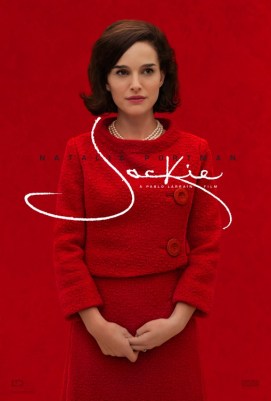
Biopics are for the fans. No matter how revisionist the narrative or inventive the form, the genre exists to privilege the audience over the subject. Instead of learning facts from a biography or textbook (but more likely Wikipedia), the biopic lures us in with a promise of approximated intimacy. It strips away the mythology built around a figure to make them more human to us.

This approach makes sense for certain subjects in narrative film, particularly those who audiences can observe with relatively little pre-existing baggage. If we know but an accomplishment here and a footnote there, a film does not have to override our assumptions. Instead, it can provide a frame of reference for us, establishing the structure by which we judge a person. (If this sounds too abstract, picture recent successful examples like “The Social Network” or “American Splendor.”)

But what about those biopics who must confront the enduring legacy of figures who loom so large in our imaginations before the first frame appears? In recent years, filmmakers have resurrected presidents, actors, musicians, inventors and more who continue to occupy space in our heads. The dominant approach has been to ignore the patina of notoriety surrounding them, opting instead to focus on our shared humanity.

These films so often fail because they forget something that Pablo Larraín’s “Jackie” does not. The mythology informs the humanity for these people. At a certain point, knowing that you lead a life that could one day be recounted in a biopic seeps into every fiber of your being. It’s not enough to go back to a time, either in childhood or pre-fame, that can connect us with them. By virtue of receiving this kind of treatment, they are different people. We all have some sense that we are performing for an audience in our daily lives, but these icons must wear their public face so much that it ultimately seeps into the consciousness of their private face.

Read the rest of this entry »


REVIEW: Miss Sloane

9 12 2016

“Lobbying is about foresight,” observes Jessica Chastain’s high-powered Washington lobbyist Liz Sloane at the outset of “Miss Sloane.” It’s a statement she delivers in direct address to the camera, practically breaking the fourth wall. Such a revelation recalls a magician movie like “The Prestige” or “Now You See Me” more than a garden-variety political thriller.

Indeed, the intrigue in “Miss Sloane” plays like an inside-the-Beltway tale of congressional arm-twisting, fundraising wizardry and reality manipulation through the media. We’re very well aware of the fact that the movie is working one step ahead of us, that another shoe is always ready to drop in the next scene. For those willing to accept that each conclusion will be overturned by a future development, the film plays like a snappy tale of intrigue.

While the heightened political gamesmanship can lead the film to some hammy acting and some soapbox script moments, “Miss Sloane” is a remarkably grounded film about the cost of principles in the sludge of the system. Chastain’s Sloane is a remarkable figure – a pro-business conservative with a George W. Bush photo on her mantle who, for a complex web of reasons, decides to take on a challenging job lobbying for common-sense gun safety measures. With a Blackberry as her third hand, she chips away at the Senate deadlock on the issue until she very nearly fractures it.

Chastain is one of the industry’s most vocal feminist activists, now working behind the scenes to put the stories about women she wants to see into the culture. “Miss Sloane” is probably her most successful work to date in this regard (perhaps excepting “Zero Dark Thirty“). The film portrays an environment controlled by crusty old white men and the effect it has on limiting the roles available to women and tailoring the expectations they set for themselves. There’s no need to declare “FEMINIST” in bold letters, much less #ImWithHer. The understanding of gender is baked into every scene of Jonathan Perera’s script.

That extends to Sloane’s final speech, a contemporary Capra monologue that coats American idealism in the appropriate cynicism of the moment. Gone are the innocent outsiders of old affecting change by holding onto their flyover-state romanticism. Instead, the film suggests, we might need someone entrenched in the slime of the Hill to bring about the will of the people. In which case, the fits of Sorkin-esque shine in “Miss Sloane” make perfect sense. B+3stars


F.I.L.M. of the Week (December 8, 2016)

8 12 2016

three-timesAfter the head-scratching experience of watch Hou Hsiao-Hsien’s “The Assassin,” which wowed me with resplendent visuals but baffled me with its labyrinthine plot, I wasn’t exactly eager to dig further back in the director’s canon – even in spite of the critical superlatives. It took a pre-show bumper card at this year’s New York Film Festival to convince me otherwise; Barry Jenkins cited Hou’s 2005 film “Three Times” as a major influence on “Moonlight.” So, naturally, I had to see what was up.
Turns out, “Three Times” is much more my style. No arcane knowledge of the Chinese wuxia genre is necessary to appreciate Hou’s craftsmanship. All it takes is some grasp of love and the frequent breakdown of communication when expressing it. This triptych of love stories between Shu Qi and Chang Chen is unique among films of its type – calling the connections between the three panels “thematic” doesn’t quite seem to grasp what Hou does here.

It’s as if the concept of love were a gemstone, and he shines a bright, pointed light at it from three different angles. Hou then delicately films the refractions, observing how this small shared moment between would-be lovers reflects back on the larger idea. The result is a tender but devastating work, one that easily rises to the level of  my “F.I.L.M. of the Week.”

In all fairness, nothing tops the first segment of the film. In 1966, a Taiwanese soldier falls for a pool-hall attendant in a reserved fashion befitting their time. They express their passion to each other in epistolary fashion, and Hou magnificently films their quiet longing as these separated sweethearts yearn to consummate their connection. When the man undertakes an arduous, patient journey to reunite, it’s nothing short of sublime.

The other two sections have their charms and insights as well, to be sure. The middle portion, a fraught relation between a courtesan and political firebrand set in 1911, is staged in the style of a silent film – title cards and all. It’s a significantly less rosy look at love, one where backgrounds and baggage play a determining factor in limiting the choices available to the lovers. This is most interesting to consider in tandem with the film’s final portion, set in then-modern 2005, where text messages inhibit the expression of desire between a rock singer and her romantic partner, a photographer.

How much or how little one wishes to draw parallels between segments seems mostly left to the viewer’s discretion; for me, “Three Times” is best appreciated as three discrete stories with a loose thread tying each together. Finding that string is important. But tugging on it too much disrupts the delicate juxtaposition.


REVIEW: Nuts!

7 12 2016

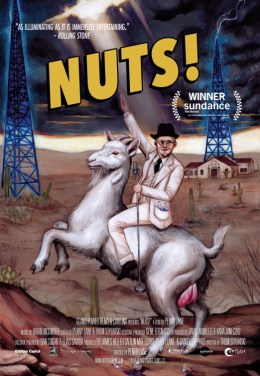
nutsFor anyone shocked by the results of November 8 who is looking for something both escapist and enlightening, “Nuts!” is your go-to movie. Penny Lane’s documentary tale of a forgotten American sensation, Dr. John Romulus Brinkley, feels too absurd to possibly be true. And yet, when you step back and consider it in light of a country that elected Donald Trump, perhaps nothing in it is all too surprising.

Think about the story this way: “Nuts!” is a Lincoln-esque rags to riches crossed with a story of a huckster rising in perfect step with a new medium of distraction and mass communication: radio. He exploited male weakness by proposing an absurd cure for impotence through the surgical transplanting of goat testes. When it appears to work, the professional class threatened by Brinkley’s ascendancy seek regulation of his media coverage.

Not to worry, though – Brinkley uses controversy to launch a media empire and brief political career. His supporters, many of whom come to him in a state of threatened and fragile masculinity, rally against elitism and federal government control when confronted with the facts about Brinkley. In his failed campaigns, Brinkley spoke to the dispossessed masses by promising a realignment of political fortunes and restacking the deck to favor his devotees. They clamor for states rights in the face of perceived cultural assault.

Sound a little familiar? The parallels are scarily uncanny, although at least the stakes are low in “Nuts!” Allow yourself to enjoy the JibJab aesthetic that Lane brings to the film, a pretty appropriately bonkers way to bring such a story to life. But don’t allow yourself to forget that history repeats itself because no one listens the first time. Listen now. B+3stars


REVIEW: Office Christmas Party

6 12 2016

As sad as it may be, if one movie from 2016 could serve as a (non-polemical) time capsule for what it was like to live in this year, that movie might be “Office Christmas Party.” From top to bottom, the film is chock full of time-specific references to technology: iCal, Uber, 3D printing, frustrating Wi-Fi. Imagine watching this in 30 years with your kids. They are likely going to ask a lot of questions about what certain terms mean.

But beyond the minutiae, very little about “Office Christmas Party” feels specifically tied to the year. Unlike television’s “The Office,” whose episodic structure dictated it ignore the ravages of time, cinema’s unique capability to provide a snapshot of a particular cultural moment has led to some invaluable representations of corporate America. Particularly in the wake of the 2008 recession, movies from “Up in the Air” to “The Company Men” to “The Internship” serve as documentation to the hopes and anxieties of the average blue-collar worker in their time.

The premise of the film seems to provide a great launchpad into some topical territory. Jennifer Aniston’s Carol Vanstone, a Miranda Priestly impersonation spiked with a Grinch attitude, rolls into the Chicago branch of her family business to announce a 40% reduction in employees and total cancellation of Christmas bonuses. There’s an initial wave of panic, anger and frustration from the managers in the office, especially from Carol’s entitled brother, branch manager Clay (T.J. Miller). But once that subsides, there’s no 2016-specific fuel to their actions, no sense of worry that the climate is unforgiving. “Office Christmas Party” could have been written at just about any time in the last 40 years and simply spruced up with current cultural products.

Read the rest of this entry »