REVIEW: Guardians of the Galaxy

3 08 2014

When I sat down and thought about it, most of the praises I could lavish on James Gunn’s “Guardians of the Galaxy” are really backhanded compliments that slap the Marvel universe in the process.

For example, I don’t really think Kevin Feige and the Marvel brain trust really deserve a great deal of lauding for creating a film that can stand on its own with a self-contained narrative.  The majority of movies already just do that anyways.  Those movies also just have well-developed characters with internal lives given as an assumption, not as a point of commendation.

But if you want to grade James Gunn’s take on a lesser-known Marvel property against their hopelessly generic and shamelessly commercial films of better known characters like Captain America, it’s going to look like a masterstroke.  “Guardians of the Galaxy” has two attributes that probably make executives at Marvel cower in fear: a unique creative vision and a good sense of humor.  It’s a playful film that often feels like fan fiction uncovered from a child of the ’80s raised on a steady diet of Lucas and Spielberg.

To achieve this adolescent fantasy of a film, Gunn assembles a very game group that becomes akin to Marvel’s version of the “Not Ready for Prime Time Players.”  The film stars Chris Pratt as Peter Quill (or Star-Lord, as he’d have you call him), a profit-motivated intergalactic thief who might be the most morally ambiguous blockbuster hero since Jack Sparrow.  On an average commission to retrieve an orb, Quill gets pulled into a gigantic power struggle that endangers both he and his precious Walkman.

Read the rest of this entry »


Random Factoid #569

2 08 2014

It’s been about 5 years since Twitter became a huge part of modern communication, and I’ve resisted it ever since.  Though my philosophy on the social media site has become more complex over time, here’s an excerpt from Random Factoid #258 back in April 2010 that pretty thoroughly explains my opposition:

“I hate Twitter and I will NEVER get one.  Ever.

Anyone who knows me or reads me is surely aware that I am a massive Facebook-er.  So why am I so opposed to Twitter?  Here’s my reason.

My least favorite part of Facebook is the status update.  I’m sorry, but I don’t want to know what you are doing at all times of the day.  If I do, I will go look at your profile.  So why on earth would I want to commit to Twitter, which is basically ONLY status updates.  Unless you are Jason Reitman, who fascinates me, I don’t want to know every little thought that pops into your head.

So, I will never get a personal (or blogging) Twitter.  You will NEVER catch me Tweeting.”

I don’t maintain a Twitter profile for “Marshall and the Movies,” yet I notice a few hits from the site every once in a while.  So, out of pure curiosity, I decided to search for my name and website on Twitter to see what was redirecting traffic to my site.

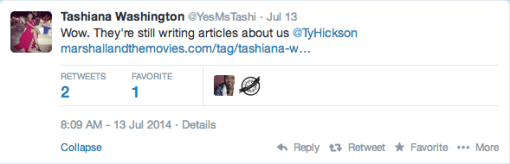
Well, as it turns out, Drafthouse Films saw my glowing review of their new film, “Nothing Bad Can Happen,” and quoted me in a tweet to hype up its release!  To my knowledge, this is the first time I’ve been quoted by a studio in promotional material.

Drafthouse Films

And on top of that, the stars of “Gimme the Loot” found my review and tweeted about it!

Gimme the Loot

So on an entirely self-serving level, maybe Twitter isn’t so bad!  I’m glad my writing is making small waves over there even though I remain a conscientious objector.


F.I.L.M. of the Week (August 1, 2014)

1 08 2014

The Snowtown MurdersIt usually takes a director two to three features to work out the kinks in their style and settle into a comfortable groove of filmmaking.  That is not the case, however, for Australian director Justin Kurzel.  His debut film, “The Snowtown Murders,” has the confidence and assurance of a director with far more experience under his belt.

Yet even without grading on a curve, it still merits the title of “F.I.L.M. of the Week” for Kurzel’s virtuosic control over mood and atmosphere.  Though a title like “The Snowtown Murders” had me in a mindset expecting something like “Bonnie & Clyde,” following a serial killer from their perspective, the film delivers something else entirely.

Kurzel provides all the chilly commentary on the allure of sociopathic killers that you might expect from a Fincher film like “Zodiac” but adds an incredibly satisfying humanist element.  “The Snowtown Murders” is less about the titular acts themselves and more about the man who perpetrated them, as well as the entourage of bystanders who did nothing to stop them.

The film is told not from the perspective of the actual murderer, John Bunting, but of a 16-year-old boy Jamie drawn into his web of violence.  Bunting spies an opening to tap into some simmering hatred and lust for revenge in a small Australian community, funneling their anger into consent for violent retribution.  Kurzel doesn’t sensationalize the goriness of Bunting’s savagery, though he hardly shies away from it, either.

These bloody events help release some of the tension in “The Snowtown Murders,” yet it hardly dissipates between killings.  Kurzel allows the very darkness of the story drive the film, something it can only do effectively because of his masterful control over tone.  Though he does struggle some with extended sequences of dialogue, his montages are simply mesmerizing.  Kurzel strings together some haunting images and makes them pulsate with a broodingly dark energy (also a function of Jed Kurzel’s score).  And to think, this is Justin Kurzel’s baseline…


REVIEW: The Lego Movie

31 07 2014

Back in 2012, “Zero Dark Thirty” gave audiences a pulse-pounding conclusions as it showed SEAL Team 6’s bold mission to kill Osama bin Laden in stunning detail.  Yet even as gripping as that was, I couldn’t help but chuckle a little bit when I saw who they cast as the finger behind the trigger: Chris Pratt, who I knew and loved as Andy Dwyer (and his FBI alter ego Burt Macklin) on the TV comedy “Parks & Recreation.”

Well, as it turns out, Kathryn Bigelow was as right about Pratt as an action star as she was about Jeremy Renner as a fine dramatic actor.  And now it’s Pratt who’s laughing all the way to the bank.  “The Lego Movie” proves that Pratt doesn’t even have to be present in the flesh to lead a movie towards some very fun adventure.

Pratt is like the world’s oldest 7-year-old, a lovable, innocent kid that you can’t help but root for because he reminds you of all the naive optimism of a simpler state of mind.  When his plastic Lego teddy bear of a character, Emmet Brickowoski, chants the film’s theme “Everything Is Awesome,” it’s hard not to smile a little bit.  He’s not just singing from a place of pure naïveté like Selena Gomez on “Barney,” but also from a position of contagious optimism that makes Emmet quite irresistible.

Thankfully, the writing/directing dynamic duo of Phil Lord and Christopher Miller (they who blessed us with the gift of “21 Jump Street“) matches Pratt’s enthusiasm throughout “The Lego Movie.”  They bring a boundless imagination to the project, resembling the kind of creativity that Legos themselves spark in children all over the world.  What they ultimately construct is wild, wacky, and quite inspired. Read the rest of this entry »


REVIEW: Super

30 07 2014

SuperJames Gunn’s “Super” plays like a stubborn sidekick to Matthew Vaughn’s 2010 revisionist comic book action flick “Kick-Ass.”  Perhaps it should have adopted a name defining itself better in relation to that film: “Half-Ass.”

Gunn’s film is made in good fun, but “Super” is a little too footloose and fancy-free for its own good.  The off-kilter antics follow cuckolded sad-sack Frank Darbo (Rainn Wilson), who dons the costume of “The Crimson Bolt” in order to win back his wife (Liv Tyler) from the clutches of a drug lord (Kevin Bacon).  The material is wacky enough for Wilson to dive into head first, but it feels a bit like an abandoned pilot for a Dwight spinoff of “The Office.”

Frank works as a quirky, peculiar character to follow, but the same could not be said for Ellen Page as his wannabe partner-in-crime “Boltie,” also known as Libby.  Page goes balls to the wall in her performance, though it winds up feeling rather sloppy, especially in her chemistry with Wilson.  She’s so unhinged that I wondered if she simply stopped taking her Adderall during the filming of “Super.”

Gunn’s total package resembles Page moreso than Wilson in the end, unfortunately.  The tone in the film fluctuates from over-the-top hum or to downbeat drama and then to a teenager’s wet dream of gory violence.  By the end, I found myself wondering if I was watching the scribblings of a deranged comic book devotee who’s been to one too many Comic-Cons.  C+2stars


REVIEW: Fading Gigolo

29 07 2014

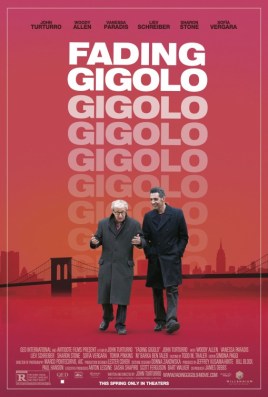
Fading GigoloOn paper, “Fading Gigolo” sounds like the kind of movie Woody Allen would have made in the ’70s or early ’80s.  The bored Murray (Allen) facing the obsolescence of his current job decides to pimp out his unconventionally virile buddy Fioravante (John Turturro) to jaded women.  The concept is ripe for laughs and some good character development.

Sadly, Woody Allen didn’t direct “Fading Gigolo.”  That position belongs to John Turturro, who can’t quite recreate the magic of the acclaimed director he managed to cast in a key role.  Whereas even the minor films of Allen manage to provide a unique experience, Turturro’s film is rather bland.

Allen’s character is firmly supporting, which is a shame since he’s the best thing “Fading Gigolo” has going for it.  Even though it’s a little bizarre to hear him speaking someone else’s dialogue, there’s a certain vitality his trademark persona brings to the screen.  The same could not be said for Turturro, who seems to be sleepwalking through the film.

Fioravante is supposed to be entrancing these women, but I’ll be darned if I could tell you what exactly was capturing their imaginations.  Either Turturro was on downers the entire shoot, or he just actually lacks the charisma to hold the screen as a leading man.  He’s been great as a character actor for the Coen Brothers in the past, so I don’t quite know what to think.

In the director’s chair, Turturro is every bit as colorless.  He could certainly have learned the economy of comedy on set from Allen, but he proceeds with making a bloated film that lacks a pulse.  Everything from the way Turturro directs the actors to the elevator music he chooses to score the film feels drained of energy.

And I don’t mean to imply that Turturro is some kind of an anti-Semite, but I felt ill at ease with the way he portrayed the Jewish community in “Fading Gigolo.”  Much of the plot centers around Murray trying to convince a Hasidic rabbi’s widow to see Fioravante for some healing sessions, creepily against her strict religious vow of modesty.  His presence brings about the curiosity of a particularly zealous Hasidic neighborhood watchman played Liev Schrieber, complete with fake sidelocks.  The whole community seems to be constructed as rather exotic by Turturro, almost to the point where their differences are the butt of jokes.

Perhaps it’s just me who found that troubling, but I can make other assertions about flaws in “Fading Gigolo” with confidence.  It’s a film conspicuously lacking in humor as well as in panache.  C+2stars


5 Years a Blogger: How did it get so late so soon?

28 07 2014

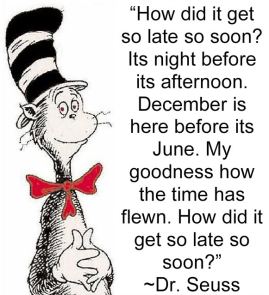
So late so soonOnce upon a time, I sat in front of a computer screen for 30 minutes and typed out a post entitled “Marshall and the Movies – The Beginning.”  That was five years, 744 reviews, 568 random factoids, and 1,658 posts ago today.  I don’t think anywhere in my wildest dreams I could have ever imagined I would be sitting here, five years later, still cranking out posts on my blog.

When I started “Marshall and the Movies,” I could not attend an R-rated movie without parental supervision.  Now, I can legally buy and consume alcohol.  The writer who began this blog was a naive high schooler, and the one who is writing this post is a (perhaps slightly less naive) rising college senior.  At times, I still feel like the same person who started the site – but realize that I’m really not.

My life now scarcely resembles what it looked like July 28, 2009, but I’ve been grateful to have this site – and the movies – to fall back on through the various sea changes over the past five years.  I haven’t always been entirely consistent, I’ll admit.  I’m so thankful to everyone who kept coming back regardless, though!

Not to beat the “Boyhood” drum again, but Richard Linklater’s film really does have me hypersensitive about the seemingly imperceptible changes in ourselves that accumulate over time.  I look back at the way I reviewed a Woody Allen movie in 2009, and it looks absolutely nothing like the way I review it now in 2014.  But I can’t really even be embarrassed about the way I used to write because the site is such an incredible time capsule for my intellectual growth (not to mention all that’s happened in the world of cinema).

I’ve so enjoyed sharing these past five years of moviegoing with you, from the good to the bad.  The discussions and debates I’ve had over posts I’ve written, whether in the comments or in person, do hearten me so.  Clearly, I’m a firm believer in the importance of film on both a personal and cultural level, and I thank you for working with me towards achieving my “mission statement,” if you will:

“What I do hope to do is to inspire a deeper appreciation of movies, foster a desire to discuss movies, and connect with people through the glorious medium of film.”

Marshall and JulieI’m filled with nothing but gratitude for everyone’s support of this endeavor, particularly those who encouraged me from the beginning when the continued existence of “Marshall and the Movies” was nothing certain.  This site has led to so many great things in my life, and I hope it has led to something great in yours as well.  Maybe it was connecting you with a great movie, or maybe it was making you think a little more about a film.  But whatever it was, I’m so humbled and honored that you’ve let me be a part of your life in some small way.

So thanks for 5 interesting years, and here’s to … who knows how many more!  I can’t express my gratitude to you all enough.


REVIEW: Noah

28 07 2014

After “Black Swan” topped my best of 2010 list, Darren Aronofsky could have made a film about virtually anything, and I would turn out to see it.  From the earliest announcement of Aronofsky’s “Noah” in 2011, I was deliriously excited to see his distinct spin on the well-known Biblical story.

I maintained faith in spite of nearly every media report drumming up controversy about the film.  It became impossible to escape stories that claimed Aronofsky was replacing the original narrative with an environmental message, or that he was purging God from the film entirely.  Going in, I had the impression that I was bound to be offended by something in “Noah,” no matter how artfully Aronofsky presented it.

As it turns out, nothing that generated headlines about the film offended me.  What did, however, was the simple and rudimentary script of “Noah.”  It felt like Aronofsky went into production with the first draft for something that shows potential for greatness but achieves little of it.

As a character, Noah feels remarkably incomplete and incoherent.  His motivations are unclear, and I’m not sure whether to interpret that as Aronofsky saying God is confused … or whether Aronofsky himself is confused.  Russell Crowe turns in a rather schizoid performance, grappling with the seeming non-sequiturs of his character as much as he is with anything relating to God.

Read the rest of this entry »


REVIEW: A Most Wanted Man

27 07 2014

A Most Wanted ManDirector Anton Corbijn came into film through photography, a background which makes itself quite evident in “A Most Wanted Man.”  There’s a certain placidity and patience in the proceedings that seem to bear the mark of a photographer’s cool distance.

Corbijn’s perspective gives this adaptation of John Le Carre (the mind who gave us “The Constant Gardener” and “Tinker Tailor Soldier Spy“) a distinct flavor, one that adds rather than detracts from the mix.  Though this spy film tackles counterterrorism, it lacks a definite endgame like “Zero Dark Thirty” had to push it along.  Instead, the focus is on the seemingly never-ending process of apprehending terrorists, not the final product of those efforts.

The calm collectedness and careful restraint of Corbijn does a great job highlighting the grimy, laborious legwork done by a Hamburg, Germany intel unit headed up by Philip Seymour Hoffman’s Günther Bachmann.  He has a knack for foresight and playing the long game, two traits that put him at odds with the more impetuous, results-driven German intelligence community (not to mention the American embassy, represented by Robin Wright’s ambassador Martha Sullivan).

Bachmann quietly enters the fray to handle the curious case of a Chechen, Issa Karpov, who washes up in Hamburg and enters the city’s network of Muslim terrorist cells.  His approach is to use this refugee as a pawn to gain access to the real power players and continue working up the chain.  Along the way, Bachmann must join forces some unwilling participants, including a shady banker (Willem Dafoe’s Tommy Brue) and a lawyer who provides counsel for terrorists (Rachel McAdams’ Annabel Richter).

“A Most Wanted Man” does drag on occasion, but it’s consistently interesting thanks to the way Corbijn’s direction allows us to savor the careful maneuvers of counterintelligence chess.  While the film might be a little less ostensibly artistic than his last outing, 2010’s “The American,” Corbijn’s chosen aesthetic for the piece suits the highly-plotted story quite well.  It also allows Philip Seymour Hoffman, in what will sadly be his last leading role, to quietly show his mastery over the craft of acting one final time.  B2halfstars


REVIEW: Lucy

26 07 2014

Lucy” may well be the most peculiar movie of summer 2014.  Director Luc Besson strangely amalgamates high-brow ambitions with B-movie antics.  It amounts to a simple-minded film about big ideas, something far less than Besson achieved on “The Professional,” but I’d be lying if I didn’t have a decent amount of fun on the ride.

Clearly Besson feels more comfortable in the realm of the non-human, staging vibrantly kinetic car chases and action sequences with flashy visuals.  These sequences have a definite panache to them, which is good given that they largely have to power the entire film.

Besson keeps “Lucy” moving at a swift clip, so brisk that you almost don’t have time to think about how excruciatingly bad his inane dialogue is.  It’s obvious that he views words as means to the ends of expression and plot development, not ends in and of themselves.  Worst of all, these unimaginative lines are delivered by Scarlett Johansson and company with feeling equivalent to rote recitation, rendering the film’s human element unintentionally laughable.

The film’s editing could have used some work, too.  Besson begins the film by heavy-handedly intercutting animals and prey with the events of the story (a clumsy attempt to be artful).  Then, he cross-cuts an intellectual lecture given by a professor played by Morgan Freeman (an obvious ploy to be taken seriously on an intellectual level) between multiple scenes of Lucy.  If you think about it, the edit really makes no sense as it either has no sense of time … or Freeman’s Samuel Norman is giving the world’s longest address!

Read the rest of this entry »


F.I.L.M. of the Week (July 25, 2014)

25 07 2014

Even the RainApparently, everyone from NPR to CollegeHumor is trying to make “Columbusing” a thing.  The phrase is used to describe the act of false discovery and claiming it as your own.  So in the spirit of trying to be trendy, my pick for the “F.I.L.M. of the Week” is Iciar Bollain’s “Even the Rain,” a Spanish film that quite literally looks at the original act of “Columbusing” and its ramifications.

Bollain’s film takes off from a story where life quite literally begins to imitate art.  In “Even the Rain,” Gael García Bernal stars as Sebastian, a Spanish director looking to film a movie about the Spanish conquest of Latin America on the cheap in Bolivia.  He ultimately gets quite a bit more than he bargained for in his location, however.

At the same time as his picture is shooting, great civil unrest and riots are rocking the community.  The workers are suffering at the hands of multinational corporations that are charging exorbitant fees for access to water.  Sebastian and his creative team find themselves drawn into the conflict, against their desires and wishes, when one of the Bolivian stars of their film leads vehement opposition against their exploitation.

Bollain’s film raises important questions about colonialism, both ancient and modern.  And thanks to fine performances from Bernal (who always seems to pick the best Spanish-language projects – no offense, “Letters to Juliet“) and Carlos Aduviri as the Bolivian firebrand, “Even the Rain” is more than just a political diatribe.  It’s gripping cinema with a real conscience.


REVIEW: Under the Skin

24 07 2014

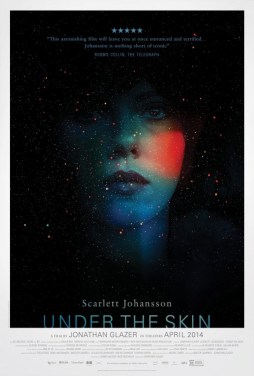
Under the SkinUnder the Skin” has the perfect title, since it reflects not only the events of the film itself but also its effect on the audience.  Jonathan Glazer’s third feature, which has been nine years in the making, features Scarlett Johansson as an alien who quite literally steps into human skin to observe us and carry out a cryptic mission.  In the process, the film seeps underneath our own skin, lingering there for quite some time and demanding to be pondered.

Glazer absolutely beguiles with his unique bending of cinematic syntax to his will, compiling what amounts to a masterclass of technical control.  Through his unique confluence of image, montage, and sound, “Under the Skin” pulsates with a dreamlike cadence.  Several of the film’s most striking sequences unfold in solidly white or black spaces, furthermore contributing to a sense of hyperreality.

Though perhaps Glazer’s intentions are not always immediately clear, he keeps us beguiled throughout – and often ravished.  He follows Johansson’s siren of the Glasgow streets, picking up and picking off men with the assistance of a strange motorcyclist, with an attention that’s languorous rather than laboriously plotted.

Our access into her head comes not through any words penned by screenwriter Walter Campbell; it arises from the curious gaze of Johansson.  Or, it surfaces from Mica Levi’s hauntingly hypnotic score, which feels like a second script for “Under the Skin” in itself.  Though it may not spark a connection in your heart, it will send a tingle up your spine.

Read the rest of this entry »


REVIEW: Magic in the Moonlight

23 07 2014

Magic in the MoonlightAt a Cannes Film Festival press conference back in 2010, writer/director Woody Allen opined rather extensively about his views on life.  Among the misanthropic murmurs, he remarked, “I do feel that it [life] is a grim, painful, nightmarish, meaningless experience, and that the only way that you can be happy is if you tell yourself some lies and deceive yourself.”

Four years later, “Magic in the Moonlight” arrives in theaters to once again hammer home Allen’s personal philosophy as expressed in the quote above.  You know, just in case we happened to miss it in any of his other four dozen or so films.

This pessimistic fatalism goes down, however, quite palatably here because Allen casts two leads far more charming than himself: Colin Firth and Emma Stone.  Though they’re spouting lines that could make Nietzsche chuckle, the film never loses its mirthful mood thanks to the effervescence that the duo radiates.

“Magic in the Moonlight,” similar to 2009’s “Whatever Works,” has the feel of an undeveloped comedy from Allen in the ’70s.  That tenor is achieved by the nature of the concept, yet it’s also due in large part to the spell that Stone casts over it.  Allen clearly sees in her the same kind of alluring wit and personality that Diane Keaton immortalized in his films; it’s simply delightful to watch a wide-eyed Stone revel in one of his creations.

Read the rest of this entry »


REVIEW: For Colored Girls

22 07 2014

For Colored GirlsIf anyone thinks Tom Hooper’s “Les Misérables” was a feckless and bumbling adaptation of a theatrical show, let me direct you to Tyler Perry’s “For Colored Girls” to see a real failure.  Granted, it’s a bird of a different color as Perry sets out to adapt Ntozake Shange’s “choreopoem” with the mouthful of a title “For Colored Girls Who Have Considered Suicide When The Rainbow Is Enuf.”  But Shange’s bold and experimental work is transmuted into a set of clichés by Perry’s uninspired writing and direction.

To start, who thought Perry was a good choice to take on this work?  What qualifies the director of crude comedies like “Diary of a Mad Black Woman” to take on an iconoclastic work of theatre?  For all those who would argue that the quintessential Tyler Perry films have elements of drama, I raise the point that those sections are by far the weakest sections of his movies.  Perry’s movies play well with audiences because of the outrageous humor of Madea and his characters, not because of anything serious.

I am not familiar with the play, but there has to be some reason it has stuck around for decades.  I can only imagine Shange as a colored woman brought a certain amount of authenticity and urgency to the struggles of black women.  If what I suspect is true, Perry has turned the play’s strengths into unwatchable melodramatic mishmash.  The faux and unearned sympathy the movie tries to evoke fails on just about every level, and the two hours of “For Colored Girls” are thus miserable and interminable.

And I think Perry doesn’t even understand what the story is about in the first place.  He does less empowering of black women than he does evisceration of black men.  “For Colored Girls” should have been a celebration of the tenacity of African-American females and the community they always form during hardship.  Instead, it’s an opportunity for some of the best black actresses working in Hollywood to chew scenery in disconnected vignettes that Perry can’t make click.  D1star


REVIEW: I Origins

21 07 2014

I OriginsThe flaws of writer/director Mike Cahill’s “I Origins” have become more apparent as I have thought about the movie more in retrospect.  But remarkably, this awareness has not led me to think lesser of the product as a whole.  I still find the film’s aspirations noble, and Cahill manages to achieve his objectives even while stumbling (unlike his prior feature, “Another Earth,” which tripped out of the gate and never recovered).

The film is rather disjointed, feeling like two separate movies conjoined in the editing room – similar to Stanley Kubrick’s assemblage of “Full Metal Jacket.”  The first half of “I Origins” follows Dr. Ian Gray (Michael Pitt) as he attempts to disprove God with his studies of the human eye while romancing the free-spirited and spiritually inclined Sofi (Astrid Berges-Frisbey).  In this section, Cahill’s dialogue is extremely overwrought and overwritten, yet it does manage to communicate the themes of the piece with great cogency.

After a mid-film climax that ultimately proves to be the apex of the entire story, “I Origins” forks off in an entirely different direction as the possibility of spiritual phenomena such as reincarnation.  This segment is quieter and more understated, perhaps leaving some things unsaid that ought to have been spoken.  In spite of those shortcomings, though, Cahill manages to ensnare us in a largely open-ended cosmic mystery.

The end does come rather abruptly, almost as if a projectionist had forgotten to show the last reel of the film (to use an illustration from a now bygone era).  Still, “I Origins” feels more or less complete even without a conventional resolution.  The film’s nearly two-hour runtime flew by – faster than most entertaining trifles being mass produced on the studio assembly line, I’d like to add.  In that period, Cahill raises a great deal of intriguing questions about tough subjects and discusses them with a fairly satisfying thoroughness.  B+3stars