REVIEW: Paul

10 08 2013

2011 saw one movie, J.J. Abrams’ “Super 8.” corner public interest on the influence of Steven Spielberg’s filmmaking on modern moviegoing.  I’m a little upset that “Paul” couldn’t bask in a little of that light.  It’s a fun, spirited send-up of science-fiction tropes featuring a hilarious self-aware alien, Paul (the voice of Seth Rogen).

“Paul” also puts science-fiction, comic-book culture under the microscope to be sent up.  And for that task, there’s probably no one better than Simon Pegg and Nick Frost, two men whose humor seems to play particularly well to that crowd.  Pegg and Frost both wrote the film, and they also star in it as Graeme and Clive, two Brits who come across the pond for comic-book Mecca … Comic-Con.

Traveling the United States in an RV, they encounter crude, crass extraterrestrial Paul.  He’s the masterstroke of the movie, perhaps the best manifestation of Pegg and Frost’s comedic brilliance to date.  He’s got ties to all sorts of conspiracy theories and is incredibly connected to the entertainment industry.  The problem is, the rest of the movie just falls short of the character’s shrewd construction.  Though it is a satire of the human-meets-alien movies of the past two decades, “Paul” often allows itself to lazily slip into the trappings of the subgenre.

And, lest I forget to mention it, “Paul” has Kristen Wiig as one-eyed fundamentalist trailer trash taught to sin by Paul.  Sure, her character’s a little juvenile, just like the rest of the movie when it isn’t cleverly harkening back to ’80s sci-fi classics.  But Wiig, and “Paul” as a whole, somehow make the stupidity seem more fun than they probably are.  B-2stars


F.I.L.M. of the Week (August 9, 2013)

9 08 2013

With Amazon.com’s Jeff Bezos buying up the Washington Post this week, I felt it would be an appropriate time to revisit Andrew Rossi’s documentary “Page One: Inside the New York Times.”  The film, which takes a magnifying glass to the paper’s 2010 calendar year, is still fresh even though the news is old.  It’s packed with enough relevant and insightful discussion of the news industry in the age of Twitter that it stands as my pick of the “F.I.L.M. of the Week.”

Rossi follows the reporters and editors of The New York Times as they deal with various journalistic challenges, including Julian Assange’s WikiLeaks revelations and the bankruptcy of the Tribune media companies.  Each provide fascinating fodder for thought on the role of the press in maintaing an open society and an informed citizenry.  Rossi’s camera catches all sorts of intriguing behind-the-scenes action to give the film the pop of an “All the President’s Men” (or even 2009’s Oscar-nominated doc “The Most Dangerous Man in the World“).

But as the slogan of the film hints, “Page One” is most concerned with the state of the paper – because as we are aware, we can get the news from a whole host of sources now.  No one is more painfully aware of this than the staff of The New York Times themselves, feeling tangible effects from the digital revolution in tandem with the collapse of their old advertising model.  They show how often we take the news for granted, often times as if it were some kind of public good.

The documentary finds a fun protagonist in David Carr, the paper’s media reporter whose blunt but always intelligent observations on the state of the industry provide a firm center for the film.  He’s an unconventional reporter who took a wild journey to end up at The New York Times, but he’s also a compelling cheerleader for the necessity of conventional journalism and the integrity that comes with it.

Carr and “Page One” make me proud to spend $8 a month to gain access to the newspaper, a decision announced during the timeframe covered in the film.  While I’m sure the monetization of my support has been helpful, the battle clearly isn’t over as I get endless mailers asking me to add home delivery to my subscription package…


REVIEW: Antiviral

8 08 2013

The world’s obsession with the lifestyles of the rich and famous is no secret.  In 2013, it’s already been the subject of Sofia Coppola’s “The Bling Ring,” a darkly comedic look at how the desire to be like celebrities is so great that it can even compel people to literally steal from their E! news idols.  You could even argue that, on a more subconscious level, it’s what made a new film adaptation of “The Great Gatsby” both necessary and commercially viable.

If you’re willing to follow this craze illogically into absurdity, you might find Brandon Cronenberg’s “Antiviral” at the end of your line of thought.  This Juvenalian satire blended with a gross-out horror imagines a dystopian future where people literally infect themselves with viruses from their favorite celebrities to feel more connected to them.  It’s an interesting and quite frightening concept, to be sure, but Cronenberg pushes the boundaries of plausibility and believability a little too far.

That’s not to say I couldn’t stomach the film, though Brandon has inherited his father David’s penchant to make his audience squirm.  Anyone afraid of needles will find “Antiviral” particularly nightmarish as no skin penetration is simulated; Cronenberg delights in the sight of piercing needles and refuses to cut away from them.

Yet as painful as all those were, they had nothing on the excruciating plot.  Brandon also seems to have inherited his father’s storytelling woes evident in fellow Cannes 2012 entry “Cosmopolis.”  Visual talent is evident here, I will concede.  But Brandon Cronenberg still has a long way to go as a writer.  C2stars


REVIEW: Monsters University

7 08 2013

Monsters UMonsters University” may not scale the emotional heights of Pixar’s most recent towering achievements “Up” and “Toy Story 3,” but that doesn’t mean the film isn’t moving, charming, or sweet in other ways.  It’s a movie that will be special and touching to anyone who has ever felt like an impostor or an underdog in their own life.  And for those big kids who have been to college themselves, it’s especially meaningful to anyone who has struggled to find their place on campus.

The film opens with a sight to make your heart melt – a tiny Mike Wazowski, the most adorable little nugget with big dreams to become a scarer at Monsters, Inc.  He’s got plenty of book smarts but lacks the intimidating frame to take the Scare Floor by storm.  Mike (Billy Crystal) meets quite the foil in a cocky young James P. “Sully” Sullivan (John Goodman), a dumb party animal who slacks off because he’s blessed with natural skill.  It’s a pretty standard nerd vs. jock dichotomy, in case you hadn’t already figured it out.

But the Pixar plot machine doesn’t have them battle in conventional ways.  Rather, after a big mistake lands them in hot water with Dean Hardscrabble (the ever-intimidating Helen Mirren), Mike and Sully are forced to team up to earn their stripes in the scare program.  They have to win the prestigious Greek Scare Cup to gain reentry into the class, leading them join up with a lovable band of misfits, Oozma Kappa.

The oddballs of Oozma Kappa, a fraternity house that’s also someone’s mom’s house, bring a lot of the vitality and humor to “Monsters University” that we don’t get in spades from seeing our old friends Mike and Sully (and Randall, who’s thrown in for good measure).  The novelty of these myriad new characters, however, does tend to overpower our reliable staples.  It’s still an enjoyable romp with astutely observed characters that offer very applicable life lessons for everyone.

And I think the fact that I’m currently in college led me to feel especially endeared to the film, which so accurately captured a key aspect of my own experience.  It’s easy to come into college expecting that we’re going to be one person, yet we so often find ourselves inexorably and immutably changed by unexpected people and events.  And thanks to Pixar’s great storytelling genius, they find a way to expand this valuable nugget of wisdom beyond the campus of Monsters University and into a larger reservoir of human experience.  B+3stars


REVIEW: Passion

6 08 2013

PassionI don’t even know where to begin with Brian DePalma’s “Passion,” an instant contender for the worst movie of 2013.  It’s one of the tackiest and most tasteless films I’ve ever seen, an exploitative B-movie that tries to masquerade as something classier.  It isn’t.

Though it cries to be taken seriously as an art film, I place “Passion” next to “The Hangover Part III” in terms of a disturbing trend from summer movies in 2013.  Both films take an undercurrent of same-sex attraction from their prior incarnations (for “Passion,” this is a well-made French thriller from 2010 called “Love Crime“) and turn into ridiculous and overt subject matter.  While the relationship between manipulative boss Christine and her brilliant protege Isabelle had some tension in the original film, it’s to the point of full-on make-outs and lesbian love declarations.

Not that there’s anything wrong with that.  However, we don’t live in a time where homosexuality needs to be transmuted into some exotic abnormality, so the campiness of “Passion” plays as somewhat offensive and insensitive.  Noomi Rapace at least plays Isabelle with some grounding in reality. Rachel McAdams’ Christine, on the other hand, is played with all the gusto of her iconic Regina George from “Mean Girls” but with all the energy channeled into making her an insatiable sexual animal.

Although to put the blame for “Passion” on the shoulders of its two leading ladies is unfair.  The movie is a mess because of director Brian DePalma, whose attempts at Adrian Lyne-esque steaminess or Wachowskian cerebral thrills just fall flat on their face.  His adaptation of “Love Crime” drains every ounce of subtlety from the story, turning a tale of professional rivalries turned criminal into crazy lesbian bloodlust (to be short and blunt about what this film is).

“Passion” aims for somewhere between Stanley Kubrick’s “Eyes Wide Shut” and Darren Aronofsky’s “Black Swan” but falls firmly into the territory of unintentional farce destined for the $2 DVD bin at CVS Pharmacy.  D+1halfstars


REVIEW: Touchy Feely

5 08 2013

Touchy FeelyHow ironic that director Lynn Shelton should begin to lose her touch in the film “Touchy Feely,” a film about people who literally touch for a living.
All the seemingly effortless perceptiveness into our very humanity in Shelton’s prior two films “Humpday” and “Your Sister’s Sister” have eluded her grasp in her latest feature.  “Touchy Feely” is a mess, unfocused and unorganized from the get-go.  Shelton writes plenty of interestingly odd characters, but they ultimately offer us nothing to take home and apply to our own lives because we can’t identify with them.

The film jumps from emotional non-sequitur to emotional non-sequitur as everyone seems to act in only the most bizarre and irrational ways possible.  Whether it’s taking ecstasy, forcing their significant other to strip in a bathroom at their place of business (only to then walk out), or going to an experimental massage therapist to improve their dentistry, Shelton’s got the sheer unpredictability of human nature cornered.  The problem is, however, that none of these quirks add up to anything – nor do they highlight anything about what it means to be alive, or in love, or a productive member of society.

The actors could have turned “Touchy Feely” into their showcase by picking up the slack from Shelton’s script, but they wind up falling into the same humdrum, forgettable pattern of the film.  Rosemarie DeWitt’s erratic Abby shows nowhere near the vitality and inner life of her titular bride in “Rachel Getting Married,” and Ellen Page just plays Juno on downers.  Not even Allison Janney could breathe any fresh air into the film.

On a final sad note, I was really hoping this would be a breakout role for Josh Pais, a stalwart character actor who first caught my eye as a cantankerous Harlem teacher in “Music of the Heart” when I was seven years old.  He’s been popping up in movies and TV shows for years, and I’ve always enjoyed seeing him.  But his role in “Touchy Feely,” a deadbeat dentist, was a droning monotone. Hopefully he gets another shot at a big part like this again; I just hope this wasn’t the first time a casting agent saw him on screen.  C-1halfstars


REVIEW: The Way Way Back

4 08 2013

Two years ago, Nat Faxon and Jim Rash stood on stage at the Academy Awards behind Alexander Payne as he delivered the majority of their acceptance speech for writing “The Descendants.” While Payne waxed poetic to millions of people, Faxon and Rash drew the attention of the cameramen through a bizarre stunt – mocking Angelina Jolie’s flaunting of her flawless leg as it protruded out of her dress that very night.

As soon as I saw that, I thought to myself that they must have provided the humor in “The Descendants,” and the tragedy and drama came courtesy of Alexander Payne. But after seeing Faxon and Rash’s directorial debut “The Way Way Back,” which they also wrote together, I’m not so sure my assumption was correct. The dynamic duo crafted a truly heartfelt and genuine film that is equal parts uproarious comedy and poignant drama. Not a moment in the movie feels false as everything hits home just by being honest.

The film might not be the most original as it is a fairly typical entry into the coming-of-age sub genre. The protagonist, Duncan, is a shy turtle of a 14-year-old boy headed for a summer at the beach with his mother Pam (Toni Collette) and her new jerk of a boyfriend Trent (Steve Carell). Both of them struggle to fit into Trent’s pre-existing world, although Pam has no escape. Duncan manages to find a surrogate family for the summer at the Water Wizz water park under the tutelage of the quick-witted Owen (Sam Rockwell).

Read the rest of this entry »


REVIEW: The Bling Ring

3 08 2013

“Too many bowls of that grain, no Lucky Charms / the maids come around too much, the parents ain’t around enough,” sings Frank Ocean over the closing credits of Sofia Coppola’s “The Bling Ring,” the perfect cherry on her blistering excoriation of millennial attention obsession disorder. It’s a quintessential Coppola story, containing an opportunity to reconsider the corrosive society of “The Virgin Suicides,” the clueless lives of the luxurious of “Marie Antoinette,” and the hollow celebrity culture of “Somewhere.” With her fifth feature, she swirls it all together into a darkly humorous fable with the pop of a tabloid headline turned music video.

The story is ever so lightly fictionalized from actual events where suburban L.A. teenagers harnessed the power of the Internet to rob celebrities while they were away from their homes. Curiously, they chose to steal from people who were mostly famous for their own fame, such as Paris Hilton, Lindsay Lohan, and Audrina Patridge. They take plenty of clothing and accessories with them, but breaking and entering becomes like a hobby or a sport for them.

“The Bling Ring” is replete with relevant discussion topics, such as intimacy, narcissism, and connection in the era of social media – just to name a few. Nancy Jo Sales’ book, an expansion of her article from which Coppola derived the film, provides excellent commentary that manages a miraculous balancing act between rich cultural criticism and the breezy feel of a magazine article. Most of that depth is absent, however, in the film as Coppola opts to skim the surface on most issues.

Read the rest of this entry »


F.I.L.M of the Week (August 2, 2013)

2 08 2013

As soon as I tell you the plot of Lynn Shelton’s “Humpday,” my selection for the “F.I.L.M. of the Week” (First-Class, Independent Little-Known Movie), you’ll immediately jump to unfair conclusions about it. You’ll inevitably start to imagine what it must be like and decide it’s not your cup of tea. I know because I, too, judged it unfairly based on the story. But once you get past that, I promise you that it’s a fantastic and well-observed comedy that feels incredibly real.

“Humpday” is about two heterosexual male friends, one of which is married, considering making a gay porn video.

While I don’t want to say too much, don’t worry, this is NOT a pornographic movie. There’s no sex, not even artistically or obliquely done. There’s no nudity, either, because the film is not about the pornographic film industry (I’d recommend Paul Thomas Anderson’s “Boogie Nights” if you want to see that, though). “Humpday” is a movie about relationships between people and the nature of intimacy.

Old friends Ben (Mark Duplass) and Andrew (Joshua Leonard) reunite after many years and find themselves locked into a dare to film an amateur scene for an adult film festival. Neither wants to be the one that backs down, so what ensues is a series of conversations between friends and lovers about what the basis of the ties that bind them to each other.

Shelton’s film takes an unconventional approach to get to these central questions of interpersonal connections, but the result is incredibly rewarding drama and insightful wisdom. “Humpday” is all brains and heart – no skin.


REVIEW: Much Ado About Nothing

2 08 2013

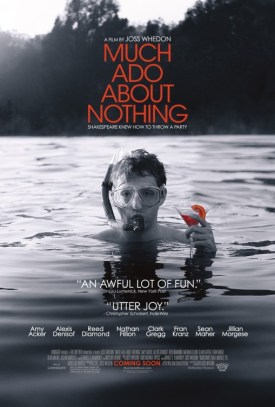
Much Ado About NothingI’m not the biggest Shakespeare fan, especially not on screen.  (Perhaps my upcoming semester in the United Kingdom will help reverse that.)  I have learned to admire his intricate plots in various English classes by studying his plays “Julius Caesar” and “Othello.”  Moreover, I can appreciate how they remain thematically relevant centuries later.

But when you stick that Elizabethan dialogue in a modern day context, it’s just too much of a stretch for me.  Unless, of course, we’re talking about Baz Luhrmann’s “Romeo + Juliet,” which sledgehammers Shakespeare’s meaning into your skull.  Joss Whedon’s “Much Ado About Nothing,” on the other hand, is seeking to bring all the nuance that was missing from his last feature (a low-budget indie called “The Avengers“).  The effort is commendable, yet it never results in anything really gripping on the big screen.

Perhaps Whedon’s take on Shakespearean comedy would have played better on a stage.  I have no doubt that Whedon and his pals, such as fixtures Clark Gregg and Nathan Fillion, enjoyed delving into the Bard of Avon.  They delight in their Santa Monica setting, and the exquisite lensing at least allows us a sort of Nancy Meyers/”It’s Complicated” vicarious enjoyment of beautiful homes.

But beyond the cinematography, I took little pleasure in “Much Ado About Nothing.”  Aside from a few of the film’s clever screwball gags, the humor didn’t really connect with me.  The romance was flat and uninteresting, save Amy Acker and Alexis Denisof’s well-played Beatrice and Benedick.  Most of all, I just didn’t feel Whedon effectively updated Shakespeare to our time, making for a rather uneven viewing experience.  C+2stars


REVIEW: I’m So Excited

1 08 2013

I'm So ExcitedLast summer, Woody Allen’s annual film was retitled “To Rome With Love” after audiences were apparently unfamiliar with the expression that gave the film its second title, “Nero Fiddled.”  So before I use “Nero fiddled while Rome burned” in a review, I figure I ought to give it the proper context.  Nero was emperor of Rome when a great fire broke out (some say because of him); while people suffered, he played his fiddle.

The central joke of Pedro Almodovar’s farce-cum-social satire “I’m So Excited” is that Spain is repeating Nero’s mistake.  If you want to do the unpacking yourself, then stop reading my review after this short verdict: it’s a film that doesn’t deliver the humor you might expect from its ridiculousness.

But if you don’t mind me going one level below the surface, I intend to show you just how simple the film’s metaphor is.  (And mind you, I only know the vaguest details about Spain’s current financial straits.)  The plane is like Spain, divided into economy and business class.  It’s being flown by clueless pilots who have taken the plane into the stratosphere, but the landing gear is broken.  There’s an imminent disaster hovering over Spain that no one knows how to solve … so they fly around in circles.

The riff-raff in the economy class have been given narcotics and are fast asleep.  But while death seems to await, the people in business class start to worry about the most inane things – namely, sex.  And the flight’s three conscious flight attendants certainly aid and abet that process, doing choreographed dances to The Pointer Sisters’ “I’m So Excited.”

The song could have been swapped for “Make ‘Em Laugh” from “Singin’ in the Rain” and had the same effect.  Almodovar’s point is simply that his country has turned to escapism and sexual pleasures to avoid dealing with the real crisis ahead of them.  The Spaniards danced while their plane hovered on the brink of a crash landing.  It’s interesting enough, but the concept wears thin rather quickly – and Almodovar does not bring enough laughs to compensate for his film’s lack of depth.  C+2stars


REVIEW: Love Crime

31 07 2013

Love CrimeAlain Corneau’s “Love Crime” is one of those rare slow-burn thrillers that delivers in the end.  (Perhaps I need to start watching more French movies, because American ones that try this seem to fail more often than succeed.)  The film is rather understated, never succumbing to easy sensationalism – although that didn’t stop me from thinking it was lurking around every corner.

“Love Crime” is particularly intriguing to watch unfold because its main character, Ludivine Sagnier’s Isabelle, is so enigmatic.  Her actions are puzzling because she seems to be setting herself up for an unnecessarily tough short game in order to win in the long game.  Saviginier clues us into the fact that Isabelle has a very sneaky master plan up her sleeves, but we’re left guessing as her introversion gives us little to work with.

Her boss Christine, played by Kristin Scott Thomas in a hint of what was to come in “Only God Forgives,” sets Isabelle up for madness and retaliation by exploiting her work at the ad agency.  Their relationship, while clearly hostile and imbalanced, could have been explored a little bit more to really make “Love Crime” a steamier and more intense thriller.  Even as is, however, Corneau’s final film is one worth watching because its conclusion delivers when it needs to.  B2halfstars


REVIEW: Blackfish

31 07 2013

Gabriela Cowperthwaite’s “Blackfish” is a pretty standard documentary about corporate malfeasance recklessly endangering the lives of humans and, in this case, animals as well.  You get angry at the SeaWorld big wigs who have cash registers for brains and bottom lines for hearts (to paraphrase a line from “You’ve Got Mail”) when they make coldly calculated moves to save money and save face.

And if you went to SeaWorld as a kid like I did, you’ll feel a fair amount of horror – perhaps even a pang of guilt – as you see the way SeaWorld treats their orcas.

The film does feel a little biased and only like one side of the story since, unsurprisingly, SeaWorld declined to be interviewed about any of the deaths involving their killer whales.  But in the absence of their commenting, “Blackfish” makes a strong case for its position, bringing in a number of former trainers and animal experts to comment on the history of the company and the industry.  To no one’s great shock, there’s a pattern of inhumane and inane behavior.

While “Blackfish” ultimately lacks the great drive to outrage and action of fellow animal documentary “The Cove,” it does have one notable accomplishment: turning a killer whale into a true character.  Tilikum, the orca responsible for several human deaths over the course of two decades, is transformed into a ticking time bomb by Cowperthwaite.  He’s a six-ton Holden Caulfield or, to pull from cinema, Vincent D’Onofrio’s Gomer Pyle from “Full Metal Jacket.”  His instability not only forms the drama that keeps us engaged in the film; it also drives home the overarching message of “Blackfish.”  B+3stars


REVIEW: The Act of Killing

30 07 2013

The Act of KillingRecently in a film class, a discussion arose about disturbing film scenes.  The conversation kept coming back to the rape scene in David Fincher’s “The Girl with the Dragon Tattoo,” which many people found uncomfortable and hard to watch.  Someone interjected as the voice of reason and said, “Well, yeah, that’s the point.  It’s rape, a horrible act – you aren’t supposed to feel comfortable!”

Joshua Oppenheimer’s “The Act of Killing” tackles another tough subject, one affecting societies rather than individuals: genocide.  Unbeknownst to many (but perhaps surprising to few), the new Indonesian military government commissioned gangsters and paramilitary groups to exterminate dreaded communists in 1965.  As you can imagine, their targets grew in scope beyond avowed Marxists, and the term “communist” came to signify anyone that they consider to be their opposition.  By the next year, they had killed over a million people.

Believe it or not, these perpetrators have not been tried for war crimes.  They proudly walk the streets of Indonesia, boasting of their murders and willing to simulate their violent acts.  Documentarian Oppenheimer crafts an unconventional film around these men by asking them to film reenactments of how they killed and what it felt like.

What ensues in “The Act of Killing” is nothing short of a crash course on the social construction of morality.  Men such as Anwar Congo have a level of impunity in Indonesia because their society does not deem such acts as wrong.  If you’ve ever thought a cinematic gangster was cool, prepare to feel rather shameful when Congo and his band of gangsters talk about how they felt inspired and empowered by films like “The Godfather.”

At times, though, the film fixates a little too strongly on these cultural differences.  The result is a rather dark comedy that happens to end on a harrowing note to drive home the horror of these acts.  While this conclusion (that I dare not spoil) is effective on perhaps the most collective of gut-levels, I didn’t leave feeling all that unsettled or discomforted.  What I’ll remember is that “The Act of Killing” was the most blackly humorous documentary I’ve seen since “Inside Job.”  That’s an accomplishment, to be sure, but not quite the one I think Oppenheimer was aiming for.  B2halfstars


REVIEW: 20 Feet From Stardom

29 07 2013

To call background singers the unsung heroes of the music industry is completely clichéd, but it’s truly the best way to describe the true importance revealed by Morgan Neville’s documentary “20 Feet From Stardom.”  Little did I know that it was the background singer that provided the sound that made “Gimme Shelter” such an indispensable part of Martin Scorsese’s films.  (Sorry, in case you hadn’t figured it out yet, I think primarily in terms of cinema.)

The curtain Neville pulls back on the industry is always interesting, and it often left me smiling while gaping in disbelief.  I never outright disdained disrespected background singers, but I never really considered them an essential portion of the music itself.  Boy, was I wrong; as one of the background singers in the film points out, much of the time we sing along with their lines.

While the cool factor makes “20 Feet From Stardom” an undeniably fun and entertaining watch for everyone who likes music, Neville ultimately settles for simple and breezy.  The documentary was on to something when it explores background singers as a metaphor for the struggle of black females in the American civil rights movement.  That thought, however, goes unfulfilled and underdeveloped.

The film also struggles a bit structurally as it jumps around from background singer to background singer without much logic, making it hard to follow at times.  With the exception of Darlene Love, whose catalog I’ve been poring through on Spotify for the past few days, I left knowing very little about each individual female.  Neville’s insights might have been sharpened had he gone more in-depth on a few women rather than hitting such a broad spectrum of experiences.

But I think my appreciation for the contributions of these background singers grew significantly from watching “20 Feet From Stardom.”  Though these vocalists do not stand front and center, their work is still crucially important to the success of so much music.  B / 2halfstars