Four years later…

28 07 2013

The last two years, my quasi-“State of the Union” speech on my birthday/anniversary has taken a self-loathing tone.  This year, however, things will be a little different.  Perhaps this lovely announcement from WordPress set the tone for the day:

4 years

Curiously enough, I would have forgotten the significance of July 28 had it not been for a calendar reminder on my iPhone yesterday.  Rather than see it as a day of shame signifying how far I’ve fallen from my days of daily posting with a consistent commenting community, I choose to see today as a day of accomplishment and pride.  I can’t say I ever thought I’d see this day.  I was rising junior in high school when I wrote my first post; I’m a rising junior in college as I write this one.

The time has flown by, and I’ve loved every minute that I’ve spent writing this blog.  Every time I pick up after a long hiatus, I’m reminded of how much joy I receive when I sit down and bang out something that could pass for insightful criticism or a valid recommendation.  Now, I seem to be back on a pretty regular schedule, and that will last until … well, until I’m not on a regular schedule.  And I’m OK with that.  Sometimes life has other plans, and I’m glad that there are still some people to read when I choose to start writing again.

But enough with reflection – time to talk about the future.  I figure this would be as good a time as ever to do that.  I’m going to make some goals, many lofty and some perhaps unrealistic, in the hopes that their codification in writing will drive me to accomplish them.

  1. Finish all my reviews from Cannes 2013 by August
  2. Clear my review backlog (which is probably close to a hundred unwritten reviews) by the end of 2013
  3. Finally start the “Auteur Hour,” a column I’ve been planning since summer 2012 to take a look at a director’s entire body of work
  4. Revive the “Classics Corner” column, perhaps to an even greater frequency than once a month
  5. Publish at least one feature/opinion every month – reviews are nice, but I can’t capture ALL my thoughts in them
  6. Provide more extensive Oscars/awards season coverage, perhaps even with a few “Oscar Moment” pieces on individual films vying for the industry’s top prize
  7. Finally finish “The Godfather” trilogy and see “Gone with the Wind”

I think I can achieve these things, but I’ll need some help and support from my readers!  So if you see me slacking or think I’m doing a great job (or a poor one), be vocal and let me know.  You’ve done a great job so far providing a feedback loop, and I’m sure you all will come through again.

So thanks once more for all you’ve done over the past 4 years.  That’s almost 20% of my life, which is a significant chunk.  It’s already become hard to imagine a past where I wasn’t blogging, and you make it even harder to see a future where I’m not blogging.

Until the next reel,
Marshall


REVIEW: Drinking Buddies

27 07 2013

Drinking BuddiesThe mainstreaming of mumblecore continues in summer 2013 with Joe Swanberg’s “Drinking Buddies,” picking up the baton from Lynn Shelton’s summer 2012 crossover film “Your Sister’s Sister.”  Swanberg, picking up on so much of the nuance that makes us human, has made one of the best cases for his emerging movement’s tropes to be taken up by higher-caliber comedies.

Alfred Hitchcock famously said that drama is life with all the dull bits cut out.  Swanberg, however, shows that plenty of drama can be found in all the conversation dead space in our lives.  In fact, it’s often the stammering, muttering, and fumbling for words that says the most about how we really feel.  If “Drinking Buddies” were any further away from Aaron Sorkin-speak on the dialect spectrum, it would be a silent film.

These moments of insight into the characters’ feelings make them feel so much more like us, not just lines of dialogue on a page.  Swanberg’s script allows so much wiggle-room for actors to explore, and the cast of “Drinking Buddies” explores it to fascinating ends.  As Kate and Luke, old friends fond of the brew, Olivia Wilde and Jake Johnson share an unconventional and unpredictable chemistry.  We’re never sure where their inebriated antics will take them, but it’s always a gripping watch.

There’s also the context of their quasi-flirtatious conversations – both of them are in serious relationships – that adds a level of suspense to the proceedings.  Kate is tied to the coldly intellectual Chris (Ron Livingston), while Luke is nearing engagement to Jill (Anna Kendrick in her best performance since “Up in the Air“).  There’s none of your usual clichéd couple drama here … just two pairs that feel like they could be friends of ours in real life.

“Drinking Buddies” doesn’t aim for grand statements on life, love, and commitment.  Swanberg’s film finds that just showing normal people going about their lives can be a rewarding exercise without overreaching and adding significance.  B+3stars


F.I.L.M. of the Week (July 26, 2013)

26 07 2013

Some movies are truly once in a lifetime.  My pick for the “F.I.L.M. of the Week,” Kevin MacDonald’s singular documentary “Life in a Day,” is one such picture.  It’s a film that may actually be able to merit the term universal as it attempts to capture not one shared experience but all worldwide collective experiences using the incredible democratic medium of YouTube.  (And camera crews were dispatched to less wired-in areas of the globe, for those of you concerned about underrepresented viewpoints.)

The experiment was simple: MacDonald and producer Ridley Scott asked people to submit whatever was happening in their lives to YouTube on Saturday, July 24, 2010.  I remember the promotion of the film being all over the site and nearly filmed something myself.  But for whatever reason, I ultimately chose not to, probably out of shame or fear or uncertainty.

Thankfully, there were tons of people who did not share my reservations and were willing to let the world see a little bit of their life.  The worldwide collage that MacDonald assembles is nothing short of earth-shattering as it encompasses as close to the full range of human experience as possible in an hour and a half.  He includes the ordinary and the extraordinary, the highest peaks and the lowest valleys, the big events and the small miracles.

In this catchall of global life, we the audience are renewed by observing how we are all so alike yet also so unique and distinct  We see how the act of recording can ascribe some sort of significance to just any other day.  Yet the miracle of “Life in a Day” is the way it also convinces us that just the act of living itself is significant in and of itself, and we ought to be proud to live each and every day.  A whole world of emotions and experiences awaits us when we wake up; it’s up to us, however, to give them meaning.


REVIEW: The Internship

26 07 2013

Strangely enough, the best moment of “The Internship” was not a big laugh; it was a dramatic exchange of dialogue.  While such moments in comedic films are often clichéd and forced, this one really hit the money.

As Owen Wilson and Vince Vaughn’s imbecillic man-children talk a bunch of bull, their much younger intern teammates set them straight by explaining to them how much is riding on this summer gig.  In a particularly haunting line, one of them declares that the American Dream is virtually dead to their generation.

As someone who has suffered through / paid my dues at / enjoyed a number of internships myself, this scene hit very close to home.  But if I wanted to be slightly depressed about my future, I would have just watched “Frances Ha” or the second season of Lena Dunham’s “Girls” again.  I came to “The Internship” to be entertained, and I left rather disappointed by its (hopefully unintentional) humorlessness.

Though I’m not a huge  fan of Wilson and Vaughn’s last collaboration, 2005’s “Wedding Crashers,” I certainly did not expect their comedic prowess to depreciate to the point where I only let out a few mild giggles over the course of two hours.  Just about every gag falls short, although none ever hit cringe-worthy levels.

“The Internship” is, more or less, a retooling of the “Legally Blonde” story for modern men.  Unhappy in their current position, Billy and Nick drastically change career paths and head to an internship at Google.  While initially their foreignness to the field makes them obvious neophytes, they take some hard knocks that force them to grow.  Yet in the end, it’s those undervalued skills they entered with that allow them to achieve success.

I enjoy a movie like “Legally Blonde” because Reese Witherspoon’s Elle Woods is an inspiring figure, learning that she is capable of things she never imagined simply by trusting her own intuitions and wiles.  I find “The Internship” more than a little sad when it declares with no detectable sense of irony that we too can get an entry level position like Billy and Nick in our forties, so long as we work hard and can fall back on basic skills.  Though perhaps for that very reason, Shawn Levy has made an emblematic film of our wretched economy in post-recessional America.  C2stars


REVIEW: The Place Beyond the Pines

25 07 2013

If ever you wanted to see the film as novel, “The Place Beyond the Pines” is there to satisfy your cinematic-cum-literary hunger.  Derek Cianfrance’s follow-up to the searing “Blue Valentine” moves from close-up to long shot, taking in multiple generations over the course of its two hour and 20 minute runtime.  It could even be argued that the film has not one, not two, but a whopping three protagonists.

Cianfrance’s story is peerless in terms of sheer ambition, and I give him great credit on those grounds.  I did feel, however, that he often sacrificed depth for breadth.  Rather than go fully into each of the three leading men of “The Place Beyond the Pines,” he cuts out a level too early in their development to squeeze each story into a film of bearable length.  While each have full and completely developed arcs, I could never totally get on board with the film because I didn’t feel that I knew the characters.

Even in spite of the sometimes slippery connection, something tells me I will forever be haunted by the eerie calm of the paralleled hovering shots of Ryan Gosling’s Luke Lanton, and then his son, Dane DeHaan’s Jason, riding their motorcycle down a twisting rural road.  Even from such a height, there’s a great deal of proximity and intimacy that Cianfrance manages to communicate in those brief interludes.

His film has the technical craftsmanship to match the epic scope of the story, particularly the eerie and somber photography of Sean Bobbitt (responsible for Steve McQueen’s immaculately shot “Hunger” and “Shame”).  Editors Jim Helton and Ron Patane take the chilling imagery and splice it poetically until it feels like cinematic Homeric verse.

Read the rest of this entry »


REVIEW: Trance

24 07 2013

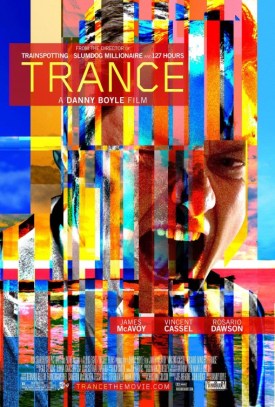
TranceFor movies with labyrinthine plots, such as “Inception” or “Shutter Island,” rigorous structural complexities come with a necessary prerequisite: a desire to care and piece together a million-piece jigsaw moving at a mile per minute.  If we aren’t engaged in the story, the pieces will just sit on the coffee table forever.

That being said, the dots of Danny Boyle’s “Trance” will forever remain unconnected for me.  It’s a convoluted mess that seems to lack a lot of basic cohesiveness.  I was so unconvinced of its self-assuredness and basic integrity that I don’t want to take the effort to figure out if it’s even worth decrypting.

I’m surprised because I consider myself a big Danny Boyle fan, particularly “Slumdog Millionaire” and “127 Hours,” both of which moved me in profound ways.  He’s definitely still got it together stylistically, as “Trance” is an impressively edited trip of a film.  But a bunch of nice cuts don’t mean much if they don’t start creating a whole greater than the sum of its parts.

What’s ultimately assembled before our eyes is a brash bombardment of sound and fury, gaudy to the point of tastelessness.  As James McAvoy’s Simon undergoes hypnotherapy with Rosario Dawson’s Elizabeth, we’re flung down a rabbit hole of bent reality with no investment in the characters or the action.  Sound like a journey worth taking?

Boyle and screenwriter try to overcompensate with bombast, including a rather unnecessary and irrelevant flaunting of Dawson’s genitalia (and then they just throw in some James McAvoy nudity at the end just for fun).  The erotic skin show actually sums up so much of what’s wrong with “Trance” in the first place.  It’s an exclamation point to get your attention, which then reminds us that there was actually no sentence that preceded it.  While I’d like to trust Boyle, his film does not make a strong enough case for its audience to go in and clean up his mess themselves.  C2stars


REVIEW: The East

23 07 2013

In 2012, I wrote a piece for a class entitled “Bad Apples Up on Top” that looked at trends in cinematic portrayals of corporations and wealth in the wake of the Great Recession.  If I were to update that post in 2013, “The East” would definitely mandate the addition of a new paragraph.  Along with films like “The Bling Ring,” “Arbitrage,” and even “The Purge,” writer/director Zal Batmanglij and co-writer/star Brit Marling tap into a growing sense of militarism towards the rich and powerful.

Marling’s Sarah infiltrates the titular anarchist group for the government, attempting to protect her firm’s corporate clients from The East’s attacks.  She quickly finds that blurred lines are not just the things of scintillating Robin Thicke summer singles; moral complexities abound everywhere.  Sarah quickly finds herself wondering if she’s working for the right side in this game – if such a side exists.

The East, as savage as their attacks might be, are not your average criminals.  They want to hold executives’ feet to the fire and jolt them out of complicity, forcing them to feel the pain they inflict on others.  Their jams are highly symbolic, coordinated by members of The East to send a powerful message to the corporations and the public as well.

While all this ambiguity and relativism is fascinating, “The East” is a film that is great at raising questions but not particularly good at answering them.  Films don’t have to force-feed you their message, nor do they have to make them patently obvious.  But Batmanglij and Marling should not have wasted their time bringing up issues they were not prepared to, or incapable of, resolving.  If you don’t stand for anything, it’s entirely possible you could wind up standing for nothing.

“The East” poises itself for a killer finale, yet it brings up far more than it’s prepared to wrap up.  As a result, the film feels like a bunch of stumper interview questions loosely wrangled together into a story.  It’s interesting enough, but “The East” gives us fairly little new evidence with which to reinterpret these ethical quandaries.  B2halfstars


REVIEW: World War Z

22 07 2013

I will say, I do admire the inverted structure of Marc Forster’s “World War Z” (if you choose to give him ownership in spite of the film’s troubled production, which reportedly saw he and star/producer Brad Pitt at the point of not speaking). It’s bold to decrescendo over the course of a movie, bringing out the big guns in what could be considered exposition and then end with a muted but suspenseful climax.

But while it’s definitely not ordinary, “World War Z” most certainly is not extraordinary.  The film is an uninspired hybrid of “Contagion” and “I Am Legend,” capturing neither the intelligence of the former nor the intensity of the latter. It skimps out on characterization, expecting us to root for its main character because … well, he’s Brad Pitt. Relying on iconography can help with identification, but it’s never an excuse to provide scant details or motivations for a character. Pitt’s Gerry Lane is quite possibly the most bland protagonist of a movie with such a whopping budget. He’s just a through-line for the film’s events, boasting no inner life or personal complexity.

While Gerry travels from Philadelphia to Korea to Israel to the UK, the movie never really feels as global a film as the name “World War Z” would imply. Nor does it ever really feel like much of a conflict because the zombies are mostly kept at bay the entire movie. By the end, it all winds up feeling like a self-congratulatory “Thanks, Brad Pitt for saving the world!” show.

Granted, if I was writing the checks for an extravaganza such as “World War Z,” I would want to give myself a pat on the back too. But such a proclivity makes the film a remarkably inconsequential affair for everyone else. We are denied the vicarious thrill of adventure and salvation, just as we are unable to grasp the fear and trepidation of the other billions affected by the scarcely seen zombies.  B-2stars


REVIEW: The Heat

21 07 2013

I won’t deny that I laughed a hefty amount in “The Heat.”  It’s definitely a far cry from Sandra Bullock and Melissa McCarthy’s respective greatest comedic hits, “Miss Congeniality” and “Bridesmaids.”  But it’s still a rollickingly funny romp, effectively harnessing the slightly awkward uptightness of Bullock and the bizarre outrageousness of McCarthy into a laugh machine.

It’s not the most efficient machine, however.  “The Heat” never takes a moment to slow down the pace of the humor, operating at full capacity for nearly two hours.  As a result, there are quite a few jokes that fall flat.  But over the course of a fairly bloated runtime, director Paul Feig and writer Kate Dippold more than make up for these missed opportunities.

The film’s Achilles heel is Dippold’s script, which just isn’t as good as the film’s humor.  It’s more of a through line than a story, connecting the dots between the jokes.  “The Heat” is predictable and formulaic, more or less writing Gracie Hart and wacky bridesmaid Megan into a standard police investigation film.

Sadly, two years after Paul Feig’s own “Bridesmaids” lit the world on fire and promised a more prominent future for female-headlined film, “The Heat” is the only studio film of summer 2013 to feature a female leading character.  And sadly, Dippold blows the chance to make the ultimate feminist statement with some cursory scenes addressing gender struggles in the typically masculine work of law enforcement.  The fact that two women were in a buddy cop flick and no one seemed to bat an eyelid is a pretty telling statement in and of itself.  B-2stars


REVIEW: Only God Forgives

20 07 2013

Only God ForgivesCannes Film Festival – Official Competition
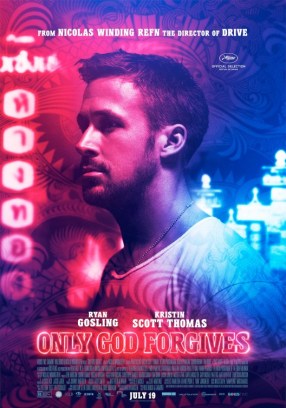
Nicolas Winding Refn’s “Drive” was mediocre genre revisionism.  His latest film, “Only God Forgives,” is an attempt at surrealist action that borders on the experimental.  On principle, I’d like to say I preferred the latter since it was at least ambitious.

However, after a second watch from the comforts of my own bed (the first, a late-night screening in Cannes, put me to sleep for large chunks), I really cannot bring myself to endorse “Only God Forgives.”  It aims for David Lynch or Alexander Jodorowsky, the great surrealist filmmaker to whom the film is dedicated, but falls far short of the mark.  Teasing at a dreamlike experience is not enough – the film must deliver, and it cannot execute on its promise.

Refn’s film lacks any internal logic, bizarrely floating through non-related scenes of a sadistic Thai police officer and Ryan Gosling’s stoically mute Julian.  All great actors run the risk of turning themselves into a cliché (see: Johnny Depp), and I’m sorry to report that we may have reached a tipping point with Gosling.  He’s so frustratingly not a presence in the film that it does not play as tough anymore; it’s just plain obnoxious.

Thankfully, the film does deploy Kristin Scott Thomas to talk enough for the both of them.  As a psychotic mother, perhaps a physical embodiment of Oedipal desire, she’s a firecracker who adds a jolt of energy every time she comes on screen.  Sadly, that’s only a few scenes.

Read the rest of this entry »


REVIEW: Man of Steel

20 07 2013

Look, it’s a bird!  No, it’s a plane!  Worse, it’s Zack Snyder’s “Man of Steel,” a bomb of heroic proportions torpedoing its way towards a multiplex near you to steal 2 1/2 hours of your life and $10 of your money.  How this could have been touched by moviemaking Midas himself, Christopher Nolan, truly escapes me.

I personally saw nothing horrendously wrong with Bryan Singer’s “Superman Returns,” though I haven’t seen it since 2006 (a fact that may ultimately speak loudest to its quality).  However, I can point out a number of gaping flaws in “Man of Steel.”  It’s one thing to leave a movie nonplussed but another entirely to be angry.  If you hadn’t already guessed, I was the latter upon leaving this film.

Most issues seemed to spring from the lackluster story.  The film takes on the practically futile task of humanizing Superman/Clark Kent/Kal-El, an invincible being.  He’s always had an identification problem because, well, how many of us can relate to someone who is essentially perfect?  (I’ll speak for myself and say that I certainly cannot.)  While the drama of Clark’s grappling with his power is relatively compelling, it’s told only in brief flashbacks.

And these scenes with his adoptive parents, played by Kevin Costner and Diane Lane, really only serve to play into the overarching Messianic allegory of the entire film.  I’m certainly not opposed to such grand implications, but they need to be done well (such as they were in Tom Hooper’s “Les Misérables“).  “Man of Steel” feels completely disingenuous, exploiting spirituality for its own gain.  If it were any more obvious about its overloaded metaphor, Henry Cavill’s Superman would be wearing the letter t across his chest.

Read the rest of this entry »


F.I.L.M. of the Week (July 19, 2013)

19 07 2013

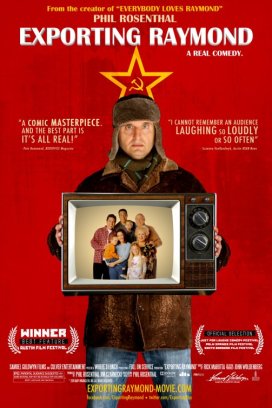
Exporting RaymondIt’s all too easy to throw around the word universal; you can look and see I’m guilty of it myself.  While a nice idea, it is a little naive to assume that there can truly be an experience that unites the entire world.  It’s an especially tempting descriptor for comedies, which often play to broadly shared feelings to illicit the desired response.
But in my pick for the “F.I.L.M. of the Week,” Phil Rosenthal’s documentary “Exporting Raymond,” we get a hilarious crash-course in how great a cultural divide can be.  Rosenthal, the creator of the hit CBS sitcom “Everybody Loves Raymond,” takes us along for the ride as he advises Russian television personnel as they struggle to adapt his show for their market.  To his surprise, more has to be changed than just the language.

As creative staff and executives prepare “Voroniny” to hit the Russian small screen, Rosenthal finds himself explaining things about Ray Barone and his family that he took for granted as just being understood.  The entire way in which Americans enact concepts of family, gender, and power are foreign to the Russians.  Rosenthal finds himself in the precarious position of trying to maintain the integrity of “Everybody Loves Raymond” without setting it up for failure in the Russian marketplace.

For those like myself who found Ray’s antics quite relatable, “Exporting Raymond” is a gentle and well-meaning reminder that our response to his character is largely conditioned by the culture in which we watch him.  Rosenthal shows us how hard intercultural communication can be, but he ultimately demonstrates how valuable the additional understanding we gain really is.


REVIEW: Fruitvale Station

19 07 2013

Fruitvale StationCannes Film Festival – Un Certain Regard
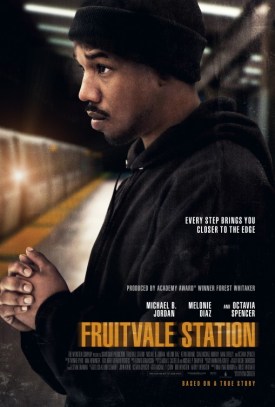
Fruitvale Station” makes no attempts to hide its bleak ending; before anything else, writer/director Ryan Coogler shows us the real-life death of the protagonist, Oscar Grant, as caught by a grainy cell phone camera.  Then we rewind the clock a day, and Michael B. Jordan assumes the role of Grant, a man with nobility and flaws just like any of us.

For an hour, Coogler walks us through the last day in his life.  It’s a poignant and well observed slice-of-life punctuated by Jordan’s great moments of humanity.  Yet without the knowledge that we’re witnessing a series of last moments in Grant’s life, the drama is essentially inconsequential.

Essentially dependent on dramatic irony for propulsion, the majority of “Fruitvale Station” feels like an average movie able to get away with not aiming for much.  But then, the inevitable conclusion arrives, and we’re faced with an incident of horrifying police brutality that claims Grant’s life (it’s hardly a spoiler, so get over it).  The emotionally charged moment is gripping and tense, enough to feel twice as long as the rest of the film.

Read the rest of this entry »


REVIEW: Despicable Me 2

18 07 2013

No one is mistaking Chris Meledandri’s Illumination Entertainment for Pixar.  Heck, on its best day, I don’t even think it stacks up with DreamWorks Animation.  But that’s not to say that “Despicable Me 2” doesn’t have a place in the market.

It’s a film content to be just simple and sophomoric, corny and childish – but who can blame them for making a kids movie that’s tailored towards children?  It’s got goofy laughs aplenty for the munchkins, and it’s not shudder-inducing for everyone else.  While “Despicable Me 2” doesn’t hit straight at the heart like a “Toy Story” movie, it’s lovable enough to bring out the soft side in everyone.

Though it hardly qualifies as TV-14 humor, “Despicable Me 2” boasts a completely successful bottling of Essence d’Kristen Wiig into an animated character.  Her Anti-Villain League agent Lucy has all the lovable awkwardness of Wiig complete with all her zany body contortions.  She makes up the deficit left by Steve Carell’s Gru and the adorable Agnes, who simply doesn’t have the same unbridled innocent charm as the original “Despicable Me.”

Yet while Agnes decreases, the Minions increase.  Those little yellow corn-nuggets of energy are back in full force, no longer relegated to side-show status like they were in the first film.  They are even better realized in “Despicable Me 2,” achieving a kind of humor not unlike that of silent comedians (albeit in a very watered down fashion).

Illumination certainly did a good job of looking at what worked in the 2010 film and made it even bigger and better for their sequel.  In other words, they’ve come to the market in 2013 with a product even better suited for the moviegoers that made “Despicable Me” such a hit 3 years ago.  That may be good for investors, but it’s not all that great for the fans.  “Despicable Me 2,” not unlike its predecessor, is a rather disposable movie that charms during the experience but dissipates the second you leave the theater.  Though it is funny, it is also rather forgettable.  B-2stars


REVIEW: What Maisie Knew

22 06 2013

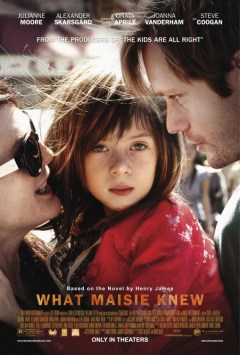
Dramatizations of divorce from “Kramer vs. Kramer” to “Mrs. Doubtfire” to “A Separation” have been echoing the same message for years: though the process may be messy and sticky for the parents, the ultimate losers are the children.  “What Maisie Knew,” the latest entry into this canon, tries to offer something similar.  Largely shot from the eye level of its titular tyke, the film conveys successfully just how ugly and catty dissolving a marriage really gets.

Yet at the heart of “What Maisie Knew,” there’s a cruel irony that kept nagging at me as the film dragged on.  The movie scolds parents who forget about the children in the process of sorting out their issues, but “What Maisie Knew” does not practice what it preaches.  Like Julianne Moore’s hopelessly selfish mother Susanna and Steve Coogan’s ill-equipped workaholic father Beale, the filmmakers ultimately lose Maisie’s story and centrality.

By the second half of the film, Maisie is no longer the protagonist; she’s merely a means to an end.  Taking center stage is Alexander Skarsgard’s Lincoln, Susanna’s boyfriend who quickly gets thrust into the role of husband and stepfather, and Joanna Vanderham’s Margo, a former babysitter at the root of the divorce itself.  These two adults are interesting enough, to be sure, but I didn’t want to watch their story.

I came to watch Maisie and see how divorce affects poor, innocent children.  Newcomer Onata Aprile does a wonderful job eliciting sympathy and bringing emotion to her role.  It’s no Quvenzhané Wallis in “Beasts of the Southern Wild,” but it’s still impressive.  Wallis was given the ability to carry her film, though, and the risk paid off in spades.  “What Maisie Knew” doubts its lead, and it’s a mediocre film at best because of its shaky confidence and erratic focus.  C+ / 2stars