REVIEW: Cedar Rapids

22 06 2011

I don’t know if you have any romanticized notions about how bloggers watch movies outside of theaters, but let me dispel just about all of them right now.  Be it through Netflix, iTunes, Redbox, Blockbuster, or basic cable, watching movies is usually just us sitting in front of some sort of screen (and in rare cases, we can manage to net a friend or family member if the movie has wide appeal).  We generally just plop, watch, and write, sharing our opinions not verbally with the person we endured the movie with but digitally with people who read our site or happen to accidentally wind up here after Googling “did the kings speech win any oscars?”

This method of movie watching inevitably favors one genre and shorts another.  It’s easy to love a drama you watch at home because it’s hardly different than watching in the theater – that is, the audience is mostly silent for the duration of the movie.  It’s hard to love a comedy because you have no one’s reaction but your own to measure as audience laughter has a significant impact on how we perceive the humor of a movie.  Plus, no one really likes to laugh by themselves.

So when I come across a movie that can make me laugh while I’m curled up alone underneath my bed sheets, I rejoice!  Ladies and gentleman, “Cedar Rapids” is one of those movies.  Sure, it may be hopelessly pathetic and wallow in endless jokes of naïveté, but it’s actually funny!  I laughed!  A lot!  In bed!  Seriously, that doesn’t happen very often at all!

Ed Helms, best known as Andy Bernard from “The Office” and Stu from “The Hangover,” stars as Tim Lippe, the insular Wisconsin insurance salesman who gets a chance to go to the titular metropolis representing his company.  There, he is exposed to the dangers and pleasures of true urban living and meets an exciting cast of characters including the crude Dean Ziegler (John C. Reilly), mild-mannered Ronald Wilkes (Isiah Whitlock Jr.), good-natured Joan Ostrowski-Fox (Anne Heche), and the prostitute with the heart of gold Bree (Alia Shawkat in the first role of its kind likely to be snubbed by the Oscars).  Tim is totally clueless the entire movie, never really leaving his tighty-whitie turtle shell of ignorance.  But even the cheap laughs work here, and my reactions ranged from chuckles to belly laughs.  So what are you waiting on, book a trip to “Cedar Rapids” and enjoy comedy that can illicit a verbal reaction from you in the comfort of your own home.  Humor me.  (It’s also alright to laugh at the pun.)  B+ / 


REVIEW: The Adjustment Bureau

21 06 2011

I’m at a bit of a loss as to what I can write about “The Adjustment Bureau.”  I saw the movie nearly five months ago, and the fact that I can recall so little about it probably speaks the most about its quality.  It’s more than a halfway decent thriller featuring two very attractive leads in Matt Damon and Emily Blunt, but it’s not exactly remarkable or memorable.

Based on a Philip K. Dick short story – and to be honest, what high concept thriller isn’t nowadays – the movie revolves around Senatorial candidate and future Presidential hopeful David Norris (Damon) who goes off the set “plan” for his life as written by the Adjustment Bureau, a group of caseworkers who ensure the execution of their mysterious Chairman’s will.  This is largely due to his interactions with the avant-garde ballerina Elise (Blunt), which begin with flirtations but progress towards romance and a relationship.  As David struggles to sort out his feelings for her, he must also weigh the input of the Bureau, who insists that they never be together.  David decides that he must write his own life rather than submit to some pre-written script for his fate.

The movie has some religious implications through its plot and some undertones courtesy of new director George Nolfi, but they feel slightly exploitative and immature.  If you are going to draw comparisons to God or throw religion clearly and obviously on the table, you need to have the ideas fully fleshed out and clearly communicated, two things I don’t think Nolfi did.  Predestination and fate are big questions that have baffled theologists for years, so don’t think that “The Adjustment Bureau” will give you a definitive answer or break any new ground in the field.  At the end of the day, it’s still just an entertaining thriller.  B


REVIEW: Green Lantern

20 06 2011

The old adage traditionally goes “money can’t buy you happiness,” but in respect to the latest Hollywood comic book adaptation, “Green Lantern,” money can’t buy you quality. The higher the pedestal, the harder the fall, and with a $200 million price tag, this movie lands a hard face plant.  Even with Ryan Reynolds turning in one of the better superhero performances in recent memory, the movie’s unimaginative script and laughable special effects render it one step short of unbearable.

The first movie in any hopeful series has to do a lot of introductions, and the hero has to earn his stripes.  But here, the exposition just made me want to howl with laughter because of its corniness, and they even brought in Geoffrey Rush to do some of the narration to make it sound serious!  The whole universe they set up feels like some rejected, half-baked idea for a Disney Channel series with its Sectors of the universe, the wise sages known as Guardians, and the intergalactic police force called the Green Lantern Corps.

Hal Jordan (Reynolds) is the lucky human who gets to join their ranks thanks to being “chosen” by the green light after another Green Lantern crash-lands on Earth.  Cocky, rule-breaking, and daredevil Jordan has his work cut out for him as the Green Lanterns draw their power from the green light of will, while the menacing Parallax (and his new convert Hector Hammond, Peter Sarsgaard’s mad scientist with a nasty receding hairline) draws his power from the yellow light of fear.  He must learn to use willpower to overcome fear by using the power of imagination – which makes it all the more ironic that the movie’s big theme copies that of the poorly received “Spider-Man 3.”  Clearly it’s not Jordan who needs the green light; it’s the people who wrote the script.

The whole mess, which goes on for nearly two hours, is full of plot holes and ridiculous implausibilities (flying next to the sun?) that make it even more laughable.  But the icing on the cake is the movie’s visual effects, which are honestly the WORST that I’ve seen in a blockbuster made this millenium.  When Jordan harnesses the green energy and transforms, he looks so fake that it’s hard to take him seriously.  It’s made worse by the fact that his eyes are sloppily changed blue, making him look borderline possessed (not to mention that it does jack squat to protect his identity).  And don’t even get me started on those Guardians; they look like the offspring of trolls bred with Smurfs.

Truly, Reynolds deserves better than this.  He may be the “Sexiest Man Alive,” but he’s also out to prove that he’s more than just a pretty face.  He puts a lot of soul into this character, giving Jordan some depth and emotion, yet he’s stifled by a terrible movie that is unintentionally more like “Bridesmaids” than “Thor.”  Reynolds is a star here, but he can’t shine bright enough to overpower the ugly light that is “Green Lantern.”  From a critical perspective, it’s a big, fat red light for this movie.  C- / 


REVIEW: Unstoppable

19 06 2011

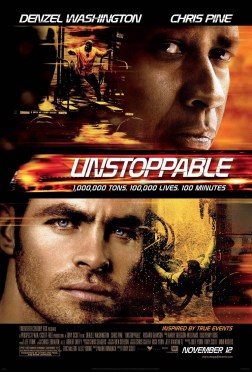
Unstoppable” is easily one of the best action films I’ve seen in a long time, and every filmmaker should be taking notes from Tony Scott here.  He takes a story that we all know very well – the worst case scenario coming to fruition – and makes it exciting again.  Scott keeps the movie paced as fast as the runaway train in the title and keeps us drawn in for the whole ride.  It’s solid entertainment done totally right, and even though it doesn’t engage the brain, it compensates by putting a pit in your stomach and keeping your heart racing throughout.

Thanks to the perfect storm of errors, a freight train carrying dangerous chemicals is barreling out of control towards Stanton, Pennsylvnia.  There are only two men who can stop it: old-timer Frank Barnes (the unbeatable Denzel Washington) and his trainee, new hire Will Colson (Chris Pine).  The two men, very different in their attitudes and approaches, must come together and grapple with the big issues of duty and death in order to save a hundred thousand lives.

Even without the movie being inspired by true events, we would already feel the inevitability of the ending.  Yet Scott’s high-octane cinema of adrenaline never lets up, still making us hold on to our seats until the exciting conclusion.  While we wait, he dazzles us with incredible aesthetics, which we can still appreciate even though they aren’t being thrown in our face like an Oscars “For Your Consideration” ad.  The film’s editing, cinematography, and sound are just as much responsible for the thrill ride of
“Unstoppable” as Washington or Pine.  By the time the credits roll, you’ll wonder why all action movies couldn’t have such impeccable production values and firm direction.  B+ / 


REVIEW: The Art of Getting By

18 06 2011

I never thought I would be so thankful for Woody Allen’s brand of cynicism and misanthropy than I did when leaving “The Art of Getting By,” an indie comedy revolving around a budding romance between two unlikable NYC teenagers.  This lame attempt at comedy is like watching the first draft of a script that Allen wrote on downers; it has all of his nihilism but none of his neuroses.  Gavin Weisen’s first feature lacks the palatability that makes Woody Allen’s personality bearable, and in just 85 minutes, he’ll make you wish you were sitting in a cookie-cutter rom-com.  (Yes, it’s actually that bad!)

Freddie Highmore, who you know from “Finding Neverland” and Tim Burton’s disastrous remake of “Charlie and the Chocolate Factory,” is now moody and emo because bangs cover his eyes and he reads Camus in the cafeteria.  As George, he’s a mopey defeatist who has Woody Allen-level pessimism at the age of 18.  He’s totally detached from school, doing no work, and from home, where he refuses to communicate with his caring mother (Rita Wilson).  Even on the verge of suspension and expulsion, he can’t bring himself to put anything on his homework other than demented doodles.

Enter Emma Roberts as his desert flower Sally, the child of a broken marriage who shares some of the same bitterness and insecurities as George without wearing it on her sleeves.  They begin a strange friendship that teeters on the brink of love, but he can’t ever snap out of his negativity and she can’t seem to say much other than “you’re really weird.”  It’s really uncomfortable, filled with poorly executed melodrama and even less appealing romance.  If there was any attempt at comedy, it wasn’t even visible.  By the end, you’ll discover that “The Art of Getting By” can’t even leave you with a half-hearted smile like other disappointing romantic comedies.  All you really feel is a slight numbness in your butt as you climb out of the seat.  C- / 


F.I.L.M. of the Week (June 17, 2011)

17 06 2011

In preparation for “The Tree of Life,” I made my way through the entire Terrence Malick filmography (which, by the way, isn’t hard since he has made all of four films in 37 years) for the first time.  I had heard so much praise for the director’s movies, yet the only one I thought was unequivocally worthy of it was “The Thin Red Line,” my pick for the “F.I.L.M. of the Week.”  Malick’s distinct style and imagery seem uniquely fitted for a movie like this, where men with killing machines are juxtaposed with the beauty of nature and the people who live in harmony with it.

Set in 1942 during the American offensive on Guadalcanal, Malick’s nearly three-hour film has the ambition and grandeur of an epic poem, and it certainly feels like one.  The beauty and the savagery Malick captures with the lens tells another story all on its own, and together with a script that plumbs for perspectives on the most primal questions of human existence, the movie’s visceral intensity can make for sensory overload.  In my opinion, it’s the only one of his films where I felt truly moved by the imagery and rambling philosophical narrations (both trademarks of his work).

Of course, I’m not going to pretend like I have a deep understanding of the movie, only that at surface level with some shallow analysis, it’s a satisfying watch.  It certainly doesn’t feel as esoteric or obscure as his other films.  I will say that I don’t think it’s any coincidence that the only one of his movies I really liked was his only adapted script.

The characters, although I’m sure still twisted for Malick’s own purposes, come from the novel of the same name by James Jones.  The men in the movie – with the exception of the now extremely famous – all look alike, so it gets a little confusing at times to separate the individual storylines of C Company.  However, as long as you are willing to accept “The Thin Red Line” as a movie of ideas and images instead of a movie of events, then you will be swept off your feet by Malick’s fim that doesn’t fall anywhere on the typical pro-war/anti-war spectrum.  It celebrates life in the most threatening settings known to mankind.


REVIEW: Client 9: The Rise and Fall of Eliot Spitzer

16 06 2011

With the chaotic Anthony Weiner scandal finally ending in his resignation (but hopefully not putting those hilarious sexual puns to rest), it seems like as good a time as ever to discuss “Client 9: The Rise and Fall of Eliot Spitzer,” Alex Gibney’s fascinating documentary of another New York politician driven out of office by the revelation of personal vice.  The prolific documentarian delivers an enthralling chronicle of Spitzer’s career, from his heights as Attorney General to the humiliating admission that he had been involved in a prostitution ring.  Gibney provides a multilateral view of it all, leaving no stone unturned and showing how Spitzer was digging his own grave while constructing his doomed political colossus.

In case anyone is unfamiliar with Spitzer from any context other than his CNN show or the embarrassing final press conferences with his wife standing steadfastly behind him, Gibney’s portrait brings everyone up to speed with his career.  Beginning from his tenure as Attorney General of the state of New York, Spitzer was deeply committed to delivering justice.  Given the state, his jurisdiction included Wall Street, and anyone who rattles the cages there is bound to piss off some powerful people.  While his dynamic regulation earned him praise from the press, with some hailing him as “the future first Jewish president,” there were men behind the scenes looking for ways to bring about his demise.

Ultimately, they didn’t have to resort to Mafia techniques to see the realization of their dream; Spitzer handed it to them on a silver platter.  Behind the successful, married, and unflappable façade he constructed was a man seeking for something more.  Unfortunately, he found that something in a high-priced prostitute known as Ashley Dupre.  It only took a little bit of dirt searching to find this secret, and as they say, the rest is history.

Gibney gets interviews from all the high-profile figures in the saga, from the pissed-off powerbrokers to the pragmatic prostitutes.  But unlike most documentaries, “Client 9” boasts having first person commentary from the two main characters in the story – Spitzer himself and Ashley Dupre, played by an actress to protect herself.  The hired hand does a great job of bringing her story to life, but it’s Spitzer that draws us in and never lets us go.  We can see how tough it is for him to admit to his mistakes and relive the painful events that brought down his life.

Watching Spitzer’s admissions with such raw humanity makes “Client 9” essential viewing in spite of Gibney’s inconsistencies.  The nearly two hour movie flip-flops between various tones, including a History Channel special, a tale of political intrigue reminiscent of the fifth season of “24,” a thriller, and an exposé of the prostitution industry.  But in spite of its shortcomings, Gibney’s film draws some important conclusions about what leads men in power to slip up, and Anthony Weiner is just further proof that what he has to say is still extremely relevant.  B / 


REVIEW: It’s Kind of a Funny Story

15 06 2011

Any good movie fan instantly associates insane asylums with “One Flew Over The Cuckoo’s Nest,” Milos Forman’s classic that is one of only three films ever to score Oscar’s Big Five (Best Picture, Director, Actor, Actress, and Screenplay).  It’s a ridiculously unfair standard for any movie to be measured against, so naturally, when a movie like “It’s Kind of a Funny Story” comes along that treads similar waters, it can’t help but disappoint coming straight out of the gate.  The dramedy just exacerbates the disparity by dealing with the thin line between sanity and insanity in a noticeably more juvenile manner.

The movie piddles around in the messed-up mind of narrator Craig Gilner (Keir Gilchrist), a suicidal teenager who checks himself into a psychiatric hospital after failing to execute a plan to jump off the Brooklyn Bridge.  As we find out, he’s just a little misunderstood, buckling under the pressure of being a teenager in the modern world.  And since I’m eighteen and heading off to college, I should totally understand and relate, right?  Wrong.  Craig is hardly a sympathetic character, and Gilchrist portrays him so awkwardly that it’s really hard to care about anything that happens to him.

Thankfully, directors Ryan Fleck and Anna Boden – who have fallen far from their 2006 debut feature “Half Nelson” – don’t saddle us with only watching Craig deal with his demons for the whole movie.  They stock the nuthouse with other mildly amusing characters, primarily Zach Galifianakis as fellow patient Bobby.  He brings a few laughs but mainly makes you wonder whether Alan from “The Hangover” belongs in an institution since he’s not all that different from his character here.  There’s also some corny, schmaltzy romance between Craig and Noelle, played by Emma Roberts, which doesn’t work at all since the two have zero chemistry.  It’s hard to believe this movie came from an esteemed novel, so do yourself a favor and watch the aforementioned acclaimed movie based on an acclaimed novel.  C / 


REVIEW: The Girl Who Played With Fire

14 06 2011

In retrospect, all my complaints about “The Girl With The Dragon Tattoo” were nothing compared to the ones I can lodge against its sequel, “The Girl Who Played With Fire.”  This adaptation of Steig Larsson’s incredibly intricate and suspenseful novel ultimately amounts to little more than a visualization of his major plot points.  As a reader of the trilogy, this was disappointing but acceptable.  However, as a watcher and reviewer of movies, this was a sloppy movie severely lacking in many significant areas.

For one, basic acting technique.  Generally, when trying to convey emotions and the importance of events, actors create stakes that then register with the audience and goad them toward the appropriate response to what’s taking place on screen.  Meryl Streep creates stakes; Al Pacino creates stakes; even Robert Pattinson and Kristen Stewart create stakes.  Yet no one in “The Girl Who Played With Fire” seems to be interested in creating stakes, though, making the movie a muddled mess where the characters just seem to wander from event to event without any idea of their importance.  I can’t even imagine how hard this movie must be to watch for someone not familiar with Larsson’s far superior book.

The movie makes the same mistake as its predecessor in cutting out all subplot to focus on Salander (Noomi Rapace) and Blomkvist (Michael Nyqvist).  This time around, it’s a fatal move as the supporting characters are so crucial to the storyline as Blomkvist searches for answers to a series of murders that seem to have Salander’s name written all over it.  In addition, Nyqvist’s total lack of emotion makes his carrying the movie simply unbearable.  I know it’s cliched to say “the book is so much better, read it before you see the movie,” so I won’t say that.  Read the book instead of seeing the movie.  C+ / 


REVIEW: Buried

13 06 2011

2010 saw the release of two cinematic interpretations of claustrophobia: “127 Hours” and “Buried.”  However, the trapped protagonist marks the films’ diverging point.  While Danny Boyle’s film is a buoyant celebration of life and the triumph of man’s will over the harsh conditions of nature, Rodrigo Cortés’ film takes place in a coffin underground, a setting which sets the bleak tone for the thriller that so badly begs to be seen as Hitchockian.

Equipped with nothing more than a Zippo lighter and a cellphone that somehow manages to get service underground in Iraq (he must not have AT&T, which can’t get me reception in my own house), American truck driver Paul Conroy (Ryan Reynolds) must find a way to get himself saved.  He only has a finite amount of time to do this, or the oxygen will run out – and he will die.  Paul has no recollection of how he managed to get himself in this position, but he must be smart and look forward to get himself out of the position.

There are no cinematic tricks hiding in the sleeves of “Buried;” it’s just straight up 90 minutes of Ryan Reynolds stuck in a box acting the hell out of his character.  Fearful, confused, alone, worried, woebegone – he runs the whole gamut of emotions in a small space and in very little time.  It’s an impressive performance that adds a humanity to the movie that feels as palpable as the sweat dripping down his forehead.

Cortés does a great job of complementing Reynolds’ intensity by craftily manipulating the tools he has.  The movie’s cinematography, editing, and score are all impeccable and keep the suspense taut.  I had my doubts that anyone could make a movie like “Buried,”truly just as straightforward as a man in a coffin, even work, but Cortés executes and makes it a great thriller.  While I’d choose to be trapped with “127 Hours” over this in a heartbeat, I definitely can’t diminish the efficacy of this equally improbable success.  B+ / 


REVIEW: Super 8

12 06 2011

I’m not exactly a romantic or a nostalgic, but I have to admit that I sure wish summer movies looked a lot more like they did back in the ’80s.  There are very few visionaries who take on blockbuster entertainment anymore, and save Christopher Nolan, you really can’t sell a movie on a director like you could with fearless masters like George Lucas and Steven Spielberg.  Few movies nowadays can produce the same wide-eyed wonder as classics like “Star Wars” and “E.T.” (in my mind, “Inception” is this generation’s equivalent).

But J.J. Abrams, the man who made us want to get “Lost” and made “Star Trek” cool again, is definitely trying to bring back some of that Spielbergian magic (and thus put his name on the poster) with “Super 8,” a movie that feels like it would have been a great way to spend $3 on a hot summer day in 1982.  It’s the kind of movie that a studio lets a director make after they deliver a big franchise hit, a true passion project that proves difficult to market because it has to be sold on Abrams’ name and story.  Using his suspense techniques from “Lost,” the character development of “Star Trek,” and the all-powerful weapon that is nostalgia, Abrams crafts a blast-from-the-past sci-fi movie that brings some substance and style back to a genre that has gone too long without it.

In fact, “Super 8” may be the first neo-Spielbergian movie as Abrams grew up on the director’s early classics and is now using his maturity and filmmaking bravura to pay homage and honor to his style.  Yet while imitation may be the sincerest form of flattery, Abrams doesn’t just stick to Spielberg’s conventions like white on rice.  Rather, he expands upon them and takes them further to make his story appeal to a new generation of moviegoers while also maintaing the timeless appeal that made Spielberg’s movies so enchanting.

Read the rest of this entry »


REVIEW: You Will Meet A Tall Dark Stranger

11 06 2011

With Woody Allen and his latest film, “Midnight in Paris,” very much the toast of the town, I figured now would be as good a time as ever to burst his balloon because the input of one 18-year-old blogger can really induce a neurotic panic attack in the famed director. I’m sorry to say that Woody doesn’t always make them like that; in fact, they usually turn out much more like “You Will Meet A Tall Dark Stranger,” a redundant statement of the director’s worldview that lacks the pop and charisma of his earlier work.

Allen’s annual entry into his cinematic canon, circa 2010, features a vintage cynicism and defeatism that stifles the possibility of any charm his impressive ensemble could endow the movie.  It shapes its grim worldview around this little Shakespearean nugget of wisdom: “[Life] … is a tale told by an idiot, full of sound and fury, signifying nothing.”  That really puts you in a jaunty, comedic mood, doesn’t it?

The movie takes shape around a group of interconnected Londoners dealing with issues of love and faith in transitory phases of life, all of which begins with the divorce of Alfie and Helena, played respectively by Anthony Hopkins and Gemma Jones.  She can’t get over it and begins seeing a fortune teller in distress while he quickly hits the scene and gets engaged to a prostitute, portrayed beautifully by the very funny Lucy Punch.  This puts an added strain on the marriage of their art-dealing daughter Sally (Naomi Watts) and her failed author of a husband Roy (Josh Brolin), tempting them to begin affairs with exotic people they see on a regular basis.  For her, it’s her boss Greg (Antonio Banderas).  For him, it’s the new Indian beauty (Freida Pinto of “Slumdog Millionaire” fame) that moved in across the street … who just happens to be engaged.

But remember, it all signifies nothing, right?  There is no point!  It’s all just a meaningless charade and a stupid exercise of emotions before we inevitably meet our mortal doom?  If you answered yes to both of those questions, perhaps you are better off saving the 90 minutes of your life that would be spent watching “You Will Meet A Tall Dark Stranger” and using them to find the beauty in life.  Because it does exist, just not in this movie.  C / 


F.I.L.M. of the Week (June 10, 2011)

10 06 2011

With “True Grit” now available to watch at home, I figure the celebration shouldn’t be just of the Western genre but of the Coen Brothers in general!  I haven’t made it through their entire filmography – don’t shoot me when I say I haven’t seen “Blood Simple” or “Barton Fink” – but I have found a gem among their movies that deserves more attention and laud.  I present “The Man Who Wasn’t There,” a quintessential example of the film noir style but still a flawless example of the Coens’ own unique filmmaking conventions.  (And for the record, I think it’s much more deserving of a Best Picture nomination than “A Serious Man.”)

Billy Bob Thornton, complete with his low and thick Southern drawl, plays the solemn and stern Californian barber Ed Crane, completely unremarkable in just about every way.  He feels emasculated and numb to the world around him, somewhat because he couldn’t serve in World War II due to his flat feet and also because he senses his wife Doris (Frances McDormand) is having an affair with her boss Dave (James Gandolfini).  Yet the game changes a shady salesman shows up with a proposition that could make Ed a very rich man.  What ensues is a crazy, unforeseeable chain of events that pushes Ed to the brink … and he still manages to stay stolid.

“The Man Who Wasn’t There” could easily be labeled a textbook for the conventions of neo-noir, just as “Double Indemnity” could be the textbook for the original school of noir filmmaking.  The lighting and the sets really shift our moods to darkness, and the crisp, clean cinematography of Roger Deakins makes the film’s look simply irresistible.  But any fan of the Coens know that they can’t just stick to outlines or formulas, usually blending in elements of dark comedy and nihilism with any genre they tackle.  Their take on film noir is just sublime, and any fan of the directors will certainly love watching a movie that feels straight out of the 1950s but has their signature spin.


REVIEW: X-Men: First Class

9 06 2011

I’m not quite sure how “X-Men: First Class” fits in to the universe created by the other 4 films (like “Superman Returns“), or if it’s supposed to create a whole new universe in itself (like “Batman Begins” or “Star Trek”).  This confusion makes it hard to write about the summer superhero tentpole movie.  However, rather than worry myself with such fanboy concerns, I’ll review it like I chose to watch it: as a fun, entertaining reintroduction to the mutants that provides some interesting background on their origins (as well as shining some light on the REAL events of the Cuban Missile Crisis).

Matthew Vaughn makes it easy to forget your worries about the movie’s place in the series by keeping a smooth pace through a script that balances big explosions with character development.  It’s like a two hour pilot that introduces you to a fantastic ensemble while also fleshing out the conflict between its two biggest stars.  He’s no Christopher Nolan behind the camera, but he’s certainly much better than Michael Bay or whoever made the horrific “X-Men Origins: Wolverine” (which I still think was just an excuse for Hugh Jackman to prance around naked on camera).

Vaughn also makes some very savvy casting decisions; rather than filling out the large cast with marquee names or falling stars, he casts up-and-coming stars who make up for what they lack in marketability with their impressive acting chops.  James McAvoy (“The Last Station“) and Michael Fassbender (“Inglorious Basterds“), Xavier and Magneto respectively, are two incredibly reputable actors who bring drama and dynamism to the roles that Patrick Stewart and Ian McKellen made campy and stale. Oscar nominee Jennifer Lawrence (“Winter’s Bone“) brings soul and heart to Mystique, two things Rebecca Romjin did not endow her character since she was too busy being sexy.  Nicholas Hoult (“A Single Man“) is a warm-hearted and lovable big-footed scientist.  January Jones provides some nice eye candy for those who might miss Halle Berry, although she will always be Betty Draper of “Mad Men” for me, while fans of Rose Byrne (“Bridesmaids,” “Get Him to the Greek“) will also rejoice to see her featured as mutant protector Moira MacTaggert.

It’s like he’s trying to have the 25 year reunion of this cast be on the cover of “People” with the title LOOK HOW FAR THEY’VE COME in big bold letters (while Lindsay Lohan is arrested for the 30th time in the sidebar).  Vaughn uses these superheroes to create superstars, many of which will be touting above-title billing after this movie.  His choice not to overload with actors who we already associate with other roles makes us more drawn in to the characters and less distracted by the people portraying them.

Read the rest of this entry »


WTLFT: July 2011

8 06 2011

Yeah, I shortened the name.  It’s a lot more palatable.  This post will tell you What To Look Forward To in the month of July.  We have transformers, captains, teen stars, teen wizards, sex friends, zoo friends, hellish bosses, honey bears, and smurfs – just to name a few.  Here they all are; you can make up your mind if any of these actually appeal to you.

July 1

Cheating- “Transformers: Dark of the Moon” actually comes out on June 29, and, if you want to get really technical, June 28 at 9:00 in IMAX 3D and RealD 3D.  So while you curse me for my horrific crimes against nature, humanity, and blogging, watch the trailer and decide for yourself whether or not you want to subject yourself to Shia LaBeouf and a lot of loud noises orchestrated by Michael Bay.

On the quieter side of things, Tom Hanks and Julia Roberts plan to use their star power to fill seats at “Larry Crowne,” which looks like perfectly middle-of-the-road rom-com territory.  On the louder side of things again – and by louder, I mean girlish screams and constantly ringing cell phones – “Monte Carlo” gives young girls what they need during the summer.  A nice helping of Selena Gomez, Katie Cassidy, and Leighton Meester should have the tweeners saying “OMG!” until the next season of “Wizards of Waverly Place” hits the small screen. (There’s also a creepy thriller called “The Perfect Host” starring David Hyde Pierce, which I feel obliged to mention since it’s the only indie offering amidst these studio genre pics.)

July 8

Fingers crossed that “Horrible Bosses” will be funny!  I remember reading a piece on a blog for The Los Angeles Times well before the movie started production that praised it, so hopefully it stuck to the script.  If it’s a hit, I motion for Jennifer Aniston to stop doing horrible rom-com fare and stick to raunchy comedy; I chuckle every time I watch the trailer and hear her say, “Shabbat shalom; someone’s circumcised!”

As for “Zookeeper” … well, I hope the kids enjoy it.

I’ve definitely been going through a documentary phase ever since last year’s “Inside Job” rocked my world, and Michael Rappaport’s “Beats, Rhymes, & Life: The Travels of a Tribe Called Quest” could feed my obsession quite well.  It follows the titular hip-hop group (known as A Tribe Called Quest if you are as clueless as I was) from formation to fame.  Best case scenario it provides a fascinating expose of the craft of rapping much like “Joan Rivers: A Piece of Work” did for standup comedy last summer.  Worst case scenario I get to see some of my favorite artists talking about a group I’ve never heard of before.

Another interesting documentary (that I can only PRAY makes it to Houston sometime before I leave for college) is “Project Nim,” the story of a chimpanzee experiment.  I’ve always been interested in stories where lines and boundaries we once thought clear are exposed and shown to be more porous and relative than we thought, and this looks to deliver on a big scale.

July 15

Some tiny little series ends on screen.  It’s no big deal, it’s not like these movies define my youth.  It’s not like it’s a worldwide phenomenon.  But in all seriousness, I’m not going to cry.  “Harry Potter and the Deathly Hallows, Part 2” – BRING IT ON!

Read the rest of this entry »