“Acting is not about being someone different. It’s finding the similarity in what is apparently different, then finding myself in there.”
– Meryl Streep
“You have to show violence the way it is. If you don’t show it realistically, then that’s immoral and harmful. If you don’t upset people, then that’s obscenity.”
– Roman Polanski
Out and About in the Community
As a sort of cop-out for not publishing this on time, I’m going to overpublicize two events I participated in recently over at the Large Association of Movie Blogs (The LAMB), a giant database of bloggers that get together and pool ideas and posts.
The first was the LAMB Acting School, a monthly series that gathers reviews and retrospectives centered around a single actor. This month, it was the legendary Meryl Streep, the woman who may well be the greatest actress of her generation. For those who get sick of her or claim that the Oscars are overly obsessed with her, just look at her filmography and tell me that the diversity of roles present and the dexterity with which she pulls them off isn’t flooring. Her emphasis is obviously on the drama, but she can pull off comedy just as easily. She is often lauded for her ability to change the accent of her voice to fit a character; however, it’s that incredible Streep pathos that she brings to every role that has made her a symbol of consistency and reliability in a volatile cinematic climate.
Not to mention I owe Meryl Streep a very special favor myself. If it hadn’t been for her and “Julie & Julia,” this blog probably wouldn’t exist. She has changed my life for better and for always, and I am eternally grateful.

Click on the graphic to go see all the posts, but here are links to what I have reviewed from her illustrious career:
Then, a week prior, I participated in the “LAMBs in the Director’s Chair” event, which celebrated the career of Roman Polanski. I haven’t seen too many of his movies and have reviewed even fewer, but I admire his skill behind the camera and don’t wish to comment on his legal status. I saw “Roman Polanski: Wanted & Desired,” which I found an interesting portrait of a haunted man, and it just made me even more torn.
Nonetheless, “The Pianist” may be one of my all-time favorite movies. It is so powerful and moving, perhaps the only intensely personal non-documentarian account of the Holocaust we will ever get. I’m really hoping “Carnage” is another big success – I always love a good play adaptation.

Again, click the link to be taken to the post with reviews and commentary. Here’s what I submitted:
Classics Corner: Rosemary’s Baby
A Week in Review
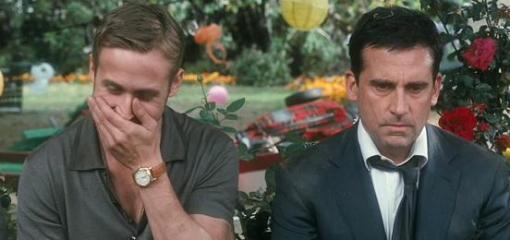
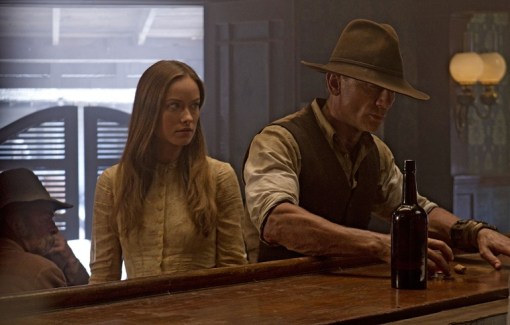
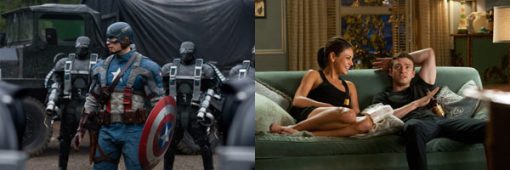
This week, I reviewed the two non-Smurf new releases, “Cowboys & Aliens” and “Crazy Stupid Love.” My expectations were high for the former, low for the latter; the output was low for the former, high for the latter. Click the pictures to be transported to the reviews.
I also celebrated my two year birthday/anniversary, whichever it is – without the pomp and circumstance. And I’m totally OK with that.
Recommended Reading
Here’s some of the great work I read this week:
- Alex at “And So It Begins” was even less impressed by “Cowboys & Aliens.” And I thought I hated that movie…
- Sam, writing this post for “Anomalous Material,” took a different take on “Crazy Stupid Love.” Different strokes for different folks, I guess.
- James at “Cinema Sights,” quite a while ago, wrote a piece entertaining the notion of slow films. I agree with almost all points, but that doesn’t mean I have to like “The Tree of Life.”
- Univarn at “A Life in Equinox” reimagines classics movie lines in the digital age. It’s guaranteed a few laughs.
- Darren at “The M0vie Blog” re-examines the place for nostalgia in our moviegoing culture. It’s a fascinating, thought-provoking read that may have you wanting to revisit “Midnight in Paris” again.
- Andrew at “A Constant Visual Feast” asked us to question our notions about reboots, remakes, reinterpretations, and any other movie term you can stick a “re” in front of, particularly in the wake of “The Amazing Spider-Man.”
The Rant
This is a thought I had upon further thought on the sex friend movies of 2011, “No Strings Attached” and “Friends with Benefits.” (Believe it or not, it is possible to think on them.)
Isn’t in hypocritical that the MPAA has begun a crusade against cigarette smoking yet have done nothing about what I think is a much bigger issue in movies nowadays: the casual attitude towards unprotected sex. While I’m not going to dismiss smoking in movies as something that can influence kids and teenagers, I would argue that they are much more likely to imitate the sexual behavior of screen characters. Smoking is a social behavior, so kids see it out in public all the time. Movies just reinforce what they see in real life.
Sex, however, is a very private matter. Their education nowadays is abstinence or a very sanitized, conservative, condoms-on-bananas approach, like Coach Carr from “Mean Girls” (see the clip below). What they see in the movies defines how they perceive it in the real world.
While sex on film has evolved with the constantly changing societal norms, from “Carnal Knowledge” to “Brokeback Mountain” to the 2011 duo touting casual sex, I’m surprised that public awareness (and perhaps anger) of how sex is being portrayed on screen hasn’t caught up with the times. While the conservative definition of sex as an act between man and wife was thrown out quite a while ago, that isn’t an excuse not to care. Attitudes may have changed, but that doesn’t mean that we turn a blind eye and abandon all responsibility simply because we don’t fully agree with something.

The routine nowadays for sex is two people start passionately kissing, find a flat spot, disrobe each other, and begin thrusting. Is it really that hard to add the simple, responsible step somewhere before the thrusting begins of adding a condom? Would it really disrupt the scene that much to add in a shot of a Trojan wrapper on the ground? A hand reaching in the drawer for a rubber? We don’t actually have to see it slide on, but for kids who believe that movies reflect real life, there really needs to be some sense conveyed that these people have taken measures to be safe. Otherwise, there should be consequences.
Only two mainstream movies (to my knowledge) have really dared to have any major results from having unprotected sex, both coming in 2007: “Knocked Up” and “Juno,” both of which featured characters who had to deal with a life-changing pregnancy either willingly not using a condom (the latter) or accidentally not using one (the former). Both tackle the issue in a respectful manner but also serving as subtle cautionary tales. But other than those, the only other movie I can think of that shows safe sex being practiced are, ironically, “No Strings Attached.” (I should also credit 2005’s “Must Love Dogs,” a lame Diane Keaton rom-com that featured a scene where she and John Cusack choose not to have sex because they can’t find a condom.)

Does Hollywood really expect us to believe that 95% of the time, there are no consequences of having unprotected sex? Wouldn’t it be so refreshing to see Katherine Heigl get chlamydia in her next romantic comedy? Or after a drunken one-night stand, have Jessica Alba get pregnant? These are things that happen to real people when they don’t act responsibly, and by dwelling on the small percentage of times that unprotected sex has no ramifications, they are promoting an illusion that could damage lives.
In our immediate gratification culture which demands movies on DVD sooner, data quicker, and social information faster, I find it almost unfathomable that people have chosen to fixate on eradicating smoking from cinema with all of its LONG-TERM effects. Lung cancer takes a while to develop; you start to feel pregnancy within a month or so, a sexually transmitted disease sets in even sooner, and emotional scarring may be present the next morning. While the wages of sex are usually not life-threatening, that doesn’t mean we should just turn a blind eye to Hollywood’s dangerous condoning of an irresponsible practice.
Check back for more “Weekend Update” on August 7 … hopefully it will be published on time!








 I know that I’m a movie blogger by name, but if you’ll allow me a brief aside, I’d like to address a different field altogether. I, like many Americans this summer, have been following the developments in the trial of Casey Anthony. Today, to the shock (and disgust) of many captivated American television watchers, she was acquitted of murdering her two-year-old daughter, Caylee.
 Just last Christmas, “
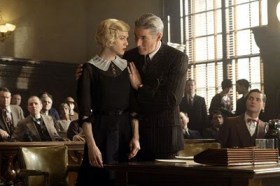 But how can Americans have strayed so far from the ideals of our Founding Fathers? In my opinion, it’s the means of information that induce such expectations for violent ends. It’s a tired argument, I know. Let’s blame the media and putting cameras in courtrooms for everything! But in this case, the drive for ratings and good television has muddled the distinction between justice and vengeance by adding entertainment to the mix. We have become convinced that the American legal system is only doing its job when it’s convicting people because there is too much crime in this country for punishment to be spared.
 While I’m indulging in pessimism at the moment, I don’t believe this condemnation is a final verdict on America’s fate. Now perhaps more than ever, I think “12 Angry Men” rings true and relevant. The movie revolves around a twelve man jury deliberating a case based on reasonable doubt, not unlike the Casey Anthony trial. When they enter the deliberation move, it seems that all will vote guilty. However, one juror known as #8, played by the noble Henry Fonda, votes in dissent. Over the course of Sidney Lumet’s movie, #8 tries to convince the other jurors that their mental picture of the defendant is not enough to justify a vote. As he so eloquently puts it, “It’s not easy to raise my hand and send a boy off to die without talking about it first …We’re talking about somebody’s life here.”



 Before I begin, let me give credit to Lisa Schwarzbaum at Entertainment Weekly for inspiring this post after
  I’ve been a little busy doing clean-up work on my own site for the past week, but one thing I’ve been meaning to address is some criticism laid out against me by a fellow blogger. In a post calling out flaws in himself and other bloggers, he specifically addressed my post on “
 I write largely for an audience that could care less about classic film. I myself don’t really care that much for it, but I know that it’s important that I see these movies to have a larger understanding of film. The movies I choose to review don’t require an incredible amount of knowledge of classics, and referring to them in reviews or posts would be largely wasted intellectual ramble. I choose to spend most of my time watching movies that help me make accurate comparisons to help my friends and bloggers. It makes more sense to say that the latest indie comedy is no “Juno,” not that it’s no “Citizen Kane.”
 I had no intentions to give “Citizen Kane” a full critical overview because I’m simply not qualified. But I believe that taking into account my purpose and my audience, my post did what it was supposed to do. I’m not asking you to trust me as a film scholar; I’m asking you to trust me as a teenager with an appreciation for film. I’m willing to hear criticism of my work, but my overall message to James at Central Florida Film Critic is that you can’t judge all writing through one lens. You have to take into account different perspectives, and I think your scolding of my post simply didn’t do that. If the way I view movies doesn’t align with the way you want to view them, I can only recommend you finding another site to read.
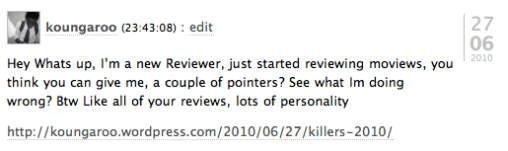 There’s no right or wrong way to be a movie reviewer; start off knowing that. But you can never stop getting better. In over a year of blogging, my movie reviews have changed quite a bit because I have been open to change. Since you seem to be so eager to accept it as well, let me offer you five tips that have helped me find success in writing reviews.
 Yesterday, I celebrated Tom Cruise by discussing the roles he didn’t take. It’s certainly an honor to be considered for so many incredible parts as he has been, and it does show a lot about him. However, like Jenny suggests in the quote above, we are defined by what we do, not by what we don’t.
 Tying into the release of “Knight & Day” today and the LAMB Acting School on Tom Cruise on Saturday, I thought I would offer up some thoughts on the star. I haven’t reviewed any of his movies in depth, but I wanted to have something to contribute because I definitely have something to say.
 Join your theater’s rewards program. This is the easiest way to be a smart moviegoer without drastically changing your moviegoing preferences. All it takes is filling out a quick application (some can even be done online) to join a rewards program. From then on, it’s just another card in your wallet to pull out at the box office when buying tickets. It won’t take long for you to start earning free popcorn, drinks, and even tickets.
 Go to early bird specials. Ten years ago, you could go to a matinee for $5. That ticket probably costs about $8 now. But AMC has a clever campaign offering patrons that same $5 ticket. They offer these discounted tickets before noon any day. I frequently take advantage of the system, and there are a lot of pluses to going to these early movies beside the price. You don’t have to wait in lines for concessions; you can get good seats; you don’t have to deal with a crowded theater. So if you can get up early enough, why wouldn’t you want to save at least $3 per movie?
 Think about the necessity of 3D and IMAX. Is it really worth your extra $4 for 3D and extra $7 for IMAX? If it’s a slipshod 3D conversion (“The Last Airbender”) or a movie not shot in IMAX (no movie actually was, but animated movies usually play better on the big screen), the overall experience may not justify the extra money. Here’s a statistic that might make you a pinch a few pennies: if you saw every movie this summer in the most extravagant format available, it would cost you over $50 in premium ticket fees. That’s


 You might not have been so blown away by the world of “Avatar” that you felt clinically depressed, but you had to have felt something. Even if the story wasn’t your cup of tea, it’s hard not to have been struck by how intricately the movie was put together. When I saw it a second time, I was floored by the impeccable attention to detail and just how thorough the world of Pandora was designed.
 At the Screen Actors Guild Awards, they call it “Best Performance by an Actor in a Leading Role.” At the Golden Globe Awards, they call it “Best Performance by an Actor in a Motion Picture.” But at the Academy Awards, the most celebrated show of them all, they call it simply “Best Actor.”


 Marshall and the Movies
Recent Comments