REVIEW: The Double

25 08 2014

The DoubleIt’s always interesting to see how two different filmmakers approach the same text and wind up with completely different interpretations.  Richard Ayode directly derives his film “The Double” from a novella of the same name by Fyodor Dostoyesvsky, while Darren Aronofsky drew heavily from it to create his Oscar-winning 2010 masterpiece “Black Swan.”

These films are not cinematic siblings, so to speak, but they are blood relatives of sorts and provide a fertile ground for analysis in tandem.  The same blood runs through their veins, but they manifest its influence in divergent fashions.  At the very least, anyone who has seen “Black Swan” will come away from watching “The Double” with an appreciation for the many choices facing the artists tasked with adapting a text.  (And I make the assumption that the majority of people interested in the latter are the kind of moviegoers who made a point to see the former.)

Aronofsky’s take on the doppelganger tale results in a horror film replete with corporal anxieties, while Ayoade finds just about the opposite in the Russian yarn.  His film is a dark comedy that often times veers into the absurd.  Its bizarre flavor regarding the humor regarding the humdrum mechanisms of the workplace  is about as far from the werewolf-swan movie as one can get.

And yet, there’s still the same underlying fear of being replaced by a better version of yourself that resonates in “The Double.”  It’s somewhat clouded by the fog of Ayoade’s peculiar funnybone, but it’s nonetheless there.  Jesse Eisenberg, essentially playing the same stammering character that won him an Oscar nomination for “The Social Network,” is an inspired choice to convey this paranoia to an audience.  He begins the film as the timid Simon James and then later appears as the supremely confident James Simon to steal all the thunder in the world of work and romance with the alluring Hannah (Mia Wasikowska).

It’s too bad we’re used to seeing Eisenberg play this character because “The Double” comes off as a bit old hat for the actor.  Either James or Simon could pop up in any of Eisenberg’s other movies as a doppelganger to induce a similar identity crisis in the native character.  He’s really doubled down, so to pun-nily speak, on this bumbling neurotic everyman.  Once or twice more, and he may very well veer into the perilous grounds of self-parody.  B-2stars


REVIEW: Dallas Buyers Club

24 08 2014

It’s tempting to look at the flashy physical transformations of Matthew McConaughey and Jared Leto for “Dallas Buyers Club” and assume that the film’s allure lies solely on the surface.  (Not helping matters were the heaps of attention and awards for the actors while the below-the-line talent went virtually unrecognized.)  Director Jean-Marc Vallée actually does deliver a film, however, with a surprisingly deep amount of care in its crafting.

We first meet McConaughey’s tough-talking Texas cowboy Ron Woodruff as he womanizes, a scene which feels all too typical.  Yet pay attention to the way the sequence is spliced together, both visually and aurally, and you may notice how simply and effectively Vallée foreshadows Woodruff’s impending HIV diagnosis.  These flourishes, subtle as they may be, go a long way to prevent “Dallas Buyers Club” from hokey Oscar bait.

Flashy though their work may be, the beauty of McConaughey and Leto’s performances also comes from these smaller moments.  While it’s easy to marvel about how gaunt Leto appears or how seamlessly he disappears into AIDS-stricken trans woman Rayon, he’s at his most impactful when breaking down in tears over fretting imminent death.  The same goes for McConaughey, who gets to slowly peel away layers of calloused toughness to reveal humanity and empathy.

Read the rest of this entry »


REVIEW: The One I Love

23 08 2014

The One I LoveIt is not uncommon to see movies tackling troubled relationships, as human relationships and conflict are often two crucial building blocks of any great story.  “The One I Love” puts a couple on the verge, Mark Duplass’ Ethan and Elisabeth Moss’ Sophie, front and center from the very first scene.  We see them at a therapy session, only to be sent off immediately by their headshrinker (Ted Danson) to a secluded locale that has apparently worked wonders on other couples.

Yet after about the first ten minutes of the movie, all that we think we know goes flying out the door in Justin Lader’s ingenious script.  Writing any specifics about the premise might spoil all the fun of “The One I Love,” but think of it as all the dimension-defying surreality of “Alice In Wonderland” without the exaggerated acid trip.  In other words, there’s no way you could possibly mistake this movie for the 2009 Vince Vaughn comedy “Couples Retreat.”

The alluringly unique magical realism of the story also comes with a relatively fresh take on issues long debated in relationship movies, such as the things people look for in a relationship and the benefits they expect to derive from it.  The revelations of “The One I Love” may not be earth-shattering, but at least they feel profoundly felt thanks to the committed performances of Duplass and Moss.  The two actors play deceptively tricky characters, and they navigate every turn with brilliant poise.

Director Charlie McDowell, on the other hand, does not necessarily hit every note correctly in his feature debut.  “The One I Love” often jumps around in search of a genre, usually vacillating between a intimate, two-hander domestic drama and a suspenseful micro-thriller.  Lader’s script thankfully lends itself to some abruptly jarring shifts, and the lack of tonal unity winds up coming aiding the film’s unpredictability on a moment-by-moment basis.

Though I doubt any major studio would ever go this far out on a limb with a big project, “The One I Love” offers a fascinating example of a fairly conventional setup being executed brilliantly through a refreshingly unconventional script.  B+3stars


F.I.L.M. of the Week (August 22, 2014)

22 08 2014

As I said in my review of “Only Lovers Left Alive,” I have not seen enough of Jim Jarmusch’s work to make a definitive statement as to whether or not he is a great director. But I have seen Jarmusch’s 2005 Cannes prize winner “Broken Flowers,” which is enough to inform me that he has at least one great film to his name.

This dryly humorous pick for the “F.I.L.M. of the Week” is second wave Bill Murray at his best (yes, even better than “Lost in Translation“).  He seems to have reached a status where he seems to reject the need for validation through actively courting our laughs, instead just allowing the comedy arise naturally from the events.  Murrray can then just sit back, maintain a stolidly unruffled facade, and just let the bizarre run-ins of “Broken Flowers” guide his reactions.

In the film, Jarmusch casts him as an aging Don Juan – appropriately named Don Johnston – served with a letter that suggests he fathered a child 19 years prior.  Don would be content to never investigate any further, but his inquisitive neighbor Winston (Jeffrey Wright) insists that he go visit the potential mothers.  So, in a sort of inverted “Mamma Mia,” Don takes off on a series of painfully awkward encounters with former lovers.

The parade of women, including Sharon Stone, Frances Conroy, Jessica Lange, and Tilda Swinton, always entertains.  But Jarmusch isn’t just wheeling out stereotypes or stock characters.  “Broken Flowers” takes each of these women and sets them on an unpredictable but well-imagined path after their split with Don.  It can’t help but raise the question of what exactly his effect on these women was.

To say too much more of what each woman brings to the film is to spoil the fun.  But just dive head first into “Broken Flowers” for off-beat fun throughout and a startling conclusion that packs an unexpected punch.


REVIEW: Are You Here

21 08 2014

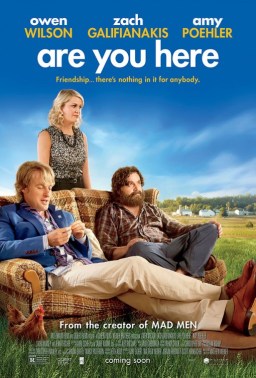
Are You HereBack in February, I got to see Matthew Weiner’s directorial debut at a special screening in Winston-Salem, NC, where the film was shot.  This event came about halfway between when the film known as “You Are Here” premiered to unanimous pans at TIFF and its eventual quiet theatrical/VOD rollout as “Are You Here.”
The film might have been recut some since that screening.  The level of retooling needed to save what I saw, however, requires change on a far greater scale than inverting the first two words of its title.  The film was a sloppy combination of slacker comedy, family melodrama, and improbable romance, a problem that is likely rooted in Weiner’s script.

It’s fruitless to size “Are You Here” up against an episode of”Mad Men” (the series Weiner created to the tune of all the Emmys) since the two aren’t even in the same league.  It might even be generous to say that the film is comprised of discarded ideas he had in the “Mad Men” writers’ room.  Better for his show’s legacy that he managed to put all the clichés on the silver screen instead of the small screen, I suppose.

Amy Poehler does redeem the film from being a complete trainwreck with a layered performance that gives her more dramatic depth than ever.  Her character, Terri, has lived by the rules and expects to reap the lion’s share of her father’s inheritance over her aimless brother Ben (Zach Galifianakis).  And whenever she gets screwed over by the will, it forces her to reexamine her values and priorities.

Read the rest of this entry »


REVIEWS: Leviathan, Manakamana (Harvard Sensory Ethnography Lab)

20 08 2014

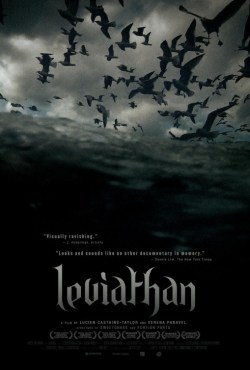
LeviathanIf you’re at all a fan of documentaries (or care about seeing the future of film aesthetics), you ought to begin familiarizing yourself with the work of the Harvard Sensory Ethnography Lab.  These groups of experimental filmmakers are beginning to push the form in exciting directions that are worth noticing.  They have not entirely hit their stride, but two recent features, “Leviathan” and “Manakamana,” are worth examining as potential harbingers of great things to come.
I don’t intend to give an informational survey as if you were applying for admission, especially since there are two superb write-ups in The New York Times and Boston Magazine.  But if I had to reduce their goals and aims into a single-sentence mission statement, the Harvard Sensory Ethnography Lab is aiming to document the wide range of experience on our planet through the use of uniquely innovative techniques.

I have a hard time figuring out what the actual first film of the lab truly was, but the first project of theirs that came to my attention was “Leviathan.”  This documentary, directed by Véréna Paravel and Lucien Castaing-Taylor, takes a look at the work of commercial fisherman in the American Northeast.  The approach to immersing us in that world is not to tell us about it, or even show it to us.  We have to feel it on a visceral level.

Paravel and Castaing-Taylor stick GoPro cameras just about anywhere they can and splice together their footage into something that often achieves hallucinatory heights.  No offense to your friends’ GoPro selfies on mountains, but “Leviathan” is the real deal in terms of utilizing the potential of these now seemingly ubiquitous compact cameras.  Simply trying to discern where the filmmakers placed the camera to achieve a given shot seems a herculean effort.

That lingering question about camera position quickly fades away, however, as we simply accept that these mesmerizing sequences of “Leviathan” lack a conventional center of gravity.  Freed from the constraints of traditional camera maneuvers, the film liberates us to allow the sensation of swimming through the water like a fish seize us entirely.

Sadly, “Leviathan” is not solely composed of these scenes.  At the opposite end of the spectrum from these formally daring scenes are portraits of the fishermen’s daily life that are far too naturalistic.  While the fishing is overwhelmingly kinetic, the still moments apart from the job are debilitatingly inert.  “Leviathan” might have been best served as a short subject documentary, taking somewhere in the range of 30-40 minutes to really showcase the brilliance of its aesthetic conceit.

Read the rest of this entry »


REVIEW: Carrie

19 08 2014

In terms of iconic decades-old horror movies, Brian De Palma’s “Carrie” probably ranks just beside Stanley Kubrick’s “The Shining.”  The 1976 film adaptation of Stephen King’s novel gave the world an unforgettable image – prom queen Carrie White soaked in blood – that most people recognize whether or not they actually saw the movie.

De Palma’s film has stood the test of time, however, not just on the stickiness of its imagery.  His take on “Carrie” is frighteningly well-made from a technical perspective, fusing eerie cinematography with a chillingly removed edit.  Not to mention, it is perhaps one of the best examples of fusing the ’70s “New Hollywood” spirit with the emerging commercial blockbuster.

So judging from the enduring strength of the original, there really appeared to be no reason for Kimberly Peirce’s remake of “Carrie” to come along 37 years later.  Thankfully, the film is not an overly reverent retread that matches its original nearly shot-for-shot.  But even so, this “Carrie” is a shadow of its former self that never quite successfully justifies its own existence.

Original “Carrie” screenwriter Lawrence D. Cohen updates the story effectively with co-writer Roberto Aguirre-Sacasa, taking into account factors like the rise of the Moral Majority as well as the sad phenomenon of cyberbullying.  In a way, it’s sobering to see how little change there has been in the high school experience for poor Carrie (Chloë Grace Moretz).  She is kept woefully uninformed about the real world by her fanatically religious mother Margaret (Julianne Moore) and is thus tormented by her peers for her naïveté.

Moretz’s performance brings all the tenderness from her work as a lonely teenage vampire in “Let Me In,” really allowing us to feel sympathy for poor Carrie.  And in stark opposition, Julianne Moore’s inspiredly demented work makes us absolutely despise Margaret.  (Also notable among the acting corps is Ansel Elgort of “The Fault in Our Stars” making a great screen debut as a popular classmate of Carrie’s who jokingly asks her to prom.)

Though the acting is good, it’s not enough to overpower the lackluster filmmaking.  Pierce relies far too heavily on CGI effects to provide the horror, and they feel particularly uninspired with their low intensity.  Without the unconventional, unpredictable filmmaking impulses of De Palma coursing through the veins of this “Carrie,” the film lacks greatly intensity and excitement.  C+2stars


REVIEW: Only Lovers Left Alive

18 08 2014

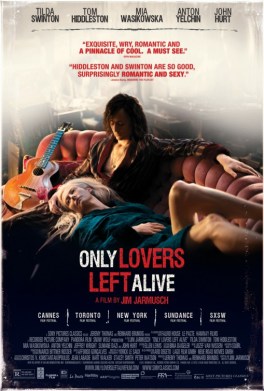
Only Lovers Left Alive posterCannes Film Festival – Official Selection, 2013

I’ve listened to countless interviews with James Gray about his film “The Immigrant,” so many that I can’t pair a quote with a particular interview and thus cite it correctly.  But in one talk about filmmaking in general, Gray talked about how great directors are effective at conveying mood.

I haven’t seen enough of Jim Jarmusch’s filmography to make a definitive statement about whether or not he is a great director.  But I have seen his latest film, “Only Lovers Left Alive,” and I can say that simply because it has control of mood does not make it a great film.  Jarmusch favors ambiance over story development to a fault in his film that probably had its proper title, “Modern Vampires of the City,” stolen by Vampire Weekend’s latest album.

The film comes from an original screenplay by the director, and it certainly earns points for being clever.  “Only Lovers Left Alive” runs in a different direction with the current vampire fad,  portraying the bloodsuckers as hipsters hiding out in the latest haunt.  When we catch up with Tom Hiddleston and Tilda Swinton’s immortal lovers, wittily named Adam and Eve, he has shacked up in Detroit while she’s hanging in Tangiers.

It’s undeniably entertaining to get immersed in the distinctive universe Jarmusch has them inhabiting.  Watching them figure out how to get the blood they need to survive is cheeky fun, as is the creative ways they choose to consume it.  Not to mention, their demeanors and attitudes are so unexpected that it can’t help but be attention-grabbing.  (Hearing them name-drop some of their famous friends makes for a good chuckle, too.)

Read the rest of this entry »


REVIEW: The Zero Theorem

17 08 2014

The Zero TheoremLondon Film Festival, 2013

Terry Gilliam’s “The Zero Theorem” is the kind of film that raises so many important and intriguing questions that it’s entirely possible to forget some of them along the journey.  This oblique tale, bordering at times on the absurd, stuns with the sheer density of the thematic issues that Pat Rushin’s screenplay can pack into 100 minutes.

The film grapples with conundrums as timeless as the meaning of life, the nature of happiness, and the imminence of death and nothingness.  At the same time, “The Zero Theorem” also has its finger on the pulse of many modern malaises, such as screen addiction, the fading appeal of observable reality in relation to virtual reality, and the electronic mediation of human connection.

We explore these through the work of a computer programmer known as Q, played by Christoph Waltz, as he attempts to solve humanity’s conundrums.  In a change of pace from the two silver-tongued Tarantino characters that won him a pair of Oscars, Waltz sits back and delivers a largely reactive performance.  As he attempts to unlock the zero theorem and get to the core of human existence, Q doesn’t instigate events so much as he lets them happen.  Because we’re less focused on a conventional narrative, “The Zero Theorem” can easily delve into the realm of the existential and philosophical.

Read the rest of this entry »


REVIEW: The Trip

16 08 2014

The TripThis summer, Adam Sandler made a few headlines for admitting a fact that shocked many but surprised few: his movies are essentially paid vacations.  Be it the countryside in “Grown Ups,” Hawaii in “Just Go with It,” or Africa in his latest disappointing film “Blended,” Sandler certainly knows how to milk the studio teat.

Across the pond, it would appear that Steve Coogan has figured out how to pull a similar magic trick.  He stars as himself in “The Trip,” a film where he gets to go around with his pal Rob Brydon (also playing himself) on a restaurant bender around England.  Surely at some point along the way, Coogan thought to himself, “My, this a great way to eat well and expense the meals to the BBC!”

The film is not without its entertaining moments – a spirited discussion of how to properly impersonate Michael Caine’s voice springs to mind – but this hour and a 45 minute trip feels like an exercise in self-indulgence above all else.  “The Trip” is a chance to spend time with Coogan and Brydon just … because.

To be fair, Coogan is a much bigger star in his native England.  In the United States, we know him mostly as a character actor from films such as “Tropic Thunder” and “The Other Guys;” he has only really begun to enter our consciousness as a public figure with the arrival of 2013’s “Philomena.”  As for Rob Brydon, I hadn’t heard of him before “The Trip” and haven’t heard from him since.

So maybe the concept would work better for me if it was done by two actors with whom I was more familiar.  If a sequel to “22 Jump Street” doesn’t happen, “The Trip” with Jonah Hill and Channing Tatum would probably be just fine.  B-2stars


F.I.L.M. of the Week (August 15, 2014)

15 08 2014

The BelieverIt seems hard to believe now, but there was a time when Ryan Gosling was not a movie star.  Plenty of people acknowledge his Mickey Mouse Club days with Britney Spears and Justin Timberlake, just as others recognize how hilarious he is in “Remember the Titans.”   But most seem to think that he just came out of nowhere, like a gift from God, to steal their hearts in 2004’s “The Notebook.”

In actuality, though, Gosling first got his moment in the spotlight as leading man from 2001’s “The Believer.”  The performance may well be the polar opposite of his stoic characters in “Drive” and “Only God Forgives.”  As Danny Balint, a self-loathing Jew who turns from his upbringing to join a radical neo-Nazi cell in New York, Gosling absolutely electrifies the screen as he futilely struggles to suppress memories of his background in order to commit heinous deeds.

But “The Believer” is not my choice for the “F.I.L.M. of the Week” simply because it is a great performance piece for Gosling.  Though he does steal the show, Gosling is hardly all the film has to offer.  “The Believer” may not quite rival “American History X,” another similar film about neo-Nazis, but it’s still a powerful examination of radicalism on both the personal and the political levels.

Writer/director Henry Bean satisfyingly delves into the psychology of Danny, looking at what might explain his volatile and unpredictable behavior.  There’s never one definitive answer, though, and the only person that seems to frustrate is Danny himself.  He’s a complete wild card, vacillating constantly between his desires to embrace the Jewish community that brought him up and his impulse to eradicate that same group altogether.  Maybe Gosling, now Mr. Strong and Silent, ought to watch “The Believer” now to bring some of the turmoil and conflict back to his work.


REVIEW: The Giver

15 08 2014

The GiverIf there was any doubt that we’re reaching the point of supersaturation with dystopian YA adaptations, “The Giver” confirms that the tipping point has arrived.  I get that life in post-recessional America doesn’t exactly inspire hope, be you a teenager or an adult.  But I doubt real life could be any worse than escaping into this derivative and, often times, outright laughable film.
I first read the film’s source material, Lois Lowry’s Newberry-winning novel that is now a staple of middle school English curricula, as an impressionable 12-year-old in 2005.  At the time, the post-“Harry Potter” adolescent fiction boom had not begun to tarnish the newly bolstered reputation of writing aimed for emerging readers (not even the “Twilight” series had been published).  YA was neither a dirty word nor a marketing buzzword then; it was just my demographic.

Lowry’s book might have been relatively short, but it sure packed a punch.  “The Giver” can serve a crucial function in the escalation of material for language arts, providing a key stepping stone towards more weighty adult literature.  If you can place yourself in the position of a teenager, the dialectical push and pull between order and chaos as well as pain and pleasure are actually quite thought-provoking.

Yet no matter how deeply one might have regarded the thematic content of the novel, it’s entirely possible to discredit “The Giver” as little more than a compilation of shallow marketing hooks for a cookie-cutter dystopian YA film.  The very premise of the story loses sophistication and nuance as it’s forced to fit the mold made popular by “The Hunger Games.”  What made Lowry’s story special is largely discarded in favor the conventional, leaving behind a film that’s a shadow of its literary incarnation.

Read the rest of this entry »


REVIEW: What If

14 08 2014

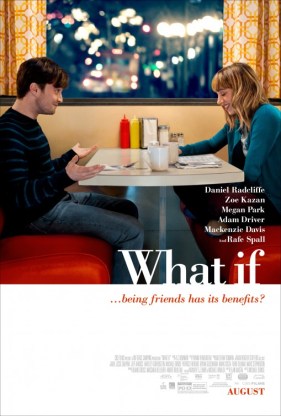
What IfRomantic comedies have been all but abandoned by major studios since 2011’s “Crazy Stupid Love,” leaving any filmmaker with an itching to tell a love story to develop their project with independent financing.  In that realm of moviemaking, the rom-com is either being outright lampooned (as in “They Came Together“) or struggling to escape the trappings of post-“(500) Days of Summer” ironically detached revisionism (like “Ruby Sparks“).

What If,” from director Michael Dowse and adapted from a stage play to screen by Elan Mastai, feels odd to watch in 2014 because it falls into neither predominant trend.  The film is unabashedly earnest as it tells the tale of Daniel Radcliffe’s Wallace as he struggles with his romantic feelings for Zoe Kazan’s Chantry, a close personal friend who happens to be in a long-term relationship.

In other words, it’s the kind of film that might have seemed quite redundant if it were wedged between, say, “27 Dresses” and “Definitely Maybe” in 2008.  But in today’s moviewatching climate, it’s a refreshing reminder of the kind of movie that’s been largely pushed out of the market by tentpole comic book flicks.  Say what you will about “Guardians of the Galaxy” being fun, but you could probably use the lessons from “What If” in your daily life much more easily than anything from the aforementioned space caper.

Read the rest of this entry »


REVIEW: Hateship Loveship

13 08 2014

Hateship LoveshipCraig Johnson, director of the upcoming Kristen Wiig vehicle “The Skeleton Twins,” remarked that even in her funniest moments, there’s a certain sadness to the characters Wiig portrayed.  I had never really thought of the comedienne in such a way, so I scoured YouTube to examine her work through such a lens.  Sure enough, the undercurrent is there in everything from her bit part in “Knocked Up” to her infamous Penelope sketches from “Saturday Night Live.”

In “Hateship Loveship,” we can see what’s left when you drain all the humor out of Wiig – and, as it turns out, it’s quite a morose sight.  She plays her character, Johanna Perry, with all the quietude of a church mouse.  Such restraint turns out to be devastatingly effective in creating a believable woman who is so passive that she practically lacks a personality altogether.

Sadly, the film veers off into such unbelievable directions – particularly in its second half – that it undermines the potential for Wiig’s performance to be a major breakthrough.  The premise of “Hateship Loveship” starts off with promise: Johanna moves into the home of an aging man (Nick Nolte) to be his caretaker and gets catfished by his granddaughter Sabitha (Hailee Steinfeld) in a rather mean-spirited prank.  Yet right when the film seems ready to veer into the realm of the tragic, it takes an unexpected turn.

After this rather shocking development, “Hateship Loveship” seems rather detached from reality.  Characters’ motivations seem hardly plausible, casting a shadow of doubt over the entire film.  The tone gets rather wonky, too.  It’s a pity that director Liza Johnson didn’t model her helming on the restraint and good judgment that Wiig brought to her character.  C2stars


REVIEW: Neighbors

12 08 2014

If you’re Zac Efron, how do you get people to take you seriously as an actor?  See you as something more than a Disney Channel star without feeling yourself with a foam finger half-naked on television?  Treat you as something more than a Google Images search?

Taking a page from the Channing Tatum/”21 Jump Street” playbook, Efron took on a role in “Neighbors,” a comedy where his entire archetype of the ultra-macho pretty-boy is a consistent butt of jokes.  The arrangement works out well for everyone.  Those who choose to watch the movie will enjoy the self-parody of Efron’s relentless shirtlessness and his over-the-top portrayal of a self-deluded frat lord.  And those fans who just want another look at Efron’s chiseled figure are indulged in the process.

Initially, Efron didn’t seem to be meshing with his character, Delta Psi Beta president Teddy Sanders.  Perhaps I was expecting him to fit a certain model of the fraternity meathead that I knew, but it’s clear that “Neighbors” knows what it’s doing with him.  There’s pretty consistent and purposeful fetishization of Efron throughout the film, by Seth Rogen’s older and squarer Mac as well as within his own fraternity.  The desire for a firm bond with him is laced with some homoerotic undertones and really provides some interesting commentary on the kind of brotherhood fostered within fraternities.

Teddy’s relationship with Dave Franco’s Pete Regazolli, another high-ranking Delta Psi officer out to preserve his legacy, provides ample hilarious opportunities to analyze the implications of the bromance.  One particular exchange of rhyming affirmations of their friendship, which sounds like something potty-mouthed teenaged girls would exchange in gym, sounds so preposterous that it’s clear “Neighbors” does not intend for its portrayal of fraternity life to be taken at face value like “Animal House.”

Read the rest of this entry »