REVIEW: Before Midnight

22 04 2013

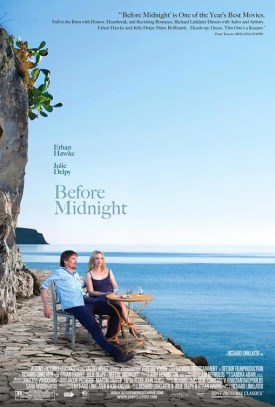
Before MidnightSome movies I just really don’t expect to fully comprehend at the ripe old age of 20.  For example, I don’t really expect to understand the intricacies of love and marriage as portrayed by “This is 40” and “Amour.”

Though both are extremely realistic and vivid, I almost feel like I’m watching a fantasy film because I cannot locate them anywhere within my own personal experiences. The same is true for “Before Midnight,” Richard Linklater’s third entry into what I suppose can be called the “Before” series (comprising of 1995’s “Before Sunset” and 2004’s “Before Sunrise”).  I just kind of have to take the word of others that the film once again captures something true about the place of love in the human condition.  I get a feeling that in twenty years, something about Linklater’s film will resonate more strongly with me.  But for now, I’m left most impacted by the saga’s first entry that explored idealistic notions of love and compatibility.

Though this is the now the third time that they’ve done it, I’m still left reeling by the fact that Linklater, along with co-writers and stars Ethan Hawke and Julie Delpy, can make long, drawn-out conversations about broad topics into compelling cinema.  It’s a bold and daring conceit to expect an audience to sit for nearly two hours and listen to fictional characters broach subjects that they themselves are often too scared to touch.  The concept seems like one bound to the stage, but it works yet again on screen.

Read the rest of this entry »


REVIEW: Houston

21 04 2013

RiverRun International Film Festival

As many of you reading this review may know, I am a proud Houstonian.  I could not be more grateful to grow up in such a great town, full of culture and vitality.  In my lifetime, I have seen it grow to become the third-largest city in the country (and also its most diverse, apparently).  A lot of great things are happening there, in case you haven’t clued into it.  In fact, it’s the setting for a new movie made by … a German.

That’s right, of all cities in America, Bastian Günther chose my hometown of Houston.  Granted, it’s the natural city to set a drama about energy trading in, but it could easily have been another New York or Los Angeles film.  His “Houston” is something decidedly different than one of those travelogues, although I can’t say it’s anything extraordinary.  Had I not had that native pull, I don’t even know if I would have been even remotely interested in the film at all.

Houston

The movie is essentially a tale of corporate espionage, although with none of the excitement a film like “Duplicity” gives it.  Günther is cold, chilly, and removed.  He prefers a darker, subdued character study of Clemens Trunschka (Ulrich Tukur), an unlikable schlub sent to Houston to steal a CEO for his own German energy company.  He winds up getting befriended by an overly gregarious traveler sculpted from the Ryan Bingham mold, Garrett Dillahunt’s Wagner, in a clichéd subplot that adds nothing to the film save a few laughs.

Thankfully, it avoids being as miserably boring as Sofia Coppola’s dreadful (and to de-bracket my objectivity, overrated) “Lost in Translation.”  But how much of that is true for non-Houstonians i cannot say.  I was able to find some middling satisfaction in spotting Houston iconography, which also might have blinded me to some of the imagery being subversive.  But to be honest, I don’t really care to reexamine to find out for certain.  And I don’t want you, the unsuspecting viewer reading this review, to throw away nearly two hours of your life to find out for me.  C+2stars


REVIEW: The Iceman

20 04 2013

RiverRun International Film Festival

The Iceman” is everything you would expect from a period gangster film like  “GoodFellas,” only with none of the rush of excitement and energy you get from Scorsese’s classic.  Director Ariel Vromen’s color-by-numbers genre pic is the epitome of middling, average entertainment.  Its full-fledged adoption of tropes led me to think less about “The Iceman” itself and more about where I might have seen that scene play out before.

Usually gangster movies are propelled by strong characterization, particularly the protagonist.  “The Iceman” settles for lazy caricaturization where everyone just plays out the stereotypes, including Michael Shannon as the titular assassin Richard Kuklinski.  Over three decades in organized crime, he takes over 100 lives … all while his beautiful wife Deborah, played by Winona Ryder, doesn’t age a day!

Shannon is a magnetic performer, particularly playing troubled and unstable characters like John Givings in “Revolutionary Road” or Curtis LaForche in “Take Shelter.”  His work in “The Iceman” can’t hold a candle to these prior tour de forces, largely because Kuklinski is so poorly written that I doubt Jack Nicholson could make it work.

And Kuklinski is the best written character of the bunch, I might add.  It could also be bad casting, but cameo appearances by James Franco as a pornographer and Stephen Dorff as Kuklinski’s brother were truly bizarre and out of place.  Roy Demeo, Ray Liotta’s character, proves the actor is more than willing to become his own worst imitator.  And I can’t even go there with Chris Evans, Captain America himself, as Robert Pronge, the shaggy-haired and cold-blooded ice cream man, or David Schwimmer as moustache-laden hitman Josh Rosenthal.

Without a compelling character at its center, why even bother watching a movie?  Particularly one that is so largely based around relationships?  I’d recommend not watching “The Iceman” and instead popping in “GoodFellas” or “Pulp Fiction” again.  Moreover, the film’s ability to delude itself into believing its own importance made me yearn for another gangster movie, “Analyze This,” where the same types of characters mix and mingle.  Only instead of being played for drama as in “The Iceman,” it’s played for laughs.  C2stars


F.I.L.M. of the Week (April 19, 2013)

19 04 2013

I’m sure when you hear the words avant-garde or experimental cinema, your first instinct is to run as far as possible in the opposite direction.  There’s no shame in that; heck, it was how I felt for a very long time.  But now I’ve realized that sometimes to find the most exciting and challenging ideas that film has to offer, you might have to venture outside of the mainstream.

That impulse was how I stumbled upon “Koyaanisqatsi,” Godfrey Reggio’s masterpiece of picture and sound that is my pick for the “F.I.L.M. of the Week.”  Over 30 years after its initial release, the film still manages to be jolting and provocative.  It asks tough questions about modern life and our relationship to nature, suggesting that perhaps we are living out the translation of the title: life out of balance.

It engages the audience in this conversation, however, without saying a single word.  No title cards either until the ending credits.  So it’s even more silent than a Chaplin film like “Modern Times” or 2011’s “The Artist.”  Don’t be daunted though!  It’s not hard to pull meaning from this film.

The images are tremendously powerful, speaking volumes in the absence of dialogue.  Yes, that means you can’t text and watch “Koyaanisqatsi.”  But with all that extra attention that has to be paid, just think of all you can observe.  I highly recommend just sitting back and letting the film wash over you like a perfume.  Look at the beauty and simplicity of the natural world … and then contrast it with the hectic industrial and urban world.  Watch how they are different, and yet somehow similar.  See how “balance” was constructed in 1983 … and marvel at how we still grapple with the same issues.


REVIEW: Laurence Anyways

18 04 2013

Laurence AnywaysRiverRun International Film Festival

Writing reviews that hinge on an “I like it, but…” are always fun, so here goes my latest.  (And if you want a classic example of this type of review, see my take on Spielberg’s “Lincoln.”)

Though I haven’t seen any of Xavier Dolan’s previous two films, “I Killed My Mother” and “Heartbeats,” I immensely respect this young wunderkind’s talent.  He is a master of cinematic art at 24, and I cannot wait to see how he pushes the form in the future.  Heck, for all we know, he could be the future of film.

But now is not the future, nor is his third film “Laurence Anyways.”  It shows promises of greatness and hints at a bold, brash masterpiece coming down the pipes.  Dolan, however, falls into plenty of typical early-feature shortcomings with this film – namely, unevenness.

I can imagine it would be a bit intimidating trying to tell Dolan to control his ambitions – after all, he only directed, wrote, and edited this film.  (Oh, and he designed the costumes.)  But he toggles between two totally different styles in “Laurence Anyways,” a pared-down reality and a wildly imaginative impressionism.  The two stand in pretty stark contrast to each other, especially when one abruptly transitions to the other.  I am not saying they can’t coexist peacefully, but the way Dolan does it here just feels sloppy and choppy.

The story he tells, that of Laurence (Melvil Poupaud) seeking to become the woman he feels that he is meant to be inside, is certainly interesting and provocative.  Tackling transvestism and transgender issues has been something seldom tackled by filmmakers save perhaps Pedro Almodóvar, and he explores its complications with sensitivity and without a hint of exploitation or disrespect.  At the heart of “Laurence Anyways” is a human story, not an exclusively LGBTQ story, as Laurence struggles with his attractions and repulsions to Fred (Suzanne Clément).  This emphasis on the personal does harm the film a little, however, when it tries to wax political at the close.

I was definitely intimidated by the nearly three hour runtime of “Laurence Anyways” going in, and it wound up being less of an issue than I expected.  I was always caught up in the action of the film; heck, by the end, I felt like I had spent a lifetime with Laurence and Fred.  Their saga spans over a decade, and the film needed to be that long to capture all the micro-level complexities Dolan wanted to portray.

Yet a part of me thinks that for a story of such sprawling breadth, perhaps film was not the correct medium.  The past five years have been an incredible artistic Renaissance for cable television.  Shows like “Mad Men” and “Breaking Bad” are moving beyond episodic plots and into exploring traditionally filmic narratives with aesthetic integrity.  Many still consider television to be a bastard art compared to film, but there really should be no shame in giving a story the room to breathe in a series or mini-series format.

So while there’s plenty to admire in “Laurence Anyways,” I saw plenty of room for improvement as well.  It’s one of those movies where I just cross my fingers and hope it’s a harbinger of better things to come further down the road, not indicative of an upper limit.  B- / 2stars


REVIEW: Identity Thief

19 03 2013

I walked into “Identity Thief” after having a pretty dismal week.  I knew I wanted to blow off some steam in the form of laughter, and I was willing to sit through just about anything to get that satisfaction.

Thankfully, Melissa McCarthy delivered.  She didn’t do it big time, but she brought enough fun and humor with her improvisational comedy that it gave me the bare minimum of the need I was looking for the movie to fill.  Now, I was hoping it would do a little bit more … but as Osgood would say in “Some Like It Hot,” well, nobody’s perfect.

The movie is enjoyable and fun when McCarthy gets to have free play and improvisation with Jason Bateman, an average joe who gets his identity stolen by her habitual plastic kleptomaniac.  Sadly, his Sandy Patterson and her “Diana” do not get nearly enough of this unstructured time.

They are often reduced to gimmicks and clichés that are beneath McCarthy’s talents for sure.  I don’t mean to suggest Bateman isn’t a capable comedian or actor; indeed, I think he plays an easily identifiable everyman that resonates with a lot of people.  He has excelled in supporting roles in Jason Reitman’s films “Juno” and “Up in the Air,” yet his starring vehicles all seem to totally miss the mark.

From “Couples Retreat” to “Horrible Bosses” to “The Change-Up,” Bateman has yet to prove himself as a capable comedic leading man.  I think this might have something to do with his persona’s defining characteristics of rigidity, though I will admit I have never watched “Arrested Development” – and that might change my opinions on Bateman.

Read the rest of this entry »


REVIEW: Me and Orson Welles

11 03 2013

Films about filmmakers often teeter on a precarious line.  If they want the viewer to appreciate that director or star, then they have to encapsulate their skill or charm in a way befitting of their name.  For example, “Hitchcock” worked because it evoked the joy of watching an old Hitchcock classic, and “My Week with Marilyn” was light fun because Michelle Williams captured the ethereal grace of Marilyn Monroe.

On the flipside, “Hugo” (though I know I’m in the minority) feels unsuccessful because it doesn’t quite reproduce the magic of the early days of cinema it so gushingly tributes.  Similarly, Richard Linklater’s “Me and Orson Welles” fails to pay proper homage to Orson Welles’ genius by not having any ingenuity of its own.  I mean, at least “Hugo” was sweet and entertaining.  This is not so lucky.

This biography is saved from being unwatchable by Christian McKay’s spirited portrayal of Welles, pre-“Citizen Kane” glory.  The movie takes place during Welles’ days on the stage, directing a visionary production of Shakespeare’s “Julius Caesar.”  But from the urgency and dignity granted it by Linklater, you would think it was a community theatre production of “Godspell.”

The biopic also suffers from Welles being far from in focus.  Granted, “My Week with Marilyn” was about Eddie Redmayne’s Colin Clark being romanced by Monroe, but it knew who the main character was.  “Me and Orson Welles” can’t really decide if McKay’s Welles is the protagonist or if it’s Zac Efron’s Richard Samuels, a teenage actor swept into the production.  Of course, they both vie for Claire Danes’ Sonja, a production assistant on the show.

So there’s a bit of a love triangle, a bit of a coming-of-age story, AND a portrait of an artist all colliding in “Me and Orson Welles.”  If these different aspects were layered, perhaps the movie would work.  But it’s just a muddled mess that reeks of ambivalence and indecision rather than the bold, brash brilliance of the real Orson Welles.  C-1halfstars


REVIEW: Abduction

28 02 2013

A lot of people were looking to “Abduction” as a test of whether Taylor Lautner could carry a movie on his own.  Away from the comforts of the “Twilight” saga where Lautner could just rip off his shirt and no one seemed to mind, would he be a viable action star?  Or is Lautner nothing more than a set of good-looking abs, destined to have girls drooling on Tumblr for all of eternity?

The quick answer to that is no, and “Abduction” is an abysmal movie that struggles to be so bad that it’s good at times.  The ridiculous romance, the half-baked plot, and the characteristic Lautner sporadic shirtlessness definitely provide some fun moments of unintended laughter.

And most people pinned the failure of “Abduction” on Lautner.  That’s not fair.  Everyone else in this movie was just as bad.

Looking at you, Lily Collins.  My goodness gracious, she grated on my last nerve.  Maybe with enough training in an acting studio and not in a gym, Lautner could be a half-decent actor one day in the way that Channing Tatum surprised us all in “21 Jump Street.”  I don’t know that I have the same hope for Collins.

I’ll hold back on some extremely harsh words for her, but know that she tried really hard to put on her big girl panties.  However, Collins just falls face first into the pavement, and no one bothered to tell her that her face is busted up and she’s bleeding everywhere (in a strictly hypothetical sense, I mean).

Read the rest of this entry »


REVIEW: In Time

27 02 2013

The concept behind “In Time” is actually fairly interesting, and maybe that’s why I was willing to overlook some of the film’s shortcomings.  In a dystopian ultra-classist 2169, people stop aging at 25, and living any longer than that requires you to literally buy time.  Extra time seems to come from just one extra strong and special handshake.

Such a kind of transfer begs the question of why people don’t just go steal it from the rich people why they sleep.  Or why people don’t just use tight grips or shake with superglue.  Needless to say, the broad strokes of inspiration blinded writer/director Andrew Niccol to the many plot holes in this world.

Watching the movie from a post-Occupy world certainly highlights this extreme case of social inequity as the rich live forever and the poor die young.  From my sociology classes in college, I can tell you that inequality is corrosive for society and poverty is quite literally a lethal force.  “In Time” is very conscious of these things and holds an interesting mirror up to the audience watching the film.

Sadly, that mirror is fogged up by some sloppy storytelling and a plot that ultimately can’t sustain beyond the novelty of the “time as life” concept.  The characterization is decent, but the cast of good looking actors who can still pass for 25 – including Justin Timberlake, Amanda Seyfried, Cillian Murphy, Olivia Wilde, Matt Bomer, and Alex Pettyfer – don’t do much to elevate the material.  The intelligence of the social commentary ultimately gives way to a fairly standard action film, but the themes raised in the beginning are enough to make me feel that “In Time” was not entirely wasted time.  B-2stars


REVIEW: Monsters

25 01 2013

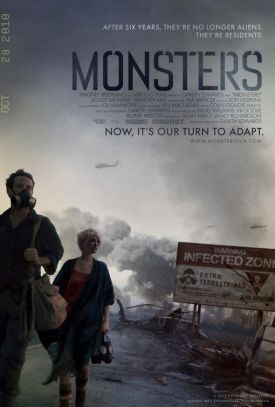
MonstersGareth Edwards, helmer the latest reincarnation of the Godzilla franchise, is about to work with monsters on a very big scale (and budget).  However, if you want to see the skill and directorial poise of Edwards on a more modest, personal level, there’s no other option than to check out his debut film, “Monsters.”

It’s not quite found-footage, but “Monsters” offers you the intimacy that the emerging subgenre always attempts to provide and usually fails to deliver.  Edwards makes the rare movie whose exposition might be more complicated than the story.  But if you decide to take the plunge into his subtly nightmarish world, you’ll discover that such simplicity of story is a noble quality, not a flaw.

The film follows the journey of Scoot McNairy’s Andrew Kaulder, a photojournalist sent down to Mexico to recover and return his boss’ daughter, Whitney Able’s Samantha Wynden.  And no, his search for her is not the main plot of the film.  In fact, he finds her within the first 10 minutes.

The titular monsters barely appear, and when they do late in the film, it’s anti-climatic and not exactly thrilling or terrifying.  “Monsters” is a movie about the effects of these creatures, extra-terrestrials who landed in Mexico six years before the events of the film.  There’s now a large “infected zone” that Andrew and Samantha have to pay a great deal to go around – or risk their lives to go through.

There are, of course, some allegorical implications for the alien invasion (creatures that Americans try to confine in Mexico by a giant fence along the border, anyone?).  But the thrill of “Monsters” is not in the political but in the personal.  It’s fascinating to watch the natural relationship and rapport develop between Andrew and Samantha in ways that are subtly affected by the presence of these monsters.  Though watching them becomes slowly less and less interesting as the movie progresses, the clever and subversive filmmaking on display from Gareth Edwards makes this 90 minutes fairly well spent.  B2halfstars


REVIEW: Stone

24 01 2013

The fact that Edward Norton is in cornrows for “Stone” should tell you about how seriously you need to take this movie.  Which is to say, not at all.

Don’t get me wrong, Norton has played a shaved skinhead in “American History X” and a tough-as-nails convict in “25th Hour.”  But those were … well, characters.  He took them very seriously, gave them humanity, and we responded.  Norton’s titular arsonist feels like an attempt to impersonate Steve Carell’s Prison Mike from “The Office.”   Perhaps this was his audition for Wes Anderson’s “Moonrise Kingdom?”

The rest of the movie also unintentionally plays out like a comedy as well.  DeNiro, in yet another role that reminds us just how long ago “Raging Bull” really was, plays Jack Mabry, a correctional officer about to retire.  Yet he’s no match for Stone and his siren of a wife, Milla Jovovich’s Lucetta.

As Jack contemplates one of his final parole cases, he finds himself torn by passion for Lucetta.  You know, despite their large age difference.  And the fact that he’s married to a loving wife.  And of course, she’s married to the man whose fate lies in his hands.

The whole movie is as laughable as Norton’s hair.  Plausibility goes out the window as one of the most absurd love triangles in cinematic history takes flight in “Stone.”  The whole enterprise should be avoided as much as prison itself.  D1star


REVIEW: Promised Land

23 01 2013

Gus Van Sant has called “Promised Land” his attempt at Capra, which is a noble thing to aim for – and it has certainly been largely MIA in today’s cinema.  But his film is hardly “Mr. Smith Goes to Washington,” a truly inspiring extolling of the virtues of the common American.  Even when you factor in adjusting the tale for our grayer, more morally relativistic culture, it still falls well short.

“Promised Land” aims for pro-small town goodness but winds up being mostly anti-corporate.  Matt Damon and John Krasinski, both the stars and writers of the film, spend most of their efforts vilifying the businessmen.  The homely townspeople, on the other hand, merely speak in vaguely familiar talking points that make them really only function for the sake of the narrative.

And I think that’s a lost opportunity for the movie to really make a great case against natural gas fracking.  As Leonardo DiCaprio’s Cobb postulated in “Inception,” positive emotion trumps the negative every time.  Maybe if we cared more for the well-being this tiny agrarian Pennsylvania town, we would come out of the movie and call our Congressman.  But all that Damon and Krasinski convince us is that businessmen are vile leeches who will go to any lengths possible to suck all the natural gas out of the ground – with as much cost to the environment as necessary to provide little cost to them.

Eventually, I believe we will look back at “Promised Land” as an interesting relic in the ongoing saga of the United States’ quest for energy independence and climate control.  The film lands at a critical nexus in our culture, where it makes sense to revive the economy and decrease our dependence on foreign oil and fossil fuels by fracking the natural gas underneath our own soil.  Yet the process is so unrefined at the moment that it can cause vast environmental damage.  You know, just never mind what it does to social capital because Damon and Krasinski are only seeing green – the color of money and the color of the environment.

But they make a mild and familiar argument within a generic framework to convey their message.  Perhaps their passion would have been best channeled into a documentary.  Although non-fiction films rarely reach large audiences, those movies can be as polemical as they want because that’s often what they are designed to be.  (For an example of how they could have frightened you with the horrifying truth, look to “Gasland.”)  What they settled on in “Promised Land” just feels like preaching to the converted; I don’t think it has the narrative or emotional strength to create any new believers.  C+2stars


REVIEW: Hyde Park on Hudson

22 01 2013

Welcome to “Whose Movie Is It Anyway?” – also known as “Hyde Park on Hudson.”  Here, you’ll get to see a multi-million dollar production that shows you what a movie is really like at the stage where it’s still being scribbled out on cocktail napkins!  To call it a first draft of something great would be generous – that is, calling it a first draft would be generous.  It hasn’t even made it to that stage yet!

Roger Michell’s slapdash film changes protagonists throughout the entire movie like Britney Spears changes outfits at a concert.  Go to the bathroom, and you’ll come back and find an entirely different storyline being pursued.  One minute, it’s the story of Laura Linney’s Margaret Suckley, a cousin of FDR portrayed here as his mistress (though that’s based on an extremely loose interpretation of her personal letters).

Then, it’s also a biopic of President Roosevelt, played as a perpetually horny tortoise by Bill Murray.  Chronicling both the personal and the political aspects of his life, it fails to provide anything mildly interesting to observe.  Not to mention, doubts about the accuracy of his affair with Margaret put the entire movie’s validity in question.

Oh, and don’t forget the history lesson that makes up most of the mid-section of “Hyde Park on Hudson.”  The King and Queen of England comes to visit FDR’s private Idaho in New York, but sadly, this companion piece to “The King’s Speech” couldn’t land Colin Firth and Helena Bonham Carter to reprise their roles.  Nor, for that matter, could it capture the same sense of gravity about an impending world war that Tom Hooper’s film conveyed so well for a film that was otherwise rather lightweight.

In essence, there are three movies in “Hyde Park on Hudson,” and you will feel it drag under the weight of that confusion.  Expect to feel like you’ve watched three full-length features … but come out only an hour and a half later from the theater.  And don’t expect some kind of great convergence that makes it all worthwhile.  The climactic scene all boils down to the consumption of hot dogs.  Not kidding.  D1star


REVIEW: Pirate Radio

21 01 2013

Musical theatre thrives on the creative sparks of others.  Not to diminish the many accomplishments of that art form, but in recent years, just about everything has been an adaptation.  (Except “The Book of Mormon” – you go Trey Parker and Matt Stone!)  Many have been taken from books, but recently, the trend has become to adapt films onto the stage.

One of the greatest advances has been the invention of the “jukebox musical,” where a story forms around immediately recognizable music, whether a fictional tale like “Mamma Mia!” or a biographical one such as “Jersey Boys.”  (It also gave us “Rock of Ages,” but we can pretend it didn’t.)

Before you ask, no, “Pirate Radio” is not an adaptation of a Broadway or a West End musical.  There’s plenty of music, but the record player does all the singing.  However, I felt that while watching Richard Curtis’ film, it was practically BEGGING to be staged as piece of musical theatre.  The music is phenomenal, and there’s so much capability for it to define a generation – because it does.

The story of the film isn’t all that interesting: banned from playing rock and roll on normal British airwaves, a group of rebels broadcast it in international waters.  The gang is full of eclectic types, ranging from characters played by Philip Seymour Hoffman and Bill Nighy to then unknown Chris O’Dowd (the cop from “Bridesmaids“).  There’s little character or story development, and when the boat finds itself in peril, I could have cared less what happened to whom.  Not to mention that it feels interminable even at 20 minutes shorter runtime from its British release under the name “The Boat That Rocked.”

But with some slight tweaking of the story – a little bit less of the people on the boat, a little bit more of the people on land, the same amount of the government censors led by an uptight Kenneth Branagh – “Pirate Radio” could actually play quite well on stage given the caliber of music.  Think about it … and I’d like to request royalties if it happens because of this review.  C2stars


REVIEW: Mud

19 01 2013

Cannes Film Festival 2012 / Sundance Film Festival 2013

(NOTE: I saw “Mud” at the first showing in Cannes last May.  I have no idea if the movie being shown in Utah is the same one I saw in France.  I have some lingering suspicion it might have been reworked and tweaked a little bit since it disappeared from the festival circuit for eight months.)

Third features are, for most filmmakers, really the first time we can gauge their capabilities and career trajectory.  A debut film is, well, a debut film.  Unless you are Orson Welles, whose first film “Citizen Kane” is the best of all-time to many, the first time behind the camera is rarely one that produces much beyond the promise of great things.  While many directors break out with their second film, some would consider that they still have the training wheels on the bike.

By the third film, however, we generally stop cutting them slack or grading them on a curve.  It’s do or die, make or break.  If you haven’t quite figured out how to make a good movie, perhaps it’s time to consider a career change.  Just to provide some perspective, Scorsese’s third film was “Mean Streets,” Spielberg’s was “Jaws,” Malick’s was “The Thin Red Line,” Jason Reitman’s was “Up in the Air,” and Ben Affleck’s was “Argo.”

Jeff Nichols, an emerging American filmmaker, made his first two movies with a very independent spirit.  His debut, “Shotgun Stories,” had an interesting concept but was poorly executed.  His second film, “Take Shelter,” was a superb ambiental drama that effectively visualized the state of economic and personal anxieties in the age of the Great Recession.  But his third feature, “Mud,” is so different that it almost feels like a first film.

With “Mud,” Nichols makes what I believe to be a very conscientious leap towards the mainstream.  It definitely plays more towards satisfying audience expectations with familiar storyline and aesthetics, not jarring them with the uncomfortable or the unknown.  And there’s nothing wrong with that; he’s fairly adept at capturing that boyish spirit in the coming-of-age movies that Steven Spielberg among others made so well in the 1980s.  But after the brilliance and originality of “Take Shelter,” I was hoping Nichols would not just fall in line.

And to reiterate, I don’t disdain “Mud” simply for daring to be similar.  It’s still quality filmmaking, but it feels more like a harbinger of things to come than something substantial in and of itself.  This transitional film is too populist to be indie; however, it’s also a little too indie to be truly mainstream.  I don’t usually talk about forces competing for the soul of a movie, yet it feels totally relevant for “Mud” as these two entirely different spirits of filmmaking run amuck throughout the movie.  Each claims a scene here or there, and the ultimate victor is unclear.

I would argue that the real winner of “Mud” are the characters, written with love and care by Nichols and brought to the screen with compassion by the cast.  Matthew McConaughey, the new king of career turnaround, beguiles as the titular character Mud.  He fancies himself an urban legend, an almost mythic figure of sorts.  Yet it’s fascinating to watch the man slip out from underneath his tough facade and see his guilt and shame manifested.

Though the movie is named for his character, Jeff Nichols’ film isn’t really about Mud.  It’s about the two boys, Ellis (Tye Sheridan from “The Tree of Life,” albeit totally changed since that film was shot so long ago) and his sidekick Neckbone (Jacob Lofland), who stumble upon Mud hiding out in a boat in the trees.  While Mud drives the narrative forward, the movie’s real story and power comes from the way those events affect these two adolescents.

“Mud” mainly follows Ellis as he navigates a new world, one where nothing seems clear-cut or black and white.  Mud teaches him what love and trust really are when they are together away from society, and then he reemerges to find alternative meanings of such concepts.  Sheridan lends a real authenticity to the struggles of growing up and realizing hard truths in a performance that evokes Henry Thomas’ Elliott in “E.T.,” a movie that feels like quite a kindred spirit of “Mud.”

To tap into a fraction of what Spielberg achieved is quite an achievement.  Now, it’s time for Nichols to relocate his old voice of originality and create a work just like “Mud,” only with that old aesthetic brilliance and creativity.  B2halfstars