REVIEW: The Deep Blue Sea

27 12 2012

There was a moment towards the beginning of Terrence Davies’ “The Deep Blue Sea” where I thought I might be watching a film made beautifully in the style of another Terrence.  That is, Terrence Malick.  The film starts with a 10-minute prologue that is marvelously expressionistic and truly poetic.  The way Davies filmed a love scene, with Rachel Weisz and Tom Hiddleston’s bare bodies intertwining and interlocking as one, is a thing of pure beauty and grace.

But like Lars Von Trier’s “Melancholia,” Davies pulls out all the stops in the opening minutes and leaves us with a mess of a movie to deal with afterwards.  It’s a boring and melodramatic replaying of the scenarios we normally see Reese Witherspoon playing out in movies like “This Means War” and “How Do You Know.”  If that comparison strikes you as a little too extreme, it also bears quite a resemblance to indie favorites of 2012 “Take This Waltz” and “Middle of Nowhere.”

As Hester Collyer, Weisz is a woman torn between duty to her husband, the older Sir William (Simon Russell Beale), and her passion for the younger RAF pilot Freddie Page (Hiddleston).  And over the course of an hour and a half, we see her torn apart by these two competing forces for heart.  I think we were supposed to feel something for her or perhaps have some sympathy for Hester going into this battle royale, but both were nonexistent.

The bulk of “The Deep Blue Sea” takes place in the self-loathing pity party stage of Hester’s indecision, a stage which is totally natural but brutally unwatchable if that’s all we are given to witness.  And Weisz, fantastic as she is, plays her character with so much angst you’d think she studied up on Kristen Stewart to get inspiration for her performance.  All she does is stare wistfully out a window, smoke cigarettes, stand still, and pout.

The two men make desperate pleas for her, and she remains in the corner chanting her own personal requiem.  If “The Deep Blue Sea” is some statement on the helplessness of 1950s women to change their situation, this film adds nothing original to the conversation.  It’s just a moping mess that wallows and ultimately drowns in its own sadness.  D+1star


REVIEW: Damsels in Distress

26 12 2012

I think my quibble with “Damsels in Distress” is with the very style of film it tries to be.  For all I know, it may be a good comedy of manners.  But I never read any Oscar Wilde or Moliere in school, so I have no context in which to place this film.  Sorry, folks.

What I can tell you is that I found myself irked quite often by Whit Stillman’s film, which seemed to be a meandering mess made bearable only by the occasionally witty and insightful quip.  The words have a pop that I feel like would be better appreciated on a page.  On screen, they just don’t have much impact.

I also think that has something to do with the fact that the energy of the actresses in the film feels like that which you’d find at a first table read.  It never felt like anybody was saying, emoting, or feeling their lines.  They were merely reciting them.  Although in the case of Greta Gerwig, it sort of worked since she has that sort of non-emotive, frumpy hipster aura about her.  But for everyone else – no.

Honestly, I think my favorite part of this movie might have been the brief Aubrey Plaza cameo.  As one of the patients at the “suicide prevention” clinic run by the four main girls of the film, she got more laughs out of me than the rest of the film did combined.  If “Damsels in Distress” tried to say anything else or get me to care about any of the other characters, it didn’t work.  C2stars


REVIEW: Django Unchained

25 12 2012

Quentin Tarantino’s name is now a brand, one with hallmarks of dialogue and style widely recognized by all cinephiles.  It’s an accomplishment achieved not only by Tarantino’s incredible virtuosity but also by the scores of cheap rip-offs who have solidified his status as a major figure in film history.  Yet with “Django Unchained,” Tarantino proves that the greatest of all these impersonators is Tarantino himself.

The experience is not unlike that of watching “Jackie Brown,” the only other film of the Tarantino canon that “Django Unchained” manages to stand next to in quality.  Both films followed major artistic breakthroughs for him that scored with audiences and critics alike, “Pulp Fiction” and “Inglourious Basterds.”

But rather than use the forward momentum to lead to further exploration of his craft, Tarantino chose to take a victory lap fueled by the high of inhaling too much of the exhaust fumes of his own success.  “Django Unchained” just feels like Tarantino on autopilot, lacking the vibrancy or surprising eccentricity of his prior films.  There are plenty of laughs to be had, sure, but it just feels like far too much of the same stylized dialogue and aestheticized violence; popping in the DVD of “Reservoir Dogs” would probably yield more satisfaction.

Read the rest of this entry »


REVIEW: Arthur Christmas

24 12 2012

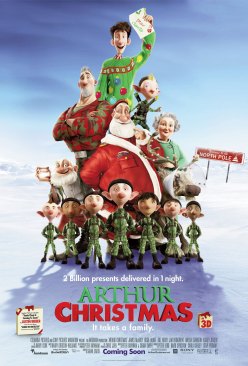
Arthur ChristmasSometimes, animated movies are so busy trying to be clever that they forget to be charming or – dare I say it – cute.  If they lack the effortless ease of Pixar and the occasional DreamWorks release, they seem to often think that the charm flows directly from the creativity.

Arthur Christmas” is all the evidence I need to believe that the hypothesis above isn’t true.  It puts a digital, industrial spin on the age-old Christmas story of Santa Claus delivering presents to children all over the world.  Moreover, it manages to make its version of the yearly phenomena both funny and plausible.

The opening scene, showing the delivery from the perspective of the elves frantically working in mission control to ensure a successful Christmas, was absolutely fantastic.  It’s ingenuity at its finest, and I was braced for a delightful ride full of holiday spirit.

But then the film shifted towards the family dynamics of the Claus family, led by the lazy patriarchal Santa Claus voiced by Jim Broadbent.  His son Steve (the voice of House – I mean, Hugh Laurie) is gunning hard for him to retire so he can fulfill his birthright.  Meanwhile, there’s Arthur (voice of James McAvoy) running around with an unfettered optimism and idealism, something his family shrugs off and attempts to marginalize.

“Arthur Christmas” depicts the wee hours of Christmas morning when the family fails.  Well, really, Santa fails first as one gift does not get delivered, and Arthur takes it upon himself to ensure it gets received.  Along with an overeager wrapping elf and his grandfather, a former Santa Claus (voiced by Billy Mack – I mean, Bill Nighy) that shares Arthur’s enthusiasm, their adventure is most definitely exciting.  But with weak characterization and an overemphasis on craftiness, “Arthur Christmas” is hardly a cup of Christmas cheer for all to enjoy.  C+2stars


REVIEW: Being Flynn

23 12 2012

My review of “Being Flynn” might read more like an obituary, and that’s fairly intentional.  I don’t understand, but the Weitz brothers appear to have disassociated themselves entirely with comedy.  They directed the riotous original “American Pie” in 1999, a high the series has yet to top.

And then they moved into the realm of dramedy, a very tough high-wire act to pull off, with “About a Boy” in 2002.  It earned them both Oscar nominations for their script, and the taste of glory for doing something remotely serious seems to have infected and corrupted them.  Last year, Chris Weitz released the dismal and self-righteous illegal immigration drama “A Better Life.”

Now, we’ve lost Paul Weitz with “Being Flynn,” a dramatic with absolutely no dramatic pull.  I don’t think I engaged with the film at all over the course of its 102 minutes – and this movie has Robert DeNiro.  As a writer inflated off his own self-worth, DeNiro is fine because he finally gives himself something to work with – not just another “Fockers” movie or a bit part in “New Year’s Eve.”

I gave the film about 20 minutes or so to engage me, and when it couldn’t manage to draw me in, I decided to only minimally follow the plot.  There are some nice father-son dynamics going on, but they are nothing particularly remarkable.  And I’m also inclined to hate it because I think Paul Dano all but ruins every movie he’s in.  Hack is a strong word … but I almost want to use it.

At least Weitz could have tailored the film towards DeNiro’s to make it play better.  Because when I watched it, I was far more proud of all the laundry I did during its runtime than anything I saw on the screen.

So come home to comedy, Weitz Brothers!  In case you hadn’t noticed, it needs you now more than ever.  C-1halfstars


REVIEW: Friends with Kids

22 12 2012

The title “Friends with Kids” sounds an awful lot like “Friends with Benefits,” the 2011 Justin Timberlake-Mila Kunis sex-friends comedy. Though the two differentiate themselves over the course of their respective films, they actually share quite a bit in common.

Both begin with a ridiculous premise: here, it’s the idea that two people can have sex once, procreate, and be parents without forming any sort of emotional connection to each other. It’s an idea that Jason (Adam Scott) and Julie (writer/director Jennifer Westfeldt) hatch one night after seeing how miserable their once happily married friends become when they have kids. And those same friends, like us in the audience, laugh at their foolishness and know it can only lead to disaster.

Their friends, by the way, are essentially a “Bridesmaids” reunion 15 years early for their People shoot. Kristen Wiig and Jon Hamm are Ben and Missy, a sex-crazed couple whose kids take a toll on their marriage. And on the more reasonable end, Maya Rudolph and Chris O’Dowd are a couple coping with the same issues but on a more authentic scale. All that’s missing is some Wilson Phillips (and perhaps a little defecating in sinks just for fun).

Yet just about every time you think it’s going down the path to predictability or genre, Westfeldt surprisingly turns the tables on you. She’s written a very thoughtful movie in “Friends with Kids,” one that makes some insightful revelations about marriage and parenthood. Though Jason and Julie move on to other people – him Megan Fox’s Broadway dancer Mary Jane, her Edward Burns’ family man Kurt – they find each other and their real feelings through those people. It might seem slightly cliched, but with all the laughs and the honesty, I didn’t really mind. B+ / 3stars


F.I.L.M. of the Week (December 21, 2012)

21 12 2012

There are few movies in the world that can make me laugh harder than “Role Models,” my pick for “F.I.L.M. of the Week.”  An R-rated romp that slipped through the cracks for most upon release in 2008, David Wain’s riotous comedy is fantastic through and through.  It’s held up miraculously well, too – trust me, I’ve watched it dozens of times and still bust a gut.

As the two leads doing a comic man/straight man routine, Seann William Scott and Paul Rudd are absolute perfection.  Scott gets to play the absurd variation of the Stifler character for “American Pie” that made him famous, while Paul Rudd plays perhaps his best bleakly blunt pessimist yet.  Though Rudd rings real in opposition to the ridiculous Scott, that doesn’t mean he’s grim or depressing.  Rather, he’s all the funnier and relatable as Paul Rudd proves once again he might be the most adept actor at bringing all our frustrations and annoyances to comedic light.

The free-wheeling Wheeler (Scott) and Danny (Rudd) find themselves in a world of trouble after a particularly bad day on the job peddling energy drinks to kids.  But rather than go to prison for their trail of destruction, they wind up getting community service at Sturdy Wings, a Big Brother-Little Brother type program.  The two quickly find out that prison is a more appealing option than most people would consider.

First of all, Sturdy Wings is run by a crackpot ex-alcoholic and drug addict, Gayle Sweeney – played by Jane Lynch pre-Sue Sylvester (this part probably got her that character).  And to say she steals the show is a vast understatement.  You only hear every other line from her because your laughs from one line bleed over well into the next one.  She speaks in bizarre metaphors that don’t make sense and LOVES reminding everyone of her former habits to a painstakingly hilarious extent.

And Gayle pairs them with two “littles” that scared off everyone else who was volunteering.  Wheeler gets stuck with a firecracker in Ronnie, a crude and manipulative little version of himself.  Danny, on the other hand, is given Augie, an introvert with a good heart that loves nothing more than a good live-action roleplaying game.  Their adventures are strange and funny, leading them to campfires and virtual battlefields, but David Wain brings a funny-bone and a heart to every moment of it.  His “Role Models” packs an excellent message of mentoring and guidance towards becoming a better person without ever being sappy or cheesy; rather, he finds a way to get it across smoothly with laughs, smiles, and good feelings all around.


REVIEW: John Carter

21 12 2012

How bad could “John Carter” really be?  How much was its failure simply a story hyped up by the media?  Especially given that it’s from a member of the Pixar brain trust, could it really be that much worse than any of the “Transformers” movies?

Such were the questions floating around in my head around hour 7 of my plane flight home from Europe this summer.  I had just woken up from an “In Darkness”-induced nap and was not trying to get back into the dark, depressing world Agnieska Holland was portraying.  I contemplated giving “21 Jump Street” or “Mission: Impossible – Ghost Protocol” a second viewing, but curiosity won out.  I decided to plunge into Andrew Stanton’s “John Carter.”

Turns out, it was pretty darn bad.  Not bad in a good way.  Not bad in a way that provides a sadistic kick.  Not bad in an “it’s so bad I have to keep watching” kind of way. (Thankfully, not bad in a Michael Bay way.  It’s slightly better than that.)  “John Carter” is bad in the good old-fashioned way: the antonym of good.

Read the rest of this entry »


REVIEW: Zero Dark Thirty

20 12 2012

If you asked me to do word associations for the subgenre procedural, I’d probably start with long, tedious, cold, and other such synonyms.  But I gladly say that none of these apply to director Kathryn Bigelow and writer Mark Boal’s “Zero Dark Thirty,” the story of the ten-year hunt for Osama bin Laden.  Spoiler alert … he dies at the end.

Though I’m sure the pursuit was a lot messier than what we saw on the screen (and plenty took place in the shadows that we will never know), Boal makes the chase relatively easy to follow given all the leads and locations the CIA follows.  He perfectly strikes the delicate balance between capturing the fine details of the operation while also keeping the big picture squarely in focus.

And Bigelow matches his careful dance every step of the way.  Essentially, she takes the unbelievable suspense she was able to create in “The Hurt Locker” and puts it on a macro scale.  It’s not just Sgt. James anymore; it’s the United States of America.  It’s a goose chase so wild and riveting that the two and a half hours will feel like twenty minutes.

In the opening scenes of the film when the detainee program is yielding little to track down Bin Laden, “Zero Dark Thirty” had me at a distance, interested but not fully engaged.  Yet two hours later as Seal Team Six embarked on the raid that would ultimately take out the most wanted terrorist, I found myself on the edge of my seat with my heart racing at a million miles per hour.  And keep in mind, I knew what was going to happen!  Bigelow’s thriller is tightly constructed with not a moment wasted as it builds towards the inevitable payoff.

Read the rest of this entry »


REVIEW: Les Misérables

19 12 2012

Les Miserables“Music expresses that which cannot be put into words and cannot remain silent,” wrote Victor Hugo in his novel “Les Misérables.”  Though his work has found expression in a number of different mediums since its publication in 1862, none has captured the public’s imagination quite like Claude-Michel Schönberg’s musical.  It took the spirit of Hugo’s classic novel and put it on stage to powerful effect with an operatic score and poetic lyrics.
The endearing place “Les Misérables” holds in contemporary musical theatre is due to the supremacy of the music, featuring showstopper after showstopper that tug on the heartstrings and open the floodgates of the tear ducts.  I’ll go ahead and declare my lack of objectivity since I was fortunate enough to be a member of a production of “Les Misérables” in high school.  Watching the show from the audience is an ethereal experience, but living with that show for several weeks and being a part of conveying that show’s magic to an audience made it a truly spiritual experience for me.

However, theater does have its limitations.  Using terminology from cinematic camera proxemics, the audience is locked in perpetual longshot, forced to view the action from a distance.  Though the immediacy of the performer is felt, we see only broad strokes of emotion.  So for “Les Misérables” on stage, the potency must come across through the notes of the music, putting the emphasis on execution of the orchestra and the voices of the performers.

Yet these complex and well-written roles are a goldmine for actors, offering them chances to explore rich internal worlds and manifest them through beautiful song.  On stage, we are overcome by spectacle and score, so much so that we can lose the depth of the characters that build the colossus that is Hugo’s novel.  If the stage actor chooses to build in nuances in facial and body movement into their performance, it would be mainly for them alone as most in the auditorium would only be able to discern larger, grander motions.

Read the rest of this entry »


REVIEW: Jeff, Who Lives at Home

19 12 2012

The mumblecore movement is slowly gaining more notoriety as some of its key figures such as Greta Gerwig and the Duplass brothers (specifically Mark) are getting some traction as mainstream personalities.  They don’t seem to be bringing the genre that made them along for the ride, though.  Movies like “Jeff, Who Lives at Home” are a reminder that even with popular actors like Jason Segel and Ed Helms, this style of comedy is still in its infancy and has a long way to go before it hits its stride.

But if anyone is going to make that happen, it’s still going to be the Duplass brothers.  Though their latest film is a definite step down from the slyly clever “Cyrus,” it still brings quite a bit of good humor and heart to the table.  Some of the peculiar directions that “Jeff, Who Lives at Home” takes feel rather forced, particularly the storyline of Susan Sarandon’s matriarch Sharon and her secret admirer.

The Duplass brothers might be taking a few too many hints from films like “Napoleon Dynamite” or “Little Miss Sunshine,” movies so quirky that they feel set in a different universe despite having their feet firmly planted in reality.  Indeed, the protagonist Jeff, Jason Segel’s great stoner-philosopher (that plays like a mellowed-out version of his Sidney Fife from “I Love You Man”) feels like a little bit too much of a constructed character and not authentic in the slightest.  Ed Helms’ ultra-nebbish Pat is slightly better, but he’s so high-strung that it negates most of his ties to a grounded reality.

These outlandish characters make “Jeff, Who Lives at Home” funnier than “Cyrus” – there’s one scene in particular that had me in stitches – but at the cost of what makes mumblecore … well, mumblecore.  It’s disassociated from the humdrum reality that creates the humor (or lack of it) to create an artificial universe for its characters where the absurd is far more plausible.

As a result, it feels like a disingenuous entry into the subgenre.  That is, if you would even call it a subgenre flick since it straddles the line between mainstream and mumblecore comedy, never fully committing to either one.  B2halfstars


REVIEW: Side by Side

18 12 2012

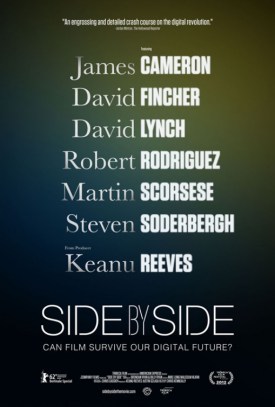
Side by SideIf you are a film buff, “Side by Side” is a documentary that is totally up your alley.

If you just enjoy watching movies for fun, “Side by Side” will easily raise you up to aficionado level on the craft of cinema.

If you don’t like movies at all, why would you consider watching a movie, especially one about movies, in the first place … and why would you have even made it this far into my review?

Christopher Kenneally’s doc about the Digital Revolution’s impact on how film is made and watched is insightful and captivating for anyone who cares about film at all.  If you don’t, again, I’m not sure how much this will work for you.  The film doesn’t preach to the converted, but rather to the convertible.  But it also manages to never feel like pandering to those with less knowledge.  I even thought I was very well-informed on the subject and found that I knew a whole lot less than I thought.

And right around the moment you might feel that “Side by Side” is playing to a level beneath you, the film geek inside will be tickled with excitement by seeing one of your favorite directors come on screen to opine on the matter.  From James Cameron to Christopher Nolan to David Fincher to Martin Scorsese, this movie has got some major talent to back up any claim it wants to make.

Then again, it also has bizarre appearances by Lena Dunham and Greta Gerwig.  Not exactly authoritative figures on these issues, but they add some nice entertainment value.  As does producer and narrator Keanu Reeves, who makes his first meaningful contribution to the cinema since “The Matrix.”  (Side note: he’s seriously disappeared from the movies these days.)

There are so many changes occurring so rapidly in the film industry, and “Side by Side” does a great job at trying to hit on all of them.  I really enjoyed taking in the full scope of all the enormous adjustments having to be made, but I also wish I could have gotten to learn a few of them in more depth rather than getting a cursory overview on several more.  Perhaps this calls for a sequel?  What do you say, Keanu, how about “Side by Side Reloaded” and “Side by Side Revolutions?”  B+3stars


REVIEW: Prometheus

17 12 2012

It’s rare to see any movie delve into deep theological, ontological, and existential questions that have puzzled humanity for millennia.  “Prometheus” isn’t even a pensive indie – it’s a blockbuster – and it still ponders them deeply in the far reaches of our universe to satisfying and intellectually stimulating effect.

Director Ridley Scott and screenwriters Damon Lindelof and John Spaihts don’t pretend to have any answers.  Thankfully, they don’t have that kind of hubris.  After all, these are the quandaries that have kept philosophers twiddling their thumbs.  But it doesn’t ever feel like a cop out or negligent writing.  They effectively stage a thoughtful drama in outer space and pose the questions to a new audience in an freshly compelling frame.

A number of people have quibbled about the small things in “Prometheus,” such as its fidelity to the “Alien” franchise, the plausibility of various events, the nature of the “engineers” that serve as the mysterious beings for the film, and the motivations of certain characters.  And if you really wanted to nitpick Scott’s film, I’m sure you could find some flaws and holes in the plot.  I, for one, really want to know why people are apparently unable to run laterally a century from now.

But to harp on the fine print is to miss the point of “Prometheus” entirely.  It’s a layered cerebral and psychological drama that just happens to use the framework of science-fiction.  The film finds fascinating parallels between the mysteries of extra-terrestrial life and the mystery of our own origins and existence.  Then, it heightens our senses and gets the heart racing.  The mind, naturally, wants to catch up and runs in overdrive after the movie to ponder what it just experienced.

Read the rest of this entry »


REVIEW: The Perks of Being a Wallflower

16 12 2012

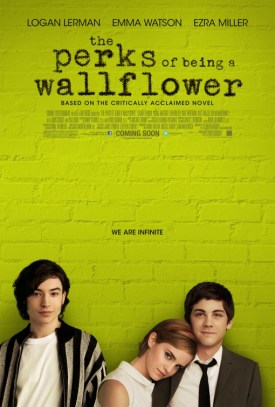
PerksIt’s rare that a high school movie captures the full range of experiences one can have in that crucial period, and “The Perks of Being a Wallflower” covers all the bases with ease.  The movie, adapted by Stephen Chbosky from his own novel, saunters at a casual mosey that allows us to take in every moment and appreciate its importance.

In a sense, it allows us to get into the character of protagonist Charlie, played wistfully by Logan Lerman.  He’s the eponymous wallflower, a passive yet perceptive observer taking it all in his freshman year rather than actively seeking to fulfill his desires.  We go from feeling sorry for him as he struggles to find acceptance on his first day of high school to quickly frustrated … because we know the easiest way to put an end to those woes!

Thankfully, Charlie stumbles into two fantastic friends before our annoyance reaches walk-out/turn-off levels.  First, there’s Patrick, an extreme extrovert who says exactly what’s on his mind no matter how inappropriate it may be.  Ezra Miller plays him with such a fantastic gusto that it’s impossible not to be drawn in by his magnetism.

Miller also sheds a tremendous light on the private shame that the very public characters struggles with: the relationship with football player Brad who won’t acknowledge the flamboyant Patrick in the halls at school.  This storyline is arguably the most compelling and dramatic of the film, especially since Miller and fellow rising star Johnny Simmons play it with such high stakes and tense emotionality.

Read the rest of this entry »


REVIEW: 21 Jump Street

16 12 2012

Recently, I watched “Fast Times at Ridgemont High,” the 1982 comedy still considered to be one of the best high school movies ever made, for the first time.  It has obviously become incredibly dated (but is still absolutely hilarious), yet it took me seeing the film to realize that virtually every high school movie for the past 30 years owes it a humongous debt.  Its fingerprints are all over the genre today, so much so that it has become almost inconspicuous.

The “Fast Times” social order still reigns supreme today.  Nice guys finish last, slackers come out on top.  If you’re smart, you’re a nerd.  If you’re a jock, you’re cool.  If you don’t hang around them, you probably aren’t.  And of course, just don’t try at anything because the naturally cool will just have people attracted to them like bugs to a light.  Whether the movies that came out of this mentality actually reflect high school is questionable, but they have all served to reinforce the “Fast Times” ideal.

21 Jump Street,” on the other hand, is a bird of a different feather.  It actually dares to question the preconceived notions of high school movies and imagine an entirely different set of tropes, ones that feel modern and appropriate.  The film’s protagonists, undercover cops Jenko (Channing Tatum) and Schmidt (Jonah Hill) graduated high school in 2005 in a very “Fast Times” environment and expect little to have changed when they go on a covert operation to their alma mater in 2012.  Boy, are they wrong.

Read the rest of this entry »