REVIEW: Limitless

4 09 2012

There is always a temptation to overstylize films.  It can be fun – heck, sometimes it can even be healthy – to indulge in this temptation.  But in a feature film, it has to be handled appropriately, and a balance must be established.

Quentin Tarantino has found it.  Wes Anderson knows where it is.  Danny Boyle exudes this equilibrium.  “Limitless” shows that Neil Burger has yet to find it.  His thriller wants to be “Inception” on 5-Hour Energy, but unlike that shot of energy’s promise, it comes with a big crash.

When it’s riding the big adrenaline high, the movie is slick fun that just draws a little bit too much attention to its own strut.  But when the projectile that shot way, way up comes inevitably back down to earth, it crashes with a loud thud and limps towards the finish line.  Once it slows down, we see “Limitless” for what it really is: an average movie that, like the average American, is only using a fraction of its brainpower.

We are also left with the realization that Bradley Cooper, handsome and composed as he may be, is still not quite the leading man that the tabloids so desperately want him to be.  He’s currently on the Ryan Reynolds trajectory  (forcibly pushed on America as a star more for his looks and less for his skills) rather than the Ryan Gosling track (an actor committed to his art but is willing to please the fans).  As Eddie Morra, a struggling writer who climbs to the top of the world with the help of a little pill called NZT, he’s convincing but not compelling, plausible but not entirely persuasive.

Cooper doesn’t carry the movie so much as the snazzy visuals do.  I’m not doubting he has talent: whether it’s scene-stealing in “Wet Hot American Summer,” embracing his looks to provide comic relief for “The A-Team,” or being the straight man that acts as the glue to hold the Wolfpack together in “The Hangover,” Cooper has proven himself quite nimble.  But in “Limitless,” he is most definitely limited.  We’ll get that towering Bradley Cooper performance somewhere down the road, though in the meantime, we’re stuck with Burger’s controlled acid trip and Cooper parading around in a suit.  B-


REVIEW: Cosmopolis

16 08 2012

Woah, woah, woah, slow down, there! What on earth did you just say? What could that possibly mean? Why should I care at all?
Such are the questions that will inevitably be invoked by anyone watching David Cronenberg’s “Cosmopolis.”  While a billionaire driving around the streets of New York in a limousine amidst massive social upheaval certainly packs a timely, relevant thematic punch, you can’t puzzle over the film’s deeper meaning because it’s so difficult to get past the first layer: the dialogue!  I’ve even read another book by Don DeLillo, author of the novel “Cosmopolis” from which the film was adapted, and I found the way the characters talked to be absolutely infuriating.

Everyone speaks in non-sequiturs, and no one ever seems to say exactly what they mean or have any sense of urgency.  At times, the dialogue even seems to delve into absurdism – where nothing relates to anything.  The film’s structure, in addition, jumps from conversation to conversation with very little explanation.  One second, Robert Pattinson’s Eric Packer is discussing the intricacies of global currency with Shiner (Jay Baruchel) … and then a quick cut to the next scene where he’s having sex with his art dealer (Juliette Binoche) – all in the limousine!

Read the rest of this entry »


Classics Corner: Jaws

14 08 2012

Everyone thinks they know “Jaws” if they have ever stopped foot in water, be it a swimming pool or an ocean. There is always that joker who starts to hum two notes that speak volumes for the generations that grew up after 1975, inducing a sense of dread. John Williams’ iconic theme for “Jaws” has become synonymous with the menace of a shark attack, and it is remarkable to see how a simple theme can still be so evocative over three decades later.

However, to characterize an entire film by something so small is vastly unfair to the filmmaking expertise that provided the canvas for Williams to compose a masterstroke. Jaws derives its terror from places other than its non-diegetic soundtrack, namely the expert direction of Steven Spielberg. Watching his film in the present day might seem like an exercise in futility given how banal the plot seems to have become, yet it actually still plays quite well.

In an age saturated with horror films that substitute gore for thrills, Jaws scares all the more because Spielberg refuses to take the easy way out. While there is plenty of blood to still freak out the faint at heart, Spielberg opts for a much more deliberate, methodical approach that recalls Hitchcock more than it does Saw. Once the shark’s theme cues up, it is inevitable that someone is about to die … but Spielberg never lets the audience know when they are going to die until the Great White sinks its fangs into their flesh. He does not even reveal the shark in its entirety almost until the climax, slowly providing clues as to just how big the beast really is. His precision pays dividends, just as it did for Hitchcock and just as it still does for directors willing to take the time to get it right, such as J.J. Abrams in “Super 8.”

Although the shark may be the most recognizable part of Jaws, the attacks really only punctuate the domestic drama occurring ashore on the island of Amity. Police chief Martin Brody (Roy Scheider), a cop from the city taking refuge in what he thought would be the quiescence of a small town, is tasked with maintaining order and calm when the massacres create massive unrest. The mayor tells him to do whatever it takes to keep the people safe, short of closing the beaches and running their summer’s economy. They hire scientist Matt Hooper (Richard Dreyfuss) to help catch the beast, but it ultimately requires the expertise of marginalized seaman Quint (Robert Shaw), himself a shark attack survivor. The three men come from vastly different backgrounds, but their unlikely camaraderie provides a refreshingly human aspect to a movie otherwise defined by the atrocities of nature.

While it may be easy to think of Jaws as little more than just the two notes of terror, it is worth a first watch or rewatch to let the true horror and humanity shine through.


REVIEW: American Reunion

11 08 2012

Was I really dying to know what happened to the characters of the “American Pie” series once Jason Biggs’ Jim Levenstein tied the knot with Alyson Hannigan’s Michelle Flaherty?  To be honest, no.  The ridiculous high school pals that love to talk about sex, sex, and … oh yeah, sex, are fun to spend an hour and a half with, yet they really aren’t worth a moment’s thought once the credits begin to roll.

But for all those who really need to know what has become of East Great Falls High’s graduating class of 1999, “American Reunion” exists.  Surprise – no one has changed all that much!  If you took five minutes to think about what the most likely life trajectories would be for all the characters, congratulations, you have the same IQ as the screenwriters.

Jim is still as horny as ever, and thankfully the film is able to justify some of his exploits by raising the stakes and amplifying the embarrassment (translation: some very uncomfortable Biggs full-frontal nudity).  Seann William Scott’s Stifler is still a jerk (and his mom is still busty as ever); Thomas Ian Nichols’ Kevin and Chris Klein’s Oz are still struggling with their feelings for the lovely Vicky (Tara Reid) and Heather (Mena Suvari), respectively; Eddie Kaye Thomas’ Finch is still an enigma to the rest of the group and to us.

If “American Reunion” really wanted to shock us, the better option would have been to have some of these characters fundamentally change.  Compared to seeing Jason Biggs’ penis smushed under the lid of a pot, a script that dared to challenge the notion that people aren’t doomed to keep reliving new version of their high school problems would have registered much higher on the Richter scale of shock.

Instead, we get to see the old archetypes thrown into a rerun of the good old days, forcing the characters we once loved to act out the plot of Adam Sandler’s “Grown Ups.”  How much that can entertain you depends on how much you liked these characters in the first place.  C


F.I.L.M. of the Week (August 10, 2012)

10 08 2012

When most people think of Edward Norton, they think “Fight Club,” “American History X,” or perhaps his brief stint as “The Incredible Hulk.”  In other words, I doubt many people would immediately classify him as a funny, light entertainer (though “Moonrise Kingdom” could change a few minds).  But take a look at Norton’s résumé and you will see that his only directorial venture was, in fact, a comedy!

His “Keeping the Faith,” my pick for the “F.I.L.M. of the Week,” is a delightful romantic comedy of interfaith understanding and rivalry.  Norton plays Brian Finn, whose best friend growing up in New York is Ben Stiller’s Jake Schram.  Fast forward to adulthood, Brian becomes a Catholic priest, and Jake is a Jewish rabbi.  Still buddies, they find hilarious commonalities between their similar positions in different religions.

But their friendship gets a shock when Jenna Elfman’s Anna, a dreamgirl for both Brian and Jake back in their teenage years, moves from California back to the Big Apple.  She may have disappeared long ago from their lives, but Anna picks up right where she left off with both men, rekindling an old flame that burns brighter than ever.  But each men presents their own problem in terms of dating: Brian is required to be celibate as a Catholic priest, and Jake has to marry a Jewish woman (which Anna is not).

Yet in spite of the occupational challenges, both men vie for her love and affection.  She’s put in the unenviable (but seemingly always optimal choice for Reese Witherspoon) situation of choosing which illicit love to pursue.  I know this sounds a little bit like “This Means War,” but give it a chance.  It’s heartfelt, funny, and truly sincere.  Plus, it’s a movie that doesn’t shy away from having a good time with religion while also taking it totally seriously.  Why Edward Norton stopped directing after “Keeping the Faith” is beyond me.


REVIEW: The Bourne Legacy

10 08 2012

No Damon, no problem, right?

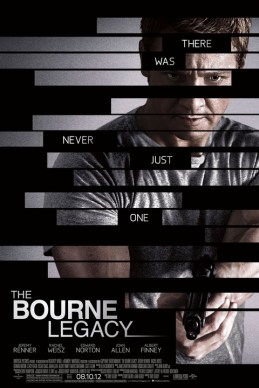
Jeremy Renner is a capable action star, so there shouldn’t be any hiccups.  Plus he’s a great actor as evinced by his Oscar nominations for “The Hurt Locker” and “The Town.”  And Rachel Weisz is a perfectly capable actress to match him; after all, she has the Oscar win (for her riveting work in “The Constant Gardener“) that has eluded Renner’s grasp.

Not to mention, the franchise is in the capable hands of Tony Gilroy.  He wrote the first three installments in the “Bourne” universe, which were all awesome.  And once those were done, he moved onto direct the taut, immaculately constructed “Michael Clayton” (earning him Oscar nominations for writing and directing) and the twisty thriller “Duplicity” (which does not get nearly enough credit).

Yet for all these reasons that “The Bourne Legacy” should work, it absolutely flops.  The expression the higher the pedestal, the harder the fall has more to do with the expectations surround the film than an evaluation of quality; however, a spin-off, sequel, or whatever the heck this movie “Legacy” claims to be cannot escape being measured against its predecessors.  And while the Greengrass/Damon films had a palpable sense of forward momentum that propelled the franchise, Renner and Gilroy’s take on the “Bourne” universe  is dead on arrival and drags for 135 long minutes.

Read the rest of this entry »


REVIEW: The Queen of Versailles

9 08 2012

Who would have thought that the best comedy of the summer would be a documentary?
Sure enough, Lauren Greenfield’s “The Queen of Versailles” captures billionaire trophy wife Jackie Siegel in all of her ridiculousness.  As if her endless supply of busty hooker outfits for every situation weren’t hysterical enough, Greenfield’s camera always seems to catch her at her best.  Or at her worst, depending on your point of view.

She talks about her obscenely ostentatious new home – which, at 90,000 square feet, is the largest in America – as if it’s a shack, always craving more.  She says that once she realized she could hire nannies to take care of her children for her, she decided she wanted to have seven kids!  She’s the E! reality show character who is too good to be true … but she is!

However, her antics aren’t played solely for “Real Housewives”-style humor; rather, Greenfield uses Jackie as an extreme case to test just how far our notions of the American Dream can extend.  Because by all means, she is living it.  From tenement to mansion is the essence of upward mobility, and Jackie’s transition from modest suburban upbringing to her own private Versailles epitomizes the American ideal.  With a little humility, she could be the poster-child for the American dream.

Read the rest of this entry »


REVIEW: Casa De Mi Padre

8 08 2012

If you ever needed a definitive case against vanity projects, “Casa De Mi Padre” should be the first bullet-point of your presentation.  Conceptually, it’s a Funny or Die video that is somehow allowed to last longer than three minutes.  An hour and twenty minutes longer, as a matter of fact.  At half the length of “The Dark Knight Rises,” it still manages to feel twice as long.  How that’s even possible still baffles me.

All the humor of Will Ferrell’s tacky Spanglish speaking is drained by the opening credits.  Any sort of political statement the movie was trying to make has already been made by Robert Rodriguez in “Machete,” a parody movie that also did in “Casa De Mi Padre” by using all the tricks of self-referential Mexploitation films first – and also better.  I didn’t even care for Rodriguez’s film all that much, but it had something that screenwriter Andrew Steele couldn’t provide this movie: a plot!

Every scene in “Casa De Mi Padre” just feels like a new YouTube video from the same Mexploitation parody channel with most of the same actors.  It’s not just that the tongue-in-cheek casting of Will Ferrell gets old incredibly quickly.  You could cast Antonio Banderas or Javier Bardem, and even if they put on a comedic game face, they couldn’t salvage the sheer juvenility of the movie.  It’s so stupid that it makes those weird  Adult Swim animated shows look like high art.

So if you’re still curious about how low comedy can go and “The Watch” wasn’t nearly torturous enough for you, by all means, check out “Casa De Mi Padre.”  You may wish Thomas Edison hadn’t pioneered the craft of film to begin with.  D-


REVIEW: The Campaign

7 08 2012

Political satires are no cakewalk, and they require keen insight to even get off the ground.  “The Campaign,” perfectly released into the silly season of a Presidential election year, is a pointed sendup of the antics of a post-Citizens United world where money can flow into elections like lava.  The message of writers Chris Henchy (who I still won’t forgive for “Land of the Lost“) and Shawn Harwell comes across loud and clear, although it lands without the strength of Will Ferrell’s punch that socks a baby.

While the satire may be sharply pointed, its impact is severely dulled by crude, sophomoric humor that is far beneath the intelligence of the ideas being expressed.  It stoops to pretty low lows – I’m talking like barely above the horrendously offensive “The Change-Up” – to provide entertainment for the masses … because heaven forbid they actually tried to level with moviegoers and not treat them like children!

Sadly enough, politicians have been providing enough inappropriate fodder for humor through gaffes and just plain idiotic behavior.  For example, in the summer of 2010, a joke where Will Ferrell’s cocky incumbent North Carolina Congressman Cam Brady sends a salacious picture to a mistress on Twitter, it would have just been laughed off as something Frank the Tank would have done in “Old School.”  Now, it’s a boneheaded move ripped from the real-life disgrace of Representative Anthony Weiner.  You stay classy, Washington.

Nevertheless, the jokes aimed straight at the heart of our nation’s capital are few and far between in the movie.  The means employed to achieve the ends of “The Campaign” distract from the real lunacy it’s trying to expose to the audience.  The fact that a few billionaires can put their puppet into play for a seat in the House of Representatives with just a few checks and a political consultant who knows what polls best in every category is probably not even that far-fetched a thing to happen off the screen.  They could probably even do it with somebody dumber than Zach Galifianakis’ Marty Huggins, the pug-loving village idiot!

No one is going to come out of “The Campaign” talking about the antics of the corrupt; they are going to come out talking about the antics of the comedians.  The movie becomes about what ridiculous lengths Brady and Huggins go to – and they go to ridiculously taboo extremes – in order to beat each other, not about what ridiculous system allowed this situation to become feasible.  It’s the billionaires, stupid.  While we’re on the topic of political slogans, the buck starts here, there’s nothing you can believe in, and no they couldn’t.  C+


REVIEW: Take This Waltz

6 08 2012

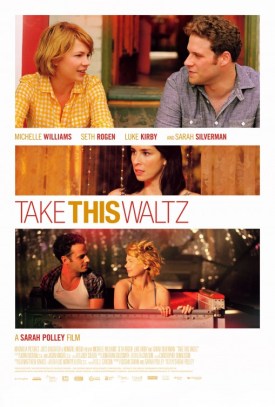
Michelle Williams, fresh off a Best Actress nomination for “My Week With Marilyn,” disappointingly dials down the charm back down to “Blue Valentine” levels for her latest film, “Take This Waltz.”  It’s a return, though not necessarily a regression, to the familiarly frumpy, downtrodden women who prefer to express their thoughts by gazing at the ground rather than through words.  Williams is a fantastic actress, and she pulls it off so well time after time – but I think it’s time to start expecting more from her.

Her portrayal of Marilyn Monroe was far more than a caricature or an impersonation; it was spirited, sexy, and oh so soulful.  It was definitely outside Williams’ comfort zone, yet she totally nailed it!  I think “My Week With Marilyn” is hardly her limit, and the longer she dwells in her pre-Marilyn state of mind, the more disappoint her post-Marilyn films are going to feel.   (Yes, “Take This Waltz” was filmed first, but virtually no one saw it first.)

Perhaps it’s less the archetype I’m frustrated with and more her character in Sarah Polley’s sauntering drama.  As a sullen Toronto-dweller bored in her marriage, she begins to ponder an affair with the literal boy next door … well, down the street.  Daniel, a shyly passionate artist as well as rickshaw for money, is the man who will indulge her deepest sensual passions and go through the Kama Sutra with her.

But she’s married to the sweet, good-hearted poultry chef Lou, played with good-natured charm by Seth Rogen.  He has moments where perhaps he seems content to let the spark go out of their marriage, although it’s always clear that he’s the man we should be rooting for because he does care for her and will always love her deeply.

The decision is overwrought and strung out over nearly two hours when it could have easily been compressed to 90 minutes.  Sarah Polley’s camera does dazzle more than the usual quiet indie drama.  However, the story those images serves to complement is little more than a segment from “He’s Just Not That Into You” that fashions itself to be a drama.  C+ 


REVIEW: Ted

4 08 2012

For better or for worse, “Ted” is a product of Seth MacFarlane through and through.  In other words, the film plays out like one of those five-part “Family Guy” story arcs.  It also doesn’t help that the comedic pairing of semi-serious Mark Wahlberg and a wildly inappropriate talking teddy bear, aptly named Ted, are essentially performing the same functions as straight-shooting dog Brian and the indecent infant Stevie.

And since “Ted” bears such an uncanny resemblance to the comedic stylings of “Family Guy,” the optimal way to consume it is the same: as a set of stand-alone YouTube clips that make you roar with laughter and cut out the story that connects the jokes.  MacFarlane, absurd metaphor-spawner that he is, has never quite figured out how to tell a story that compels anywhere near as much as his cut-away humor does.

Granted, his borrowed, trite plot is merely there to string together the laughs.  Yet it also winds up depreciating the value of the entire film because eventually you forget all the jokes.  But the story is something that sticks in your head.  For instance, I could recite one or two funny lines from “Ted” off the top of my head, but that creepy and unnecessary subplot involving Giovanni Ribisi as a sexually disturbed adult willing to kidnap a talking teddy bear will always haunt my memory.

Read the rest of this entry »


F.I.L.M. of the Week (August 3, 2012)

3 08 2012

Well, if I hadn’t taken a number of hiatuses, my 100th entry in the “F.I.L.M. of the Week” series (that’s First Class, Independent Little-Known Movie, just a reminder) would have come around June or July 2011.  But a belated milestone is still a milestone, so I’m going to celebrate by writing about “Wet Hot American Summer,” perhaps one of the most underappreciated cult comedies of recent memory.  Starring just about all your favorite comedians WAY before they were famous, it’s a hilarious time capsule that surely needs to be opened if you are a fan of anyone in the massive cast!

It’s the last day of summer at a Jewish camp in Maine – in 1981, no less – so that means everyone is trying to attend to some unfinished business.  The movie juggles a ton of storylines in an hour and a half, some of which don’t work as well as others, I’ll admit.  A number of the jokes are just so stupid, you have to wonder whether you want to laugh or just cringe.

But director David Wain, who later found commercial success and critical acclaim with “Role Models,” just never lets the relentless onslaught of over-the-top, farcical comedy end.  And for that, it could make for a “Napoleon Dynamite”-style viewing trajectory: perhaps just some chuckling the first time, and then those giggles turn into full-on belly laughs as the nuances of the humor reveal themselves over multiple viewings.

It’s certainly worth watching to see the beginnings of Paul Rudd’s caustic humor, albeit slightly more hammed up, as an airheaded horndog lifeguard who can really cop an attitude.  The object of his affection, at least momentarily, is Elizabeth Banks – until he decides she tastes like hamburgers and doesn’t like her anymore.

Amy Poehler is another scene-stealer as Susie, the bossy, controlling counselor in charge of theater intending to stage a number of “Godspell” as if she were working on Broadway.  What makes her character even better, though, is that she is flanked by preppy, Lacoste-clad minion Ben at all times.  Now, Ben is played by none other than Phil Wenneck himself, Bradley Cooper.  His PR people have done a mighty great job keeping this movie on the down low … I’ll let you find out for yourself why he probably doesn’t want many people to discover this early role of his.  I think it’s absolutely hilarious, as is the rest of the movie, and I highly recommend you find out Bradley Cooper’s surprise and many other raunchy delights I didn’t even mention in this cursory overview!


REVIEW: Ruby Sparks

3 08 2012

My second review on this site was for a movie I was quite high on three years ago, “(500) Days of Summer,” and remain a big fan of to this day.  Back then, it was the little indie that could, a summer sleeper that provided a smile and welcome relief to canned romantic comedies like “The Ugly Truth,” and a nice reminder of the acting prowess of Joseph Gordon-Levitt and Zooey Deschanel.  Then, it went mainstream, said the slightly bitter pseudo-hipster with a sigh.

Never could I have imagined that Marc Webb’s film could have been so influential.  Beyond just elevating Joseph Gordon-Levitt into major leading man status and turning Zooey Deschanel into the modern ideal of the “manic pixie dream girl,” the film made quirky a cool and acceptable facet for the genre.  “Ruby Sparks,” the sophomore film from the people that gave us the middling “Little Miss Sunshine,” attempts to dovetail the success of “(500) Days of Summer” by virtually replicating its emotional ride.

To be fair, “Ruby Sparks,” written by its star Zoe Kazan, is probably quite a bit smarter than its rom-com relative.  However, the film’s charms are far too easy to resist, namely because Kazan is a poor man’s Zooey Deschanel and Paul Dano is just a poor excuse for an actor in general.  They can sell the film on an intellectual level, but neither is particularly good at making us care.  Had it been Gordon-Levitt and Deschanel in the highly-strung emotional climax, I’m convinced I would have been riveted and moved.  Instead, I just sat there pursing my lips like Miranda Priestly.

Read the rest of this entry »


REVIEW: Total Recall

2 08 2012

I was fully strapped into the 2012 remake of “Total Recall” – which, by the way, is probably the first of many frightening remakes of ’90s films that will make me feel old and nostalgic – for the first two acts.  It was working a bullet-riddled “Inception” or “Shutter Island” angle, and I was preparing for a climax that had a cerebral twist on the average adrenaline rush.

Well, I waited in vain.  While people tend to blame Christopher Nolan for the sorry state of action films that are not in the “Batman” franchise, he’s hardly the most influential figure in the genre these days.  Few try to emulate his dark twist on the familiar because even an ambitious failure requires some ambition and effort.  The Nolan-inspired blockbusters are still few and far between.

“Total Recall” winds up in the Michael Bay category of action flick, adhering to his “there’s nothing like a good destruction scene” principle.  Every time Len Wiseman’s movie seems to be taking a turn towards the intelligent or the thoughtful, someone starts getting chased, someone fires a gun, or something just gets blown towards the heavens.  It’s not quite as bad in the beginning as you attempt to puzzle out whether Colin Farrell’s Douglas Quaid is just a normal man thrown into extraordinary circumstances like a Hitchcock hero … or a cold-blooded mercenary brainwashed into believing he’s average like Liam Neeson in last year’s dull thriller “Unknown.”

But in the end, Wiseman decides that it’s better to just blow people up rather than provide answers or catharsis.  Who needs to tie up storylines when you can just sever their heads instead?  Moreover, who needs to blow our minds with a statement on the subjectivity of reality when you can blow our minds and some buildings with pyrotechnics? As such, “Total Recall” makes for an intellectually unfulfilled experience.  Though on the bright side, he does give us the ridiculously awesome Kate Beckinsale as the best female gunslinger since Chloe Moretz’s Hit Girl in “Kick-Ass.”  Her unstoppable ruthlessness is as hilarious as it awesome … well, probably more on the hilarious side since her hair manages to stay so perfect even as she gets the snot kicked out of her.  B-


REVIEW: Savages

1 08 2012

I’m not one to say that a movie HAS to be made a certain way or in a certain style. Having said that, movies about drug trafficking, drug cartels, and drug violence should really be done in a raw, gritty fashion.  That’s the standard, be it Steven Soderbergh’s “Traffic” or television’s “Breaking Bad.”  The style and the content really work in perfect harmony.

And it’s a standard for a reason.  Oliver Stone, ever the belligerent iconoclast, feels no need for such formalities.  He’s begging for attention as usual in his latest feature effort “Savages,” a film that’s about two drug growers in a ménage à trois with a girl who winds up being used as a pawn against them, although it’s really just about Oliver Stone.  His insistence on making curious directorial choices often makes the film feel like a tasteless, hair-brained Tarantino flick.

His insistence on savagely graphic violence aestheticizes slaughterings, tortures, and killings to the point where it seems to serve only Stone’s eye.  One particular scene goes way too far; it’s a disgusting sight to behold and really doesn’t have much to say about the morality of violence.  Scorsese-esque, this is not.

And if the violence doesn’t make “Savages” unwatchable for you, then maybe the acting will.  Blake Lively, taking a page from the Kristen Stewart playbook, grunts, moans, and brays her way through a juicy role that could have been memorable in the hands of someone like Elizabeth Olsen or Rooney Mara.  Aaron Johnson and Taylor Kitsch as leading men in a love triangle (that Stone presents with some homoerotic undertones) are passable, but Kitsch really should find a role where he can channel the emotional honesty he brought to Tim Riggins on television’s “Friday Night Lights.”

Stone also finds a way to turn Oscar nominees John Travolta and Salma Hayek and winner Benicio del Toro into caricatures, particularly Hayek, whose thick accent is played for comedy.  It’s a shame that “Savages” is hijacked by its director to flaunt the peculiarities of his own mind.  The story, a caper of duplicity and cannabis, is actually quite captivating.  But to Oliver Stone, it’s merely a canvas onto which he can make his “Bonnie & Clyde.”  In the hands of a director who respects the source material enough to subvert and subdue their own tendencies if they were not suited for the story, “Savages” could have easily been something very special.  C+