REVIEW: Philomena

13 01 2014

PhilomenaLondon Film Festival

At first glance, the real-life story of Philomena Lee would seem like the stuff of depressing drama. After being impregnated as a teenager, she is thrown into a convent and forced to sign away her son. 50 years later, Philomena (Judi Dench) is still haunted by his loss and embarks on a journey to find him – only to uncover some unsettling truths.

In the hands of the average screenwriter, “Philomena” would have emphasized the tragedy and milked the story for every tear possible. Yet Philomena’s quest is filtered through the lens of Steve Coogan (yes, Damien Cockburn from “Tropic Thunder,” among many other roles) and Jeff Pope’s unique worldview, making it a rather different movie. It definitely has its heart in the very heartbreaking dramatic truth of her life; however, it’s a surprisingly and heartwarmingly hilarious.

Much of the humor comes from Coogan’s own presence as an actor in the film, portraying Martin Sixsmith, the journalist who takes an interest in investigating Philomena’s past. He’s quite the counterpoint to her seemingly incurable optimism: having just been fired from his government job, he’s rather merciless and defeatist. Coogan and Dench don’t just have a standard comic man-straight man routine going, though. They each express their worldviews wittily and distinctly, with both having moments of vindication and defeat.
Read the rest of this entry »


REVIEW: The Wolf of Wall Street

11 01 2014

Sex. Cocaine. Hookers. Profanity. Quaaludes. Destruction. Money. Orgies. More profanity. More sex. More cocaine. More destruction. More money.

Normally these are the kinds of things that liven up a movie, but in Martin Scorsese’s “The Wolf of Wall Street,” it’s pretty much all that’s being served. The movie is three hours of high-intensity bacchanalia in the life and work of Leonardo DiCaprio’s Jordan Belfort. With a piece being played at such a prolonged forte, it’s quite frankly an exhausting and draining film to watch. While obviously satirical and darkly comedic in tone, the sheer amount of repetition dulls outrageousness into monotony.

“The Wolf of Wall Street” is not without its profound moments of insight, however. Yet I was so exhausted by the relentless onslaught of anarchical madness that I lacked the stamina to really analyze Belfort’s speeches and Scorsese’s curious stylistic choices. Screenwriter Terence Winter and Scorsese present Wall Street as a synecdoche for America, and I’d be curious to re-watch some scenes again and subject them to further criticism.

But that dissection is going to have to be on video or as YouTube clips because I simply don’t think I could sit through “The Wolf of Wall Street” in its entirety again. The film may not condone the behavior it presents on screen, yet it’s so drunk on its own energy it luxuriates in all these obscene shenanigans. It doesn’t really matter if Scorsese communicates disgust for Belfort’s actions; by including such a large volume of his antics, he glorifies Belfort’s narrative over those left ruined in his calamitous wake.

Read the rest of this entry »


F.I.L.M. of the Week (January 10, 2014)

10 01 2014

Alfonso Cuarón is an almost certain nominee for Best Director (although you never know with the Academy’s directors branch, I said Ben Affleck and Kathryn Bigelow were undebatable nominees at this point last year).  If his work on “Gravity” isn’t enough, just look at the incredible stylistic and storytelling diversity of his post-2000 work.  He’s tackled a Harry Potter film (and made the best one, in my opinion), made a dystopian Nativity allegory, and “Y Tu Mamá También,” my pick for the “F.I.L.M. of the Week.”

This 2002 Mexican road trip drama is character driven like “Gravity” but has a lot more to offer in terms of a firm story to follow.  (The original screenplay netted Cuarón and his brother Carlos their first Oscar nominations.)  Even in subtitles, their snappy dialogue has an undeniable pop to it.

The movie follows the exploits of two sexually active teenage boys, Julio (Gael Garcia Bernal) and Tenoch (Diego Luna), who find themselves suffering from upper-middle-class ennui after their girlfriends go for an extended trip to Italy.  Looking for something to do, they take a spontaneous trip to the beach with the older Luisa (Maribel Verdu) whom they just met at a wedding.

As they drive through the poorer parts of their country to find the beach, the three have frank conversations about love and sexuality.  Eventually, their conversations give way to … well, do I really have to say?!  Don’t watch this movie with anyone with whom you’d feel awkward seeing lots of naked bodies.

But in case that last sentence had you thinking “Y Tu Mamá También” is some kind of smutty pornographic film, you’d be mistaken.  It’s a fascinating character study, a gripping journey, and a bold exploration of what men are really expressing when they enter into love triangles.  I’ve only seen this movie once, but I’d love to give it a second look soon to more closely examine how the surprising ending is foreshadowed and how the film addresses the sociopolitical context of late ’90s Mexico.


REVIEW: Saving Mr. Banks

9 01 2014

I’m a firm believer in the magical power of cinema, in case you hadn’t figured it out by the fact that I take the time to write this blog. Few films, however, have really shown the true enchantment of the movies on screen. Recently, the dancing scene in “The Artist” and the storyboard scene in “Argo” have illustrated it well.

Now, add to that list the scene in “Saving Mr. Banks” where Emma Thompson’s P.L. Travers gives herself over to the undeniable charm of “Let’s Go Fly a Kite,” a song being written for the film adaptation of her “Mary Poppins” books. The curmudgeonly writer shoots down idea after idea from the composing team of the Sherman brothers (Jason Schwartzman and B.J. Novak) and writer Don DeGradi (Bradley Whitford). Yet when they play the tune for her, we get to watch Travers’ heart melt before our eyes. They all dance and sing with such passionate mirth that I found myself moved to the brink of tears.

The film presents the captivating narrative of how Travers came to Hollywood in order to maintain the artistic integrity of her books from the kitsch of Walt Disney, an American icon fittingly portrayed Tom Hanks. She scoffs at any attempt to make the film have the saccharine appeal of his other movies: no singing, no animation, and Mary Poppins is not to be sweet.

Read the rest of this entry »


REVIEW: Frozen

8 01 2014

Disney’s latest home-grown animation effort, “Frozen,” seems like it’s going to follow in the path of their traditional princess narrative.  In fact, the film boasts two marriageable princesses that sing show tunes flawlessly.  Yet as the movie progressed, I couldn’t escape just how dark the whole thing was.

Sure, other Disney princess stories have their share of bleak moments, but they’re usually right before everything gets better.  From the get go in “Frozen,” Elsa (voice of Idina Menzel), one of the princesses, is banished to her room until she can control her magical power to create ice.  Because, you know, it would have just been too easy for some Disney-Pixar intermingling to allow Frozone from “The Incredibles” to come train her).

Her younger sister, Anna (voice of Kristen Bell), is left lonely as a result.  Had Anna’s musical number of desolation and emptiness pleading for her sister to come out and play, “Do You Want to Build a Snowman,” been a little less cloying, it might have had me in tears.  But the song, like nearly every other tune in “Frozen,” feels a bit over the top.  They aren’t really in line with the catchy Disney tunes of their ’80s and ’90s animation renaissance; they are stock Broadway numbers that recall the cliched sounds of “Wicked.”

Read the rest of this entry »


REVIEW: Inequality for All

7 01 2014

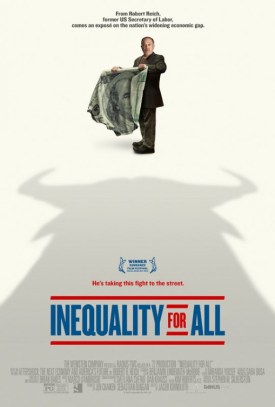
Inequality for AllAs a sociology major in college, you could say I might know a thing or two about inequality.  Ok, so it’s essentially our bread and butter.    Whether you’ve taken one sociology course or not, whether you followed the Occupy movement or not, you’ll find Robert Reich’s documentary “Inequality for All” both enlightening and fascinating.

Reich, a former Secretary of Labor for President Bill Clinton, is certainly not using this movie to push a party’s agenda or invective.  As he lays out from the beginning of the film, the terms liberal and conservative are becoming irrelevant anyways.  He does not pander to those who are already persuaded or talk down to anyone who has never thought deeply about inequality.  It’s a documentary out to shake assumptions, and it succeeds admirably at doing just that.

Reich even tells the audience that they are welcome to decide that inequality isn’t an issue.  But after all the facts he lays out, you’d be pretty hard-pressed to find anyone who won’t concede it is somewhat of a problem.  Reich helps his argument by presenting positives instead of preaching negative vitriol.  “Inequality For All” isn’t about calling for an end to trickle-down economics; it’s a documentary passionately advocating for middle-out economics.

His rhetoric is also aided by his lack of defeatism or pessimism, which is remarkable given that he compares the Great Recession’s causes and effects to those of the Great Depression.  Reich is brilliant at showing how both downturns came about as well as explaining the cyclical nature of economic growth and decline.  The goal should be to move from vicious circles characterized by debt and inflation to virtuous circles where production, efficiency, and education spawn reduced costs and lower prices.

As 2014 dawns, inequality will apparently be a pressing issue for both political parties in Congress.  So while they (and your friends who watch them on partisan news channels) spew a lot of empty partisan platitudes, why don’t you be the level-headed one with the facts to dispel the myths?  You can be that person by watching “Inequality for All.”  B+3stars


REVIEW: Anchorman 2: The Legend Continues

6 01 2014

Maybe Adam McKay should have let the marketing and promotions team write the movie “Anchorman 2: The Legend Continues” for he and Will Ferrell.  They certainly had a much better grasp of the power present in Ron Burgundy’s cult iconography gained over the year and used it to leverage interest in a follow-up to a film released nearly a decade prior.  It’s a shame that the abysmal sequel had nothing to deliver.

I certainly don’t dislike 2004’s “Anchorman: The Legend of Ron Burgundy,” but I never quite understood why it above other movies had gained such a foothold in the pop culture lexicon.  A plethora of lines from the original film are now such staples of conversation these days that I often forget their origin. While I was entertained by the movie the one time I watched it on HBO, I certainly did not think it deserved a sequel over a film like, say, “Pineapple Express” or “Role Models.”

While the former got a humorous pseudo-sequel in “This Is The End,” I can now say with certainty I never want to see a follow-up to the latter after “Anchorman 2” just destroyed the legacy of its predecessor.  While there are intermittent laughs to be had, the utter stupidity of its jokes and lack of care in maintaining its characters made for what might be the most unpleasant moviegoing experience of 2013.

Read the rest of this entry »


REVIEW: The Hobbit: The Desolation of Smaug

5 01 2014

It’s a shame that it has not yet become en vogue for a deep voice to announce “previously on…” at the beginning of a film like they do at the start of an episode of “Homeland” or “Lost.”  This would certainly have come in handy for “The Hobbit: The Desolation of Smaug,” the middle chapter of Peter Jackson’s film adaptation-cum-trilogy.  I will confess that I found the first entry, “An Unexpected Journey,” so forgettable that I spent 15 minutes reading the plot summary on Wikipedia  – and even longer trying to figure out how to remember or comprehend it.

Call me crazy, but I’ve always been rather immune to the appeal of Jackson’s Middle Earth epics.  While I admire the impeccable make-up work, the gorgeous cinematography, and the sheer amount of attention to detail apparent in the creation, the whole always feels less than the sum of its parts.  The plots never really engage me, and I find myself mentally exhausted by the end simply trying to both follow the chain of events and keep the characters straight.

“The Desolation of Smaug” seems about on par with its predecessor.  Neither have the same sense of urgency that propelled the original “Lord of the Rings” trilogy, thus making their north-of-160-minute runtimes feel more like a chore than an afternoon of entertainment.

Read the rest of this entry »


REVIEW: The Secret Life of Walter Mitty

4 01 2014

24 hours before I saw “The Secret Life of Walter Mitty,” I was sitting in a press screening of “The Wolf of Wall Street” for three straight hours of sex, drugs, profanity, and despicable behavior.  Roughly an hour before I saw it, though, I was watching TCM’s broadcast of “White Christmas” with my family and listening to my parents ask once again where the nice movies are in theaters today.

It should be fairly obvious that “Walter Mitty” falls in line with the latter of the two aforementioned films; after all, it is based on a film from the 1940s.  And following an evening of watching a candle stuck wedged between Leonardo DiCaprio’s butt cheeks (one of the few shenanigans I dare to write about), it was just nice to watch a good, clean family feature.  Even though Ben Stiller’s film is nothing spectacular, its intermittently successful embrace from a bygone era is a nice change of pace.

Stiller, who also stars as the film’s titular character, does not drown the film in excessive sentimentality, often a hallmark of Hollywood’s golden age cinema.  But perhaps it would have been welcome had it brought any charm, which is largely absent from this languidly paced film.

Read the rest of this entry »


F.I.L.M. of the Week (January 3, 2014)

3 01 2014

Tom Hanks, even at the relatively young age of 57, is such a legend of the screen that every role he takes is reason for excitement.  (Unless it’s “Larry Crowne.”)  2013 graced us with not just one but TWO Hanks performances in “Captain Phillips” and “Saving Mr. Banks,” at least one of which is likely to result in an Oscar nomination.  The two-time winner hardly needs any recognition for his acting prowess, nor does he need to be lauded for his producing skills (the man has 5 Emmys sitting on his mantle).

What does deserve some attention, though, is Hanks’ directorial debut “That Thing You Do.” (We’ll just pretend “Larry Crowne” didn’t happen, just like American audiences did.)  My pick for “F.I.L.M. of the Week” shows a fun-loving, crowd-pleasing side to Hanks that will make you wish he was sitting in the director’s chair as often as the producer’s seat.

The film follows a would-be Beatles boy band, the Wonders (formerly the One-Ders), as they rise from garage obscurity to Billboard chart-topping fame.  None of it would have happened, though, without the inspired improvisation of replacement drummer Guy (Tom Everett Scott) that turns the song “That Thing You Do” from a ballad into an up-tempo rock ‘n’ roll number.  From there, they acquire a swanky manager played by Hanks himself, go on tour, perform on television … and deal with all the motion sickness caused by such a meteoric ascent to stardom.

Thanks to HBO, I’ve seen “That Thing You Do” dozens of times over the past 15 years or so, and I’ve never tired of it.  (For that same reason, I’ve only seen it start to finish a handful of times.)  Similarly, I still listen to the movie’s soundtrack frequently; it’s got a number of ditties that you can have stuck in your head for days.  The whole movie, really, is such a delight.  It’s a toe-tapper of a musical with plenty of dramatic tension and rich characters that’s wonderfully orchestrated by Maestro Hanks.


F.I.L.M. of the Week (December 27, 2013)

27 12 2013

The year 2014 is fast approaching, which portends a myriad of things for people.  For many, it is a fresh start, a chance to renew lapsed goals and resolve to become a better person.  Yet for all of us, it is an inescapable marker of time slipping through our fingers.  For what is a year but just two signposts of elapsed time, a set of brackets to contain our ups and downs?

Mike Leigh’s “Another Year,” my pick for the final “F.I.L.M. of the Week” in 2013, looks at this widely-recognized span of time from a refreshingly realistic angle.  It’s not a tale that escalates dramatically like a conventional fictional plot.  Rather, Leigh presents four chapters – one for each season – in the lives of ordinary people going about their business.  There is not necessarily any grand significance to their trials and triumphs, but in simply recognizing these normally unrecognized moments, Leigh grants them a beautiful dignity.

To detail the occurrences of “Another Year” in any great detail would be to spoil the flow of the picture.  Like many films by Mike Leigh, it involves a large ensemble cast who are more than just actors in the movie – they are true collaborators.  Their characters drop in and out of the story with the exception of the two anchors of the film, the old married couple Tom and Gerri Hepple (Jim Broadbent and Ruth Sheen, respectively).  They are a solid bedrock for their many friends, steady and resolute from their many years of experience weathering whatever is thrown at them.

There’s no indication that the year chronicled in “Another Year” is one of any particular challenge for Tom and Gerri.  Both continue to work their jobs, tend their house, care for their grown son, and love each other.  They even manage to stay relatively unfazed by their erratic friend Mary, played by Lesley Manville in what should have been an Oscar-nominated performance. (Sadly, confusion over whether she was a leading or a supporting actress may have cost her a shot at a trophy she deserved to win.)

As she endures a particularly biting mid-life crisis with an accompanying lack of direction and self-worth, Mary provides the tension that makes “Another Year” more than just pure naturalism.  Manville is nothing short of stunning in the role, providing just about every emotion one can feel over the course of a year within the film.  Leigh closes with a long-held shot of her face, and it is truly devastating.  Not unlike the final shot of “Zero Dark Thirty,” all the action and events of the film are ultimately reflected in the face.  And in “Another Year,” the events are life itself, in all its small victories and tough disappointments.


REVIEW: The Hunger Games: Catching Fire

1 12 2013

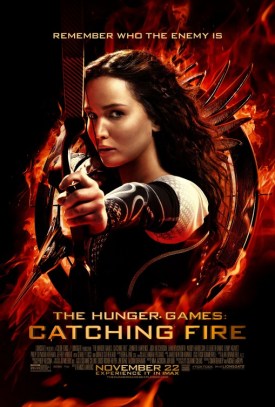
Hunger GamesWhen I wrote my review of the first film in “The Hunger Games” series over a year and a half ago, I couldn’t stop gushing about Gary Ross’ gritty, unsparing aesthetic.  The shaky camera and rough editing made the movie’s form brilliantly match the dark content of Suzanne Collins’ trilogy of young adult novels.  But Ross is gone for the second installment, “The Hunger Games: Catching Fire,” and his unique stylization went with him.

The absence of artistry is likely to only bother people like me who study film, however.  And while I was sad to see it go, “Catching Fire” more than compensates with a tighter focus on storytelling and fidelity to its source.  Under the steady direction of Francis Lawrence and the pen of Oscar-winning scribes Michael Arndt (‘Toy Story 3“) and Simon Beaufoy (“127 Hours“), this sequel is among the rare class that manages to outdo than its predecessor.

“Catching Fire” manages to pack a remarkable amount of events into its nearly two and a half hour runtime; in fact, I had read the book a few months before seeing the movie and could hardly think of anything excised from the plot.  Yet even in spite of how much it bites off, the film never feels its length at all.  Lawrence keeps the action unfolding at a steady clip, never hurried enough to make us feel frenzied but never so drawn out that we can get bored.  (And unlike the first “Hunger Games,” I was actually excited for the next film when “Catching Fire” ended.)

Read the rest of this entry »


REVIEW: Scream 4

22 10 2013

Few franchises can come back from after a decade and still be entertaining, much less relevant.  Pixar can do it, but just about everybody else is incapable of such a feat.

And though the poster for “Scream 4” promises “new rules” for this new decade, I can think of few sequels that make the case for their own existence less persuasively.  Wes Craven’s latest parodic horror entry into the “Scream” series is just the same old stuff, entertaining the first time but now just stale as day-old popcorn.

He tries to hide the rotting of the franchise with two transparent ploys.  First, he brings back some of the surviving characters from the original trilogy to gin up some nostalgia sympathy for “Scream 4.”  If nothing else, you should enjoy seeing Neve Campbell’s Sidney Prescott, the smart one who outwits the morons slashing people with the “Ghostface” mask.  And they also trot out David Arquette’s Sheriff Dewey and Courtney Cox’s obnoxious reporter Gale Weathers just for fun too!

But then, of course, they have to bring in the new … because every horror franchise needs young, fresh blood!  We get it in the form of Hayden Panetierre, Adam Brody, Rory Culkin, Allison Brie, and the grating Emma Roberts.  I wouldn’t mind if it had just been an “American Reunion” style sequel where they just brought back the old characters for another unnecessary adventure, but these new characters just bring nothing to the series.  Make a clean break, go no old or all old.

“Scream 4” is the Emma Roberts show, much to my chagrin, as her character Jill Roberts becomes the new final girl for the franchise.  There are laughs to be had and frights to be felt, sure.  But by the time the movie reaches its conclusion, I was left with little but a painful awareness of how far the “Scream” franchise had fallen from grace.  I wished I hadn’t tarnished my image of “Scream;” the better choice would have been to watch the 1996 original again.  That opening scene with Drew Barrymore just doesn’t get old.  C2stars


REVIEW: Rush

21 10 2013

Ron Howard is a pretty reliable director to deliver well-made movies that everyone in the family over the age of 11 can watch when it plays TNT on Sunday afternoons.  He really has come to hone the craft of making generally agreeable prestige pictures, from “Apollo 13” to “Cinderella Man” to “Frost/Nixon.”  At times, his movies can really hit the spot when I’m looking to be entertained somewhere in the range of mindfulness and mindlessness.

Rush,” though, fails to meet Howard’s normal lowest common denominator criterion.  While it’s thrillingly shot by Anthony Dod Mantle, the DP who brought you “Slumdog Millionaire” and “127 Hours,” the film hardly runs like a well-oiled machine.  It’s leaking oil all over the place.  Thankfully, no one was around to light the fatal match.

Most of its problems begin at the script, so deeply rooted that there was probably very little Howard could do to direct his way out of its flaws.  Peter Morgan’s screenplay for “Rush” crashes and burns from the moment it begins – with clunky, obvious narration that he could have easily worked into subtext.  It proceeds unevenly and never really developing the rivalry between its two protagonists, the lothario James Hunt (Chris Hemsworth of “Thor“) and the weaselly Type A Niki Lauda (Daniel Brühl of “Inglourious Basterds“).

Both give decent performances, particularly Brühl, who has several moments where he flirts with tremendous power.  But neither can transcend the clichés that mire “Rush.”  Perhaps Howard could have stepped in to add more gravitas to their head-bashing where Morgan made them inane schoolyard boys with clashing egos.

Alas, he did not, and “Rush” delivers little of what its title promises.  There are well-executed racing sequences that at least keep our attention, which is actually a fair accomplishment since I am not very invested in or knowledgeable about Formula 1.  But in a movie about racing, isn’t that the expectation?  In “Rush,” these sequences are coherent and interesting on a most basic level.  Beyond that, however, there isn’t an interesting or daring visual choice in the entire movie.  I saw every wheel in the film turning just as I saw every turn coming.

You could say I’m an expert driver behind the wheel of film criticism.   But really, I just fancy myself as just a normal moviegoer armed with the knowledge that one gets from seeing too many films.  And I’ve come to the point where I’ve taken so many laps around the movie theater that I really don’t want Ron Howard taking me for a spin anymore unless he can recapture a spark of ingenuity and adventure.  It doesn’t have to be experimental or even all that daring.  It just needs to be fresh enough to be agreeable.  C+ 2stars


REVIEW: Incendies

2 10 2013

IncendiesIt’s hard for me to figure out which foreign films to see in any given year; that’s why I’m so glad for the Academy Awards to come along and give me a list of five must-sees.  From their five yearly nominees, I’ve discovered “A Separation,” “In a Better World,” “Waltz with Bashir,” “The Class,” “The Lives of Others,” and “Amelie,” among many others.

Occasionally, though, this list produces a few movies that I’d consider duds.  “Incendies” is one such movie.  Though wildly acclaimed, I found Denis Villeneuve’s movie to be rather dull and tedious.  I definitely saw aspects deserving of the praise they received, however.  For whatever reason, I was just in no mood to put up with the pacing of the film and its painstakingly deliberate plot.

And I’m willing to put up with the fact every once in a while, I’ll disagree with the Academy picks.  I’m a little disappointed that I didn’t like “Incendies” because on paper, it sounded like a movie totally in my wheelhouse.  Dead mother, mysterious will, two children left to fulfill its strange requests – sounds like the stuff of compelling drama!  Instead, I wasn’t operating on this movie’s wavelength from the get-go.  I was perpetually bored by it, and lord knows I tried to engage in it.

A part of me was seriously contemplating turning it off, but I kept watching just to see how it ended.  Maybe in a few years, I’ll watch it again to find what everyone else seemed to think was so special about “Incendies.”  C2stars