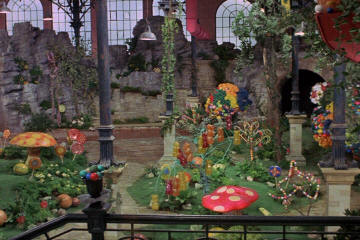
There was a time in my life when Willy Wonka’s three-course-dinner gum was just something of, well, pure imagination. Something that could only be found in the movies, specifically the 1970 classic that I grew up loving. But apparently now, the gum actually exists!
Here’s scientist Dave Hart of the Institute for Food Research:
“Wonka’s fantasy concoction has been nothing but a dream for millions of kids across the world. But science and technology is changing the future of food, and these nanoparticles may hold the answer to creating a three course gourmet gum. Tiny nanostructures within the gum would contain each of the different flavours. These would be broken up and released upon contact with saliva or after a certain amount of chewing – providing a sequential taste explosion as you chew harder.”
Be honest, did anyone ever think this was possible? I’ve always wanted Willy Wonka’s chocolate factory to be true, and now I’m astonished that it actually can be. Let’s move on to the candy room next, please.
Folks, we are moving closer and closer towards the best movies of the year – at least according to the Academy. How many Oscar nominees are we looking at in this bunch? How many box office smashes? I’m looking forward to a healthy helping of turkey and movies this month.
November 5
The highlight of the week for me has to be “127 Hours,” although I’m sure New York and Los Angeles are going to hog it for several weeks before it comes to Houston. Turning such a gut-wrenching story into a life-affirming movie is something I’m really excited to see. (Check out more of my thoughts in the “Oscar Moment” I wrote on it.)
“Megamind” seems to be a little bit of “The Incredibles,” a little bit of “Shrek,” and a little bit of every Will Ferrell movie. The combination should be fun – keyword should. This is no certain bet.
“For Colored Girls” looks intense and depressing. I do have to ask though – does anyone know what the plot is going to be about just from the trailer? It’s basically like a montage of angry African-American actresses looking to put on a show for the golden Oscar.
As for other movies on the indie circuit, if “Client 9” looks so interesting to you, just pay the $10 to watch it during October on iTunes. A story about Eliot Spitzer’s prostitution ring is certainly a story that many don’t want to hear, but how much of it we really want to spend hours of our time hearing is debatable. I’ll talk more about “Fair Game” in an Oscar Moment next week, but I think it looks like an intriguing contemporary thriller. I just hope it doesn’t become some blatant political manifesto.
November 12
I liked “Skyline” better when I saw it as a little movie called “Independence Day.” Carbon copy much? On the same note, I liked “Unstoppable” better when it was called “The Taking of Pelham 123.” Denzel Washington even stars in them both.
To save the weekend, there’s Rachel McAdams in “Morning Glory!” As if she’s not enough, Harrison Ford and Diane Keaton are on board for this drama-comedy mix that doesn’t seem to favor any genre over the other. What a great surprise awaits us!
November 19
HARRY. FREAKING. POTTER. That’s really all.
“The Next Three Days” brings us Russell Crowe far removed from his Oscar days, here as a man trying to organize a prison break for his wife. Even with Paul Haggis (Oscar-winning screenwriter of “Crash”) onboard, I still can’t really get behind this.
Again, I hate to delay my thoughts, but more will be coming on “Made in Dagenham” in an Oscar Moment. I think it looks like a fantastic comedy, and I love Sally Hawkins.
November 24/26
The only movie not getting a head start on Thanksgiving weekend is “The King’s Speech,” so expect the Oscar buzz to cue up in a big way around this weekend.
As for those movies opening on Wednesday, there’s quite an interesting array of releases. We have Christina Aguilera and her crazy vibrato in “Burlesque.” There’s also the dubious “Faster” starring Dwayne Johnson … er, The Rock. Apparently the remake of “Red Dawn” is supposed to open too, but given MGM’s financial troubles, I’m hearing that’s not going to happen.
There are two nice options this holiday weekend, one for families and one for adults. “Tangled” comes from the Disney animators who can’t cut it at Pixar, and the company has been furiously selling it to boys after the gender deserted “The Princess and the Frog” based on its name. Notice that the movie is not called “Rapunzel” in an attempt to make it seem less girly. Nonetheless, I can almost guarantee you that once the turkey has settled, my family will be headed to this. (Side note: WHERE ARE THE CHRISTMAS MOVIES THIS YEAR??)
And another semi-cop out to save commentary for an Oscar Moment, but “Love and Other Drugs” looks to be the weekend’s adult hit. Starring Jake Gyllenhaal and Anne Hathaway, the story of one of the earliest Viagra salesman seems like a well-acted, steamy comedic outing. I’m in, although this could go wrong.
So, what are YOU looking forward to in November? Looking like a pretty thin slate, but not a shabby one.
The score now stands at: moviegoers – 1, 3D – still too many conversions.
On Friday, Warner Bros. announced that they would abandon plans to release “Harry Potter and the Deathly Hallows, Part 1” in 3D because the conversion was not satisfactory. All I can say is where was this logic when “Clash of the Titans” was being converted? Here is the studio’s exact statement:
“Despite everyone’s best efforts, we were unable to convert the film in its entirety and meet the highest standards of quality. We do not want to disappoint fans who have long-anticipated the conclusion of this extraordinary journey.”
There aren’t very many times that a studio makes me feel like I, the moviegoer, matter that much. But with this kind of news, I definitely feel important. Along with many other dedicated fans, I have protested being ripped off by these hasty conversions for four unwarranted dollars. However, by acknowledging that a bad conversion isn’t worth the alienation of fans, I certainly feel like I count for something.
All those complaining 3D factoids really weren’t for nothing then, I guess.
UPDATE 10/11:/Film has the whole story. Check it out.
Has Facebook made us more connected to our friends? Or does hopelessly staring at their pictures, their moments, their lives only increase our feeling of isolation? Such has been the question for the past five years as the Silicon Valley start-up has all but taken over the world. We have been forced to ponder how much we want people to know about who we are, using our profile pages as a façade to cover the person hiding deep inside. We can sculpt social perfection on the site, and perhaps that is why we pour so much time into it.
That’s the story of us in the Facebook age. However, anyone not willing to closely scrutinize “The Social Network” might have the mistaken notion that the movie is only about the founders of the site. While Aaron Sorkin’s script concerns itself entirely with the Facebook’s early years, the perspective is not limited merely to those intimately involved in creating the predominant social networking site of our time.
If Sorkin and director David Fincher had been interested in doing that, they would have made a documentary on the birth of Facebook. Instead, their fictionalized account is meant to challenge our conceptions of communication and friendship in the digital era, as well as the changing nature of innovation. As the face of human interaction becomes increasingly digital, this commentary will be an important work to consult. “The Social Network” could very well be the movie that future generations will watch to get an idea of the millenials (or whatever history will call us). The movie now puts the pressure on us to decide how to interpret its message: do we go polish our Facebook profiles or become disillusioned with the site?
Since creator Mark Zuckerberg refused to participate with the production, Sorkin and Fincher present him as they see him: a visionary with his fair share of vices who winds being torn asunder by two people with different ideas for the future of his creation. Jesse Eisenberg hardly makes him sympathetic, but the ultimate interpretation of Zuckerberg is left to the viewer. Is he a hero, a villain, or an antihero? Whatever mold he fits, it cannot be denied that he is a figure of huge importance to the digital age. Take his social idiosyncrasies out of the picture, and his journey is not too different than our journey with Facebook.
I was wondering how long it would take Hollywood to discover the GOLDMINE that is the 1900 Galveston hurricane. It can function as both a period piece and a disaster movie! There would be beautiful sets and homes, and then the hurricane would come and the visual effects would give us the joy of watching them all turn into piles of wood. (Not to mention that Houston became Texas’ big city as a result of the hurricane. Had Galveston remained intact, it would have become the commercial power of the state.)
Although I don’t live in Galveston, per se, I’m definitely excited to watch it get destroyed. I’m definitely a child of the disaster movie generation since there is this latent desire in my soul to watch my hometown of Houston to get pummeled in true cinematic fashion. Is that natural? Probably not.
Anybody else want to see their hometown get destroyed?
There are many categories on my Oscar ballot that I always call a toss-up, such as the short films. However, one such category regrettably includes the Best Documentary Feature, which I have, in the past, had little interest in. These movies tackle important current events or shine new perspectives on old ones, and as I’ve become more educated, these have become more intriguing to me.
So in 2010, I’ve vowed to take an active interest in handicapping the Best Documentary Feature race, and it starts today with this Oscar Moment. First on tap is Charles Ferguson’s “Inside Job,” the documentary on the 2008 financial collapse that opens today in New York and Los Angeles.
The documentary first made a blip on my radar when it premiered at Cannes back in May. There it was the best reviewed movie of the festival, receiving nothing but the highest of praise from all angles. According to IndieWIRE, “Inside Job” was the only movie at Cannes to score an A average. Sony Pictures Classics picked it up there in France and played it at the Toronto and Telluride Film Festivals last month and the New York Film Festival last week.
The movie makes the argument that Wall Street has been heading for collapse ever since the 1980s when institutions were allowed to trade on their own behalf. The idea that banks and firms are betting against the customers is frightening, and the marketing campaign behind the movie seeks to make it look like an “economic horror movie.” It’s an interesting notion, and given some of the movie’s revelations, Sony Pictures Classics may be on to something.
The movie is more than just Ferguson’s hypotheses based on CNBC reports; he managed to get some high-profile figures on camera. While there’s no Alan Greenspan or Ben Bernanke, he did manage to land former New York Governor Eliot Spitzer and a high-end Wall Street prostitute. These interviews make for an interesting aspect, according to Kris Tapley of In Contention:
With the brave subjects at apparent fault who somehow thought it was a good idea to go before Ferguson’s lens, the filmmaker takes on the role of interrogator, holding fast as they squirm and never allowing retreat (to the point that one subject, clearly flustered, asks that the camera be turned off for a moment). The thickness of the material and the dizzying nature of the underhanded tactics held up for examination pretty much becomes the point as the film moves on.
The movie is narrated by all-American boy Matt Damon, but it seems to me like Ferguson is the big character in the movie. He has a stance, and he’s not afraid to put himself out there to make it known. This isn’t just the facts; there is a slant. The politics of “Inside Job” line up nicely with Academy politics, so the movie’s opinion certainly won’t work against it.
The real question is if “Inside Job” will align with the Academy’s flavor of the month in the documentary category. Last year’s winner, “The Cove,” dealt with a very strong ethical cause that had not been anywhere in the news. Two years ago, “Man on Wire” told the story of Philipe Petit’s 1973 walk between the World Trade Center towers. Three years ago, Ferguson’s own Iraq documentary “No End in Sight” lost to “Taxi to the Dark Side,” which took a look at American policy on torture in Iraq. Four years ago, winner “An Inconvenient Truth” made global warming an issue. Five years ago, “March of the Penguin” charmed everyone in America.
Political hot-button issues may have a place on Fox News and CNN, but the Academy doesn’t always welcome them as we can see by their track record over the last five years. With the economy being all over the news, do we need it again at the Oscars?
BEST BETS FOR NOMINATIONS: Best Documentary Feature
I’m entering my last week of being 17, and I’ve certainly enjoyed seeing R-rated movies hassle-free. Surprisingly, it hasn’t even entered my mind that I could go see and an NC-17 movie if I so desired. In fact, I probably would have gone through my entire seventeenth year without thinking about it had it not been for Time reminding me that NC-17 turned 20 this week. Happy birthday!
The rating is now a kiss of death for business, and a step forward in censorship became a step backwards in effectiveness. Here’s an excerpt from the article on the meaning of NC-17:
On a teenager’s life timeline, the 17th birthday is pointlessly wedged between sweet 16th and legalizing 18th celebrations. While it affords no adolescent soirees or lottery tickets, the middle milestone does impact Friday nights at the movies. Twenty years ago on Oct. 5, “Henry & June” hit theaters as the first film to hold an NC-17 rating. Unlike an R-rated flick that would force a parent to be your date, there is no wiggle room with these titles — moviegoers under age 17 are not permitted in the audience. But how come this particular Motion Picture Association of America (MPAA) rating is so young? And why is it not commonplace to hear that baritone “rated NC-17” voice bookend movie trailers at the theater or on television?
What better way to celebrate an anniversary than giving a totally unnecessary NC-17 rating? “Blue Valentine” got slapped with a harsh NC-17 rating today, which is completely ludicrous according to The Los Angeles Times.
Derek Cianfrance’s movie shows plenty of harrowing moments of a couple arguing and brutalizing each each other psychologically. It’s not easy to watch, but it’s hardly graphic or hardcore in any conventional sense of the term; it’s emotional brutality and explictness, nothing more. There was no scene we could find in the film’s extended version that would merit something stronger than an R.
And certainly if the movie was cut down from its earlier versions it wouldn’t include more offending material. (There’s also an irony in that the company was shortening the movie to make it more commercial, but then got slapped with an NC-17 anyway.)
I don’t really even see the need for the rating anymore with the ease of piracy and the ease of sneaking into a movie. I am NOT advocating these measures by any means, but it is a harsh reality that the people rating movies need to acknowledge. If a robber wants to break into a house, an alarm system really won’t deter him; the same goes for moviegoers. If someone wants to see a movie, they will find a way to see it.
The R rating carries with it the assumption that moviegoers under 17 can’t buy their own ticket; someone has to buy it for them. By barring people from certain movies, the MPAA either takes over the role of the parent and claims they know best OR they acknowledge that the R rating is too weak. Why not strengthen the protection around R-rated movies as an alternative? Crack down on lazy theaters that don’t enforce R ratings tough enough, and that should keep the people who don’t have permission to see R-rated movies out of them.
Sigh. Things won’t change, though. You can read my dissertation … em, eighth grade research paper … on how flawed the MPAA is if you so desire.
This week’s “F.I.L.M.” is Steve McQueen’s “Hunger,” a short volume of harrowing power. The movie follows the Irish hunger strikers in 1981 who essentially martyred themselves after Britain refuses to recognize their rights while in prison. The focus is specifically on Bobby Sands (Michael Fassbender), the leader of these strikers who ultimately died protesting for what he believed in.
“Hunger” is an incredibly striking visual movie, and McQueen goes into great depths to acquaint us with the conditions in the prison. There is very little dialogue save a 23-minute conversation between Sands and the prison’s priest trying to talk him out of the protest, 17 minutes of which come from a single unbroken shot. For those wondering, it is the longest shot in cinematic history.
Beyond the film’s notorious unbroken shot, there are plenty of haunting images that McQueen fills out heads with, particularly from the “no wash” protest that precedes the hunger strike. We see the beatings and the tortures of naked prisoners in all their graphic form, and we watch in horror as the bruises appear on their skin at the hands of their captors. We see the walls covered in excrement and the halls flooded with urine. Believe me, fewer movies make you want to follow the law more than this one.
On the other hand, Fassbender’s Bobby Sands makes us question how far we are willing to stick with our beliefs. He fights for equity from prison all the way to the grave, and while there were less drastic measures with which to make his point, his message gets across loud and clear. Fassbender is as committed to the role as Sands is committed to the cause. He goes to the physical and emotional limits of the character, and the performance is incredibly raw and forceful. Fassbender will go places, mark my words. Watch “Hunger” and say you knew it before he goes big.
Hooray for memes! It’s been a while since I’ve been tagged in one of these … good to be back on the circuit! Thanks to Sebastian for tagging me. Here’s the pitch:
The idea is that you list off the first 15 directors that come to your head that have shaped the way you look at movies. You know, the ones that will always stick with you. Don’t take too long to think about it. Just churn em’ out.
Here are my 15:
Woody Allen
Judd Apatow
Darren Aronofsky
Alfonso Cuarón
Clint Eastwood
David Fincher
Sam Mendes
Fernando Meirelles
Christopher Nolan
Sean Penn
Roman Polanski
Jason Reitman
Martin Scorsese
Steven Spielberg (no, it isn’t cliched)
Quentin Tarantino
In case anyone was wondering, I got to about 10 and then had a major pause.
I’m in love with Natalie Portman and I don’t care who knows it!
She’s seriously one of the most awesome people working in Hollywood. She’s great at being funny and at being serious, she seems incredibly down-to-earth, and she has her act together.
Add consultant to that list of things she does well. According to Aaron Sorkin, “Natalie Portman got in touch with me when she heard that I was doing this to say, ‘Listen…come over for dinner and I’ll tell you some stories,’ I would’ve come over for dinner under any circumstances. But that was really helpful.” Since she was at Harvard when Facebook was founded, her insights were very valuable. I’m not sure if she led Sorkin to the very dark, gloomy feeling that the school had, though.
What was her thanks? Getting mentioned cleverly in one of the movie’s lines. I totally caught it, no big deal. For those of you who didn’t, here’s the quote.
“[Zuckerberg] is the biggest thing on a campus that included nineteen Nobel Laureates, fifteen Pulitzer Prize winners, two future Olympians, and a movie star.”
“Who’s the movie star?”
So thanks, Natalie. You rock. I rarely pick up on little easter eggs (and for another one, click here) like that, but I did thanks to you. Anybody else catch this? I felt pretty proud of myself since the only easter eggs I ever catch are the really obvious self-referential ones in Pixar movies.
There was once a time when a Clint Eastwood movie being released meant instant Oscar attention and presumed to have nearly automatic entry into the Best Picture category. Wait, that was just in 2008. After picking up his second Best Picture/Best Director combo package for “Million Dollar Baby” in 2004 and nominations for “Letters from Iwo Jima” in 2006, the Academy has been cold as ice to the 80-year-old legendary filmmaker.
Is it a sort of backlash to Eastwood? Have they simply had enough of him? Or have his last three movies just really not been that good?
I personally don’t think he will ever win again, simply because twice is nice – and enough. However, he can still have some horses in the race; they just aren’t in it for the win. If Clint Eastwood directs one of the ten best movies of the year, they can’t be denied a spot simply by virtue of being directed by Eastwood.
So where does that put us with “Hereafter?” We’ve hit the pedigree, which is kind of a toss-up as to whether it will hurt or help come awards season. As of now, all we have to work with is critical reaction and looking at how the Academy has reacted historically to similar movies.
Eastwood’s latest directorial venture debuted last month at the Toronto Film Festival to a very polarized reaction. Some critics seemed to really like it. Roger Ebert went to bat in a big way for the movie:
“Clint Eastwood’s ‘Hereafter’ considers the possibility of an afterlife with tenderness, beauty and a gentle tact. I was surprised how enthralling I found it. I don’t believe in woo-woo, but there’s no woo-woo anywhere to be seen. It doesn’t even properly suppose an afterlife, but only the possibility of consciousness after apparent death … it is made with the reserve, the reluctance to take obvious emotional shortcuts, that is a hallmark of Eastwood as a filmmaker. This is the film of a man at peace. He has nothing to prove except his care for the story.”
Other critics, however, were not impressed. Many called it the worst movie Eastwood has ever directed. Some used words like uneven” while others just went straight to “trash.” But according to Kris Tapley of In Contention, this may not be entirely bad.
“… even among the appreciators, Peter Morgan’s script may come together in a rather unsatisfying manner in the third act. But words like “facile,” “cliche” and “manipulative” describe many, many former Oscar nominees and winners, so we should keep an eye on it. To be perfectly honest, it sounds like a contender now more than ever.”
As I have said many times before, critical tastes do not determine Best Picture. They didn’t love “The Blind Side,” and it still got in. They didn’t lavish praise on “The Reader,” and it still got in. While critics can shape Academy taste, they do not define it. The Academy is not a group of critics; it is a group of filmmakers. The fact that it has gotten a polarizing reaction thus far is not necessarily bad. Several of last year’s Best Picture nominees had their fair share of detractors, such as “Avatar,” “Inglourious Basterds,” and even “Precious.”
And while on the subject of Academy tastes, speaking to the dead is a concept that they have readily embraced in the past. Both “Ghost” and “The Sixth Sense” received Best Picture nominations. But according to Dave Karger of Entertainment Weekly, “Hereafter” reminds him more of “Babel” because of the movie’s three inter-connecting storylines. “Babel” received nominations for Best Picture, Director, and Screenplay in 2006. I could see Eastwood’s latest taking a similar trajectory. I’m not expecting it to win (Eastwood has already won here twice), but it would be a nice inclusion on the shortlist.
Beyond the movie itself, I think Matt Damon can also be seriously considered in the Best Actor category. He received his first acting nomination last year for “Invictus,” a collaboration with Eastwood, and he also has a nice Oscar sitting on his mantle for writing “Good Will Hunting.” But with Damon also being an apparent scene-stealer in the much more Academy friendly “True Grit,” Warner Bros. may choose to campaign him harder there.
He stands a better chance in Best Supporting Actor, which has yet to be formed, than in Best Actor, which many people have narrowed down to Firth, Franco, Eisenberg, Duvall, and Bridges with Wahlberg and Gosling as strong outside shots.
There’s also a chance that Peter Morgan’s original script could make it in the field since he has been nominated before. I don’t think much else from the movie has much of a shot, even the visual effects which make a tsunami look pretty good.
To close, I want to quote the wonderful review by Sasha Stone of Awards Daily. While she was not a huge fan of the movie, she still states that it is one of Eastwood’s best and puts it all into perspective quite nicely.
“In his later years, he is ruminating on bigger questions, like what it means to be alive, to be killed, to be loved – to die, and to mourn … ‘Hereafter’ fits in to a triptych of films that meditate on childhood and loss: Mystic River, Changeling and now, ‘Hereafter’ … it isn’t the flavor of the month, but it is quintessentially Eastwood … at 80 years old, Eastwood remains a visionary.”
Since the idea of death is something especially pertinent to someone at the end of his life like Eastwood is, perhaps the emotional impact on the voters will prompt them to show some gratitude to a man who has been an outstanding contributor to the cinematic way.
BEST BETS FOR NOMINATIONS: Best Picture
OTHER POSSIBLE NOMINATIONS: Best Director, Best Actor, Best Original Screenplay
So apparently James Cameron wants our money again for “Avatar.” As if he didn’t make enough on the rerelease in theaters, the first DVD release, and the record-shattering first release. Now, there is “Avatar: Extended Collector’s Edition.” This time, Cameron is so nice he’s even going to include bonus features!
1. Alternate audio track in which the humans speak Latin and the Na’vi speak Klingon
2. Deleted cameo by Steve Martin as shorts-wearing waiter who serves wine on Jake and Neytiri’s first date
3. “Behind The Making Of 17 Featurettes” featurette
4. Locker-sized Jake Sully poster with “AVATAR” spelled out in pink bubble letters
5. Bonus video: “How To Make Your Own Motion-Capture Feature Film Using A Disposable Camera, A Utility Knife, A Car Battery And 400 Ping-Pong Balls”
6. Blooper reel, including embarrassing love-scene moment where hair braid is accidentally inserted into ear
7. Secrets Of The Flying Horsey Thing
8. Feature-length commentary by James Cameron comparing every scene to similar but slightly inferior sequence in The Hurt Locker.
9. Alternate audio track in which every long and thoughtful pause is accompanied by “The Syncopated Clock.”
10. Teaser trailer for Avatar 2: The Day The Giant Magic Trees Turned.
While all those things are worthy of a good laugh and worthy of my money, I don’t plan on buying “Avatar” on DVD until it comes with a program to turn yourself into a Na’Vi with the full body suit and I can add myself into the background of every scene. The movie will be on HBO in the next month or so, and the special features will pop up on YouTube soon enough.
A month ago, “Never Let Me Go” looked like the perfect awards candidate. I even went down a bulleted list of all the things it had in its favor in my Oscar Moment. To summarize …
Based on a best-selling novel
British
Oscar-friendly British actors
“Love, loss, hidden truths”
You all bought it just like me. The vote was 80% in favor of the movie’s Oscar chances and 20% against it. But with a mid-60s average on Rotten Tomatoes, pretty middling box office numbers, and no critical champions, this looks like a lost cause. Maybe I shouldn’t have bought the book…
Today’s factoid was inspired by Simon/Ripley of Four of Them. I read her post “You want multitasking?” this weekend which consisted of only this brief paragraph:
I’ve somehow managed to alternate between The Wayward Cloud, Boxing Helena, He Died With a Falafel in His Hand, and Treeless Mountain since last night. Granted, I haven’t finished any of them…
I find myself doing the same thing all the time, and I can’t stand it. I find myself starting a ton of movies, getting distracted, and turning them off. Usually the distraction is me falling asleep…
Right now, I am 15 minutes into “Solitary Man,” 10 minutes into “Pollock,” 40 minutes into “Control,” 7 minutes into “Down to the Bone,” 2 minutes into “The Girl with the Dragon Tattoo,” and I’m probably forgetting countless others. This fragmented moviewatching style totally doesn’t work for me, yet I’m having to resort to it more and more because of my demanding schedule.
Anybody else have this dismembered moviewatching style as well?
First it was “Up in the Air;” then it was “Inception;” now it’s “The Social Network.” Some movies are just that good that they become a regular Random Factoid topic. So here we go…
I read a fascinating article in The New York Times on the generational divide that the movie has exposed, particularly around the figure of Mark Zuckerberg. Here is Scott Rudin, the movie’s producer, on the differing viewpoints from generations:
“When you talk to people afterward, it was as if they were seeing two different films. The older audiences see Zuckerberg as a tragic figure who comes out of the film with less of himself than when he went in, while young people see him as completely enhanced, a rock star, who did what he needed to do to protect the thing that he had created.”
I don’t want to ruin what’s coming my review of the movie, but I definitely leaned more towards how the older audiences felt. Does this mean I’m an old person trapped inside a teenager’s body? Am I somehow abnormal because my views don’t fit the rest of my generation? Am I … more mature? More cynical?
Interestingly enough, this isn’t the first polarizing movie on the age spectrum this year. I’ve had a post from The Los Angeles Times bookmarked since August on the reaction from different generations. Patrick Goldstein observed this:
“The other day I was talking to an old Hollywood hand who was astounded by the runaway success of “Inception.” It turned out that he’d seen the film on its opening weekend in a private screening room with a number of industry elder statesmen, including at least two former studio chiefs and a couple of their young offspring. After the movie was over, the industry elders were shaking their heads in disbelief, appalled by the film’s lack of clarity, having been absolutely unable to follow the film’s often convoluted story.
But before anyone could register their complaints, one of the younger people on hand, flush with excitement, praised the film to the rooftops. To him, it was such a thrill ride that if the projectionist could show the film again, he’d sit through it again right away.”
I can’t even imagine there being one day where I look at movies and wonder what the darned kids see in it. Why do our tastes have to evolve with age? I’m scared that if I side with the elder generation on “The Social Network,” I could become some kind of cranky geezer film snob when I get older.
 Say it ain’t so!
 The score now stands at: moviegoers – 1, 3D – still too many conversions.
 It’s about time.
 There are many categories on my Oscar ballot that I always call a toss-up, such as the short films. However, one such category regrettably includes the Best Documentary Feature, which I have, in the past, had little interest in. These movies tackle important current events or shine new perspectives on old ones, and as I’ve become more educated, these have become more intriguing to me.
 The movie makes the argument that Wall Street has been heading for collapse ever since the 1980s when institutions were allowed to trade on their own behalf. The idea that banks and firms are betting against the customers is frightening, and the marketing campaign behind the movie seeks to make it look like an “economic horror movie.” It’s an interesting notion, and given some of the movie’s revelations, Sony Pictures Classics may be on to something.
 The real question is if “Inside Job” will align with the Academy’s flavor of the month in the documentary category. Last year’s winner, “The Cove,” dealt with a very strong ethical cause that had not been anywhere in the news. Two years ago, “Man on Wire” told the story of Philipe Petit’s 1973 walk between the World Trade Center towers. Three years ago, Ferguson’s own Iraq documentary “No End in Sight” lost to “Taxi to the Dark Side,” which took a look at American policy on torture in Iraq. Four years ago, winner “An Inconvenient Truth” made global warming an issue. Five years ago, “March of the Penguin” charmed everyone in America.
 This week’s “F.I.L.M.” is Steve McQueen’s “Hunger,” a short volume of harrowing power. The movie follows the Irish hunger strikers in 1981 who essentially martyred themselves after Britain refuses to recognize their rights while in prison. The focus is specifically on Bobby Sands (Michael Fassbender), the leader of these strikers who ultimately died protesting for what he believed in.
 I’m in love with Natalie Portman and I don’t care who knows it!
 There was once a time when a Clint Eastwood movie being released meant instant Oscar attention and presumed to have nearly automatic entry into the Best Picture category. Wait, that was just in 2008. After picking up his second Best Picture/Best Director combo package for “Million Dollar Baby” in 2004 and nominations for “Letters from Iwo Jima” in 2006, the Academy has been cold as ice to the 80-year-old legendary filmmaker.
 Eastwood’s latest directorial venture debuted last month at the Toronto Film Festival to a very polarized reaction. Some critics seemed to really like it.
  Beyond the movie itself, I think Matt Damon can also be seriously considered in the Best Actor category. He received his first acting nomination last year for “Invictus,” a collaboration with Eastwood, and he also has a nice Oscar sitting on his mantle for writing “Good Will Hunting.” But with Damon also being an apparent scene-stealer in the much more Academy friendly “True Grit,” Warner Bros. may choose to campaign him harder there.
 So apparently James Cameron wants our money again for “Avatar.” As if he didn’t make enough on the rerelease in theaters, the first DVD release, and the record-shattering first release. Now, there is “Avatar: Extended Collector’s Edition.” This time, Cameron is so nice he’s even going to include bonus features!
 Oh, how time can change things.
 First it was “Up in the Air;” then it was “Inception;” now it’s “The Social Network.” Some movies are just that good that they become a regular Random Factoid topic. So here we go…

 Marshall and the Movies
Recent Comments