A real review of David Fincher’s work should begin with “Se7en,” the first movie he takes full credit for. It was a financial success in 1995 and has since become an adored movie by fans on video. The movie currently sits at #26 on IMDb’s Top 250 movies as voted by users, and in today’s installment of Fincherfest, I will attempt to explain what has made it so endearing over the past 15 years.
I’m a big fan of “Seven,” but I hate to say that I don’t think it’s quite as good as some people think it is. According to Lisa Schwarzbaum, overrated is a big critical no-no word; however, since this is more a look in retrospect than a review, I don’t feel quite as bad using it.
Fincher does an excellent job directing a very cerebral world of horror, and as his first real directorial effort, it’s quite impressive. Yet overall, I wasn’t quite as affected by it as I felt I should have been. When it comes to serial killer movies, I much prefer “The Silence of the Lambs” and “No Country for Old Men.”
Yet I acknowledge that “Seven” has a very different kind of horror. We aren’t meant to be freaked out by the murderer John Doe (Kevin Spacey). We never see him committing any crimes, nor does he ever give us any indication that he might flip and kill another person. He’s just like anyone you could round up off the streets, and that makes him all the more frightening. John Doe is like Heath Ledger’s The Joker without a makeup and without any sense of humor. The tacit implication is that all of us have the capability to be John Doe, something quite scary to suggest and not the kind of message you want to walk away from a movie having learned. We never see the results of the killings, inspiring the audience to imagine the murder for themselves. Anyone who can do so has the inherent ability to be Doe.
Such a killer is the last person Detective Somerset (Morgan Freeman, pre-God) wants to deal with in his waning hours on the job. He and his replacement, Detective Mills (Brad Pitt), are drawn into the world of John Doe, who commits murders related to the Seven Deadly Sins. Catching him requires intellect, and they delve into the classic work of Dante, Thomas Aquinas, and others to figure out his modus operandi. The dialectic struggle between Somerset about to apathetically walk off the job and Mills eagerly awaiting his future is a fascinating backdrop to the rest of the brutal themes of the movie.
Apparently back in the ’90s, New Line Cinema advertised “Se7en” as a movie that you shouldn’t watch in the dark because that atmosphere would scare anyone to death. I did just that, and I found the darkness to be nothing more than a fitting complement to the universe Fincher crafts. It’s always muggy and rainy in the unidentified city where the murders take place, and the world view the movie espouses is bleaker than the weather. According to Somerset, the world is worth fighting for, but it’s hardly a fine place.
The more you think about it, the more you realize Fincher’s challenge to our assumptions of what is good and what is evil. The villain is defined … or is it? Such an idea is a little unsettling to audiences, but that hasn’t kept it from being very well received. Perhaps its forte isn’t in being a serial killer movie; the strength is in the social critique of the godlessness of society.
Lindsay Lohan is back in jail – wait, just kidding, she posted bail and has now been sprung from the slammer! The whole saga has gotten so out of hand, and I’ve quickly lost all respect for Lohan. She needs to serve her entire sentence; I don’t care if she is a celebrity, a criminal is still a criminal! She broke the law, and she ought to pay just like anyone else.
I don’t know why I feel so compelled to offer my thoughts on Lohan today. I guess I just care about people, not celebrities. It’s clear that she’s headed down the path to destruction, and buying her way out of prison and rehab isn’t going to help her at all.
I guess the overarching feeling that does tie this into the movies is that while I admire and love people who star in movies, I don’t think that by virtue of their work they are better people than us common folk. They deserve to spend as much time in jail for drunk driving as any movie blogger. We send politicians and executives to jail for extreme sentences; what makes movie stars more untouchable than them?
Kicking off Fincherfest here at “Marshall and the Movies” is the director’s first feature film, “Alien 3.” Released six years after James Cameron’s “Aliens” and thirteen after Ridley Scott’s “Alien,” it certainly had high expectations. After being mired in development hell, Fox managed to get the ball rolling and brought in Fincher fairly late in the game. The result was the beginning of the decay of the franchise.
I debated whether or not to include “Alien 3” in my purveying of David Fincher’s collective work. After all, he did disown the movie publicly thanks to Fox’s ceaseless creative interference. Fincher had nothing to do with the editing of the movie, which in itself took a year. According to IMDb, he was denied permission to shoot a scene with Sigourney Weaver in prison by the movie’s producers, so he stole her and shot it anyways. Even as of 2004, Fincher still wasn’t willing to make peace with the experience when Fox asked him to do a commentary for the DVD release of the movie.
After watching the movie, I get a sense of why he doesn’t want to be associated with it. “Alien 3” is a mixture of the action-adventure feel of “Aliens” with the horror atmosphere of “Alien.” The result is a jumbled mash-pot of little character, simply gliding on the success of its predecessors. It brings nothing new to the table, and watching this rip-off only makes you wonder why you aren’t watching one of the vastly superior installments that preceded it.
Sigourney Weaver’s ultra-feminist heroine Ripley just can’t catch a break here as she has to fight off the nefarious aliens for the third time (I hope she dreams well in cryo). Instead of having the crew of the Nostromo or the Marines, she has a crew of celibate space monks led by Charles S. Dutton who feel violated by the presence of woman in their ranks. Nevertheless, once an alien is found on board, they unite to trap it in the steaming hot pool of lead on board their ship.
The movie suffers from intense familiarity and oversimplification, even though the latter made Scott’s take on the franchise a classic. “Alien 3” was rewritten many times; one draft reported to be far superior to the one that was produced didn’t even have Ripley in it. But since she did make it, we can safely conclude that the movie was made simply to make more money off the franchise – and that’s all the more reason to avoid it.
I’m all busy applying to college now, and my future in a year has become one of the biggest things on my mind as of recent. But there was a time when the idea of going to college was as far away as getting married or having children. Now it’s almost here … and I can’t believe it.
As I said in Random Factoid #383, there are certain subjects that my knowledge of is based entirely on what I have learned from the movies. And when I posted that picture of “Legally Blonde” yesterday, I remembered the indelible impact that the movie had of my perceptions of college.
I got to see the movie when I was 10 years, a pretty rare occurrence for me. Most of the adult humor flew over my head, and my mom was abhorred when she found out what I had seen. But nevertheless, I had seen it and I absorbed some of it.
Mainly, I got the idea that picking a college meant picking a career. I didn’t understand that Reese Witherspoon’s Elle Woods was going to GRADUATE school to study law, not COLLEGE. So when people asked me if I was headed to Harvard (because I was quite precocious as a young child and not afraid of showing it), I told them no because “I didn’t want to be a lawyer.”
While now I know the difference, there was a large period of my life where my views of college were defined by what I learned from “Legally Blonde.” Thanks, Elle!
This week’s “F.I.L.M.” is “A Mighty Heart,” the movie that chronicles the 2002 search for kidnapped Wall Street Journal reporter Daniel Pearl in Pakistan. Running parallel to the hunt is the story of his pregnant wife, Mariane (Angelina Jolie), as she deals with his disappearance – and ultimately, his death.
(I think the story of Pearl’s captivity and beheading is well-known enough that I didn’t need to preface that with a spoiler alert, but if anyone thinks I’m ruining the surprise, let me know and I’ll take out that last part.)
On his last day on assignment on Pakistan, Daniel ventures into some sketchy areas to interview a very mysterious but powerful figure. When he doesn’t come home that night, Mariane instantly fears that his disappearance was a kidnapping. And as the days go by without word from him, the investigation takes on a graver importance. The Department of Justice takes over the search; the CIA releases a report denouncing allegations that Daniel was an agent for them; even Colin Powell acknowledges the situation.
While the hunt for the kidnappers is mostly gripping, it doesn’t feel like anything we haven’t seen before. “A Mighty Heart” works best when Angelina Jolie is on camera giving her tour-de-force performance as Mariane Pearl. Clearly people that dismiss her celebrity as due to her beauty clearly haven’t seen “A Mighty Heart” (or, for that matter, any of her Oscar-nominated and -winning roles).
Jolie has a pitch-perfect range and totally nails Pearl’s every move. While at the beginning she doesn’t show much emotion, we don’t feel distant at all. In fact, it only draws us in more. When we reach the tragic end, it’s absolutely heartbreaking to watch her let it all out. It’s Angelina’s movie, and she owns every moment of it with as much grace as she has on the red carpet.
I’ll close out this week chalked full of Oscar Moments with the movie that has been a favorite since it premiered at Cannes back in May, Mike Leigh’s “Another Year.” It received adoring review after adoring review, most speculating that it would win the prestigious Palme d’Or. And while it didn’t take home any hardware, it emerged as the movie with the most buzz from the festival.
This month, it played at Telluride and Toronto, not really gaining any more traction but rather cementing its status as a sure-fire critical favorite. So can all that awards season heat from May last all the way until February?
I’m not a big Mike Leigh fan, although I certainly have a lot of respect for the way he makes his movies. For those who may not be familiar with his filmmaking methods, allow me to explain. Here’s a critical perspective from the British Council:
Instead of writing a script, Leigh works from a basic premise, however vague it may be, that will be fleshed out through months of improvisation and rehearsal. This will involve an exploration of the actor’s own experiences and people they know, things which will then inform the characters they develop; Leigh’s work then, is devised, so much of the credit must be given to those he works with. Equally significant is the way Leigh controls story: ‘You have to be free as an actor from knowing what your character wouldn’t know.’ Yet while his performers are vital to the process, it is Leigh, who moulds and shapes the work, who provides the simple instructions which allow the narrative to develop. The material is continually reshaped until the very moment the cameras role. It is then that the work is in some way ‘fixed’. After that, there is little time for improvisation.
It’s a fascinating idea, although from my experience with Leigh’s work, I’m not sure how much it works for me. Nevertheless, the Academy loves his writing and direction. He has been nominated four times for Best Original Screenplay, most recently in 2008 for “Happy-Go-Lucky,” and twice for Best Director, most recently for 2004’s “Vera Drake.” As for the overall success of his movies, only one, 1996’s “Secrets & Lies,” was nominated for Best Picture.
While Leigh’s track record with the Academy is overall pretty spotty, it’s clear to see that they do really like him, especially as of late. I think the movie’s surest bet is in the Best Original Screenplay category, Leigh’s most common stomping grounds. Although Owen Gleiberman of Entertainment Weekly says of the script, “This time, Leigh doesn’t bother with the pretense of a story; like a more boisterous Eric Rohmer, he simply splits the movie into four seasonal chapters over the course of a year, thereby liberating it from the clank of narrative,” so we can’t be totally assured.
However, at 67, Leigh may be the beneficiary of “let’s-give-it-to-him-before-he-leaves-us” syndrome in the Best Director category. If he’s nominated, he’ll be a big threat because he’s been there twice before and many will feel that he finally deserves it. Plus, according to Kris Tapley of In Contention, “to say the least, it’s Leigh’s finest hour in years.”
I’d say given the critical fanfare, “Another Year” should easily slide into the Best Picture field of ten. The real challenge for the movie will be landing acting nominations. Given the film’s large ensemble, will anyone other than Lesley Manville have a shot at a nod? Here’s Gleiberman again, this time on the actress’ turn:
Lesley Manville, who plays Sheen and Broadbent’s most regular, and desperate, Saturday night dinner companion, a fragile, sozzled, enthusiastically needy secretary who has been coyly girlish, and drunk, for so long that she has no idea the loneliness she’s seeking to escape is of her own devising.
Manville has been hogging the spotlight, and when anyone talks of the ensemble, they single her out. She’s the movie’s best bet for an acting nomination, although category fraud may play a part. Most pundits consider her a leading actress, but Sony Pictures Classics may want to sneak her into the weaker Best Supporting Actress field.
The rest of the cast, save for prior winner Jim Broadbent, has so little name recognition that it’s going to be hard for any of them to sneak in. Ruth Sheen could have a shot at Best Supporting Actress, as could Broadbent in the Best Actor category. But for any of them to be legitimate contenders, I think they are going to need support from critics’ groups in December to thrust them into contention. No one really knew who Amy Ryan was in 2007, yet thanks to being named Best Supporting Actress by association after association, she wound up with an Oscar nomination.
If anyone thinks “The King’s Speech” is going to have a hard time keeping September buzz, I think “Another Year” may have it just as hard. How can it keep riding the wave of critical success into Oscar season? With a release of December 29, did Sony Pictures Classics wait until the last minute so the wave can die and begin anew?
BEST BETS FOR NOMINATIONS: Best Picture, Best Director, Best Actress (Manville), Best Original Screenplay
OTHER POTENTIAL NOMINATIONS: Best Actor (Broadbent), Best Supporting Actress (Sheen)
I do love musicals, and I sure have invested a lot of time into them over the past four years. My production of “Godspell” is in 10 days, and I’ll also delve into “Fiddler on the Roof” later this year.
But away from my school, there are some interesting developments on Broadway with new musicals. They are always looking for new source material, and the flavor of the moment is finding it in movies. It was announced today that “Newsies,” a movie I have only heard of once or twice, will be adapted into a Broadway musical. And in other news, “Catch Me If You Can” will apparently be making a similar transformation.
I’m in the camp that believes movies should stay on the screen. They aren’t meant to have their plots stretched to maintain interest over two and a half hours, and they aren’t meant to have spontaneous musical breaks. What ever happened to originality in writing musicals? We claim that movies are bad about recycling; look no further than Broadway for someone doing it worse. Name the last new musical based on an entirely original premise. I can’t.
Case in point – “Legally Blonde: The Musical.” It debuted to horrible reviews, got almost no Tony nominations, and is now destined to become an audition favorite for teenage girls with no idea of the classics that made the craft what it is.
Two years ago, Danny Boyle was atop the world, winning Best Director for “Slumdog Millionaire,” a movie that won eight Oscars, the second-biggest haul for any movie of the decade. And now, he may be poised to stand there again. His follow-up feature, “127 Hours,” is generating a whole lot of positive awards buzz.
But is it too soon? Two years is hardly any time to be back in the awards hunt. And usually, winners come back pretty under the radar. Boyle is back with all pistons firing.
Is it possible for a director to be back in the hunt for their follow-up movie to the one that won them Best Director? It has happened once in the past twenty years. Guess who did? James Cameron, although the nominations came 12 years apart for “Titanic” and “Avatar.”
The list of Best Director winners over the past two decades is hardly shabby (look for yourself if you don’t believe me), so we can reasonably assume that back-to-back nominations is something hard to come by. Danny Boyle is very well-respected and certainly very loved, but he doesn’t seem like quite enough of an Academy favorite to make him a sure bet to defy the odds. Before “Slumdog,” his movies were mostly cult favorites with niche audiences.
Then again, “127 Hours” isn’t your conventional movie. Its success will be mainly because of Boyle’s directorial skills as the movie requires a firm hand behind the camera. The movie tells the story of Aron Ralston (James Franco), a camper who winds up stuck in a canyon for over five days, ultimately leading to … well, you know. It gets rough, and Boyle said he wants the movie to be a challenge to moviegoers. The premise doesn’t seem very translatable to the big screen, and making it work is surely a directorial triumph.
The movie is also highly dependent on Franco’s performance, since he’s the only person we will get to watch for most of the movie. Early reviews from Telluride and Toronto say he pulls it off marvelously, and a Best Actor nomination seems all but inevitable. Franco nearly got one in 2008 for “Milk,” but he’s been doing quality work for quite some time now that a nomination seems like it’s a long time coming.
The movie also has hopes in technical categories as Boyle’s vibrant style often leads to flashy displays of editing, cinematography, and sound. Not to mention that the score is being done by AR Rahman, the Oscar-winning composer of “Slumdog Millionaire.” I’d sure love to hear some “Jai Ho” cranking from those canyons.
Writing might be a little bit more of a stretch as the movie may be thin on dialogue, but with Boyle penning the script with the Oscar-winning writer of “Slumdog Millionaire,” Simon Beaufouy, it could happen.
As for Best Picture, I’d say that “127 Hours” has a very good chance. I hate to say it’s sure because some people have called it “too hard to watch.” But others have called it “life reaffirming,” and it’s people like that who will drive the film down the path to glory.
BEST BETS FOR NOMINATIONS: Best Picture, Best Director, Best Actor, Best Cinematography, Best Film Editing
OTHER POSSIBLE NOMINATIONS: Best Adapted Screenplay, Best Sound Mixing, Best Sound Editing, Best Original Score
If I weren’t a) a student with a ton of homework and rehearsal or b) living in Houston, the fourth-biggest city in the nation which still can’t get any street cred for indie movies, I would so be hitting up this amazing opportunity to pay what I want for “Freakonomics.” According to Cinematical, it’s just as simple as this:
Most people who abstain from going to the movies seem to do so because of the price. Well, what if you could go see a film for one cent? Yes, one penny. That’s theminimum you have to pay for an advance screening of‘Freakonomics’this Wednesday (September 22, 2010). The maximum? $100. Which would you rather? Or might you want to give something in between? Maybe you feel obligated to pay what you’re usually charged for a movie?
All you have to do is fill out a quick, anonymous survey so economists can analyze data about what kind of person chooses what kind of cost for him or herself. The questions are mostly related to age, education level, income and how much you usually spend at the movies, if at all regular. Also, you have to be able to get to one of the participating Landmark Theaters in the ten select U.S. cities (the ten big ones).
The pay-what-you-want model has long been a staple of museums and has in recent times been used for digital music. But this might be the first major feature film to employ the concept, and it makes sense with a documentary about alternative economics. It also could hopefully — though doubtfully — influence how movies are priced in the future, if not theatrically than digitally.
Is anyone curious to hear what I would pay if I could have gone? Even if you aren’t, I’m still telling you here.
I would pay $6. As a student, cheap movies are something I actively seek, and I will seize the opportunity to see them when I can. I couldn’t honestly pay a penny because I would feel a certain sense of obligation to be somewhat charitable with my money since Magnolia Pictures was nice enough to provide the screening. However, that charity would not make me pay a normal ticket price or a larger sum.
I’m curious to see the results of this social experiment. How many people spent $100?
Have we found a Best Picture winner with Tom Hooper’s “The King’s Speech?”
According to pundits, we have a certain nominee here. It won the People’s Choice Award at the Toronto Film Festival, which coupled with the movie’s resounding critical reception could make it quite a force for Hollywood’s top prize. If it can enter mainstream consciousness, then it’s going to be pretty hard to beat.
I talked about how “Never Let Me Go” had the perfect Oscar formula three weeks ago, but things have changed now and this has the new best road to success. The Academy has largely begun to ally itself with British tastes, and all signs point to this being the choice movie from our English allies.
“The King’s Speech” follows King George VI (Colin Firth) as he leads his country into World War II. The royal family is always popular with voters; the past 15 years have seen Best Picture nominees “The Queen” and “Elizabeth,” and winner “Shakespeare in Love” with a cameo by Judi Dench as Queen Elizabeth I.
But there’s more to the movie than just the royal blood line. There’s also an underdog story as George has no confidence in his ability to lead, mainly because of his stuttering and stammering. The “speech” in the title does not refer to a long oration but rather George’s inability to be eloquent. He hires an Australian speech therapist (Geoffrey Rush) to help him with his issue, which becomes more and more pressing as Hitler becomes a bigger threat to the country by the minute. According to a blurb from Cinematical, the movie is “not too heavy, it’s got its funny/kooky moments, and it ends on an inspirational note.”
After the win at Toronto, it’s riding a sort of front-runner status (although “The Social Network” managed to steal some thunder after many rave reviews popped up). The People’s Choice Award certainly correlates more to the Oscars than the Venetian Golden Lion. They have picked three Best Picture winners – “Slumdog Millionaire,” “American Beauty,” and “Chariots of Fire” – and plenty more nominees including “Precious,” “Life is Beautiful,” and “Shine.” The award hasn’t been entirely effective in predicting Academy tastes, but it’s been very close in recent years. “The King’s Speech” has to be considered a big contender, though, by virtue of winning.
On a different note, Kris Tapley of In Contention offered some wise words as to why being the movie on top at the moment may not be so good:
After coming out strong with the of-the-moment ‘Up in the Air’ last season, taking the same Telluride-Toronto crowd-pleasing path, their film slowly boiled down to an also ran and even came up short in the one category it seemed assured going into the Academy Awards … It’s easy to peak early in an Oscar season. It takes tactical endurance to really come out on the other side with something to show for yourself and ‘The King’s Speech’ is burning fuel fast and early.
So there’s a chance that “The King’s Speech” has had its moment in the sun. But there’s certainly nothing wrong with being at the top of the list for the moment, and many have speculated that Best Picture may come down to “old school Academy play versus a Gen-Y instant classic.” I’d say given the fact that it’s a light drama with an acceptable amount of bait, it’s a pretty good bet for Best Picture and thus Best Director.
(No matter what happens, it’s a British period piece, and that guarantees at least Best Costume Design and Best Production Design at the very least.)
The actors are also going to be a big selling point for the movie. Firth is coming straight off his first Oscar nomination last year for “A Single Man,” and people are beginning to take him very seriously as an actor. As I said last year, “he is a likable actor, never demanding much attention, and making missteps in only the quietest of fashions. Firth is the kind of actor the Academy would want to give the golden statue to, and he’s at a prime point in his career to get it.
Geoffrey Rush could easily find himself in the Best Supporting Actor race. With no clear front-runner, he could easily charge to the front despite having won before back in 1996. The fact that he’s already been awarded an Oscar should only be a factor when choosing the winner; the effect should be minimal on his nomination. And Helena Bonham Carter, as George’s wife, should be able to squeeze out a nomination as well. While she’s taken on some kooky roles since her last nomination in 1997 for “The Wings of the Dove,” a return to Academy fare could find her back in their favor once more.
It’s easy to call “The King’s Speech” a leader now as it rides high on the buzz of film festival success. But let’s not forget that it has to ride out a full-scale release and the precursor season before it can climb the stage at the Kodak Theater in February.
BEST BETS FOR NOMINATIONS: Best Picture, Best Director, Best Actor, Best Supporting Actor, Best Supporting Actress, Best Original Screenplay, Best Costume Design, Best Production Design
OTHER POSSIBLE NOMINATIONS: Best Cinematography, Best Film Editing
Is this the end for DVDs? I know I’ve been predicting their demise for quite some time now, but 2010 seems a little soon. It’s been a hot topic in factoids recently, appearing in #404, #414, and #416.
Listen to this disturbing report from Best Buy via Cinematical:
Even as the popularity of digital media continues to rise and the Blockbusters of the world struggle to hang on, the demise of the DVD always seemed to be in the distant future. Well, it looks like the format may pass away sooner rather than later because a major DVD retailer is opting to axe the amount of space allocated to DVDs this holiday season. According to Daily Finance, Best Buy is shifting things around to make more room for video games and consumer electronics, namely netbooks and tablet PCs.
Best Buy Chief Executive Brian Dunn explained, “We’ll have another store reset before the holidays, which will include an increase in the space for higher-growth and, in the aggregate, higher-margin categories, like Best Buy Mobile, e-readers and gaming, with a heavy emphasis on new gaming platforms and pre-owned game titles.” He added, “This will be enabled by our reorganization of the DVD and CD sections.”
All I can say is that I’m not ready to go entirely digital for movies yet. Transferring doesn’t work as easily, and there’s nothing simpler than bringing a disc over to someone’s house and plopping it in a player. So has Best Buy jumped the gun on mourning DVDs? Or is this the beginning of the end?
The big winner at Venice was “Somewhere,” which won the coveted Golden Lion there. According to jury president Quentin Tarantino, the movie ” . But does that mean anything?
The Golden Lion is hardly an indicator of Oscar success; the only winner to receive a Best Picture nomination in the prize’s history is “Brokeback Mountain” in 2005. Other movies have received nominations, such as 2008 champion “The Wrestler” and 2004 winner “Vera Drake.”
In addition, the win for “Somewhere” was marred by accusations of favoritism and bias. Here’s a report from the Los Angeles Times on the allegations:
..the Italian press has been in an uproar after it learned that some of the Venice Film Festival’s biggest prizes went to filmmakers with longstanding ties to jury president Quentin Tarantino. Sofia Coppola, who is close with Tarantino (the Reporter piece describes her as his former girlfriend), won the Golden Lion, the festival’s top prize, for her new film, “Somewhere.”
Hmmmm. Did Tarantino really stack the deck? I’d say it’s hard to make that charge stick. Having been on a few minor-league film juries in my time, I’ve learned that it’s really hard for a jury chief, even one as passionate as Tarantino, to prod a group of independent-minded film nuts into voting for any movie they didn’t really like. Tarantino might well have pushed through a special prize for Hellman, who is beloved by all sorts of film zealots — even some who’ve probably never seen one of his movies. But promoting a pal for a special prize is one thing; steering the jury into awarding Golden Lions to the wrong movies seems far-fetched to me.
So there’s no indication that the Golden Lion is going to help “Somewhere;” in fact, it may wind up hurting the movie. But to make up for that, there’s the prestige power of Sofia Coppola, Academy Award-winner for her screenplay of “Lost in Translation.” While I’ll keep my biases out of this piece (for my opinion on the filmmaker, see the most discussed piece on this blog, a review of the movie that put her on the map). Granted, her shining moment on stage was for one movie. Her other two directorial efforts, 1999’s “The Virgin Suicides” and 2006’s “Marie Antoinette,” failed to receive any serious awards attention. The latter, in fact, was largely critically derided.
I’ll pose the question, and don’t think it’s because I have anything against Coppola: is there anything that leads us to think that this movie has a legitimate shot at any Oscars?
Critical response was tepid at Venice; “Black Swan” was the movie on everyone’s lips. I’m not really getting the feeling that this could be an audience favorite either. The plot, which revolves around a self-absorbed movie star (Stephen Dorff) required to take on responsibility for his young daughter (Dakota Fanning’s sister, Elle), feels like something we’ve seen before. “The Game Plan,” the campy Disney movie, anyone? I’m sorry to say that I don’t see many Oscar vibes emanating from that storyline. Then again, if it’s told with brutal Coppola subtlety, the Academy will go gaga.
I see the movie’s best chances being in the acting categories. Best Actor will be a tight field, but Dorff could sneak in if his performance is a breakout. Jeremy Renner did it last year, and he can do it this year. Elle Fanning could find her way into the Best Supporting Actress category, which seems to be pretty unformed at the moment with no clear frontrunner or sure-fire contenders. Not to mention I’d LOVE to see the “SNL” sketch that shows the fit Dakota throws when her sister gets an Oscar nomination before she does.
Although I will give “Somewhere” this – if all else fails, the movie will have an awesome soundtrack. If it’s produced by Phoenix, one of my new favorite bands, I’m willing to buy it.
BEST BETS FOR NOMINATIONS: Best Supporting Actress (Elle Fanning), Best Original Screenplay
OTHER POSSIBLE NOMINATIONS: Best Picture, Best Director, Best Actor (Stephen Dorff)
* FBO stands for “Facebook official,” a nice tidbit for those not entirely up-to-date on Internet slang.
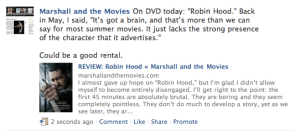
I created my Facebook fan page back on my first anniversary about two months ago, but I haven’t really been using it for much. It’s been a nice gesture to “like” my site on the social network, but I haven’t done much to make it worth the few milliseconds it took of your life to click “like.”
That changes TODAY. I am introducing my first Facebook-exclusive feature, the Throwback Tuesday (a phrase borrowed from some blogger who should step up and claim credit for it). On Tuesdays, I will repost my reviews of movies being released on DVD that day, provided that I have in fact seen something being released that day.
I’ll probably introduce more features to be Facebook only, but for now, I’m sticking with this. So if you aren’t a fan of me on Facebook yet, you should do so now. I’ll even provide a convenient link in the picture below.
And while I’m still on the topic of social networking, I have added integration to Facebook at the bottom of each post. So if you really feel compelled by something you read here, feel free to click the icon and share it with your friends! Simple enough, right?
The Toronto Film Festival closed yesterday, and Oscars season 2010 has kicked off now as a result. To commemorate this commencement, I am dedicating the next five days solely to theorizing about the five major contenders emerging from the festivals held in Venice, Toronto, and Telluride.
While I could have (and probably should have) begun with the big winners, “Somewhere” from Venice and “The King’s Speech” from Toronto, I’m going to start by talking about the movie that appeals to me the most, “Black Swan.” I’m a huge fan of director Darren Aronofsky, and the cast and plot are both incredible.
The whole premise of a movie centered around the price of art is something that connects personally with me as I dedicate most of my free time currently to theater and music. “Black Swan” stars Natalie Portman as an ambitious New York ballerina, compelled to keep going by the hopes that her director (Vincent Cassel) will feature her more. But along comes a strong and beautiful rival (Mila Kunis) who wins him over with her talent and starts shifting the spotlight her way. Eventually the envy and rage begins to consume Portman’s Lily, and her mental sanity begins to collapse.
The movie’s trailer is absolutely terrifying, but it drew me in with this incredible force. Yes, it is scary, but it is also elegant and gorgeous. The cinematography, the choreography, the score, the cast – it’s a mad rush of beauty emerging from the screen under the magnificent direction of Aronofsky.
Opinion on the movie emerging from the festival is incredibly polarized, with the prevailing side being those in favor. Here’s Peter DeBruge of Variety weighing in:
“A wicked, sexy and ultimately devastating study of a young dancer’s all-consuming ambition, ‘Black Swan’ serves as a fascinating complement to Darren Arononfsky’s ‘The Wrestler,’ trading the grungy world of a broken-down fighter for the more upscale but no less brutal sphere of professional ballet.”
“The movie is so damn out-there in every way that you can’t help admiring Aronofsky for daring to be so very, very absurd. ‘Swan’ is an instant guilty pleasure, a gorgeously shot, visually complex film whose badness is what’s so good about it.”
On the slightly less professional side, blogger Kris Tapley of In Contention had this to say about the movie and its chances:
“The film is the perfect marriage of Aronofsky’s past work, containing all of the paranoia of ‘Pi,’ the identity concerns of ‘Requiem for a Dream,’ the sense of inevitability apparent in ‘The Fountain,’ and the professional obsession of ‘The Wrestler.’ Portman gives her best performance to date and could well find her way to an Oscar nomination, while Matthew Libatique’s splendid photography also deserves recognition. It may play too dark to AMPAS types, but I imagine many members will at the very least grasp a powerful theme that relates very much to filmmakers as it does as to painters, musicians and, well, ballerinas.”
It’s not just a hit with the critic; audiences are fawning over this rabidly. At the Venice festival premiere, it received a five-minute standing ovation, and it remained an incredibly buzzed piece the entire festival. And according to a Los Angeles Times report on the screening in Toronto, “During the screening, moments of unexpected scares sent ripples of gasps and nervous laughter through the crowd. Festival screenings can feel a little cold, and thus less communal, than the commercial variety. That wasn’t a problem here.”
I think the movie has the goods to be a Best Picture candidate – the subject matter may just be a little too intense for them. Mental psychodrama, as one person describe the movie, just isn’t up their alley. But if the public gets behind it and critical response is still great, it could have a chance.
If and only if it lands a Best Picture nomination, Aronofsky could net his first Best Director nomination. Back in 2008 when there were only five Best Picture nominees, his name was constantly thrown around as a replacement for Ron Howard in the directorial race. He’s very respected and honoring him for “Black Swan” makes more sense that nominating him for “The Wrestler” as this is the kind of movie that he is most proficient at making. Perhaps a screenplay nomination will also follow, but I’d say that’s probably the least likely of the bunch.
But the movie’s support will most likely be expressed in the acting categories, where it has four strong contenders in Natalie Portman, Vincent Cassel, Mila Kunis, and Barbara Hershey.
Portman is the film’s shining star. She’s in every scene and apparently has total command of the screen, challenging her emotional and physical limits constantly. The Academy has noted her once before for her complex and rough role as Alice in “Closer” back in 2004, but her acting has matured much since then. This is a very demanding performance for Portman in a very demanding movie. Even those who oppose the movie will still have good things to say about her work.
At 30, her youth is an asset as she is now old enough to not be written off as “too young.” In fact, since 1997, only two actresses older than 35 have won Best Actress, both of which came in the past four years. So a win for Portman keeps the trend going. She faces stiff competition this year; many are calling it the strongest leading actress field in years. Her stiffest competition may come from Annette Bening, who at 52 won raves for “The Kids Are All Right” over the summer. With three nominations to her name, Bening will be a force to reckon with. Awards Daily proposed today that the race may be down to the two of them:
Portman’s performance is said to be her best yet – brilliant, harsh, challenging. If only she was also playing a prostitute or a drug addict – she’d been the winner. But, from what I gather, her character is not likable. Likability, or at least great sympathy is key to a win. Can she make it on sheer ability? Of course. Liking her character, really really liking her character helps a wee bit more. I haven’t yet seen the film so I can’t say for sure.
Portman has a sex scene. I don’t think this is necessarily a turn-off. Best Actress winners often have on screen nudity or sex scenes — The Reader, Monster’s Ball, etc. But usually it’s with a man. Still, since when have men objected to sex between women? Bening is probably way ahead in terms of likability. She too has a sex scene to contend with.
This time last year, I boiled the race down to Carey Mulligan vs. Meryl Streep, the film festival breakout and up-and-comer pitted against the awards mainstay. While Bening is know Meryl Streep and Portman is hardly unknown, the race is very similar. Of course last year, Sandra Bullock came out of nowhere to take it all. I think simplifying a race down to two people now is misguided, although I will say that they are the two strongest candidates at the moment. A nomination of Portman is almost certain; a snub would mean that the Academy really needs to grow up and learn how to handle tough subject matter.
The other three actors are all wild cards. Cassel could do well in awards season; his performance was voted second-best in the supporting category from INDIEwire’s informal critical polling. He’s pretty unknown stateside, which could propel him higher or doom him. Kunis also has potential, but I get the feeling that she will be seen more as an object of lust than an actress. Her past movie choices won’t do her much good either.
Outside of Portman, the best shot “Black Swan” may have at another nomination would be through Barbara Hershey, who plays Lily’s aggressive mother, a former ballerina herself. At 62, the movie could prove to be a great swan song for her (pun fully intended). Hershey hasn’t been in much since her 1996 Best Supporting Actress nomination, practically nothing in the past decade. But a welcome return to grace the screen with her presence could land her another nomination.
It’s important for “Black Swan” to keep the massive buzz and allure it gained over the past few weeks in check so that upon its release in December, the can of worms will be opened anew. But until then we wait. And hope the movie is as good as we anticipate.
BEST BETS FOR NOMINATIONS: Best Actress, Best Supporting Actress (Hershey), Best Cinematography, Best Original Score
OTHER POSSIBLE NOMINATIONS: Best Picture, Best Director, Best Original Screenplay, Best Supporting Actor, Best Supporting Actress (Kunis), Best Film Editing
Following up on movie disruptions from yesterday’s factoid, I turn today to my biggest moviegoing pet peeve: disruptive children.
I’m glad to see that theater are FINALLY addressing the issue. It can seriously ruin an entire movie, like I described in Random Factoid #32:
I was at “Funny People,” and I was jammed next to a woman and her baby. I knew that it would be bad news before the movie started when her daughter wouldn’t stop whining during the pre-show entertainment. She managed to keep it together for the beginning of the movie, but I knew she was a ticking time bomb. During a poignant and emotional scene between Adam Sandler and Leslie Mann, the baby starts screaming at a level so loud that it blocked out the sound from the movie. And if the audience was staring bullets at her mother, she must have been wearing a Kevlar body suit. She let her daughter scream and cry for over 2 minutes before taking her out, just in time to ruin the scene for the entire theater.
I’m happy to report that over the summer, I went to a theater that added “please go outside if your child is disruptive” to the opening messages like “silence your cell phones” and “please throw trash in the specified containers.” It’s about time. But alas, that was only one theater. Just one.
Is anyone else with me to sign some sort of petition to get EVERY theater to do this?
 Lindsay Lohan is back in jail – wait, just kidding,
  I’m all busy applying to college now, and my future in a year has become one of the biggest things on my mind as of recent. But there was a time when the idea of going to college was as far away as getting married or having children. Now it’s almost here … and I can’t believe it.
 I’ll close out this week chalked full of Oscar Moments with the movie that has been a favorite since it premiered at Cannes back in May, Mike Leigh’s “Another Year.” It received adoring review after adoring review, most speculating that it would win the prestigious Palme d’Or. And while it didn’t take home any hardware, it emerged as the movie with the most buzz from the festival.
 It’s a fascinating idea, although from my experience with Leigh’s work, I’m not sure how much it works for me. Nevertheless, the Academy loves his writing and direction. He has been nominated four times for Best Original Screenplay, most recently in 2008 for “Happy-Go-Lucky,” and twice for Best Director, most recently for 2004’s “Vera Drake.” As for the overall success of his movies, only one, 1996’s “Secrets & Lies,” was nominated for Best Picture.
 Manville has been hogging the spotlight, and when anyone talks of the ensemble, they single her out. She’s the movie’s best bet for an acting nomination, although category fraud may play a part. Most pundits consider her a leading actress, but Sony Pictures Classics may want to sneak her into the weaker Best Supporting Actress field.
 I do love musicals, and I sure have invested a lot of time into them over the past four years. My production of “Godspell” is in 10 days, and I’ll also delve into “Fiddler on the Roof” later this year.
 Two years ago, Danny Boyle was atop the world, winning Best Director for “Slumdog Millionaire,” a movie that won eight Oscars, the second-biggest haul for any movie of the decade. And now, he may be poised to stand there again. His follow-up feature, “127 Hours,” is generating a whole lot of positive awards buzz.
 The movie also has hopes in technical categories as Boyle’s vibrant style often leads to flashy displays of editing, cinematography, and sound. Not to mention that the score is being done by AR Rahman, the Oscar-winning composer of “Slumdog Millionaire.” I’d sure love to hear some “Jai Ho” cranking from those canyons.
 Have we found a Best Picture winner with Tom Hooper’s “The King’s Speech?”
 Geoffrey Rush could easily find himself in the Best Supporting Actor race. With no clear front-runner, he could easily charge to the front despite having won before back in 1996. The fact that he’s already been awarded an Oscar should only be a factor when choosing the winner; the effect should be minimal on his nomination. And Helena Bonham Carter, as George’s wife, should be able to squeeze out a nomination as well. While she’s taken on some kooky roles since her last nomination in 1997 for “The Wings of the Dove,” a return to Academy fare could find her back in their favor once more.
 Is this the end for DVDs? I know I’ve been predicting their demise for quite some time now, but 2010 seems a little soon. It’s been a hot topic in factoids recently, appearing in #
 The big winner at Venice was “Somewhere,” which won the coveted Golden Lion there. According to jury president Quentin Tarantino, the movie ” . But does that mean anything?
 Critical response was tepid at Venice; “Black Swan” was the movie on everyone’s lips. I’m not really getting the feeling that this could be an audience favorite either. The plot, which revolves around a self-absorbed movie star (Stephen Dorff) required to take on responsibility for his young daughter (Dakota Fanning’s sister, Elle), feels like something we’ve seen before. “The Game Plan,” the campy Disney movie, anyone? I’m sorry to say that I don’t see many Oscar vibes emanating from that storyline. Then again, if it’s told with brutal Coppola subtlety, the Academy will go gaga.
 * FBO stands for “Facebook official,” a nice tidbit for those not entirely up-to-date on Internet slang.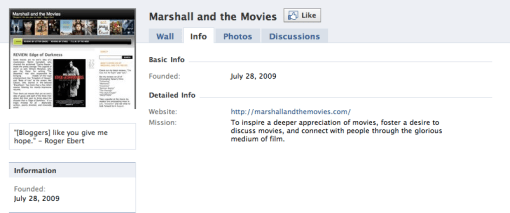
 The Toronto Film Festival closed yesterday, and Oscars season 2010 has kicked off now as a result. To commemorate this commencement, I am dedicating the next five days solely to theorizing about the five major contenders emerging from the festivals held in Venice, Toronto, and Telluride.
 Opinion on the movie emerging from the festival is incredibly polarized, with the prevailing side being those in favor. Here’s
  I think the movie has the goods to be a Best Picture candidate – the subject matter may just be a little too intense for them. Mental psychodrama, as one person describe the movie, just isn’t up their alley. But if the public gets behind it and critical response is still great, it could have a chance.
 At 30, her youth is an asset as she is now old enough to not be written off as “too young.” In fact, since 1997, only two actresses older than 35 have won Best Actress, both of which came in the past four years. So a win for Portman keeps the trend going. She faces stiff competition this year; many are calling it the strongest leading actress field in years. Her stiffest competition may come from Annette Bening, who at 52 won raves for “The Kids Are All Right” over the summer. With three nominations to her name, Bening will be a force to reckon with.
  This time last year, I boiled the race down to Carey Mulligan vs. Meryl Streep, the film festival breakout and up-and-comer pitted against the awards mainstay. While Bening is know Meryl Streep and Portman is hardly unknown, the race is very similar. Of course last year, Sandra Bullock came out of nowhere to take it all. I think simplifying a race down to two people now is misguided, although I will say that they are the two strongest candidates at the moment. A nomination of Portman is almost certain; a snub would mean that the Academy really needs to grow up and learn how to handle tough subject matter.
 Following up on movie disruptions from

 Marshall and the Movies
Recent Comments